International Journal of Psychology and Behavioral Sciences

p-ISSN: 2163-1948    e-ISSN: 2163-1956

2026;  16(1): 21-37

doi:10.5923/j.ijpbs.20261601.03

Received: Apr. 17, 2026; Accepted: May 9, 2026; Published: May 20, 2026

 

Structural Violence, Conspiracy Theorizing and Collective Mobilization of the Disadvantaged for Group Empowerment: A Study in the Context of the Secessionist Crisis in Cameroon

Gustave Adolphe Messanga1, Dolly Shiness Nguéfack Zoda1, Achille Vicky Dzuetso Mouafo1, Monique Pélagie Tsogo À Bebouraka2, Sylvestre Nzeuta Lontio1, Afiah Nelvis Kope-Waghah1, Hermann Kevin Ekango Nzekaïh1

1Unité de Recherche de Philosophie et Sciences Sociales Appliquées (URPHISSA), Department of Philosophy-Psychology-Sociology, University of Dschang, Cameroon

2Department of Psychology, University of Yaoundé I, Cameroon

Correspondence to: Gustave Adolphe Messanga, Unité de Recherche de Philosophie et Sciences Sociales Appliquées (URPHISSA), Department of Philosophy-Psychology-Sociology, University of Dschang, Cameroon.

Email:

Copyright © 2026 The Author(s). Published by Scientific & Academic Publishing.

This work is licensed under the Creative Commons Attribution International License (CC BY).
http://creativecommons.org/licenses/by/4.0/

Abstract

Structural violence can be considered a contextual determinant of conspiracy beliefs, as adverse socio-political circumstances (discrimination, discontent, and victimization) are associated with an increase in conspiracy beliefs. These beliefs, directed toward outgroups or governments perceived as conspirators, are likely to amplify marginalized groups members’ grievances, frustration, and anger, potentially increasing their hostility that can lead to their collective mobilization for group empowerment or, in extreme cases, to war, particularly when they believe the threat to their groups can be prevented, mitigated, or countered. These logical links, not yet empirically established, are the subject of this study, conducted in the context of the ongoing secessionist crisis in the Anglophone regions of Cameroon, which allows us to contribute to the recent literature on the antecedents of conspiracy beliefs, which focused its attention on the social and intergroup aspects of conspiracy thinking, highlighting how conspiracy theories can reflect perceptions of social, political and historical reality structured around antagonistic groups. The hypothesis being tested posits that structural violence is indirectly linked to the intention of collective mobilization for group empowerment through conspiracy beliefs. This hypothesis was tested on a sample of 998 participants of Cameroonian nationality, aged between 18 and 56 years (M=23,541±5,777), who were administered a questionnaire measuring various constructs. The results provide empirical support for this hypothesis.

Keywords: Structural violence, Conspiracy beliefs, Collective mobilization for group empowerment, Secessionism, Cameroon

Cite this paper: Gustave Adolphe Messanga, Dolly Shiness Nguéfack Zoda, Achille Vicky Dzuetso Mouafo, Monique Pélagie Tsogo À Bebouraka, Sylvestre Nzeuta Lontio, Afiah Nelvis Kope-Waghah, Hermann Kevin Ekango Nzekaïh, Structural Violence, Conspiracy Theorizing and Collective Mobilization of the Disadvantaged for Group Empowerment: A Study in the Context of the Secessionist Crisis in Cameroon, International Journal of Psychology and Behavioral Sciences, Vol. 16 No. 1, 2026, pp. 21-37. doi: 10.5923/j.ijpbs.20261601.03.

1. Introduction

Structural violence, which is situated in the perspective of the conflictual relationship between the system and the individual, within institutional, cultural, or social frameworks, can be defined as the intentional or unintentional violation or limitation of individuals or groups’ rights resulting from systemic conditions [18]. It is expressed, for example, through the attitudes and behaviors that constitute oppression, conceived as a state or process of domination in which the possibility for the oppressed to access well-being is obstructed by exploitation, marginalization, discrimination, and violence [46]. Indeed, emanating from the structure, that is to say the underlying societal systems, institutions and models that shape behaviors, relations and power dynamics [94], structural violence corresponds to all forms of constraints (exploitation, segmentation, marginalization or fragmentation; [34]) weighing on an individual’s potential. These constraints, which cannot be attributed to a clearly identified actor (i.e., an individual, for example; see [108]), result in unequal access to resources, political power, education, health, and justice for the people or groups who are their victims (see [109]). This is why structural violence can be considered, to some extent, as social injustice (see [29] [34]), or more broadly as a human rights violation [90]. It follows that despite its relative invisibility compared to personal or physical violence, it is by far the most lethal form of violence, due to the consequences of the inequalities it creates and the potential for stimulation it has on physical violence (homicides, suicides, mass murders, and wars; [59]).
For their victims, the search for the origins of structural violence could give rise to conspiracy theorizing, since the belief that others are conspiring against the ingroup is more likely to emerge when individuals consider their group as undervalued, disadvantaged, or threatened (see [25]). In this vein, it should be noted that even though the literature available to date has not yet explicitly assessed the potential link between victimization by structural violence and conspiracy theorizing, studies linking the feeling of relative deprivation to conspiracy theorizing suggest that this link is plausible, since the feeling of relative deprivation can be felt as a result of perceived injustice (see [38]), in a conceptual context where social injustice is, to some extent, comparable to structural violence (see [34]). Indeed, particularly in the economic sphere, relative deprivation, conceived as an increased perception of vulnerability linked to a disadvantageous position generated by perceived injustice [62], may be connected to the prevalence of conspiracy theorizing [92], since members of marginalized groups may adopt conspiracy beliefs to explain sociopolitical events with negative implications [43]. Along these lines, structural violence can be considered a contextual determinant of conspiracy beliefs, since adverse sociopolitical circumstances, such as low socioeconomic status, discrimination, discontent, and victimization, are associated, in the literature, with an increase in conspiracy theorizing (see [24]).
Conspiracy theories (see [16] [23] [22] for some reviews of the available literature) are characterized by providing a narrative that attributes ingroup’s victimization to hidden agendas, secret power structures, or intentional acts perpetrated by a powerful and malevolent outgroup (see, for example [82])—or by some ingroup members (see [48]). As a result, the literature reports that these beliefs are prevalent among minority and disadvantaged groups, i.e. those who suffer from power asymmetry [77] and who, consequently, struggle to meet their material and psychological needs. The reason for this is that, in their search for meaning in their unfavorable situation [5], they are inclined to subscribe to the idea that members of powerful groups conspire against them daily (see [19]); this leads them to make external attributions for their unfavorable situation, particularly blaming outgroups, even though in many cases, the conspiracy theories that underpin their position towards these groups are unviable, untrue, or misleading [81]. In situations of failure, these attributions, which consist of explaining events by external causes (see [96]), are underpinned by self-serving strategies aimed at protecting and enhancing individuals’ self-esteem (see [37]), by highlighting that they are not responsible for these situations due to their potential limitations or shortcomings.
The consequence of outgroup-oriented conspiracy beliefs (or “out-group” conspiracy theories; see [67]) is that they are likely to amplify marginalized groups members’ grievances, frustration, and anger. In turn, these emotional reactions are likely to increase their hostility toward alleged conspirators [66], fuel collective action against them (see [35]), or, in extreme cases, constitute a motive for armed conflict (see [106]). Indeed, victimization is a potential catalyst for feelings of injustice and collective action among members of disadvantaged groups (see [95]), particularly because the social inequalities it carries can activate feelings of restricted collective autonomy among their members (see [89]). This collective action is catalyzed, in particular, by the feeling of relative deprivation (see [38]) which can fuel perceived injustice and related emotions, such as anger (see [3] [12]) or moral outrage (see [12] [100]), which the literature reports are linked to mobilization for social change (see [57]), potentially leading groups’ collective empowerment (see [93]). It can target both specific outgroups and governments considered to be conspirators whose malicious methods and actions are known with some certainty, and are likely to negatively impact ingroup members’ well-being, particularly in cases where they feel that the threat posed by these conspirators can be prevented, mitigated or confronted (see [87]).
The aim of this research is to examine the nexus between structural violence, conspiracy theorizing, and collective mobilization for group empowerment; a relationship not yet formally documented, but whose existence is suggested by the available literature on these various constructs. However, understanding this nexus requires an analysis that takes into account factors such as the historical and sociopolitical contexts of the research. Indeed, social psychologists have been emphasizing for decades that failing to consider context exposes researchers to the essentialization and individualization of phenomena inextricably rooted in the social [80]. In connection with this concern, the literature on the antecedents of conspiracy beliefs has recently focused its attention on the social and intergroup aspects of conspiracy thinking, highlighting how conspiracy theories can reflect perceptions of social, political and historical reality structured around antagonistic groups [83]. In the field of intergroup conflict specifically, this reality now appears self-evident, particularly in light of the interethnic conflict in the former Yugoslavia (see, for example [64]). In this vein, the study is conducted in Cameroon, a former German protectorate (1884-1916) which experienced dual French and British administration between 1916 and 1960 [73]. This situation divided it into two territories, one French-speaking majority (80% of the population) and one English-speaking minority (20% of the population); thus laying the foundations for a hegemonic decolonization, characterized by an asymmetry of power between the two linguistic communities (see [9]). Several decades after the unification of the populations of these two territories into a single state in 1961, Cameroon is gripped by a secessionist conflict, which constitutes the culmination of a past of structural violence against the Anglophone minority group (discrimination, marginalization and disregard; see [31] [79]), whose members feel threatened in terms of identity, politics and economy [70] by a political system which they consider oppressive and assimilationist [45]. This threat inclines them to believe in the existence of a strategy implemented by Francophone institutional authorities, with a view to their annihilation (see [31] [71]), through the erasure of all the cultural and institutional foundations of their identity (see [97]). This could explain the violent extremism embraced by some of them (see [15] for a review of the empirical literature on the links between conspiracy beliefs and violence) and which is manifested in the ongoing secessionist crisis in their region.
The secessionist crisis in the Cameroonian context: From structural violence to collective mobilization for group empowerment
The secessionist crisis that has been unfolding in Cameroon since 2016 is simply the culmination of a history dating back to the end of the First World War. This history comprises both distant and recent events, the analysis of which allows us to understand how and why a country that had been relatively stable since its independence in the early 1960s is experiencing a major crisis, namely an armed secessionist conflict with significant human, financial, and material consequences (see [6] [7]). To account for this history, this study structures its analysis around three points: 1) structural violence, threats to group identity, and conspiracy theorizing; 2) popular protests for group empowerment and state repression; and 3) radicalization leading to secessionism.
Structural violence, threats to group identity, and conspiracy theorizing
The triple European colonization/administration suffered by Cameroon gave it a certain specificity in Central Africa [2]. Indeed, colonial history reveals that this territory, under German protectorate since 1884, was placed, at the end of the First World War, under the mandate of the League of Nations, which entrusted its administration to France and England until its independence [69] [71]. From then on, these two colonial powers implemented a policy of de-Germanization, consisting not only of eradicating the traces of the German colonial legacy, but also of imposing their own cultures on the two parts of the territory placed under their respective administration. After French-administered Cameroon gained independence in 1960, British-administered Cameroon chose to unite with the former French Cameroon to form a federation of two states with equal status, in a plebiscite organized by the United Nations in 1961. It is important to note that this plebiscite did not offer the possibility of independence for this territory. It gave voters the choice between achieving independence by joining Nigeria or French Cameroon; hence their grievances and frustrations, fueled by the fact that they would have preferred an independent state (see [32] for a detailed account of these events). However, it is alleged that while Anglophones considered the federation as the definitive form of the state, Francophones saw it only as a veiled preparatory phase for the total assimilation of Anglophone Cameroon into a highly centralized Francophone unitary state. In this vein, a referendum, marred by irregularities, aimed at creating this unitary state, held in 1972, brought an end to this federation, without consulting the existing federal legislative institutions (see [8]) and in violation of Article 47 of the 1961 Federal Constitution, which stipulated that: “any proposal for the revision of the present constitution which impairs the unity and integrity of the Federation shall be inadmissible”. In the Anglophone community, this constitutional revision, considered unilateral and illegal, is seen as the main source of the Anglophone problem in Cameroon [99].
In Cameroon, the Anglophone problem refers to the structural violence of which the minority populations in the former British Cameroons consider themselves victims, in numerous sectors (education, health, employment, infrastructure, and resource distribution, for example; see [27]), due to a central government held by the Francophone majority since 1961 [71]. According to them, this central government opts for a systematic policy of assimilation and marginalization of the Anglophone populations [36], which exposes them to socio-cultural victimization [4], the deprivation of their rights, their treatment with suspicion, the neglect of their interests, and the limitation of their participation in national life to non-essential functions [31]. This is why they feel treated as second-class citizens [11] or even as foreigners [31] in a country dominated by their Francophone compatriots. Similarly, these populations allege that the natural resources of the Anglophone regions are being exploited excessively, and that the revenue generated is primarily used for the development of the Francophone regions of the country [102].
The structural violence that Anglophones believe they experience in Cameroon contributes to the construction of a minority Anglophone community that feels subjugated, marginalized, and assimilated [70]. In other words, this community is made up of citizens who consider themselves members of an oppressed and captive group whose territory has been annexed [54] by their Francophone compatriots who they perceive as colonizers [70], notably because they would have impose their language, as well as their educational and judicial systems on them [69]. Consequently, they feel threatened by their group identity, as is the case for many linguistic minorities around the world who face linguistic assimilation, language-based discrimination, and the non-recognition of their groups’ linguistic specificities (see [110]). In short, in Cameroon, Anglophones would experience intercultural domination stemming from intergroup asymmetry, in which the dominant group imposes its culture on the subordinate group [40]; hence their grievances against the governing system [75].
The threat to group identity felt by Anglophones, due to the structural violence they experience, leads them to explain their negative situation by the existence of a conspiracy orchestrated by Francophone institutional authorities aimed at their annihilation (see [31]). An analysis of the literature on conspiracy theories helps to understand this explanation. Indeed, conspiracy theories refer to the belief that certain individuals or organizations, or even secret and powerful groups, intentionally conspire to achieve malicious and illicit goals [25]. Individuals and groups in an unfavorable or threatening situation, such as the Anglophones in Cameroon, are particularly susceptible to these theories [5] [77], notably in crisis situations which have the potential to exacerbate this tendency, due to the increased uncertainty, anxiety and perceived loss of control that they are likely to generate in individuals (see [28] for details). To combat this feeling of threat, these populations decided, at the end of 2016, to resort to collective action with a view to empowering their group.
Popular protests for group empowerment and state repression
From a certain perspective, the Anglophone problem in Cameroon can be analyzed within the theoretical frameworks of internal colonialism (see, for example [50]) and ethnonationalism (see, for example [31] [47]). Internal colonialism refers to structural, social, cultural, and political inequalities between different regions of a country [39]. These inequalities manifest themselves through the unequal distribution of economic resources, political domination, and cultural marginalization [4]; hence the emergence of two types of groups: privileged and disadvantaged. The former establish mechanisms to maintain the status quo, while the latter, who may develop a nationalist consciousness, may fight for social change. Ethnonationalism, for its part, argues that ethnonational identities are important in conflict situations because they impact the emergence of the them(outgroups)/us(ingroups) syndrome [20], which can turn into them versus us [4] which, in the case of Cameroon, has marked the shift, since 2016, from the Anglophone problem to the Anglophone crisis.
A review of the literature reveals that the current crisis in the Anglophone regions of Cameroon is simply the culmination of a situation that has persisted for decades (see [4] for details). In fact, since the end of 2016, protests and strikes have been organized by groups including lawyers and teachers [49] in opposition to what they perceived as the increasing marginalization of the Anglophone minority, particularly through the alleged destruction of its heritage and culture. In practice, lawyers have taken to the streets to demand the translation of certain legal texts into English and to denounce the appointment, in Anglophone courts, of Francophone judges trained in the Civil Code, and therefore unfamiliar with the Common Law system inherited from the British colonial power, and supposedly applied in the legal system of the Anglophone regions [63]. Teachers, for their part, went on strike to condemn the appointment of French-speaking staff in schools and universities of Anglo-Saxon tradition, as well as the degradation of the Anglophone education system by these administrative acts [6]. Thousands of ordinary people from other sectors of professional life (students, shopkeepers, and transporters, among others) joined these demonstrations to express their solidarity and voice other grievances, such as youth unemployment and the deteriorating infrastructures in the Anglophone regions. These demonstrations were structured around various tactics of civil disobedience, including school boycotts and “ghost town” operations. Although generally—though not always—peaceful in nature, these popular protests were met with disproportionate, indiscriminate, and brutal repression [84] [98]. These repressive tactics constitute a well-established modus operandi among Cameroonian institutional and security authorities in their response to dissent (see [1] [26] [73] [74] [76] for details on authoritarian practices in the Cameroonian context), that they nevertheless take the precaution of covering with a seal of legality (autocratic legalism; see [61]) to give them the appearance of practices of a democratic country simply facing threats to its stability. As a result, hundreds of people were arrested, civil society organizations were banned, and internet and telephone access was cut off for several months. Unfortunately, this repression affected even the more moderate voices within the movement, i.e. those who favored either decentralization or a return to federalism [49]. This left the field open to the most radical elements, marking an escalation in the conflict between the Anglophone populations and the governing system [51].
Radicalization leading to secessionism
Within the Anglophone community of Cameroon, secessionist tendencies did not originate with the ongoing crisis since October 2016. They date back to the unification of French and British Cameroon in 1961. Indeed, nationalists in British Cameroon experienced the de facto association between the French and British parts of Cameroon as an annexation, and therefore a colonial occupation of British Cameroon by the authorities of French Cameroon. Adding to this was the illegal and illegitimate dismantling, in 1972, of the 1961 federal agreements, and the unilateral change of the country’s name in 1984, now called the Republic of Cameroon, that is to say, the name that French Cameroon bore at its independence in 1960; thus erasing the country’s dual colonial past [32]. To address the consequences of these events for their community, Anglophone elites began to reintroduce concepts such as federalism and even secession into the political agenda. In this vein, they created a regional organization in 1995 to represent the aspirations of the population. This organization, called the Southern Cameroons National Council (SCNC), is a self-determination entity whose goal is the independence of Anglophone Cameroon from the Republic of Cameroon. Because of this declared and embraced secessionist ideology, that organization has been declared illegal by institutional authorities who consider its members terrorists and not freedom fighters, as they define themselves (see [21]). Consequently, its meetings are regularly disrupted, and its members are often arrested and detained [10].
Due to various factors, including maneuvers by institutional authorities to undermine all efforts by the Anglophones to develop a sense of belonging, as well as infighting among local elites driven by their own interests, the secessionist tendency mentioned above, however, remained a minority and very little visible for decades (see [32]). One such maneuver involves highlighting ethnic divisions between Anglophone populations from the North-West Region (the Bamileke) and those from the South-West Region (the Sawa). For example, in most towns in the Southwest region, non-indigenous people or settlers are referred to as “Graffi” (a distortion of the word Grassfields, which represent the highlands from which the Anglophone populations of the North-West Region originated) or “come no go” (strangers); derogatory terms used to describe people from the North-West Region, who are accused of sympathizing with separatist ideas [10]. For these authors, the aim of this maneuver is to add to the Anglophone identity, which unites the populations of the former British Cameroon, an ethnic identity that differentiates them from one another. This constitutes an obstacle to the idea of a separate Anglophone territory, which presupposes Anglophone cultural homogeneity, even if most separatist movements (Southern Cameroons National Council (SCNC) or Southern Cameroons Youth League (SCYL) for example) are less interested in the idea of making an ethnocultural space correspond to the territory of a State than in that of controlling resources considered vital [68].
The violent repression of demonstrations by lawyers, teachers, and students exacerbated feelings of marginalization and inhumane treatment of Anglophones by institutional authorities, thereby promoting separatist ideas. As a result, on October 1, 2017, secessionist leaders gathered within the Southern Cameroons Ambazonia Consortium United Front unilaterally declared the independence of Southern Cameroons, under the name Federal Republic of Ambazonia, and created armed militias to defend their self-proclaimed territory (see [33]). The situation deteriorated sharply following popular demonstrations organized to celebrate this symbolic independence of the Anglophone regions [6]. Indeed, in response to this secessionist act, security forces fired on the crowd, killing unarmed people. In the aftermath, many people were arrested, while others fled their homes, forming the first waves of internally displaced persons and refugees in neighboring Nigeria [1].
Consequently, the more moderate voices of the Anglophone cause were gradually overshadowed by separatist groups (Bui Unity Warriors, Mountain Fako Lions, Lebialem Red Dragons, Marine Forces of Bambalang, or Buffalos of Bali Nyonga, for example [7]), which advocated armed struggle. These groups began perpetrating violent attacks against the defense and security forces, symbols of the Cameroonian state, and even civilian populations. This escalation of armed violence coincided with the militarization of the Anglophone regions and its consequences for civilian populations, who were sometimes equated with separatists and therefore treated as such [6]. Far from finding a peaceful solution to the crisis, this militarization and the human rights violations that accompany it (see the case of the massacre of civilians in the locality of Ngarbuh for example; [42]), has provided the fuel that has powered the emergence of more radical and violent separatist movements (see [30] for the analysis of some explanatory factors of violent extremism), focused on secession and armed struggle, thanks to their increasingly sophisticated arsenal [7]. The actions of these separatist movements fall under the category of violent extremism, which can be understood as the set of beliefs, attitudes, and actions that advocate, commit, or support ideologically motivated violence with social, economic, or political objectives. According to the specialized literature, those who perpetrate this type of (defensive) violence often act not as rational actors seeking to maximize their utility, but as devoted agents guided by ethical principles and sacred values; hence, they often perceive it as “virtuous”, that is, as a morally necessary means of regulating, maintaining, or restoring essential social relations, and not, as one might think, as a loss of self-control (see [56]). Within the framework of social dominance theory, this form of violence falls under the category of strategies for mitigating intergroup inequalities. This hierarchy-attenuating violence is therefore motivated by the desire to redress intergroup power imbalances and improve the condition of subordinate groups. Its objective is to liberate oppressed groups from their dominators (see [86]). As a result, a decade after its outbreak, the Anglophone crisis has caused several thousand deaths; hundreds of thousands of internally displaced persons and refugees in neighboring countries; as well as significant economic and infrastructural damage (see [88]).
Hypotheses
This research tests the following hypotheses:
- Hypothesis 1: Structural violence, conspiracy beliefs, and intention of collective mobilization for group empowerment are linked;
- Hypothesis 2: Structural violence is linked to contextual variables;
- Hypothesis 3: Conspiracy beliefs and contextual variables are linked;
- Hypothesis 4: Contextual variables and the inclination towards collective mobilization are linked.
The study assesses the structural relationships between the main variables by incorporating conspiracy theories as an intervening variable in the model. In this context, a model of structural relationships is examined to test Hypothesis 5 below:
- Hypothesis 5: Structural violence is indirectly related to the intention to engage in collective mobilization for group empowerment through conspiracy beliefs.
This hypothesis is broken down into sub-hypotheses. Specifically, Hypothesis 5a (Path a) argues that structural violence does not have a significant direct structural relationship with intention of collective mobilization for group empowerment. Hypothesis 5b, on the other hand, posits that structural violence positively and significantly predicts conspiracy beliefs (Path b). Hypothesis 5c posits that conspiracy beliefs positively and significantly explains intention of collective mobilization for group empowerment (Path c).

2. Method

Participants
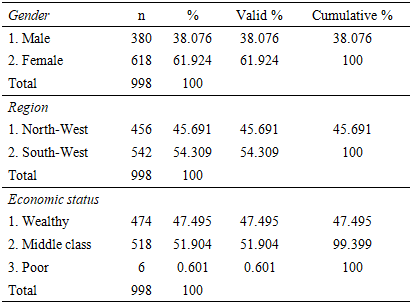
To participate in this research, each participant had to: 1) belong to one of the two Anglophone regions of Cameroon; 2) be able to read and write English; and 3) agree to participate voluntarily and without compensation. From an ethical standpoint, participants signed an informed consent form guaranteeing that the information they provided for the research would be anonymous and used solely for scientific purposes. Their numbers and sociodemographic characteristics are presented in Table 1 below.
Table 1. Sociodemographic characteristic of sample
     
Table 1 reports that the number of participants was 998 Cameroonians (380 men, or 38.076%, and 618 women, or 61.924%), aged between 18 and 56 years (M=23.541±5.777). 474 of them can be considered rich, 518 as members of the middle class, and 6 as poor.
Measures
Participants’ sociodemographic characteristics were collected in addition to the eight study variables listed below:
- Structural violence (PSV, α=.73; ω=.73) was assessed using a psychometric instrument developed for this study (e.g., “Anglophone populations are unfairly deprived of their rights and their interests are neglected in this country in favor of those of Francophones”);
- The Responsibility of the authorities for the injustice (RAI, α=.70; ω=.701) was measured using statements formulated for the purposes of this study (e.g., “The socio-political situation that pushed the Anglophone regions into crisis was created by government authorities”);
- Generic Conspiracy Beliefs (GCB, α=.75; ω=.75) were assessed by adapting [17] scale’s items to the research focus (e.g., “The adoption of the national flag with a single star in the center was a secret plan by the Francophone authorities to annihilate Anglophones’ specificity represented by the second star”);
- Grievances against political authorities (GAPA) were measured using an item inspired by [14] (“I am furious because of the treatment that the political authorities subject the Anglophone populations of this country to”);
- Political distrust (PD, α=.622; ω=.626) was assessed using items inspired by [91] (e.g., “If I had a difficult problem, I would rather be quiet than resort to the authorities of this country”);
- Perceived economic inequalities (PEI, α=.70, ω=.701) were measured using items adapted from [103] scale (e.g., “In Cameroon, the real opportunities for success in life are available only to rich people”);
- Legitimization of radical political actions (LRPA, α=.848; ω=.849) was assessed using items inspired by [107] (e.g., “In the Anglophone crisis, it is legitimate for people to physically harm a government official to express political discontent”);
- Support for secessionism (SS) was measured using items formulated for the purposes of this research (α=.73; e.g., “To promote their specificity, Anglophones must definitely separate from Francophones”);
- Intention of collective mobilization for group empowerment (ICMGEs, α=.670; ω=.666) was assessed using a measure developed for this research (e.g., “To put an end to Anglophones’ mistreatment, I am ready to block the streets and physically attack this country”).
Data were collected through self-administration of these instruments by participants, who were asked to respond to each item using a 7-point Likert scale (ranging from 1=strongly disagree to 7=strongly agree).
Data analysis
The study data were processed using JASP 19.2 and SPSS 27 statistical software. Preliminary analyses present descriptive statistics (Means (M) and Standard Deviations (SD), median and normality statistics, minimum and maximum) and correlational statistics (Pearson’s correlation coefficient). The correlation test examines the links between the study’s main variables and the relationships between these variables and contextual variables. The structural equation modeling (SEM) method, which tests the structural relationships between variables, allowed for the evaluation of direct and indirect relationships, taking into account contextual variables that could play the same role as structural violence. Each structural relationship constitutes a hypothesis. Thus, the prediction coefficients (R²) and the beta coefficient (estimated at the 5% threshold within the 95% confidence interval) were estimated to test the direct and indirect relationships of the established mediated structural model. The results are presented in tables and figures (structural model).

3. Results

Descriptive statistics and testing of the relationships between the main and the contextual variables
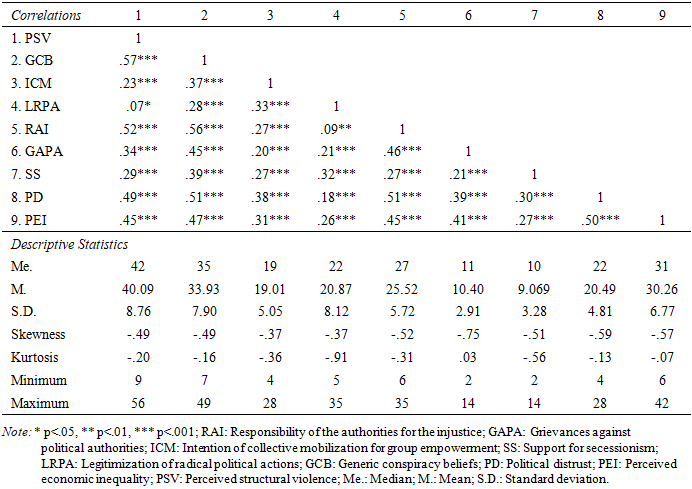
Table 2 presents the Pearson correlations (r), as well as the descriptive statistics of the study variables. First, the normality test of the data indicates Skewness (-0.49 to -0.37 with an absolute value <3) and Kurtosis (-0.36 to -0.03 with an absolute value <10) values well below the thresholds. According to the criteria for normality of a statistical distribution [52], this indicates that the data perfectly meet the conditions for normality or for the use of parametric tests (Pearson correlations and structural equation modeling). Second, these results generally indicate that the standard deviations are proportionally consistent with the means, suggesting that there is no problem of extreme concentration of responses. Third, Table 2 presents the correlation indices between the main variables of the study on the one hand, and the correlation indices between these variables and the control variables on the other hand; indices that test the study’s hypotheses.
Table 2. Descriptive statistic and Pearson’s correlations
     
Hypothesis 1: Structural violence, conspiracy beliefs, and intention of collective mobilization for group empowerment are linked.
The results (see Table 2) reveal significant relationships (p<.001) between the study’s main variables. Specifically, a positive and significant relationship was observed between structural violence and conspiracy beliefs (r=0.57, p<0.001). This suggests that the more participants perceive structural violence against ingroup, the more likely they are to adhere to conspiracy beliefs about the origin of this violence. These beliefs are significantly related to the intention to collective mobilization for group empowerment (r=0.37, p<0.001), indicating that high levels of conspiracy beliefs are associated with a strong intention to collectively mobilize for group empowerment. At the same time, the results report a positive but weaker correlation between structural violence and intention to collectively mobilize for group empowerment (r=0.23, p<0.001). Although there is a direct link between structural violence and intention of collective mobilization for group empowerment; this link is less robust than that mediated by conspiracy beliefs. This reinforces the idea that conspiracy beliefs could be a key mediator. Structural violence is strongly linked to conspiracy beliefs. These two variables are, in turn, linked to intention of collective mobilization for group empowerment.
Hypothesis 2: Structural violence is linked to contextual variables
The results presented in Table 2 indicate that structural violence has positive and significant relationships with the study’s contextual variables. Specifically, structural violence is strongly and significantly linked to the responsibility of the authorities for injustice (r=0.52, p<0.001), grievances against political authorities (r=0.34, p<0.001), political distrust (r=0.49, p<0.001), perceived economic inequalities (r=0.45, p<0.001), and support for secessionism (r=0.29, p<0.001). This suggests that structural violence and these contextual variables follow the same direction. In contrast to these observations, structural violence is weakly and significantly linked to the legitimization of radical political action (r=0.07, p<0.05).
Hypothesis 3: Conspiracy beliefs and contextual variables are linked
The observations made in this research (see Table 2) report the existence of positive and significant relationships between conspiracy beliefs and contextual variables. Specifically, these beliefs are strongly linked to the responsibility of the authorities for injustice (r=0.56, p<0.001), political distrust (r=0.51, p<0.001), and perceived economic inequalities (r=0.47, p<0.001). These beliefs are also significantly linked to grievances against political authorities (r=0.45, p<0.001), support for secessionism (r=0.39, p<0.001), and tendency to legitimize radical actions (r=0.28, p<0.001).
Hypothesis 4: Contextual variables and the inclination towards collective mobilization are linked
The results presented in Table 2 indicate that the intention to mobilize collectively for group empowerment is significantly linked to certain factors in the context of the ongoing separatist crisis in the Anglophone regions of Cameroon. Specifically, this intention is associated with political distrust (r=0.38, p<0.001), perceived economic inequalities (r=0.31, p<0.001), grievances against political authorities (r=0.20, p<0.001), legitimization of radical political actions (r=0.33, p<0.001), and support for secessionism (r=0.27, p<0.001).
In conclusion, regarding the correlation analyses, it should be noted that all the relationships reported for the three main variables are positive and strictly significant at the 0.1% level. Furthermore, strong links between structural violence and conspiracy beliefs appear to impact the intention of collective mobilization for group empowerment, and even the legitimization of radical political actions and the support for secessionism. These links thus reinforce the prerequisites for testing a mediation model involving structural violence (independent variable), conspiracy beliefs (mediating variable), and intention of collective mobilization for group empowerment (dependent variable).
Mediation test between the main variables of the study
Table 2 presents the results of the mediation analysis between the variables. It assesses the structural relationships between the main variables of the study. In this vein, a model of structural relationships is examined, with the aim of testing the hypothesis that structural violence is indirectly linked to the intention of collective mobilization for group empowerment through conspiracy beliefs (Hypothesis 5).
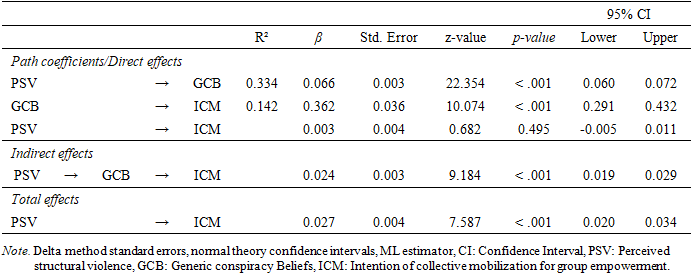
Table 3 presents the results of a path analysis using structural relationships. The objective is to understand sequentially whether conspiracy beliefs (GCB) explain the link between structural violence and intention of collective mobilization for group empowerment. To achieve this objective, observations focused on structural relationships, each corresponding to a sub-hypothesis of Hypothesis 5, indicate in a processual manner that: Hypothesis 5a (Path a) is supported by non-significant results. Indeed, Table 2 indicates that structural violence does not have a significant structural relationship with intention of collective mobilization for group empowerment (β=0.003; z-value=0.682, p=0.495, 95% CI=-0.005, 0.011). The 95% confidence interval contains zero, which confirms the absence of a residual direct effect. This justifies the existence of a possible indirect or mediated link between these two variables; hence the relevance of analyzing the indirect relationship through conspiracy beliefs.
Table 3. Mediation parameters analysis
     
Structural violence positively and significantly predicts conspiracy beliefs (Path b, Hypothesis 5b). In fact, the analysis of the baseline path coefficient (direct effect) of the mediation reveals a positive and significant direct relationship between structural violence and conspiracy beliefs (β=0.066, z-value=22.354, p<0.001, 95% CI=0.060, 0.072). Furthermore, the predictive value of the change in conspiracy beliefs under the influence of structural violence is estimated at approximately 33.40% (R²). Thus, the more participants perceive the existence of structural violence against the ingroup, the more they adhere to conspiracy beliefs about the origin of the said violence, thereby supporting Hypothesis 5b.
Conspiracy beliefs positively and significantly explain intention of collective mobilization for group empowerment (Path c, Hypothesis 5c). Indeed, the prediction coefficient indicates a significant direct increase of 14.20% (R²=0.142) in this intention, depending on conspiracy beliefs (β=0.362, z-value=10.074, p<0.001, 95% CI=0.291, 0.432). This means that conspiracy beliefs explains a significant increase in the intention of collective mobilization for group empowerment among participants; a trend that provides empirical support for Hypothesis 5c.
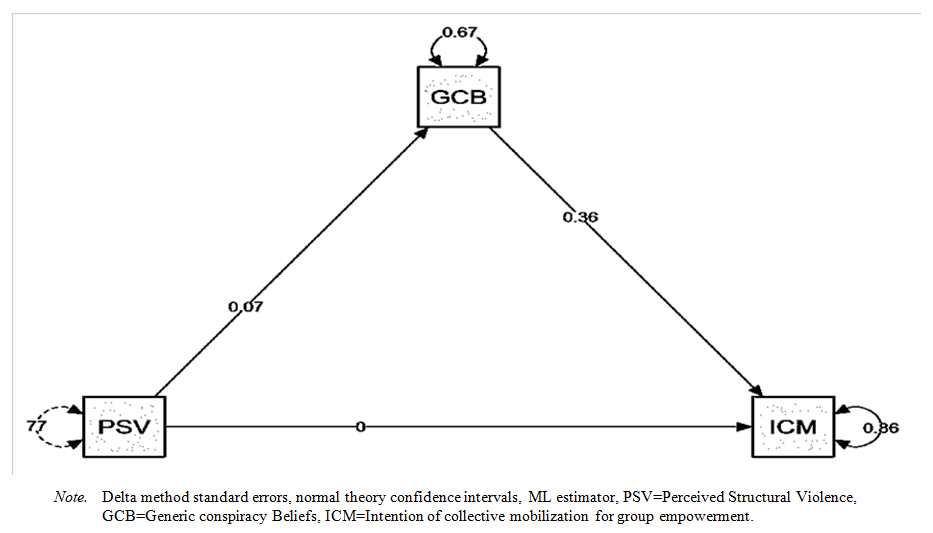
The assessment of the indirect effect (PSV → GCB → ICM) Representing the shift from structural violence to the intention of collective mobilization for group empowerment via conspiracy beliefs, a significant indirect effect (β=0.024, z-value=9.184, p<0.001) is indicated, with the 95% confidence interval [0.019, 0.029] not including zero. Based on this result (see Figure 1), since the indirect effect is significant while the direct effect (Path c) is not, we conclude that mediation is complete. This means that structural violence does not directly increase intention collective mobilization for group empowerment, as one might expect. This increase only occurs when structural violence first impacts conspiracy beliefs, and subsequently, these beliefs significantly impact intention of collective mobilization for group empowerment. In light of these relationships (see Figure 1), a significant overall effect of structural violence on intention of collective mobilization for group empowerment is observed (β=0.027; z-value=7.587, p<0.001, 95% CI=0.020, 0.034). This mediated passage is summarized by models that explain 33.4% of the variance in conspiracy beliefs and 14.2% of the variance in the intention of collective mobilization for group empowerment. These results provide significant empirical support for the idea that structural violence is linked to the intention of collective mobilization for group empowerment through conspiracy beliefs (Hypothesis 5).
Figure 1. Mediation role of Generic conspiracy beliefs
The results of this study further indicate that conspiracy beliefs play a significant mediating role in the relationship between structural violence and intention of collective mobilization for group empowerment. While structural violence influences this intention overall, this influence disappears in favor of conspiracy beliefs when these are introduced into the model. In short, structural violence appears to mobilize individuals primarily by reinforcing their conspiratorial worldview within the context of the Cameroonian separatist crisis; a context in which the analysis of the specific variables collected further enriches the study’s findings by providing information necessary for understanding the process of collective mobilization aimed at group empowerment.
Analysis of the effects of variables in the context of the separatist crisis
The contextual variables measured in this study are analyzed alongside structural violence to identify those directly or indirectly linked to the intention of collective mobilization for group empowerment.
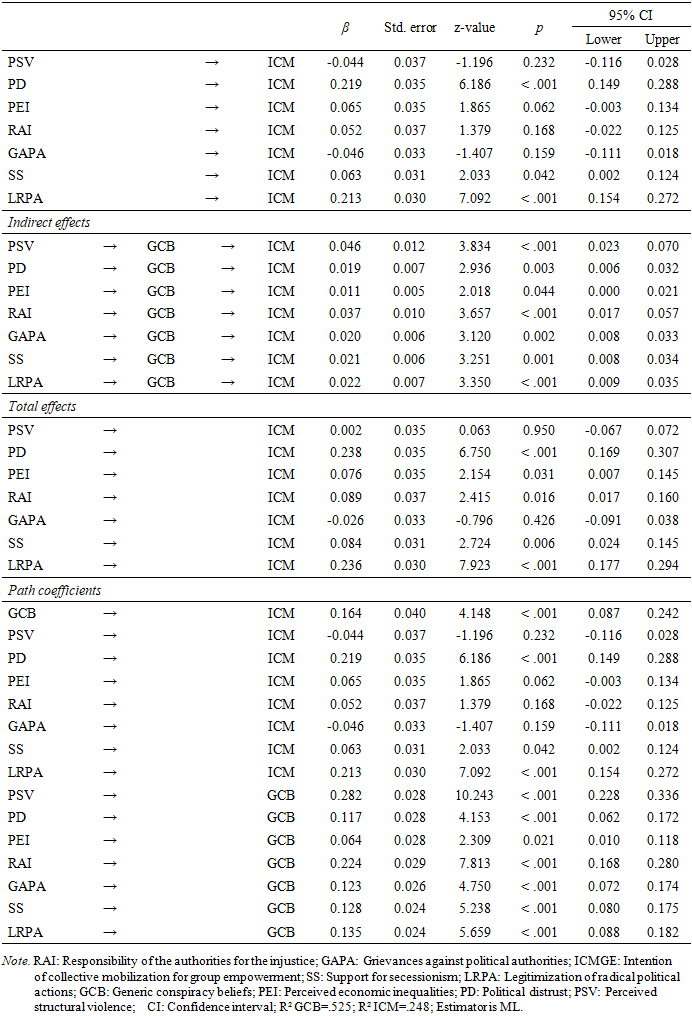
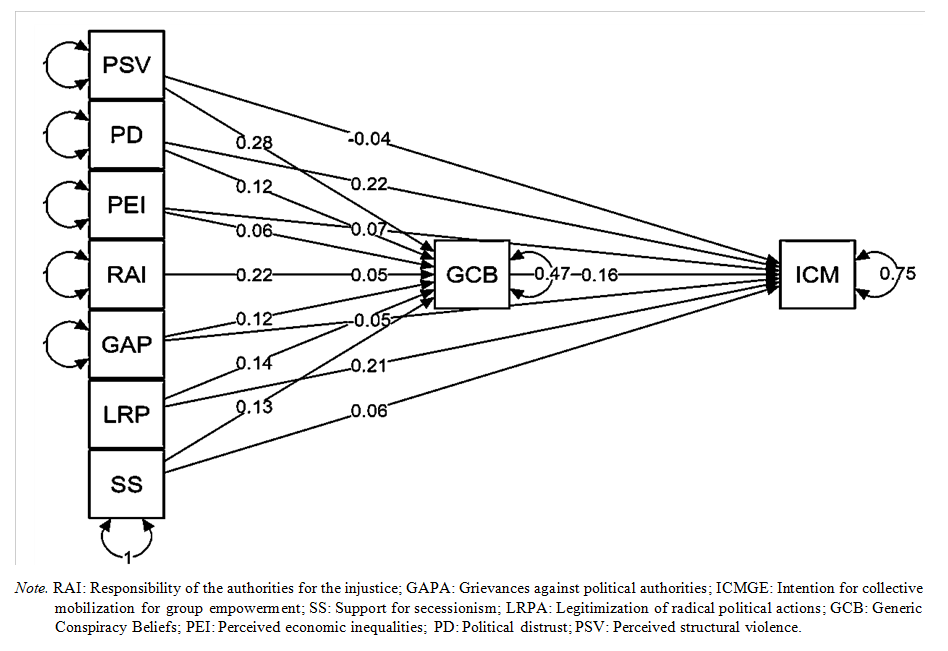
These results, derived from a structural equation modeling analysis, explore the significant direct and mediated determinants of the intention of collective mobilization for group empowerment. The model tests the influence of several psychosocial variables through conspiracy beliefs. The results indicate, according to the three respective levels of relationships (direct, indirect/mediated and total), that political distrust of the authorities (β=0.219; z-value=6.186, p<0.001, 95% CI=0.149, 0.288), legitimation of radical political actions (β=0.213, z-value=7.092, p<0.001, 95% CI=0.154, 0.272) and support for secessionism (β=0.063, z-value=2.033, p<0.05, 95% CI=0.002, 0.124) are the most relevant direct significant determinants of the intention of collective mobilization for group empowerment in the context of the separatist crisis in Cameroon. In short, these variables directly predict the inclination towards collective mobilization for group empowerment. On the other hand, as observed previously (Path a, hypothesis 5a, Figure 1, Table 4), grievances against political authorities (β=-0.046, z-value=-1.407, p=0.159, 95% CI=-0.111, 0.018), perceived economic injustice (β=0.065, z-value=1.865, p=0.062, 95% CI=-0.003, 0.134) and the responsibility of authorities in the face of injustice (β=0.052, z-value=1.379, p=0.168, 95% CI=-0.022, 0.125) do not directly generate collective mobilization for group empowerment. In other words, although they seem relevant, these determinants are not sufficient to induce an intention of collective mobilization for group empowerment. They would only act through conspiracy beliefs about the origins of the structural violence of which the ingroup is the victim. Along these lines, the assessment of indirect relationships via conspiracy beliefs shows how these variables (grievances against political authorities, perceived economic inequalities, and responsibility of the authorities for the injustice) significantly fuel intention of collective mobilization for group empowerment by first feeding conspiracy beliefs (see Table 4, Figure 2).
Table 4. Direct/indirect contextual determinants of the intention of collective mobilization for group empowerment
     
Figure 2. Structural relationships between the direct/indirect contextual determinants of the intention of collective mobilization for group empowerment
These variables only lead to intention of collective mobilization for group empowerment because they reinforce conspiracy beliefs (total mediation or effect). In the specific context of the separatist crisis that Cameroon has experienced since 2017, this catalyst for the intention of collective mobilization for group empowerment thus constitutes a universal pathway, as all indirect or mediated relationships are statistically significant (p<0.05). Furthermore, partial mediation relationships are observed between intention of collective mobilization for group empowerment and political distrust, support for secessionism, and legitimization of radical political actions. In this case, conspiracy beliefs partially and significantly reinforce intention of collective mobilization for group empowerment already present in the direct relationships between these variables. Similarly, the analysis of the overall factor weights (total effect) indicates that political distrust (β=0.238, z-value=6.750, p<0.001, 95% CI=0.169, 0.307) and legitimation of radical political actions (β=0.236, z-value=7.923, p<0.001, 95% CI=0.177, 0.294) are the variables that best explain intention of collective mobilization for group empowerment. The overall effect of structural violence cancels out (β=0.002, z-value=0.063, p=0.950, p=00950, 95% CI=-0.067, 0.072), suggesting that its positive impact via conspiracy beliefs is offset by a non-significant direct tendency towards demobilization or resignation (see Table 4, Figure 2).

4. Discussion

The aim of this research was to assess the relationships between structural violence, conspiracy beliefs, and intention of collective mobilization for group empowerment. Several hypotheses establishing relationships between the main and contextual variables were tested using Pearson correlation and the structural model. The results showed significant linear relationships between structural violence, intention of collective mobilization for group empowerment, and conspiracy beliefs. These variables were also associated with contextual variables such as the responsibility of the authorities for injustice, grievances against political authorities, political distrust, perceived economic inequalities, support for secessionism, and legitimization of radical political actions. These results supported the formulated hypotheses. In a structural model, the study tested the hypotheses establishing a structural relationship between structural violence and intention of collective mobilization for group empowerment, mediated by conspiracy beliefs. The results also supported this hypothesis. Furthermore, the assessment of the relationships between contextual variables and intention of collective mobilization for group empowerment revealed that political distrust, legitimization of radical political actions, and support for secessionism directly and significantly determine participants’ intention of collective mobilization for group empowerment, unlike grievances against political authorities, perceived economic injustice, and authorities’ responsibility for injustice. In this context, conspiracy beliefs partially and fully catalyze the effect of these determinants of the intention of collective mobilization for group empowerment.
The data collected in this study indicate that structural violence positively and significantly predicts conspiracy beliefs, thus supporting the propositions in the specialized literature which argue that conspiracy beliefs are prevalent among disadvantaged minority groups suffering from power asymmetry [77]. In the context of the secessionist crisis in which this study is conducted, the disadvantaged Anglophone minority falls within this perspective, since it believes in the existence of a secret strategy by the Francophone majority to make it disappear [31], notably through the erasure of all the cultural and institutional foundations of its identity [97]. This conspiracy belief is fueled by the numerous instances of harm this minority has suffered, linked to discrimination, marginalization, and assimilation over several decades [99]; situations likely to generate a feeling of lack of control over its future in a state controlled by the Francophone majority since its unification in 1961 [70]. In this vein, observations suggesting that conspiracy beliefs can stem from a lack of control (as is the case for the Anglophone minority in Cameroon) seem relevant here. Indeed, theoretically, evidence suggests that the feelings of aversion people experience in times of crisis, fear, uncertainty, and a sense of lack of control are likely to stimulate the motivation to make sense of the situation [19]; in turn increasing the likelihood of perceiving conspiracies in social situations [105].
The results of this research also report a positive and significant link between conspiracy beliefs and intention of collective mobilization for group empowerment. Along these lines, the specialized literature suggests that beliefs that an outgroup is implementing a secret strategy that results in harm to the ingroup are likely to generate grievances, frustrations, and emotions among its members against that outgroup, and fuel collective action against it (see [35]). This connection between conspiracy beliefs and collective action against conspirators is linked to the fact that unfavorable sociopolitical circumstances in which a group finds itself are likely to push it toward conspiracy theorizing [24]. This theorization itself is likely to push individuals to collective mobilization against conspirators, including through radical extremist actions (see [13]), to put an end to their malicious action, the consequence of which is that it threatens the said group’s well-being [87].
We noted earlier that victimization is a potential catalyst for feelings of injustice and collective action among members of a disadvantaged group seeking empowerment (see [93]), particularly because the social inequalities it carries can activate feelings of restricted collective autonomy among its members [89]. The results of the present study support this view, reporting a positive link between structural violence and support for secessionism; a link, however, mediated by conspiracy beliefs, through which institutional authorities are seen as conspirators acting against the ingroup. As a reminder, these conspiracy beliefs are also positively linked to strong expressions of grievances against political authorities, legitimization of radical actions, a propensity for collective mobilization for group empowerment, and support for secessionism. This supports the idea that separatist tendencies, in which individuals opt for one of the most extreme forms of intergroup conflict, are underpinned by the lived experiences of the members of the groups employing this strategy. Generally, these experiences stem from dissatisfaction among the populations concerned with the socio-economic, political, and structural conditions offered by the state from which they wish to separate (see [53] for the analysis of secessionism). These unfavorable conditions are a source of grievances that are often left unaddressed by authorities in the long term [101]; grievances that ultimately lead to the radicalization of segments of the affected populations, particularly because they are prone to developing a sense of distrust toward political institutions, which the literature indicates is a potential catalyst for support for political violence, due to its relationship with grievances [85]. However, the results of this study also indicate that while conspiracy beliefs can transform certain attitudes into a willingness to take concrete action for group empowerment, some contextual factors that can directly influence the intention of collective mobilization for group empowerment should be controlled for a better explanation and interpretation of the results. These include political distrust, support for secessionism, and legitimization of radical political actions, which have been shown to have direct effects on the intention of collective mobilization for group empowerment.

5. Conclusions

The separatist crisis that has been ongoing in Cameroon since 2017 provides a fertile ground for examining the nexus between structural violence, conspiracy beliefs, and collective mobilization for group empowerment; a relationship not yet formally documented, but whose existence is suggested by the available literature on these various constructs. In the specific case of this crisis, the grievances accumulated by the Anglophone community since unification with French Cameroon in 1961, the change in the form of the Cameroonian state in 1972, with the end of the two-state federation in favor of a unitary state, as well as the brutal repression used by the authorities to stem the waves of popular demonstrations in 2016, can be considered responsible for the resurgence of separatist movements. To date, attempts at dialogue to end the crisis have been met with the refusal of both sides to budge from their positions, with the separatists determined to create a new state, and the government authorities unwilling to hear of either secession or even a return to federalism [33]. From this perspective, as the results of this study show, conspiracy beliefs highlighting the role of authorities in the trajectory of events in the distant and recent past, particularly the repression following mobilizations by Anglophone populations to voice their grievances, are clearly brought to light. These theories underpin the perception of economic inequalities, grievances against political authorities, authorities’ responsibility for injustice, and support for secessionism. On the other hand, political distrust and legitimization of radical political actions, which are also key contextual determinants of the intention of collective mobilization for group empowerment, impact that intention without resorting to conspiracy beliefs. Under these conditions, given that secessionism is sometimes a (radical and extreme) response to structural violence, made up of discrimination, segregation [60], and subjugation of a population by institutional authorities, how can we envision peace in the near future if the two opposing groups remain entrenched in their positions, despite the Grand National Dialogue organized in October 2019? Time will tell!

References

[1]  Abgor, A. A., & Effundem Njieassam, E. (2019). Beyond the contour of normally acceptable political violence: Is Cameroon a conflict/transitional society in the offing? PER/PELJ, 2019(22). http://dx.doi.org/10.17159/1727-3781/2019/v22i0a4691.
[2]  Abwa, D. (2000). Le problème anglophone au Cameroun: facteur d’intégration ou de désintégration nationale ? In C. Dubois, M. Michel, & P. Soumille (Eds.), Frontières plurielles, frontières conflictuelles en Afrique subsaharienne (pp. 115-141). L’Harmattan.
[3]  Adra, A., Harb, C., Li, M., & Baumert, A. (2020). Predicting collective action tendencies among Filipina domestic workers in Lebanon: Integrating the Social Identity Model of Collective Action and the role of fear. Group Processes & Intergroup Relations, 23(7), 967-978. https://doi.org/10.1177/1368430219885180.
[4]  Agwanda, B., & Asal, U. Y. (2021). The Anglophone problem in Cameroon: The change from crisis to conflict, and a possible way forward to resolution. African Journal on Conflict Resolution, 21(1), 9-34.
[5]  Albath, E. A., Greifeneder, R., Douglas, K. M., Cichocka, A., Marques, M. D., Wilson, M. S., Kerr, J. R., Sibley, C. G., & Osborne, D. (2024). Does lower psychological need satisfaction foster conspiracy belief? Longitudinal effects over 3 years in New Zealand. Personality and Social Psychology Bulletin, 1-15. DOI: 10.1177/01461672241292841.
[6]  Amnesty International. (2017). A turn for the worse: Violence and human rights violations in anglophone Cameroon. AFR 17/8481/2018.
[7]  Amnesty International. (2023). Avec ou contre nous: La population prise en étau entre l’armée et les milices dans la région du Nord-Ouest du Cameroun. AFR 17/6838/2023.
[8]  Anyangwe, C. (Ed). (2008). Imperialistic politics in Cameroon: Resistance and the inception of the restoration of the statehood of Southern Cameroons. In African books collective (pp. 1-160). Amazon.
[9]  Atabongwoung, G. (2020). History never dies, how silent past returns: Southern Cameroons/”Ambazonia”. Africana Studia, 33, 95-109. DOI: 10.21747/doi.org/0874-2375/afr33a7.
[10]  Awoh, E. L., & Nkwi, W. G. (2015). A disease of will among African states: The separatist agenda of Southern Cameroon National Council (SCNC), c. 1995-2004. Conflict Studies Quarterly, 12, 3-17.
[11]  Anyefru, E. (2008). Cyber-nationalism: The imagined Anglophone Cameroon community in cyberspace. African Identities, 6(3), 253-274. DOI: 10.1080/14725840802223572.
[12]  Ayanian, A. H., Tausch, N., Acar, Y. G., Chayinska, M., Cheung, W-Y., & Lukyanova, Y. (2021). Resistance in repressive contexts: A comprehensive test of psychological predictors. Journal of Personality and Social Psychology, 120(4), 912-939. https://doi.org/10.1037/pspi0000285.
[13]  Bartlett, J., & Miller, C. (2010). The power of unreason: Conspiracy theories, extremism and counter-terrorism. Demos.
[14]  Becker, J. C., & Tausch, N. (2015). A dynamic model of engagement in normative and non-normative collective action: Psychological antecedents, consequences, and barriers. European Review of Social Psychology, 26(1), 43-92. https://doi.org/10.1080/10463283.2015.1094265.
[15]  Belton, E., Mulholland, T., & Murphy, K. (2025). Linking conspiracy beliefs with violence: A Scoping review of the empirical literature. Terrorism and Political Violence, 1-27. https://doi.org/10.1080/09546553.2025.2462601.
[16]  Biddlestone, M., Green, R., Douglas, K. M., Avezedo, F., Sutton, R. M., & Cichocka, A. (2025). Reasons to believe: A systematic review and meta-analytic synthesis of the motives associated with conspiracy beliefs. Psychological Bulletin, 151(1), 48-87. https://doi.org/10.1037/bul0000463.
[17]  Brotherton, R., French, C. C., & Pickering, A. D. (2013). Measuring belief in conspiracy theories: The Generic Conspiracist Beliefs Scale. Frontiers in Psychology, 4:279. DOI: 10.3389/fpsyg.2013.00279.
[18]  Chrobak, K. (2021). Structural Violence. Horizons of Politics, 13(42), 171-186. DOI: 10.35765/HP.2207.
[19]  Ćirović, N., & Pedović, I. (2025). Construct validity, measurement invariance, and nomological network of Conspiracy Mentality Questionnaire (CMQ) across four different languages. Journal of Personality Assessment. DOI: 10.1080/00223891.2025.2465830.
[20]  Connor, W. A. (1994). Nation is a nation, is a state, is an ethnic group, is a… In Connor Walker (Ed.), Ethnonationalism: The Quest for Understanding (pp. 90-117). Princeton University Press.
[21]  Dicklitch, S. (2011). The Southern Cameroons and minority rights in Cameroon. Journal of Contemporary African Studies, 29(1), 49-62. DOI: 10.1080/02589001.2011.533059.
[22]  Douglas, K. M., & Sutton, R. M. (2025). Chapter One - The social psychology of conspiracy theories: Key insights and future challenges. In B. Gawronski (Ed.), Advances in Experimental Social Psychology, 71, 1-68. https://doi.org/10.1016/bs.aesp.2024.10.004.
[23]  Douglas, K. M., Sutton, R. M., Biddlestone, M., Green, R., Toribio-Flórez, D. (2024). Engaging with conspiracy believers. Review of Philosophy and Psychology. https://doi.org/10.1007/s13164-024-00741-0.
[24]  Douglas, K., Sutton, R. M., Van Lissa, C. J., Stroebe, W., Kreienkamp, J., Agostini, M., … et al. (2023). Identifying important individual and country level predictors of conspiracy theorizing: A machine learning analysis. European Journal of Social Psychology, 53(6), 1191-1203. https://doi.org/10.1002/ejsp.2968.
[25]  Douglas, K. M., Uscinski, J. E., Sutton, R. M., Cichocka, A., Nefes, T., Ang, C. S., & Deravi, F. (2019). Understanding conspiracy theories. Political Psychology, 40, 3-35. https://doi.org/10.1111/pops.12568.
[26]  Dzuetso Mouafo, A. V., Taffo Nemboué, W., Messanga, G. A. (2023). When perceived official terror drives people out of politics: A systemic analysis of political alienation in the context of authoritarian democracy. Psychology and Behavioral Sciences, 12(6), 88-98. DOI: 10.11648/j.pbs.20231206.11.
[27]  Ebune, B. J. (2016). The Dilemma of the federal system in West Cameroon, 1961-1972. Journal of Scientific Research and Studies, 3(7), 133-137.
[28]  Endtricht, R., & Kanol, E. (2024). Conspiracy beliefs and negative attitudes towards outgroups in times of crises: Experimental evidence from Germany. PLoS ONE, 19(11), e0312418. https://doi.org/10.1371/journal.pone.0312418.
[29]  Ferguson, N., McDaid, S., & McAuley, J. W. (2018). Social movements, structural violence, and conflict transformation in Northern Ireland: The role of loyalist paramilitaries. Peace and Conflict: Journal of Peace Psychology, 24(1), 19-26. https://doi.org/10.1037/pac0000274.
[30]  Firdiani, N. F., Milla, M. N., & Hudiyana, J. (2025). The underlying mechanism behind quest for significance and its role in violence extremism: A systematic literature review. Buletin Psikologi, 33(2), 192-209. DOI: 10.22146/buletinpsikologi.99985.
[31]  Fonchingong, T. (2013). The quest for autonomy: The case of Anglophone Cameroon. African Journal of Political Science and International Relations, 7(5), 224-236. https://doi.org/10.5897/AJPSIR10.033.
[32]  Fonkem Achankeng, M. (2012). The Southern Cameroons’ nationalist conflict in Cameroon Republic: A destiny in the shadows? www.researchgate.net/publication/293632170.
[33]  Fru, W. B. (2022). Separatism in ambazonia and its countering [Master’s thesis; Masaryk University]. https://is.muni.cz/th/zbu27/MU_Dissertation.pdf.
[34]  Galtung, J. (1969). Violence, peace, and peace research. Journal of Peace Research, 6(3), 167-191. https://doi.org/10.1177/002234336900600301.
[35]  Gkinopoulos, T., & Mari, S. (2023). How exposure to real conspiracy theories motivates collective action and political engagement? The moderating role of primed victimhood and underlying emotional mechanisms in the case of 2018 bushfire in Attica. Journal of Applied Social Psychology, 53(1), 21-38. DOI: 10.1111/jasp.12923.
[36]  Goertzel, T. (1994). Belief in conspiracy theories. Political Psychology, 15, 731-742.
[37]  Guérin, F. et Famose, J.-P. (2005). Le concept de soi physique. Bulletin de psychologie, 475(1), 73-80. https://doi.org/10.3917/bupsy.475.0073.
[38]  Gurr, T. R. (1970). Why men rebel? Princeton University Press.
[39]  Hechter, M. (1972). Internal colonialism: The Celtic Fringe in British National Development. Transaction Publishers.
[40]  Hewstone, M., Rubin, M., & Willis, H. (2002). Intergroup bias. Annual Review of Psychology, 53, 575-604. https://doi.org/10.1146/annurev.psych.53.100901.135109.
[41]  Hornsey, M. J., Bierwiaczonek, K., Sassenberg, K., & Douglas, K. M. (2023). Individual, intergroup and nation-level influences on belief in conspiracy theories. Nature Review of Psychology, 2, 85-97. https://doi.org/10.1038/s44159-022-00133-0.
[42]  Human Rights Watch. (2020). Cameroon: Massacre Findings Made Public - Despite Flaws, Conclusions that Soldiers Bear Responsibility Important Step. https://www.hrw.org/news/2020/04/24/cameroon-massacre-findings-made-public.
[43]  Imhoff, R., & Bruder, M. (2014). Speaking (un‐)truth to power: Conspiracy mentality as a generalised political attitude. European Journal of Personality, 28(1), 25-43. https://doi.org/10.1002/per.1930.
[44]  Imhoff, R., Dieterle, L., & Lamberty (2021). Resolving the puzzle of conspiracy worldview and political activism: belief in secret plots decreases normative but increases nonnormative political engagement. Social Psychological and Personality Science, 12(1), 71-79. https://doi.org/10.1177/1948550619896491.
[45]  International Crisis Group (2019). Cameroun: la crise anglophone à la croisée des chemins. Crisis Group Rapport Afrique n°250.
[46]  Jeong, H. Y., Vollhardt, J. R., & Twali, M. S. (2025). Power and resistance: Black Americans’ multifaceted perceptions of ingroup strengths and their effects on collective efficacy and resistance. British Journal of Social Psychology, 64(3). https://doi.org/10.1111/bjso.12904.
[47]  Jua, N., & Konings, P (2004). Occupation of Public Space Anglophone Nationalism in Cameroon. Cahiers d’Études Africaines, 175. DOI: 10.4000/etudesafricaines.4756.
[48]  Karakula, A., Marchlewska, M., Molenda, Z., Michalski, P., Rogoza, M., Górska, P., & Kofta, M. (2026). The conspiracy of us: Political narcissism promotes ascription of conspiracy intentions to in-group members. European Journal of Social Pysychology. https://doi.org/10.1002/ejsp.70053.
[49]  Kaushal, T. (2020). Contextually engendering conflict analysis. The case of the Anglophone conflict in Cameroon. Working Paper 11. Gender Centre, The Graduate Institute of International and Development Studies.
[50]  Keke, R. C. (2020). Southern Cameroons/Ambazonia conflict: A political economy. Theory & Event, 23(2), 329-351.
[51]  Ketzmerick, M. (2023). The anglophone crisis in Cameroon: Local conflict, global competition, and transnational rebel governance. Small wars & Insurgencies, 34(1), 247-278. https://doi.org/10.1080/09592318.2022.2113691.
[52]  Kline, R. B. (2023). Principles and practice of structural equation modeling. Guilford publications.
[53]  Kingsbury, D. (2021). Separatism and the state. Routledge. https://doi.org/10.4324/9780429297113.
[54]  Konings, P. (1996). The post-colonial State and Economic and political Reforms in Cameroon. In A. E. Fernandez Jilberto, & A. Mommen (Eds), Liberalization in the developing world: Institutional and economic changes in Latin America, Africa and Asia (pp. 244- 265). Routledge.
[55]  Konings, P., & Nyamnjoh, F. B. (2003). Negotiating an Anglophone identity: A study of the politics of recognition and representation in Cameroon. Brill.
[56]  Kunst, J. R., Besta, T., Jaśkiewicz, M., Gajda, A. N., Sanden, M., Flatebø, M. M., Adebayo, S.O., Adonis, M., Agyemang, C. B., Boateng, R. A., Akfirat, S. A., Al-adawi, S., Ambrosio, C., Anjum, G., Aruta, J. J .B. R., Austers, I., Barry, O., Bastian, B., Becker, M., [...] & Obaidi, M. (2026). The psychology of offensive and defensive intergroup violence: Preregistered insights from 58 countries. Proceedings of the National Academy of Sciences U.S.A., 123(13), e2535665123. https://doi.org/10.1073/pnas.2535665123.
[57]  Landmann, H., Solak, N., Chayinska, M., & Uluğ, Ö. M. (2025). Is there a place for positive emotions in peace protests? Being moved and anger predict different goals of peace activism among third parties. Journal of Community & Applied Social Psychology. https://doi.org/10.1002/casp.70184.
[58]  Lazar, M. (2019). Afro Barometer: Cameroon’s linguistic divide deepens to rift on questions of democracy, trust, national identity. https://www.afrobarometer.org/publications/ad283-cameroons-linguistic-divide- deepens-riftquestions-democracy-trust-national-identity.
[59]  Lee, B. X. (2019). Violence: An Interdisciplinary approach to causes, consequences, and cures. John Wiley & Sons, Inc. DOI: 10.1002/9781119240716.
[60]  Lee, M. J., & Atchison, R. J. (2022). We are not one people: Secession and separatism in American Politics Since 1776. Oxford Academic. https://doi.org/10.1093/oso/9780190876500.001.0001.
[61]  Letsa, N. W., & Morse, Y. L. (2023). Autocratic legalism, partisanship, and popular legitimation in authoritarian Cameroon. Public Opinion Quarterly, 87(4), 935-955. https://doi.org/10.1093/poq/nfad051.
[62]  Loziak, A., & Havrillova, D. (2024). Conspiracy mentality: How it relates to populism, relative deprivation, mistrust of expertise and voting behavior. Europe’s Journal of Psychology, 20(1), 1-15. https://doi.org/10.5964/ejop.10049.
[63]  Lyonga Ngange, K., Nengieh Wantchami2, L., Mesumbe Ndiwang, N., & Mewoabi Temateh, S. (2020). Media violence reports on the Cameroon Anglophone crisis: Implication on Buea denizens. International Journal of Media, Journalism and Mass Communications, 6(1), 21-27. http://dx.doi.org/10.20431/2454-9479.0601003.
[64]  Majstorovic, S. (1999). Autonomy of the sacred: The endgame in Kosovo. Nationalism and Ethnic Politics, 5(3-4), 167-190. https://doi.org/10.1080/13537119908428575.
[65]  Mancosu, M., Vassallo, S., & Vezzoni, C. (2017). Believing in conspiracy theories: Evidence from an exploratory analysis of Italian survey data. South European Society and Politics, 3(22), 327-344. https://doi.org/10.1080/13608746.2017.1359894.
[66]  Mang, V., Winter, K., Epstude, K., & Fennis, B. M. (2026). If only I had not fallen down the rabbit hole: Counterfactual thinking reduces engagement with conspiracy theories. Journal of Experimental Social Psychology, 123, 104849. https://doi.org/10.1016/j.jesp.2025.104849.
[67]  Mao, J.-Y., van Prooijen, J.-W., & Van Lange, P. A. M. (2024). Conspiracy theories: Groups, ideology, and status as three distinct bases for expressions in society. Current Directions in Psychological Science, 1-7. DOI: 10.1177/09637214241280742.
[68]  Mbembé, J.-A. (2000). At the edge of the world: Boundaries, territoriality, and sovereignty in Africa. Public Culture, 12(1), 259-84.
[69]  Messanga, G. A. (2018). Effet de la scolarisation des élèves issus de familles francophones dans le sous-système éducatif anglophone sur l’identité sociale anglophone: Une analyse dans la perspective théorique de la menace intergroupe. In A. E. Ebongue & A. Djoum Nkwescheu (Eds.), L’insécurité linguistique dans les communautés anglophone et francophone du Cameroun (pp. 251-274). L’Harmattan.
[70]  Messanga, G. A. (2021). Perceived similarity as the source of the feeling of intergroup threat: Testing the Brown’s (1984) hypothesis in the Cameroonian linguistic context. Journal of Advanced Research in Social Sciences, 4(1), 41-51. https://doi.org/10.33422/jarss.v4i1.512.
[71]  Messanga, G. A., & Dzuetso Mouafo, A. V. (2014). Contact intergroupe et préjugés à l’égard des anglophones en milieu universitaire bilingue et monolingue francophone au Cameroun. Nka’ Lumière, 12, 179-202.
[72]  Messanga, G. A., & Ekango Nzekaih, H. K. (2022). When society deteriorates: Political intolerance, perceived anomic threat and participation in anti-system collective actions in the context of authoritarian democracy. Psychology and Behavioral Sciences, 11(3), 92-104. DOI: 10.11648/j.pbs.20221103.14.
[73]  Messanga, G. A., Ekango Nzekaih H. K., & Npiane Ngongueu, S. (2020). Effet de la culpabilité groupale ressentie sur le soutien à la réparation de l’oppression à l’égard de l’exogroupe: Le cas des Anglophones du Cameroun. European Scientific Journal, 16(10), 135-153. DOI: http://dx.doi.org/10.19044/esj.2020.v16n10p135.
[74]  Messanga, G. A., Fotso Magne, P., & Taffo Nemboue, W. (2020). Adhésion aux théories conspirationnistes et soutien aux politiques répressives à l’égard des libertés politiques en contexte de démocratie autoritaire: Le cas du Cameroun. European Scientific Journal, 16(26), 51-73. http://dx.doi.org/10.19044/esj.2020.v16n26p51.
[75]  Messanga, G. A., Youmbi, K. A., & Ekango Nzekaih H. K. (2021). Self-perception as an inclusive victim of oppression, intergroup emotions and support for resistance to the victimization of disadvantaged outgroups. Psychology and Behavioral Sciences, 10(5), 165-177. DOI: 10.11648/j.pbs.20211005.12.
[76]  Ndjio, B. (2024). Rhizomic authoritarianism: Power, biopolitics and transnational authoritarian practices in Cameroon. Globalizations, 21(6), 1125-1142. https://doi.org/10.1080/14747731.2023.2207272.
[77]  Nera, K., Douglas, K. M., Bertin, P., Delouvée, S., & Klein, O. (2024). Conspiracy reliefs and the perception of intergroup inequalities. Personality and Social Psychology Bulletin, 0(0). https://doi.org/10.1177/01461672241279085.
[78]  Ngenyam Bang, H., & Azibo Balgah, R. (2022). The ramification of Cameroon’s Anglophone crisis: Conceptual analysis of a looming “complex disaster emergency”. Journal of International Humanitarian Action, 7(6). https://doi.org/10.1186/s41018-022-00114-1.
[79]  Ngum Achu, N., & Tutumlu, A. (2023). Why recognition? Deciphering justice claims in 2016 anglophone crisis in Cameroon. Social Dynamics, 49(3). DOI: 10.1080/02533952.2023.2267767.
[80]  Obradović, S., Vincze, O., & Sammut, G. (2025). Social psychology of context and in context: Understanding the temporal, spatial and embodied dimensions of contemporary geopolitics. British Journal of Social Psychology, 64(e12851). https://doi.org/10.1111/bjso.12851.
[81]  O’Mahony, C., Murphy, M., Linehan, C., & Murphy, G. (2025). The Critical Thinking About Conspiracies (CTAC) Test: Development and validation. Applied Cognitive Psychology, 39, e70120. https://doi.org/10.1002/acp.70120.
[82]  Pantazi, M., Gkinopoulos, T., Witkowska, M., Klein, O., & Bilewicz, M. (2022). “Historia est magistra vitae”? The impact of historical victimhood on current conspiracy beliefs. Group Processes & Intergroup Relations, 25(2), 581-601. https://doi.org/10.1177/1368430220968898.
[83]  Papaioannou, K., & Pantazi, M. (2025). Please reduce the gap! How psychological distance to politics fuels belief in conspiracy theories. British Journal of Social Psychology, 65, e70019. https://doi.org/10.1111/bjso.70019.
[84]  Pelican, M. (2022). The Anglophone conflict in Cameroon – historical and political background. Working Paper n°20, Arnold Bergstraesser Institut.
[85]  Piazza, J. A. (2024). Populism and Support for Political Violence in the United States: Assessing the Role of Grievances, Distrust of Political Institutions, Social Change Threat, and Political Illiberalism. Political Research Quarterly, 77(1), 152-166. https://doi.org/10.1177/10659129231198248.
[86]  Pratto, F., Levin, S., Rusowicz, A., Möring, J. N. R., & Lemieux, A. F. (2025). Political violence versus violent extremism: A social dominance theory approach. In M. Obaidi & J. Kunst (Eds.), The Cambridge handbook of the psychology of violent extremism (pp. 301-322). Cambridge University Press. https://doi.org/10.1017/9781009407892.018.
[87]  Pummerer, L., Gkinopoulos, T., Douglas, K., Jolley, D., & Sassenberg, K. (2024). The appraisal model of conspiracy theories (AMCT): Applying appraisal theories to understand emotional and behavioral reactions to conspiracy theories. Psychological Inquiry, 35(3-4), 159-178. https://doi.org/10.1080/1047840X.2024.2442906.
[88]  Razafindrakoto, M., & Roubaud, F. (2022). Aux soubassements de la crise anglophone au Cameroun: frustrations politiques et défiance à l’égard des institutions publiques. Statéco, 116, 121-137.
[89]  Rivera-Rodriguez, A., Mercado, E., Tropp, L. R., & Dasgupta, N. (2025). When social hierarchy, power, and collective autonomy motivate social movement and counter-movement mobilization among disadvantaged and advantaged groups. Personality and Social Psychology Review, 0(0). https://doi.org/10.1177/10888683241305662.
[90]  Rodríguez-Gómez, D., & Russell, S. G. (2022). Human rights violations through structural violence: A case study of human rights education in New York City. American Educational Research Journal, 59(1), 38-72. https://doi.org/10.3102/00028312211057307.
[91]  Rusk, J. D. (2018). Trust and distrust scale development: Operationalization and instrument validation [Doctoral dissertation; Kennesaw State University].
[92]  Salvador Casara, B. G., Suitner, C., & Jetten, J. (2022). The impact of economic inequality on conspiracy beliefs. Journal of Experimental Social Psychology, 98, Article 104245. https://doi.org/10.1016/j.jesp.2021.104245.
[93]  Selvanathan, H. P., Jetten, J., & Umeh, A. (2023). A history of collective resilience and collective victimhood: Two sides of the same coin that explain black Americans’ present-day responses to oppression. British Journal of Social Psychology, 62(1), 136-160. https://doi.org/10.1111/bjso.12562.
[94]  Sinqobile, W. N., & Alan, S. P. (2019). An investigation on the impact of organizational structure on organizational performance. Financial Risk and Management Reviews, 5(1), 10-24. DOI: 10.18488/journal.89.2019.51.10.24.
[95]  Smallpage, S. M., Enders, A. M., & Uscinski, J. E. (2017). The partisan contours of conspiracy theory beliefs. Research & Politics, 4. https://doi.org/10.1177/2053168017746554.
[96]  Suter, F., Karlen, Y., Merki, K. M., & Hirt, C. N. (2022). The relationship between success and failure causal attributions and achievement goal orientations. Learning and Individual Differences, 100, 102225. https://doi.org/10.1016/j.lindif.2022.102225.
[97]  Takougang, J. (1993). The Post-Ahidjo era in Cameroon: Continuity and change. Journal of Third World Studies, 10(2), 268-302. http://www.jstor.org/stable/45193445.
[98]  Tala, K. I. & Ngange, K. L. (2019). Anglophone lawyers and teachers strikes in Cameroon (2016 - 2017): A multidimensional perspective. Les Presses Universitaires de Yaoundé.
[99]  Tchinda Kenfo, J. (2017). Le “problème anglophone” au Cameroun: La réponse par le processus participatif au développement territorial. https://www.thinkingafrica.org.
[100]  Tel, G. (2012). Collective action as a means for social equity: Two mediation models predicting collective action intentions in situations of structural versus incidental inequality [Master’s thesis; University of Twente]. https://esj29449_(verslag).pdf.
[101]  Thomas, C. G., & Falola, T. (2020). Secession and Separatist Conflicts in Postcolonial Africa. University of Calgary Press.
[102]  Toh, N. P. (2001). The anglophone problem in Cameroon: The prospects for nonviolent transformation, proposal for peaceful transformation of the anglophone problem in Cameroon. University Bradford Press.
[103]  Valtorta, R. R., Vezzoli, M., Mari, S., Durante, F., & Volpato, C. (2024). Measuring subjective inequality: Development and validation of the Perceived Economic Inequality Scale (PEIS). Spanish Journal of Psychology, 27(e2), 1-12. DOI: 10.1017/SJP.2024.4. PMID: 38311914.
[104]  van Prooijen, J.-W. (2020). An existential threat model of conspiracy theories. European Psychologist, 25(1), 16-25. https://doi.org/10.1027/1016-9040/a000381.
[105]  van Prooijen, J. W., & Douglas, K. M. (2017). Conspiracy theories as part of history: The role of societal crisis situations. Memory Studies, 10, 323-333. https://doi.org/10.1177/1750698017701615.
[106]  van Prooijen, J.-W., Fousiani, K., Šrol, J., Čavojová, V., Kaneko Ebert, A. C., Müller, E., & Sağlam, E. (2025). The evil enemy: Belief in conspiracy theories predicts attitudes to war. European Journal of Social Psychology, 55(7), 1420-1435. https://doi.org/10.1002/ejsp.70021.
[107]  Vegetti, F., & Littvay, L. (2022). Belief in conspiracy theories and attitudes toward political violence. Italian Political Science Review/Revista Italiana di Scienza Politica, 52, 18-32. https://doi.org/10.1017/ipo.2021.17.
[108]  Vorobej, M. (2008). Structural violence. Canadian Journal of Peace and Conflict Studies, 40(2), 84-98.
[109]  Winter, D. D., & Leighton, D. C. (2001). Structural violence. In D. J. Christie, R. V. Wagner, & D. D. Winter (Eds.), Peace, conflict, and violence: Peace Psychology In the 21st century. Prentice-Hall.
[110]  Wright, S. C., & Bougie, É. (2007). Intergroup contact and minority-language education: Reducing language-based discrimination and its negative impact. Journal of Language and Social Psychology, 26(2), 157-181. https://doi.org/10.1177/0261927X07300078.