
-
Paper Information
- Next Paper
- Paper Submission
-
Journal Information
- About This Journal
- Editorial Board
- Current Issue
- Archive
- Author Guidelines
- Contact Us
International Journal of Psychology and Behavioral Sciences
p-ISSN: 2163-1948 e-ISSN: 2163-1956
2015; 5(2): 80-88
doi:10.5923/j.ijpbs.20150502.05
Correlational Study of Age, Family Warmth and School Connectedness as Factors Affecting Juvenile Delinquency among Secondary School Adolescents in Osun State, Nigeria
 Abstract
 Reference
 Full-Text PDF
 Full-text HTML
Animasahun R. A., Aremu C. A.
Department of Guidance and Counselling, University of Ibadan, Ibadan, Nigeria
Correspondence to: Animasahun R. A., Department of Guidance and Counselling, University of Ibadan, Ibadan, Nigeria.
| Email: |  |
Copyright © 2015 Scientific & Academic Publishing. All Rights Reserved.
Delinquency has been a major challenge of adolescents in the recent time. It has now gone beyond ordinary youthful exuberance to heinous crime. Hence, these young ones that are believed to be the hope of the nation, the future leaders and strength of the country are turning criminals by the day. It is therefore suffice to say that the whole country is resting on a keg of gun powder that may explode any time. The issue must be vigorously addressed in order to secure the future for this country. Therefore, this study investigated the influence of age, family warmth and school connectedness on juvenile delinquency among secondary school adolescents in the State of Osun, Nigeria. The study adopted a descriptive survey of the ex-post type. Using a multi-stage sampling technique, three hundred students were selected for the study. The State of Osun is divided into three Senatorial Districts namely; Osun East, Osun West and Osun Central. Each Senatorial district consists of 10 local governments. Two schools were selected from each local government through simple random sampling method. From each school, 50 SS2 students were randomly chosen for the study based on balloting. The age of the students ranged from 14-16, with a mean age of 14.45. Three hypotheses were raised and answered at 0.05 level of significance. Data was collected using three validated research instruments: Family Warmth Scale, School Connection Scale and Self-Report of Delinquency Scale. Analysis of data was done using Pearson Product Moment Correlation analysis. Findings indicated that the three null hypotheses were rejected as significant relationship was found between each variable and juvenile delinquency. This indicate that the family from which the child comes, his current age and the kind of school must be taken note of in finding lasting solutions to adolescents’ delinquency. Thus, it is recommended that the family and school which happen to be two significant environments where adolescent behaviour could be moulded either positively or negatively should take proper care of the adolescents.
Keywords: Juvenile delinquency, Age, Family warmth, School connectedness
Cite this paper: Animasahun R. A., Aremu C. A., Correlational Study of Age, Family Warmth and School Connectedness as Factors Affecting Juvenile Delinquency among Secondary School Adolescents in Osun State, Nigeria, International Journal of Psychology and Behavioral Sciences, Vol. 5 No. 2, 2015, pp. 80-88. doi: 10.5923/j.ijpbs.20150502.05.
1. Introduction
- In March, 2010, an 18 year old Nigerian girl – Victoria Osoteku- instigated a 20-youth mob attack on a 15-year old talented Moroccan footballer in London. She used the social networking site - Face book- to recruit “troops and weapons.” The deceased was stabbed to death at the Victoria tube station, in front of terrified commuters during rush hour at about 5pm. The killer squad, whose ages were between 18-19 years, included an eighteen year old pastor’s son. They all recently (April, 2012) got life jail terms to serve a minimum of 18 years [1]. The above is an example of delinquency among adolescents not only within the country but outside the country [2].The term juvenile delinquency refers to a young person less than 18 years of age who engages in behaviours punishable by law. There is no universal definition of a juvenile or delinquency. The laws of different nations stipulate different age bracket for the juveniles. Besides, the concept of a juvenile is sometimes used interchangeably with other concepts like a child, an adolescent and a youth. But the law is usually more specific in its definition of a child or juvenile or youth.Manifestations of delinquency among secondary school adolescents in Nigeria include: cruelty, bullying, fighting, vandalism, stealing, lying, sexual immorality, mob action, carrying of weapons etc [3]. [4] noted that there are two main categories of delinquent behaviours which Nigerian adolescents engage in; these are: criminal and status offences. The criminal offences include: stealing, arson, rape, drug offences, murder, burglary, pick pocket, and armed robbery. However, she listed status offences to include: running away from home, malingering, truancy etc.Delinquency in Nigeria is a persistent source of apprehension to parents, school authorities, government and the society at large. Participation in delinquent acts by adolescents is assuming an alarming proportion and dangerous dimension which are becoming out of control to parents, police and other organs saddled with the responsibility of handling such issues. For example, adolescents engagement in inter-school fight recently in Ibadan –a city in one of the South-Western States in Nigeria - could have passed for a mere inter-school rivalry, but for the use of dangerous weapons such as knives, cutlasses and charms; it was reported that severe injuries were sustained not only by the fighting students but by passers-by in that neighbourhood [5]. Age, family warmth and school connectedness are variables that are very germane in explaining delinquency in adolescents. The adolescent age has been described as a period of transition characterized by the fact that the individual enters a cognitively unstructured region that results in uncertainty of behaviour [6]. As a result, the adolescent may behave in ways that are considered unacceptable. Family and school are two extremely important institutions in the life of a child especially an adolescent who is neither an adult nor a child. The impact the family has on the child goes a long way in determining what the child would be as an adult or even the kind of parent he/she would be in future, while the school is equally an important environment which impacts greatly on the adolescent. The school is where knowledge and skills needed for future sustenance are acquired. Not only that, some societal values too are impressed on the adolescents at this stage. This study seeks to examine more closely the influence of the age, family warmth and school connectedness on delinquency. Age and Juvenile Delinquency[7] opined that the two oldest most widely accepted conclusions in criminology are first, that involvement in crime diminishes with age and second, that males are more likely than females to offend at every age. Youngsters between the ages of 8 and 14 begin to confide less in parents and more in peers and to be more influenced by those peers for assistance in making decisions about what behaviour to adopt [8]; [9]. There is a huge variation in age factor of adolescent from one society to another [10]. Arrests data show that the intensity of criminal behaviour slackens after the teens and it continues to decline with age. Much research indicate that males are more likely to participate in crime compared to females ([11]; [12]; [13]; [14]) and that individual offending rates tend to peak in late adolescence then drop off in early adulthood ([15]; [12] & [16]).[17; 18] in contributing to the age-crime debate, view the “constant” maturity out of “crime or desistance from crime as individual’s age. They indicate the following: They question the emphasis on career criminal research incapacitation and the recent “fetish” longitudinal research that justifies a search for groups of offenders (career criminals) whose criminality does not decline with age ([19]; [16]; [20], [21]). [16] suggests that offenses of different types peak at different times and this represent ‘crime switching’ rather than replacement of one group of offenders by another. The outcome of this age-crime controversy is claimed by the disputants to have important consequences for career criminal research [22]. Why do criminals mature out of crime? [16] suggests factors such as influence of wives, girl-friends, decline of gang or peer group support, and increased penalties, as well as increased legitimate opportunities as individuals reach their twenties. However, [23] found from their studies that increase in age of participants attracted increase in the rate of delinquency. They infer that as the adolescent grows older he/she has more courage to try out new things, more criminal things and rebellious nature increases.Empirical research shows that as predicted by [24], people change over the life course and the factors that predict anti-social behaviour evolve over time. As predicted by [24], as levels of cumulative disadvantage increase, delinquency-resisting elements of social life are impaired. Adolescents who are convicted of delinquency at an early age are more likely to develop anti-social attitudes later in life. They develop low educational achievement, declining occupational status and unstable employment record. Evidence is also available that confirms [24] suspicion that delinquent career trajectories can be reversed if life conditions improve and they gain social capital. However, involvement in delinquency of children who have long-term exposure to poverty may escalate.A sizeable portion of adolescent offenders, who in all likelihood do not experience the positive building blocks of human development continue offending behaviour into young adulthood [24]. Teenagers exposed to authoritative as opposed to authoritarian parentings are less likely to turn to peers for advice for they have already established a history of open communication and self-disclosure with their parents [25]. They are also more likely to choose friends of whom their parents approve which often mean friends who do well in school [26]. Unfortunately, adolescents’ accesses to these protective influences have declined in recent years because parents are spending more and more time in workplaces. Children in the United States today spend an average of 10-12 hours per week less with their parents than children did in 1960 [27]; [28].[29] in the first national study of family violence reported that parents’ use of violence on their adolescent children was extensive. 54% of young ones between 10-14 years; 33% of 15-17 years were hit by their parents. The data is consistent with [30] report that 28% of abuse incidents involved youths over 12 years of age. Statistics vary in statutory definitions of the age for juvenile court jurisdiction [14] ranging from minimum age of 10 to maximum age of 16 -17. Recent trends are for treating younger offenders as adults in cases of serious offences. Minors can be executed at age 18 for murder, 3 years before they can legally purchase and use tobacco products, alcohol or acquire handguns [31]. Criminal behaviour is supposedly a sign of maturity and therefore legal culpability.School Connectedness and Juvenile DelinquencySchool connectedness construct was empirically developed as a general indicator of student’s perceived bonding and quality of relationship with peers and teachers [32]. [33] later proposed a theoretical model to explain how it might operate as a protective force for youth. She found support for a conceptual model based on the linkages of connectedness with increased student (a) involvement in meaningful roles at school, (b) safety at school, (c) academic engagement. The National Longitudinal Study of Adolescent Health looked at the impact of protective factors on adolescent health and well-being among more than 36,000 7th -12th grade students. The study found that family, school and individual factors such as school connectedness, parent-family connectedness, high parental expectations for academic achievement and the adolescents’ level of involvement in religious activities and perceived importance of religion and prayer were protective against a range of adverse behaviours [27]; [34]; [35]. Other studies indicate that individual student’s feelings of being connected to school are influenced by their peers as well as by adults [27]; [36].School connectedness was found to be the strongest protective factor for both boys and girls to decrease substance use, school absenteeism, early sexual initiation, violence and risk of unintentional injury [27]. Research has also demonstrated a strong relationship between school connectedness and educational outcomes [37]; [38]; [39]; [40] including school attendance [37; [41] staying in school longer [38] and higher grades and classroom test scores [37]; [40]. Researchers have reported that school connectedness is associated with reduced risk of negative development outcomes. For example, it has been shown to buffer against aggressive behaviour and exposure to violent behaviour [42]. Furthermore, school connectedness reduces barriers to learning such as delinquency and violence, gang membership, substance use and school dropout [43]. Also, school connectedness is positively associated with the reduction of substance use [44], exposure to weapon violence [45], the initiation of smoking [46], the prevention of dropping out of school [47]. One study found that schools with a higher average sense of community score (i.e. composite of students’ perception of caring and supportive interpersonal relationships and their ability to be autonomous and have influence in the classroom) had significantly lower average students drug use and delinquency [48]; [49]. In addition, schools that have higher rates of participation in extra-curricular activities during or after school tend to have higher levels of school connectedness [36]. Teachers who promote mutual respect in the classroom foster a sense of safety and connectedness by reducing the threat of being embarrassed or teased [50].[51] listed the following school characteristics that have at least some effects on in-school delinquents: -Large schools with few resources; poor discipline (rules for behaviour are unclear, and rules are not consistently enforced in a fair manner); Limited opportunities for student success and little praise for student accomplishments; Low expectations for students; unpleasant working conditions for teachers; poor cooperation between administration and teachers and limited community involvement. Delinquents are more likely than non delinquents to report that they dislike their teachers and have negative relationships with them [52]. Schools with these characteristics are likely to create strain for students because they are perceived as unpleasant and unfair, students are unlikely to achieve their success goals. Students who are unlikely to achieve their success goals are likely to have negative relationships with teachers and others in the school [51]. Family warmth and Juvenile DelinquencyFamilies play an intricate role in delinquency. Most of the criminological treatments of families have centered on the various mechanisms of parental controls [18]; [24] or linking risk to family functioning. Researchers have found that family environment influence juvenile delinquency; for example, the number of people in a family, inconsistent parenting, familial problems, child neglect and the children’s attachment to parent [53]; [54]. Major longitudinal studies of delinquent and criminal behaviour have consistently documented links between family factors and subsequent anti-social behaviour [55]; [56]. Prominent among these have been parental characteristics such as lack of warmth, poor supervision, inconsistency and poor child rearing practices – factors that have been demonstrated more in recent studies to be associated with anxious child-parent attachment [57].Researches indicate that the family environment is an important variable in the development of delinquency. [58] discovered that parental conflicts and parental aggressiveness predicted involvement in property crime. [59] study shows that single-parent families produce more delinquent children than two-parent families. Many researchers agree that the foundation of adolescent delinquency is rooted in the kind of home the adolescent is brought up [60]; [61]; [62]; [63]. The basis for good behaviour orientation and good adolescents’ attitude development is founded on positive parenting. [60] stated that the parents should be blamed and be made to take responsibility for the misfortunes that befall the adolescents. Many familial variables have further been studied in an attempt to better understand the aetiology of delinquency. [56] examined the significant influences of parents and the family on delinquency, finding that a lack of cohesion and low levels of domestic affection were linked to higher rates of delinquency among boys in the Cambridge-Somerville study. [64] claimed that youths from intact or two-parent families are less likely to report school problems than are children from single-parent families. [65] found a correlation between familial communication and juvenile delinquency. [66] investigated the role of cohesion and found that a cohesive family environment reduces the chances of delinquent behaviour. The effects of the larger context on anti-social behaviour are hypothesized to be mediated through micro social interactions. In support of this hypothesis, [67] have studied effects of family stress on the development of anti-social behaviour. [68] showed parenting practices co-varied on a day-by-day basis with daily ratings of stress as did the child’s display of aversive behaviour in the home. Also, [69] found that parental discipline mediated between maternal stress and child anti-social behaviour. Similarly, [24] in their analysis of the Glueck’s data, found emotional ties adolescent boys had with their parents, were associated with a lower likelihood of becoming involved in delinquent activity. [70] found that when parents are responsive and when strong affection is present, delinquency desistence is much more significant than when only one of these factors is present. [71] posited that a warm parent-child relationship promotes adolescents’ honest communication with their parents about their activities and those adolescents reporting poor relations with their parents are more likely to lie about their activities outside the home.HypothesesThree hypotheses were raised and answered at 0.05 level of significance. They are:(i) There is no significant relationship between age and juvenile delinquency among secondary school adolescents in Osun State(ii) There is no significant relationship between school connectedness and juvenile delinquency among secondary school adolescents in Osun State(iii) There is no significant relationship between family warmth and juvenile delinquency among secondary school adolescents in Osun State.
2. Methodology
- The research design for this study is the descriptive survey of the correlational type. This design is chosen because the study is intended to establish the relationship between each of the independent variable (age, gender, and family warmth) and delinquency.ParticipantsMultistage random sampling technique was utilized to select a total of 300 school-going adolescents in the state of Osun.The State of Osun is divided into three Senatorial Districts, namely; Osun East, Osun West and Osun Central Senatorial Districts. Each Senatorial district consists of 10 local governments. Two schools were selected from each local government through simple random sampling method. From each school, 50 SS2 students were randomly chosen for the study. The sample size was three hundred students. The age of the students ranged from 14-16, with a mean age of 14.45.InstrumentsThe instruments used are the School Connection Scale, Family Warmth Scale and Self Report of Delinquency Scale. The School Connection Scale was developed by [72] with four subscales. The first subscale measures power within the school context, the second measures belief or perceived view of the validity of the institution, the third subscale measures the students’ view of the school as important to individual goals while the fourth subscale measures the social or emotional attachment to others within the school context. The scale is a 16-item scale, on 4-point Likert scale, ratings include Strongly Agree = SA, Agree = A, Disagree, = D, Strongly Disagree = SD. Total score was obtained by summing all responses. Higher scores indicate students’ perceived connectedness to the school. Reliability coefficient alpha was found to be .86 [72]; also, [73] found reliability coefficient alpha to be .87, the scale measures school connectedness in the study revalidation revealed reliability co-efficient of 0.8.The Family Warmth Scale is an instrument developed by [74]. The original 14-item scale was divided into three subsections and measures parent-child attachment, family cohesion and parental control. The instrument was used in a study of Mexican American and White Youth by [74]. The reliability co-efficient was found to range from 0.59 - 0.77. But for suitability and to take care of cultural bias, the researchers adapted the scale and renamed it Family Warmth Scale for use. The original name was Family Delinquency Scale. Response pattern is on a five-point scale ranging from Strongly Disagree 1, Disagree 2, Neither Agree nor Disagree 3, Agree 4, Strongly Agree 5. From a pilot study conducted by the researcher, reliability co-efficient was found to be 0.81. The Self-Report of Delinquency Scale was adapted from [75]. The scale contains 23 items. Each of the item focuses on a specific delinquent behaviour (for example, used, stole small items, hit someone, damaged property or received stolen items). Participants were asked to indicate the frequency of committing a particular behavior which ranged from 1 =Never, 2 = Once or twice, 3 = Several times or 4 = Very often. The revalidation of instrument revealed reliability co-efficient of .93.Procedure for Instrument AdministrationThe researchers approached the school principals and obtained permission for the instruments to be administered. The students were told that the test was not an examination and there were no right or wrong answers. They were also informed that their responses would be kept confidential. They were implored to give honest responses to the questionnaires. The students were told to use either pencil or pen.
3. Results
- Hypothesis 1: There is no significant relationship between age and juvenile delinquency among secondary school adolescents in the state of Osun.The result is displayed in Table 1.
|

|
|
4. Discussion
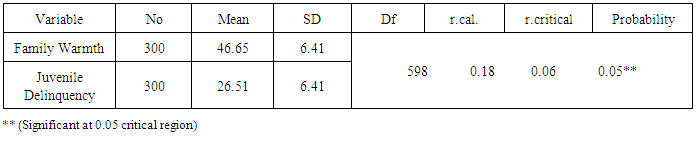
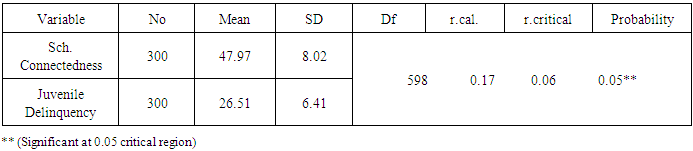
- Hypothesis 1: There is no significant relationship between age and juvenile delinquency. The hypothesis was rejected as the results indicate that there is significant relationship between age and juvenile delinquency. This finding supports [23] who found from their studies that increase in age of participants attracted increase in the rate of delinquency. They infer that as the adolescent grows older he/she has more courage to try out new things, more criminal things and rebellious nature increases.The reasons for this may not be far-fetched. As the child grows up, he/she may become bolder in trying out new things which include delinquent acts, especially if such a child does not have proper and close parental/adult monitoring. He could experiment with anything that catches his/her fancy. Also, the adolescent stage is a phase of ‘storm and stress’. The adolescent may not even have control over what is happening to him/her, he just ‘floats with the tide’. The adolescent just finds himself/herself growing up, increasing in size, in weight, change in voice, in appearance and suddenly he/she is being noticed and probably admired by peers and significant others. All the aforementioned changes without proper monitoring cum explanation could make the adolescent involve in any kind of activity. He/she probably starts with ‘hanging out’ with friends, followed by introduction or initiation into the world of alcohol and drugs. The stage is set for all manner of negative activities. Also at this age, the adolescent becomes argumentative, he/she challenges instructions, authority, rules and regulations, if there is no firm control at this stage, the adolescent may take the delinquent course. Having engaged in one form of delinquent act or the other during adolescence, some eventually age out of delinquency.Hypothesis 2:There is no significant relationship between family warmth and juvenile delinquency among secondary school adolescents in Osun State. The hypothesis was rejected, thus, there is significant relationship between family warmth and delinquency. This finding upholds studies such as [60]; [61]; [62]; [63] who have agreed that the foundation of adolescent delinquency is rooted in the kind of home the adolescent is brought up. There are many reasons that could be attributed to this fact. One of the reasons is economic stress. The economic realities of today are such that both parents have to spend a lot of time outside the home working long hours. The children are left to themselves or at the mercy of housemaids or relatives who themselves need monitoring. The children grow up into adolescents with these surrogates learning a lot of things from them most times negative things. The male surrogates introduce the young girls into immoral acts or the boys into pornography and other vices. The adolescents begin to learn many bad behaviours and acts from those people that their parents had enlisted to take care of the children in their absence.Another reason for this is parental relationships. As a result of the ‘troublesome’ nature of the adolescent phase, many parents ‘go to war’ with their adolescents. The parents cannot just tolerate the unruly behaviour of their adolescent wards, they daily engage in one fight or the other. It could be over the choice of food, friends, fashion, career etc. The adolescent becomes rebellious to whatever the parents wants them to do and if care is not taken, delinquency could arise. The adolescent wants to get back at the parent who is forcing him to do what he does not want to do. Still it could be as a result of having favourites among children. Maybe because of a particular child’s brilliance or special endowment, he/she is given special privileges at the expense of the less performing child, the latter may become delinquent in order to protest the lack of warmth in the family.Also, it could be the family type. It is believed that children from broken homes are generally delinquent. This is not always the case, as experience has shown that even children from intact homes do engage in delinquent acts while the adolescents from so called broken homes, are well behaved. What matters are factors such as love, warmth, acceptance, understanding and discipline of the adolescent which would determine whether the adolescent becomes delinquent or not, though intact families are more preferable in the upbringing of a child.Hypothesis 3:There is no significant relationship between school connectedness and juvenile delinquency among secondary school adolescents in the State of Osun. The research question was rejected as the results indicate that there is significant relationship between school connectedness and juvenile delinquency. This finding supports [35] who reported that school connectedness has been shown to buffer against aggressive behaviour and exposure to violent behaviour. There are various reasons that could be averred for this. When a school environment is conducive, it makes a student connected to the school positively. It enhances academic performance and conformity to the societal rules, regulations and expectations all other things being equal. The thought of being wanted and accepted in the school would propel the adolescent to eschew acts that would be considered inimical to the progress to the adolescent in school, while a non-conducive environment would be a breeding ground for all manner of undesirable behaviours which include: smoking, consumption of alcohol, gang activities and a host of others.School connectedness also enhances good academic performance and achievement. Connectedness involves the student establishing a close relationship with the teachers in school, serious attention to class work and assignments, asking questions in class and answering questions and cooperation with other members of the class. All the aforementioned variables put together keep the adolescent out of trouble.Sporting activities could also be a factor that enhances school connectedness in adolescents. When the school encourages healthy sporting activities both in-door and out-door, the adolescent’s mind is shifted away from nefarious acts. Instead the dominant thought would be how to beat the opponent and clinch the prize/trophy to be given out to winners. Not only that, it could also be a way by which a means of livelihood would be discovered by the adolescent rather than he/she becoming a vagabond or nuisance to the community.
5. Conclusions
- The influence of age, family warmth and school connectedness cannot be overemphasized when adolescent delinquent behavior is being addressed. The family has got a very important role to play at ensuring that the adolescent does not go astray. Parents should realize that the task ahead of them in nurturing an adolescent into a decent adult. But with determination and commitment, the adolescent would come out as desirable. Also, the teachers in the school are not left out in the battle against delinquency as it is also a source of concern to the school when adolescents engage in activities that are not expected of adolescents. Therefore, there should be a combined effort from parents, teachers, counseling psychologists and school counsellors at ensuring that the adolescents sail through the stage with minimal disruptions. It is a stage that must be handled with care or else, the battle would be lost.
ACKNOWLEDGEMENTS
- The authors acknowledge the unflinching support of their better halves: Achitect Abayomi Aremu and Princess Veronica Oluwatoyin Animasahun. May the Lord strengthen our love and prolong our lives so as to reap the fruit of our labour in Jesus Name, Amen.