
-
Paper Information
- Previous Paper
- Paper Submission
-
Journal Information
- About This Journal
- Editorial Board
- Current Issue
- Archive
- Author Guidelines
- Contact Us
International Journal of Psychology and Behavioral Sciences
p-ISSN: 2163-1948 e-ISSN: 2163-1956
2013; 3(6): 157-162
doi:10.5923/j.ijpbs.20130306.03
Perspectives and Practices of Suspension as a Tool Modifying Disruptive Behavior: The Case of four Universities
 Abstract
 Reference
 Full-Text PDF
 Full-text HTML
Ewnetu Hailu Tamene
Institute of Education and Professional Development Studies, Jimma University: Jimma, Ethiopia
Correspondence to: Ewnetu Hailu Tamene, Institute of Education and Professional Development Studies, Jimma University: Jimma, Ethiopia.
| Email: |  |
Copyright © 2012 Scientific & Academic Publishing. All Rights Reserved.
Suspension is commonly used as a tool modifying disruptive behavior while controversial concerns on its efficacy and implementation. This study intended to explore implementers’ perspective as well as to inform strategic thinking by showing common practices and gaps among participating universities on student’s discipline management. Total of 55 participants from four purposely selected universities were involved. Members of student union, university police; student service directors/deans/ of universities were key informants. To fully understand the real sense and meaning of suspension, from within: off campus students due to suspension and students on campus after suspension were also participants, through snow ball data collection technique. Qualitative multi case study method is employed in which in depth interview and FGD and document analysis were used data tools. Findings show that suspension is perceived as warning, temporary relief and necessary evil. It is imposed to maintain peace and security and to care for the majority. At the same time it is described as damaging, that expose to more serious behavioral and psychological chaos. It is also evident that there is no practice of communicating parents to link the suspended students. There seems nobody responsible for what happen to the suspended student outside the university once s/he suspended.
Keywords: Suspension, Disruptive Behavior, Punishment
Cite this paper: Ewnetu Hailu Tamene, Perspectives and Practices of Suspension as a Tool Modifying Disruptive Behavior: The Case of four Universities, International Journal of Psychology and Behavioral Sciences, Vol. 3 No. 6, 2013, pp. 157-162. doi: 10.5923/j.ijpbs.20130306.03.
Article Outline
1. Introduction
1.1. Background
- This article is part of ongoing study on university students discipline management, focusing on suspension as administrative tool modifying disruptive behavior. In Ethiopian public higher education institutions, suspension have been used as tool modifying disruptive behavior & implemented as it has been used for decades while there are many instances that forces one to pauses question on its effectiveness.Since 1994, the current Ethiopian Education and Training policy, the number of Higher Education Institutions and access to higher education dramatically increased from four to 31 public universities, though the gap between need and supply in not filled yet. Long experience shows students at the completion of senior secondary school, who fulfill the university entrance requirement, are centrally assigned to all Universities by Ministry of Education following long lived practice. Due to the historical, social and cultural context of the country the increase of the diversity in the university community became natural development. This, above all calls for caring peace and security for building and maintaining peaceful co-existence and creating conducive learning environment in the university.Hence, ‘all universities’ have standard administrative policy that comprises the students’ code of conduct that promote and protect the rights of students and the university community at large. Accordingly, students who violets these standards will be subjected to the disciplinary sanctions in order to promote his/her own personal development to protect the university community, and to maintain order and stability on campus.The standards of conducts expected of students are explicitly explained with minor contextual difference in the student’s code of conduct of the participating universities. Suspension, as one of the disciplinary measures, aiming at reducing the opportunity of reinforcement for the behavior and provides a period of respite between the incident and the resolution process. It is assumed that suspension provides opportunity not only to the student, but also, the parents, and university management staff to reflect on the incident and behavior to have time for positive resolution and re-entry plan. There is no argument that Universities has to have sound disciplinary standard to foster and maintain sustainable learning. However there are ongoing arguments that suspension come up with unexpected results that it may break down the relationships between the student, parents and university unless the resolution process is effectively managed. Whatever the disciplinary measure it is, experience and a report from universities show that the number of indiscipline students with disruptive behavior and the types of behavior increases from time to time. Consequently the number of students suspended from university is increasing particularly due to repeated behavior. Common experiences of all public universities in Ethiopia shows managing students’ code of conduct and handling students’ disciplinary issues are one of the student affair’s (student deans) responsibilities. Under the office of student affairs, student discipline is handled little differently from university to university. For instance, Jimma University, Adama University and Wallaga University formed a committee from various sections of the university structure-student council (union), campus police, and gender office and the committee is chaired by student dean or student service director. While Hawasa University established students discipline team, whose sole responsibility is to manage students discipline issues to some extent proactively and the team is accountable to student dean.The impetus of this study emerged from these practical challenges as well as my professional and official query. Professionally, I call myself practitioner researcher, though novice; and ask ‘what can I do to improve, the practice that continues to resolve disputes the way it have been done for decades. Officially, I am director for students’ services of Jimma University, chairperson for students discipline committee who is responsible for student’s code of conduct management. I feel responsibility both from professional and official point of view.In 2010, while our committee was doing usual duty, a student who returned to the university after one year on suspensions, came again accused with the same behavior that would expel him for good from the University. The moment he entered the room and described what happed exactly similar with what had happened before a year and left. Right after he left the room, I raised abrupt and pity questions ‘why we suspend if the behavior is not improved? What is the purpose of suspension? The questions, unfortunately turned out to heated debate.It was that moment; I learnt that we, committee members, hold different expectations and understanding of the purpose of suspension in particular and student’s code of conduct in general. It was like ‘aha’ spot that I decided to explore perceptions and practices of similar people in other universities.This study therefore, focused on three closely interrelated aspects of the disciplinary practice in the University. First, it investigates participants’ perspectives of suspension as administrative tool for modifying disruptive behavior and reasons for suspending from university. Second, the efficacy of suspension is explored from participants’ perspectives. Finally it examines practices on students discipline management.
2. Review of Literature
2.1. Discipline
- Discipline is defined as the practice of making people obey rules of behavior and punish them if they do not. As to[1] discipline is necessary condition for effective action in the social world, on the other hand[2] argues that discipline is a repressive operation by which individuals are seasoned into productive labor... common element between these two scholars lie the intention of teaching. Although school discipline has increasingly come to be associated in the public mind with the use of punishment and exclusion[3] there are a number of important instructional and organizational purposes to any school disciplinary system:ü Ensuring the safety of students and teachersü Creating a climate conducive to learningü Teaching students needed skill for successful interaction in school and society andü Reducing rates of future misbehavior, (Skiba & Rausch 2004 in[5]Charles,[4] argues that the aim of discipline is not merely to chastise students but to cause them to internalize self-discipline and display it and also to reduce the intervention by helping students learn to control their own behavior. The student’s code of conduct in the participating universities in one way or another affirms the importance of these arguments.
2.2. Punishment
- Punishment is a term used in behavioral psychology to refer to any change that occurs after a behavior that reduces the likelihood that that behavior will occur again in the future (Alberto &Troutman, 2003; Driscoll, 2000; Maag, 2001; Skinner, 1953 in[5]. Arguably, it is difficult to label students code of conduct to positive or negative punishment due to the prescience of both elements. The introduction of students’ code of conduct and the consequence at the violation of it can be assumed as positive punishment while depriving one’s right to the University for specified period of time can be assumed as negative punishment. Suspension is the act of removing a student from the university who violates students’ code of conduct, to maintain safe learning environment and to deter others from similar behavior.[6] define suspension one of the description of zero tolerance. Many schools adopt the disciplinary philosophy of zero tolerance since early 1990, with the increase incidence of campus violence[7].Although there are arguments on the effectiveness of zero tolerance assumes removing students who engage in disruptive behavior will maintain a safe learning environment as well as deter others from disruption. In this light there are a number of important purposes for school discipline that are associated to zero tolerance:ü A belief the deterrent function of school punishment; an implied purpose of severe punishment is the deterrent effect on others who may witness that punishment[7]. They further argues that zero tolerance ‘apparently denounce violent student behavioral no uncertain terms and serves as a deterrent to such behavior in the future by sending a clear message that acts which physically harm or endanger others will not be permitted at school under any circumstancesü Remove trouble makers in order to improve the school climate for others; central to the idea of suspension and expulsion is the notion that removing the most persistently disruptive students will lead to substantial improvement in the learning climate for othersü What happens if we don’t punish? This assumption the inverse of a belief in the deterrent capability of punishment. It suggests that the failure to punish misbehavior sufficiently will send message that school is not serious enough about safety[8]On the other hand studies show that punishment instead of curbing the behavior can aggravate it[9]. Punishment does not discourage misbehavior but rather reinforces the pupils’ view of adults as treacherous” McManus, 1995 in[10].
2.3. Disruptive Behavior
- Misbehavior as defined by[4] is an intentional behavior that is considered in appropriate for the setting or situation in which is it occurs. He further codified such behavior in five categories: aggression, immorality, defiance of authority, class disruption and goofing off. Disruptive behavior in schools is the inevitable manifestation of increased violence, or at least of increased reporting of violence, in the world as a whole[13]Despite the increase in the use of suspension, the experience in the university has yet not been able to establish evidence that –suspension reduces the frequency of the misconduct. Furthermore,[12] stated that suspension proved to be an ineffective punishment in curtailing inappropriate behavior. In addition, other research examined the effects of suspension and found that there are higher rates of dropping out of school, engaging in drug abuse and delinquency for those students who have been suspended[14];[15].Although students code of conduct of all universities clearly articulates that any punishments including suspension aimed at supporting the student to improve the unwanted behavior practically the process and implementation is combating, and punitive not redemption in nature[11]. They further argue that restorative discipline can enhance supporting students in curbing the behavior as well as create conducive situation for healing the wound.
3. Research Design and Methodology
3.1. Research Design
- As the aim of the study is to understand how students, university managers make meaning pertaining to suspension, the type of inquiry lends itself to a qualitative approach that is aligned with interpretive theory. To maximize richness and accuracy of data, multiple case studies are carried out in which in depth interview is major method of data collection.
3.2. Participants
- A total of 55 individuals were involved from four universities. Jimma, Adama, Hawasa and Wellega Universities were purposefully selected due academic programs, economic and social situations and establishment. Wallaga is one of the newly established universities with easy access and Adama University is selected due to its technology oriented curriculum. Key informants (Participants): members of students’ councils of all participating universities, who have experience in discipline management minimum of one year, are selected. Student service directors/deans, chairing discipline committee are chosen key participants of the study. Addition, head of university campus police are included due to their experience for university security and also sit in the discipline committee. Students on suspension and returned students to the university after suspension for some times are included in the study with the snow ball technique. All participants purposely selected based on their rich experiences on the issue under discussion.
3.3. Data Collection and Analysis
- Each participant received a letter outlining the research topic and a consent form for their records. Then consent of all participants was secured in written form and each participant’s interview response is tape-recorded by permission. All individual oral interviews and FGD with participants from university administration and students representatives were held in their respective offices, while with returned and on suspension students it is held outside university campus to make respondents comfortable. Finally data is coded organized and analyzed independently within the case and across cases. After the data from in depth interview is coded, organized, and themes emerged, focused group discussion (FGD) is held to confirm or refute the theme at each case. This is to prove the trustworthiness of the data, and theme emerged and to check if I captured the information correctly. It is also to rectify the individual data with the group opinion. All the data and themes emerged are confirmed right. Finally, the findings from cross case analysis found similar then an example is presented for simplicity and clarity. Students code of conducts and other documents related to student’s disciplinary issues were used data source. All transcripts, notes and audiotapes are kept secret.
3.4. Participants Profile
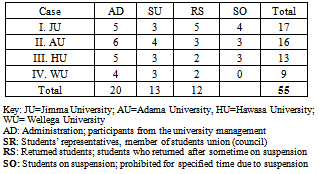
4. Presentation of Findings
4.1. Findings from In-Depth Interview
4.1.1. Perceptions and Reasons of Suspension
- Q1. How do you define ‘suspension’?
4.1.2. Efficacy of Suspension
- Q3. How do you evaluate the efficacy of suspension with regard to its effect?
|
4.2. Common Practice among Participating Universities
- According to students code of conduct, suspension is determined based on the degree of guilt, taking into account disposition of the wrong doer, his/her antecedents, motives and purpose as well as the seriousness of the misconduct and manner and circumstances. The procedure of suspension is similar except slight differences on investigating and handling the issues.Hence the suspended student is forced to leave campus right after the decision is made whoever he/she is. S/he has no right to stay in premises of the university up to the completion of the suspension period. Then apply for readmission right at the end of suspension to start over from the semester he/she stopped. AD participants assume responsibility only on campus, and student representatives share the feeling that they are representing students who are in the system of university. From experience and from these participants it found that there is no ways to link suspended with parents, and no mechanism is devised as to follow where about the suspended students during the time of suspension. One of my participants described the situation as “I was suspended for two years. I have passed one year in the campus, hiding myself from campus police, and left for Addis Ababa and stayed in ‘Gojam Berenda’, one of the busiest area of Addis Ababa, for the rest one year… do not ask how I lived…” RS4.On readmission the returned students start over not only academic issue but also life in the university which was interrupted by the suspension. It is the student who should find his/her way to the campus life and adapt to the probably new situations- new dormitory friends and others. There is no restorative practice to heal psychological and sociological damage happened to the behavior. Contrary to restoration there is discriminations and labeling returned students complained. Some of them describe the situation as “In any case if you appear any officer, particularly campus police, who knew about your past history the first word you hear is, the behavior that you had punished for, that you never wanted to hear about…”RS1
4.3. Discussion
- Participants defined suspension as warning and necessary evil. These agree with[9] who argues that serve as a deterrent to such behavior in the future sending clear message… Their description as necessary evil shows that the importance of protecting the university as well as unintended consequence suspension might have. In support of this,[9] studies show punishment instead of curbing the behavior can aggravate it, punishment does not discourage misbehavior rather it reinforce. It is found that returned students believe that suspension as frightening decision that left them discriminated and fearful on campus. Instance was given that they are labeled with the behavior. AD and SR Participants assume responsibility to protect the university and the majority in the university. In doing this, the suspended student is forced to leave the university without any precondition and discrimination. There is no way to link them with family or guardian. This practice exposes them for more serious behavior which agrees with[7].It is also evidenced that there is no restorative practice that could put one in the right track psychologically socially or academically. Some of them find difficult to find where to star new life, finding new friends. In some instances they are discriminated and verbally assaulted because of their misconduct of sometimes in the past.
5. Conclusions
- One of the most important finding of this study is that there is no conceptual and practical difference among the participants of all cased that dictate common concern1. Any disciplinary practice should serve its main intent: protecting the right of the majority and maintain peaceful learning and teaching situation as well as supporting the student in modifying the disruptive behavior that expose him/her to suspension. 1.1. To this effect the university management needs to work closely with the government officials to minimize external factors that have negative role to the welfare of life in the university.1.2. university management need to closely work with surrounding community in creating common understanding in producing responsible citizen and how to maintain well protected university environment.1.3. There should be mechanisms by which the behavior will be punished, not punishing him/her by putting in difficult circumstances. To this effect, I recommend professional members of the committee with psychology or counseling background. 2. As universities are one of the institutions in the given society need to share concern for what happened in the community, there should be mechanism in which universities inform the family as well as the surrounding community through the administrative structure that a student is suspended and going to stay leave the campus. 3. After suspension/on the arrival/, there should be restorative practice to make sure that he/she finds the right way to adapt with new friends, new dormitory and other changes in the university. It is like creating conducive environment by erasing the feeling of guilty from their mind that have supportive role in curbing the behavior.4. Students code of conduct should focus on proactive measures, like clearly articulating right and responsibilities, and making sure that the message is well understood by the majority at regular bases. 5. Practically, students discipline management is responsibility that shouldn’t be handled by committee meeting at the point of the problem. Rather it should be carried out basically by professionals from relevant disciplines like: law, counseling and psychology and psychiatry at regular basis. Finally investigated and confirmed issues could be presented to the discipline committee established by the university.
References
| [1] | P. Freire, Pedagogy of Freedom:Ethics, democracy and civil courage, Lanham: Rowman & littlefield,1998. |
| [2] | M.Foucalt, Discipline and punish: the birth of Prison. New York. Vintage Books,1995. |
| [3] | R. Skiba & R. Peterson , The dark side of zero tolerance: Can punishment lead to safe schools? Delta Kappan, 1999. 80, 5, 372 – 376. |
| [4] | C.Charles, Discipline in schools: The Birth of Prison, New York: Vintage Books, 1998. |
| [5] | M. Evertson, Zero tolerance, suspension and expulsion:question of equity and effectiveness, Lawerence: Erlbaum Associates Publishers, 2006. |
| [6] | R.Skiba. Zero tolerance and alternative discipline strategies. Indiana University. Bloomington,2006. |
| [7] | P.A.N.Noguera, "Preventing and Prodicing Violence: A critical analysis of Responces of School violence," Harvard Education Review, pp. 289-212, 1995. |
| [8] | C.L.Larson & C.J. Ovado , "Racial Conflict in Divi ded Community: an Illustrative Case Study of Soci Political conflict," Belmont, pp. 31-60, 2001. |
| [9] | R. Driekurs, Maintaining Sanity in the Classroom, Philadelphia, 1998 |
| [10] | E. Nakopodia, "Teachrs Disciplinary Approach to Students Discipline Problems in Nigeria Secondary scholls," International NGO Journal vol.5(6), pp. 144-151, 2010. |
| [11] | R.Claassen & Zenebe.A., "Restorative Dioscipline at Fresno Pacific University," ACResolution Magazine,, p. Vol.6 issue 3, 2007. |
| [12] | M.S. Atkins et, al,). “Suspensions and detentions in an Urban, low- Income school: Punishment or reward?” Journal of Abnormal Child Psychology, 2002, 30, 4, 361-371. |
| [13] | Galloway, D., Ball, T., Blomfield, D., & Seyd, R., (1982). Schools and disruptive pupils. Essex, UK: Longman Group Limited |
| [14] | Kilpatrick, R., (1998). Exclusion from school: The Why and Wherefore, Paper presented at British Educational Research Association Annual Conference. Retrieved June 2, 2012, from http://www.leeds.ac.uk/educol/documents/000000913.htm |
| [15] | V.Schiraldi & J. Ziedenberg, Schools and Suspensions, Self-reported crime and the growing use of suspensions. Washington, 2001. |