
-
Paper Information
- Paper Submission
-
Journal Information
- About This Journal
- Editorial Board
- Current Issue
- Archive
- Author Guidelines
- Contact Us
International Journal of Materials and Chemistry
p-ISSN: 2166-5346 e-ISSN: 2166-5354
2026; 16(6): 117-120
doi:10.5923/j.ijmc.20261606.01
Received: Sep. 28; Accepted: Oct. 16, 2026; Published: Oct. 23, 2026

Physicochemical Regularities of the Decomposition of Aznek Deposit Phosphorites Depending on Sulfuric Acid Concentration
 Abstract
 Reference
 Full-Text PDF
 Full-text HTML
Kudiyarova Ayimxan Abdijabbarovna1, Nurmurodov Tulkin Isomurodovich2, Erkaev Aktam Ulashovich3, Reymov Axmed Mámbetkarimovich4
1Doctoral Student, Karakalpak State University, Uzbekistan
2Vice-Rector for Research and Innovation, Professor of Technical Sciences, Department of Chemical Technology, Navoi State University of Mining and Technologies, Uzbekistan
3Professor of the Department of Technology of Inorganic Substances, Doctor of Technical Sciences, Tashkent Institute of Chemical Technology, Uzbekistan
4Academician, Professor of Technical Sciences, Chairman of the Karakalpakstan Branch of the Academy of Sciences of Uzbekistan
Copyright © 2026 The Author(s). Published by Scientific & Academic Publishing.
This work is licensed under the Creative Commons Attribution International License (CC BY).
http://creativecommons.org/licenses/by/4.0/

This study investigated the acid activation process of phosphorite raw material from the Aznek deposit (Central Kyzylkum basin) using sulfuric acid at various concentrations (30%, 40%, and 50%) and application rates ranging from 10% to 100% of the stoichiometric requirement. The process was conducted at 70°C for 30 minutes, and the resulting products were analyzed for pH, mass changes, and the dynamics of total, assimilable (in 2% citric acid), and water-soluble forms of P₂O₅ and CaO. Experimental results indicate that increasing the acid concentration reduces the amount of water introduced into the system with the reagent, thereby decreasing mass loss during drying from 43.49% (with 30% acid) to 23.40% (with 50% acid). When the acid application rate reached 100%, the phosphorus assimilability ranged from 90.52% to 98.17%. These results enable the selection of optimal technological parameters for producing simple phosphate fertilizers from low-grade Aznek phosphorites.
Keywords: Aznek phosphorite, Sulfuric acid, Acid concentration, Decomposition, Assimilable P2O5, CaO content, Hydrogen ion concentration (pH)
Cite this paper: Kudiyarova Ayimxan Abdijabbarovna, Nurmurodov Tulkin Isomurodovich, Erkaev Aktam Ulashovich, Reymov Axmed Mámbetkarimovich, Physicochemical Regularities of the Decomposition of Aznek Deposit Phosphorites Depending on Sulfuric Acid Concentration, International Journal of Materials and Chemistry, Vol. 16 No. 6, 2026, pp. 117-120. doi: 10.5923/j.ijmc.20261606.01.
Article Outline
1. Introduction
- Meeting the demand of our republic's agriculture for phosphorus fertilizers makes the deep processing of local low- and medium-grade phosphorite raw materials a priority task. The phosphorites of the Aznek deposit, located in the Navoi region, have a distinctive mineralogical structure and are characterized by a high content of calcium carbonate and siliceous compounds. Processing such raw material into phosphoric acid by the traditional extraction method entails high acid consumption and technological difficulties. Obtaining simple phosphate fertilizers by direct sulfuric acid decomposition of low-grade phosphorites is a low-waste and economically efficient approach [1,3]. However, the depth of the decomposition process, the rheology of the resulting pulps, and the distribution of phosphorus forms in the product depend directly on the concentration of the acid and the rate applied. The degree of dilution of the sulfuric acid solution changes the liquid-to-solid phase ratio in the system, which in turn affects the crystallization kinetics of calcium sulfate dihydrate and the acid–base balance of the reaction mixture. The aim of this study is to carry out a comprehensive physicochemical analysis of the decomposition of Aznek phosphorites under the action of 30%, 40% and 50% sulfuric acid and to determine the regularities of changes in acidity (pH) and of the formation of phosphorus and calcium forms [2,6].
2. Materials and Methods
- Raw material and reagents: Aznek deposit phosphorite ore was taken as the object of study. First, the phosphorite samples were crushed and passed through a sieve with a 0.5 mm mesh. Purified sulfuric acid (H2SO4) solutions with concentrations of 30%, 40% and 50% were used as the reagent. Research methodology: For each experiment, a 100 g sample of phosphorite that had been passed through a 0.5 mm sieve was weighed out. According to the stoichiometric calculation, the acid rate was increased from 10% to 100% (in 10% steps). The reaction was carried out in a laboratory reactor equipped with a water bath, using a constant-speed glass stirrer, at 70 °C for 30 minutes. After the reaction, the mass of the resulting pulp was measured, and it was dried at 60 °C to constant mass. The finished dry product was ground again and passed through a 0.5 mm sieve [4]. Analytical methods: Physicochemical parameters: A 10% aqueous suspension of the obtained products was prepared, and its hydrogen index (pH) was measured at 27 °C with a laboratory pH meter [9]. Chemical analyses: The total P2O5 and CaO, as well as the fractions soluble in 2% citric acid (assimilable) and the water-soluble fractions in the dry product, were determined by standard photocolorimetric and complexometric (trilonometric) analytical methods. All measurements were repeated 3 times and the average values were taken [5,9].
3. Results and Discussion
3.1. Mass Balance of the Reaction System and Dynamics of the Hydrogen Index (pH)
- The concentration of sulfuric acid directly determines the volume of process water introduced into the system. The studies showed that when the acid concentration is increased from 30% to 50%, at the 100% acid rate the wet mass decreases from 313.68 g to 223.20 g, and the mass loss on drying decreases from 43.49% to 23.40%. This shows the possibility of saving the thermal energy spent on evaporation when concentrated solutions are used. The acidity of the reaction system changes depending on the acid rate and concentration. In the weakly acidic range (10–30% rate), the pH drops sharply: from 6.10 to 3.67 with 30% acid, from 5.75 to 3.54 for the 40% solution, and from 5.55 to 3.32 for 50%. At this stage, the acid is consumed primarily to neutralize the mobile calcite (CaCO3) and dolomite minerals present in the phosphorite [9,10]:
 | (1) |
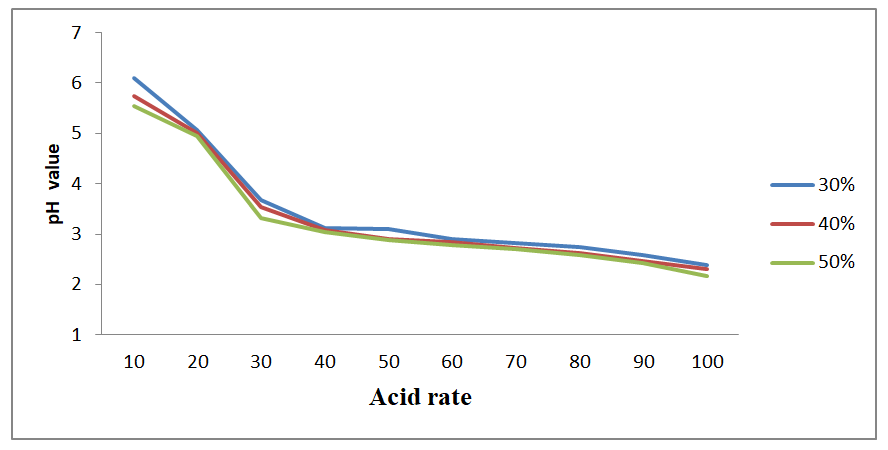 | Figure 1. Graph of the dependence of the pH of the reaction system on acid rate and concentration |
3.2. Regularities of the Conversion of Phosphorus and Calcium Compounds
- As the amount of acid increases, a decrease in the total P2O5 content in the dry product is observed. This phenomenon is associated not with a loss of phosphorus but with an increase in the mass of heavy calcium sulfate dihydrate (CaSO4·2H2O) in the system (expansion of the ballast mass). Table 1 presents comparative indicators of the phosphorus and calcium forms in the product at different acid concentrations (using the main technological points of 10, 50 and 100% rates as examples). The analysis of the results shows that when 40% and 50% acid solutions are used, at intermediate rates (50% rate) the amount of assimilable phosphorus is significantly higher than with 30% acid (57.77% and 53.88% versus 39.46%, respectively). This is explained by the high acid activity in the initial stages of the acid decomposition reaction at higher concentrations [7,9].
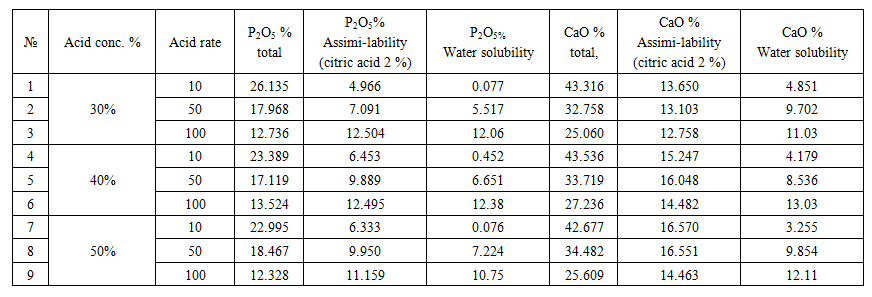 | Table 1. Comparative indicators of Aznek phosphorite products treated with H2SO4 solutions of different concentrations |
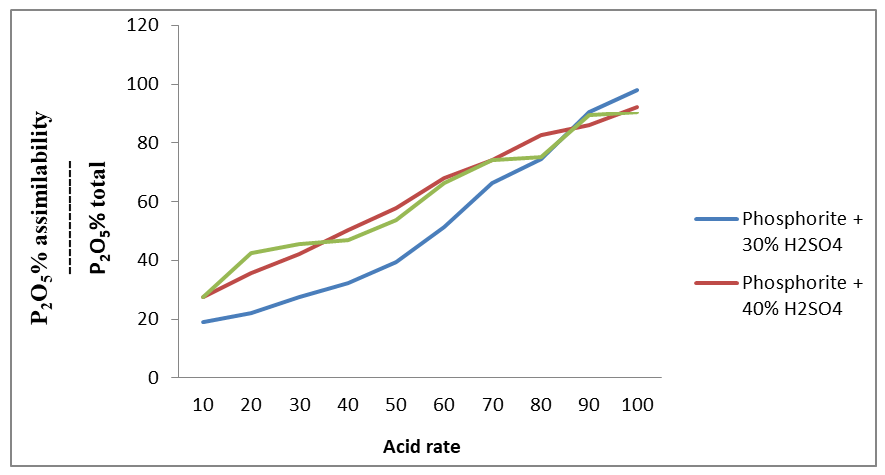 | Figure 2. Ratio of assimilable P2O5 to total P2O5 in the fertilizer |
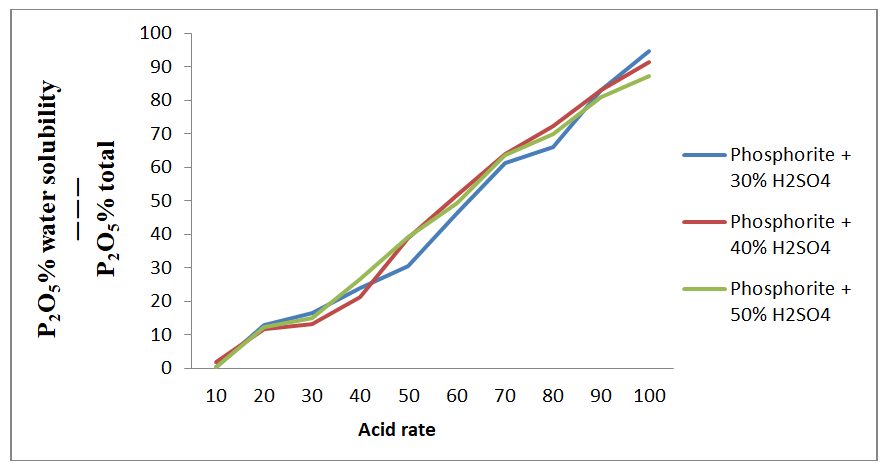 | Figure 3. Ratio of water-soluble P2O5 to total P2O5 in the fertilizer |
4. Conclusions
- 1. The physicochemical parameters of the decomposition of Aznek deposit phosphorites with 30%, 40% and 50% sulfuric acid were studied, and the effect of acid concentration and rate on product yield and composition was determined. 2. It was demonstrated that increasing the acid concentration from 30% to 50% reduces the mass loss during pulp drying from 43.49% to 23.40%, which makes it possible to reduce thermal energy consumption. 3. In terms of the formation of assimilable P2O5, the 40% sulfuric acid solution is considered optimal: at a 100% acid rate it yields 92.39% assimilable and 91.60% water-soluble phosphorus. 4. The relative assimilability of calcium in the obtained product is 50.90–56.48%, which forms the basis for developing a technology for producing simple phosphate fertilizers that are effective in increasing the fertility of acidic soils.