
-
Paper Information
- Paper Submission
-
Journal Information
- About This Journal
- Editorial Board
- Current Issue
- Archive
- Author Guidelines
- Contact Us
International Journal of Materials and Chemistry
p-ISSN: 2166-5346 e-ISSN: 2166-5354
2026; 16(5): 100-102
doi:10.5923/j.ijmc.20261605.02
Received: Sep. 8; Accepted: Sep. 29, 2026; Published: Oct. 10, 2026

Study of Adsorption–Desorption Isotherms and Pore Structure of an Inorganic Polymer Sorbent Derived from Local Clay
 Abstract
 Reference
 Full-Text PDF
 Full-text HTML
Gulmira Turaliyevna Mustafayeva1, Firuza Gayratovna Rakhmatkarieva2, Mansur Saburovich Khudayberganov3
1Doctoral Researcher, Namangan State Technical University, Namangan, Uzbekistan
2Doctor of Chemical Sciences, Senior Researcher, Institute of General and Inorganic Chemistry, Academy of Sciences of the Republic of Uzbekistan, Tashkent, Uzbekistan
3PhD in Chemistry, Chirchiq State Pedagogical University, Chirchiq, Uzbekistan
Correspondence to: Gulmira Turaliyevna Mustafayeva, Doctoral Researcher, Namangan State Technical University, Namangan, Uzbekistan.
| Email: |  |
Copyright © 2026 The Author(s). Published by Scientific & Academic Publishing.
This work is licensed under the Creative Commons Attribution International License (CC BY).
http://creativecommons.org/licenses/by/4.0/

In this article, the porous structure of an inorganic aluminosilicate polymer sorbent, synthesized from local clay using the sol-gel method, was investigated via low-temperature nitrogen adsorption-desorption at 77 K. The specific surface area was determined using the BET method, while the pore size distribution was calculated based on Density Functional Theory (DFT). The isotherm resembles a Type IV classification according to IUPAC standards, characterized by a wide hysteresis loop and low-pressure hysteresis. The material exhibited a specific surface area of ≈32 m²/g and a total pore volume of 0.0186 cm³/g. The DFT distribution is bimodal in nature, showing primary pore widths of ≈1.9 nm (supermicropores) and ≈3.6 nm (mesopores). The pore volumes determined via DFT and adsorption data are consistent with each other.
Keywords: Inorganic polymer, Aluminosilicate sorbent, Nitrogen adsorption, BET, DFT, Pore structure, Pore distribution, Hysteresis, Specific surface area
Cite this paper: Gulmira Turaliyevna Mustafayeva, Firuza Gayratovna Rakhmatkarieva, Mansur Saburovich Khudayberganov, Study of Adsorption–Desorption Isotherms and Pore Structure of an Inorganic Polymer Sorbent Derived from Local Clay, International Journal of Materials and Chemistry, Vol. 16 No. 5, 2026, pp. 100-102. doi: 10.5923/j.ijmc.20261605.02.
1. Introduction
- The specific surface characteristics, porosity parameters, and specific pore volume of inorganic polymer sorbents derived from local raw materials are among the key factors determining their sorption properties [1]. While pore size and pore-size distribution govern the diffusion rate of substances within the porous structure, analysis of the specific pore volume is essential for evaluating the physicochemical properties of inorganic polymer sorbents [2].To prepare the inorganic polymer sorbent, local clay was first treated with 1 M sulfuric acid at a solid-to-liquid ratio of 1:5 at room temperature for 2 h. The acid-treated clay was then washed with distilled water until neutral conditions were reached, followed by treatment with 3 M NaOH solution at a ratio of 1:3 at room temperature for 4 h [3]. The textural properties of the pristine clay and the resulting sorbent were investigated from nitrogen (N₂) adsorption–desorption isotherms measured at 77 K. Prior to analysis, a 0.0882 g sample was degassed under vacuum at 120 °C for 2 h 56 min. Adsorption and desorption isotherms were recorded over the relative-pressure range P/P₀ = 0.03–0.99.The specific surface area (SBET) was calculated using the Brunauer–Emmett–Teller (BET) equation from adsorption-branch data in the P/P₀ = 0.05–0.30 range [4]:
 | (1) |
 | (2) |
 | (3) |
 | (4) |
 | (5) |
 | (6) |
2. Results and Discussion
- The nitrogen adsorption–desorption isotherms of the inorganic polymer sorbent at 77 K are presented in Figure 1. The adsorption branch does not exhibit a sharp increase in the low-relative-pressure region (P/P0 < 0,1); thus, no distinct stage characteristic of volumetric filling of micropores is observed. As the relative pressure increases, the adsorbed nitrogen volume increases almost linearly and approaches saturation at approximately 8 cm³ g⁻¹ at P/P0 ≈ 0,9. The maximum adsorption value (≈8.1 cm³ g⁻¹) is relatively low, indicating limited overall porosity of the material.
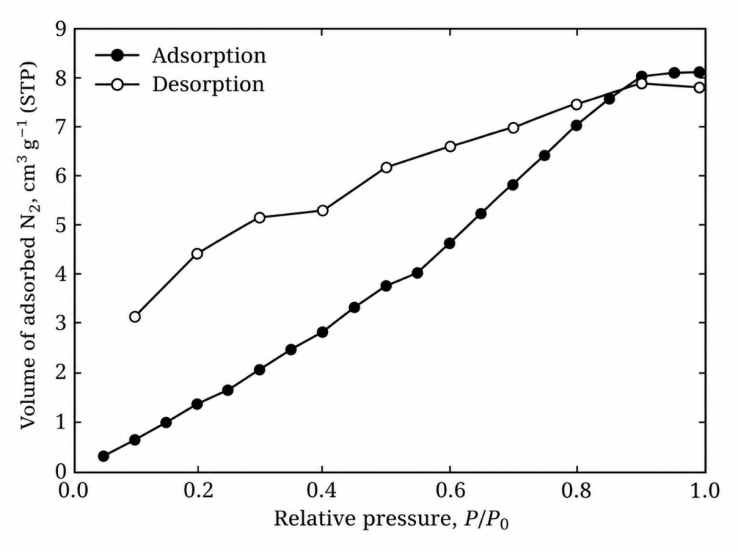 | Figure 1. Nitrogen adsorption (●) and desorption (○) isotherms of the inorganic polymer sorbent at 77 K |
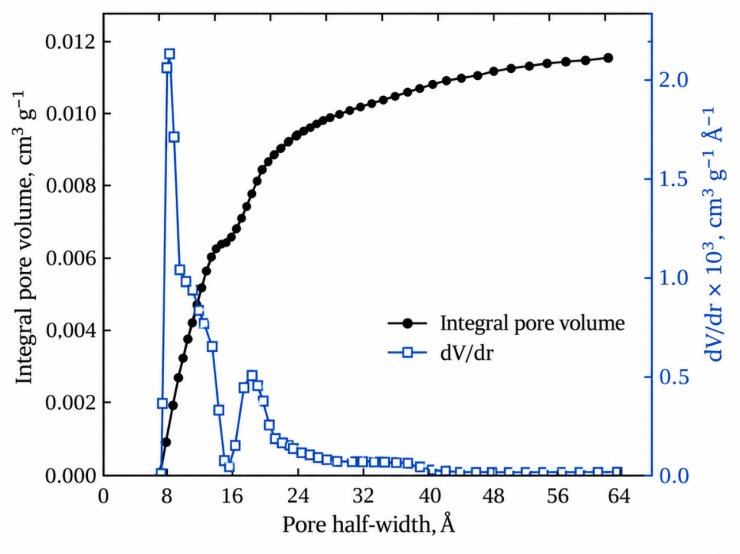 | Figure 2. Integral (●) and differential (□) pore-volume distributions of the inorganic polymer sorbent determined by DFT |
|
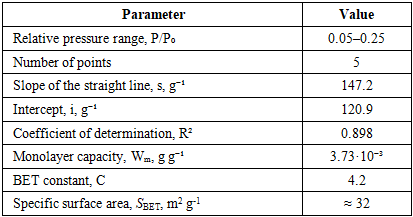
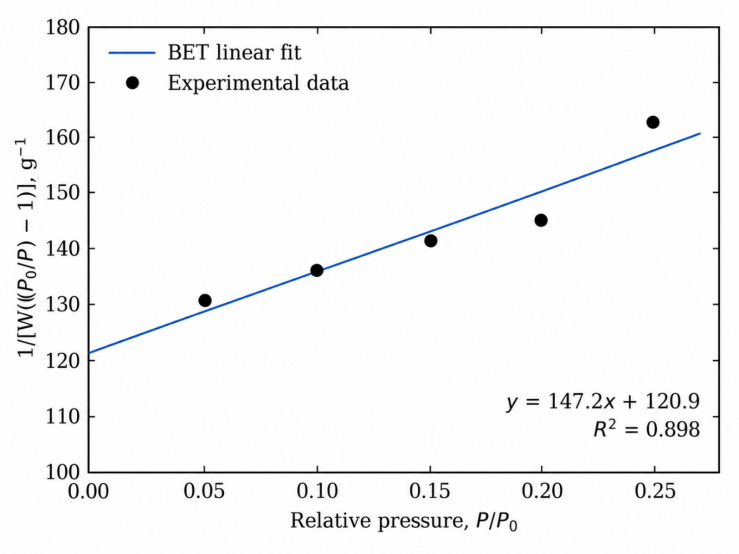 | Figure 3. Multipoint BET plot for the inorganic polymer sorbent |
3. Conclusions
- Mesopores in the 15–20 nm range were retained most prominently, which is considered an optimal range for ion exchange and diffusion. The modification preserved the overall pore volume while promoting the formation of active sites for ion exchange. The predominance of mesopores in the 10–20 nm range provides a scientific basis for the high sorption performance of the inorganic polymer sorbent.