International Journal of Materials and Chemistry

p-ISSN: 2166-5346    e-ISSN: 2166-5354

2026;  16(5): 89-99

doi:10.5923/j.ijmc.20261605.01

Received: Sep. 3; Accepted: Sep. 28, 2026; Published: Oct. 10, 2026


Heterogeneous Photocatalysis Based on Titanium Dioxide (TiO2) for Sustainable Industrial Effluent Remediation

Marcellin Randrianantenaina1, Mahandrimanana Andrianainarivelo2, Christian Andriamiadamanana1

1Laboratoire de Chimie Physique Appliquée, Université d’Antananarivo, 101, Madagascar

2Laboratoire de Chimie des Matériaux et de Chimie Minérale, Université d’Antananarivo, 101, Madagascar

Correspondence to: Marcellin Randrianantenaina, Laboratoire de Chimie Physique Appliquée, Université d’Antananarivo, 101, Madagascar.

Email:

Copyright © 2026 The Author(s). Published by Scientific & Academic Publishing.

This work is licensed under the Creative Commons Attribution International License (CC BY).
http://creativecommons.org/licenses/by/4.0/

Abstract

Water, an essential resource for human activities, is increasingly threatened by pollution. In order to solve the increasingly serious environmental, the development of highly efficient heterogeneous photocatalysts has attracted a great deal of attention in recent years focused on semiconductor based photocatalysts for pollutant degradation. Titanium dioxide (TiO₂) is a semiconductor photocatalyst with a wide range of applications. The purpose of this literature review is to undertake a thorough comparative assessment of the diverse polymorphs of titanium dioxide, alongside prospective alternative materials, within the domain of heterogeneous photocatalysis.

Keywords: Photocatalysis, Heterogenous and titanium dioxide

Cite this paper: Marcellin Randrianantenaina, Mahandrimanana Andrianainarivelo, Christian Andriamiadamanana, Heterogeneous Photocatalysis Based on Titanium Dioxide (TiO2) for Sustainable Industrial Effluent Remediation, International Journal of Materials and Chemistry, Vol. 16 No. 5, 2026, pp. 89-99. doi: 10.5923/j.ijmc.20261605.01.

1. Introduction

Nowadays, the environment’s protection is one of the most important human’s challenges to improve life quality and a sustainable development. However, water, an essential resource for human activities, is increasingly threatened by pollution. This pollution mainly results from the use of toxic chemical and biological substances by industries. Not only these pollutants are harmful to ecosystems but also to human health. In order to solve the increasingly serious environmental, the development of highly efficient heterogeneous photocatalysts has attracted a great deal of attention in recent years [1].
Many investigations are mainly focused on semiconductor based photocatalysts for pollutant degradation. Photocatalysis, being a photochemical technic, allows the oxidation of water contaminants until complete purification [2]. TiO2 has been proven to be the most suitable for wide environmental applications due to its remarkable properties. The advantages of TiO2 are its chemical stability, durability, low cost, photo-reactive [3] and high transparency to visible light compared to other materials [4].
Titanium dioxide (TiO₂) is a semiconductor photocatalyst with a wide range of applications. It has been extensively employed in water purification and waste treatment [3], as well as in self-cleaning surfaces [5] [6], sterilization processes [7], and anti-fogging coatings [8]. Moreover, TiO₂ plays an important role in lithography [9], the degradation of organic pollutants [10] [11], the prevention of metal corrosion [12] [13], and even in the photocatalytic reduction of CO₂ into energy fuels [14].
TiO2 is polymorphic material that exists in four naturally occurring crystalline phases: anatase, rutile, brookite and TiO2 (B) [15].
In this context, the purpose of this literature aims to provide a thorough comparative assessment of the diverse polymorphs of titanium dioxide, alongside prospective alternative materials, within the domain of heterogeneous photocatalysis. Specifically, this paper evaluates the mechanism of TiO2 as photocatalysts, the types of TiO2, TiO2 doping and the possible competitors of TiO2.

2. Mechanism of TiO2 as Photocatalysts

2.1. Principle of Photocatalysis

Photocatalysis includes the process of photosensitization by which a photochemical alteration is made to a chemical species resulting from the initial absorption of radiation by other chemical species called photosensitizers [16].
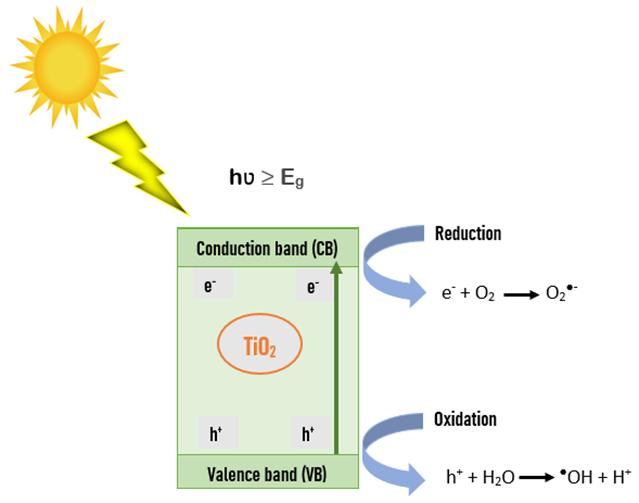
Heterogeneous photocatalysts hold great potential for converting photon energy from light into chemical energy, which is highly relevant for the advancement of renewable energy technologies. This process can take place in different media, including the gas phase, pure organic liquids, and aqueous solutions [16]. In principle, when a semiconductor catalyst (SC) of the metal oxide family, such as oxides (TiO₂, ZnO, ZrO₂, CeO₂, …) or sulphides (CdS, ZnS,…), is exposed to photons with an energy equal to or higher than its band-gap energy (EG), these photons are absorbed and electron–hole pairs are generated within the bulk material. These pairs then dissociate into free photoelectrons in the conduction band and photogenerated holes in the valence band. [17]. In general, the mechanism of photocatalysis using TiO2 is clearly illustrated in the figure 1 [18].
Figure 1. Schematic diagram of TiO2 photocatalytic principle
The photocatalytic process is based on the excitation of TiO₂ by light irradiation with a wavelength shorter than 387 nm, which corresponds to an energy equal to or greater than the band gap (3.2 eV) [19]. In fact, the electrons in VB (valance band) will be excited to CB (conduction band) causing holes in VB [20]. (Equation 1)
(1)
The photoexcited electrons (e⁻) and holes (h⁺) participate in redox reactions with adsorbed species, leading respectively to the formation of superoxide radical anions (●O₂⁻) and hydroxyl radicals (●OH). These reactive species play a crucial role in the degradation of pollutants in water [21] [22].
The positive holes (h⁺) react with water and the organic pollutants adsorbed on the TiO₂ surface, to generate oxidizing species capable of degrading contaminants [16]. (Equation 2; 3)
(2)
(3)
However, if the electrons in the conduction band are not rapidly captured by acceptors, they may recombine with the holes, which greatly reduces the efficiency of the photocatalytic process. To prevent the recombination of electrons with holes, the excited electrons in the conduction band can be captured by electron acceptors such as oxygen, forming superoxide radicals (equation 4). This reaction is crucial because it prolongs the lifetime of the separated charges and enhances the overall efficiency of the photocatalytic process [23].
(4)
Reactive oxygen species (ROS) produced during the photocatalytic process vary greatly, mainly the ROS that is formed is the superoxide radical ●O2- and the hydroxyl radical ●OH. In any case, other species such as ●OOH and H2O2 may be formed through further oxidation process, dimerization, or disproportionation [24] [25].
The overall photocatalysis process can be described in five distinct steps [26]:
• Mass transfer of the organic contaminant(s) in the liquid phase to the TiO2 surface.
• Adsorption of the organic contaminant(s) onto the photon activated TiO2 surface (i.e. surface activation by photon energy occurs simultaneously in this step).
• Photocatalysis reaction for the adsorbed phase on the TiO2 surface.
• Desorption of the intermediate(s) from the TiO2 surface.
• Mass transfer of the intermediate(s) from the interface region to the bulk fluid.

2.2. Main Parameters Influencing Photocatalysis

In photocatalysis, the degradation of a pollutant and its intermediates depends on sufficient contact with the irradiated titanium dioxide. It is therefore essential to understand the various factors that influence the kinetics of photocatalytic reactions. Key parameters include the concentration of the reactant, the amount of catalyst, the light energy supplied, as well as the level of dissolved oxygen, temperature, pH, and the possible presence of organic compounds or dissolved metals. The influence of each of these factors will be discussed in the following sections.
2.2.1. Oxygen
In general, oxygen plays a crucial role in the photocatalytic degradation of organic compounds [27]. Dissolved molecular oxygen, being highly electrophilic [28], is essential in TiO₂ photocatalysis as it provides enough electron scavengers to capture the excited conduction-band electrons and prevent their recombination [29]. Oxygen does not interfere with adsorption on the TiO₂ surface since the reduction reaction occurs at a different site than the oxidation reaction [30].
Furthermore, dissolved oxygen can help stabilize organic radicals formed from pollutants presents in aqueous solution [31], contribute to their direct mineralization through O₂ radicals, or indirectly promote the generation of hydroxyl radicals [32]. Several studies have demonstrated that increasing the amount of oxygen in the solution leads to a significant improvement in overall photocatalytic efficiency [33] [34].
2.2.2. Temperature
Several studies have been conducted to investigate the dependence of photocatalytic reactions on temperature [35], [36] [37].
Although thermal energy alone cannot directly activate the TiO₂ surface, its influence can still be considered when the process is carried out under natural sunlight. Photocatalysis is a photon-driven process and does not require external heating [38]. Most studies have shown that raising the photocatalytic reaction temperature above 80 °C increases electron–hole recombination [39] and reduces the adsorption of organic compounds on the TiO₂ surface [26], which lowers overall photocatalytic activity.
The true activation energy of the reaction is essentially zero, and the apparent activation energy remains very low (a few J.mol⁻¹) between 20 and 80 °C [38]. At very low temperatures (−40 to 0°C), activity decreases as the apparent activation energy becomes positive, while at higher temperatures (70–80 °C) for various photocatalytic reactions, activity decreases and the apparent activation energy becomes negative.
This behaviour can be explained by the Langmuir–Hinshelwood mechanism: at low temperatures, adsorption is stronger, including that of reaction products, which can block active sites. This means temperature affects not only electron-transfer rates but also the balance between adsorption and desorption that determines overall photocatalytic performance [40].
The fact that no external heating is required is a major advantage of photocatalysis for water treatment, as it allows significant energy savings. This also explains why photocatalysis is relatively cost-effective compared to other purification methods [41].
2.2.3. The Initial Concentration of Pollutants
Several studies have investigated how the concentration of contaminants present in water affects the rate of photocatalytic reactions [42] [43] [44] [29]. Even under identical operating conditions, variations in the initial concentration of pollutants can lead to different mineralization times [43]. It is evident that higher initial pollutant concentrations result in longer treatment durations under the same conditions.
At low initial pollutant concentrations, the photomineralization rate of the organic compound follows the Langmuir–Hinshelwood kinetic model. This kinetic model, widely used in heterogeneous photocatalysis, allows the evaluation of the degradation rate of an organic pollutant at different concentrations and describes the reaction kinetics of the photocatalytic oxidation of organic pollutants [45] [46] [47].
The Langmuir–Hinshelwood model is based on several fundamental assumptions [48]:
• The adsorption of organic molecules follows the Langmuir isotherm, meaning that a monolayer is formed on a homogeneous surface without interactions between adsorbed molecules.
• The adsorption and desorption steps are rapid compared to the chemical reaction, which represents the rate-limiting step.
• The chemical transformation involves only adsorbed species and free active sites.
Under these conditions, two situations can be taken to illustrate the adsorption on the surface of the catalyst:
• On the same types of active sites, the reagent and the solvent are adsorbed on the surface of the catalyst without competition.
• The pollutant and the water are in competition for the occupation of the active sites of the catalyst.
By applying the L-H model for these two cases, the reaction rate v is directly related to the fraction of the catalyst surface occupied by the pollutant, represented by Ɵ:
(5)
(6)
We can integrate equations (6) and (7) if the part of the surface covered by water is always identical.
(7)
(8)
If the initial concentration C₀ is very low, the equations can be simplified to a first-order kinetic equation:
(9)
The slope of the line ln (C0/C) = f(t) can determine the apparent rate constant k’. Thus, the concentration of adsorbed intermediates increases with the concentration of pollutant, which leads to a change in the rate of the reaction [40].
2.2.4. Effect of pH
The pH is a key factor in heterogeneous photocatalysis, as it simultaneously affects the surface charge of TiO₂, the size of aggregates [49], the electrostatic interactions between the catalyst and the pollutant, the adsorption of compounds onto the catalyst, the efficiency of the photocatalytic reaction [50], and the balance of radical reactions [51].
Each photocatalyst has an isoelectric point or electrical zero point (EZP), corresponding to a pH at which the TiO₂ surface is neutral, typically ranging from 5,6 to 6,4 [38].
When pH < EZP, the surface is positively charged and favours the adsorption of anionic compounds; when pH > EZP, it becomes negatively charged and attracts cationic species [26]. In contrast, the degradation of neutral species, which do not interact electrostatically with the catalyst, is relatively insensitive to pH variations [52].
The pH also influences the particle size: near pH ≈ EZP, TiO₂ particles tend to aggregate due to reduced electrostatic repulsion [53]. Additionally, pH has been observed to shift the valence band position, with a change of approximately 0.059 eV per pH unit [30] [54].
2.2.5. The Intensity of the Luminous Flux
It has been shown that the rate of photocatalytic reactions is generally proportional to the light intensity [30]. However, above a certain photon flux, the influence of light intensity on the reaction rate decreases, and the reaction order drops from 1 to 0.5 [55] [56]. This reduction is attributed to the formation of an excess of photogenerated species, such as electrons (e⁻), holes (h⁺), and hydroxyl radicals (•OH) [57].
At even higher light intensities, the reaction rate becomes independent of the incident radiation, corresponding to a zero-order regime, where the process is primarily controlled by mass transfer [58] [59]. In this regime, further increases in photon flux do not enhance the degradation rate; instead, they favor the recombination of electron-hole pairs, limiting the overall photocatalytic efficiency [60] [61].

3. Types of TiO2

3.1. Allotropic Forms

As is well known, TiO2 exists commonly in three forms: rutile, anatase and brookite [15]. These three types are octahedral with different distortions [62]. But there is another polymorph found from TiO2, namely TiO2(B) [63].
Titanium dioxide is a wide band-gap semiconductor. The band gaps of its three crystalline forms: rutile, anatase, and brookite are indirect, with values of 3.0 eV (411 nm), 3.2 eV (384 nm), and 3.10 eV (400 nm), respectively [64]. It has a high refractive index at 590 nm (nrutile = 2,70 et nanatase = 2,55) and a high diffusion coefficient (96%), that is to say the incident light is reflected in the visible. Its theorical density, high for an oxide, is 4,25 (measured between 3,9 and 4,2) [65]. It has a melting point of 1892°C in an oxygen atmosphere and 1843°C in air [66].
Titanium dioxide (TiO₂) is a widely available material on Earth, mainly found in the form of ilmenite (an iron–titanium oxide) and rutile. It can be produced either by treating ilmenite with sulfuric acid (the sulphate process) or by chlorinating natural rutile (the chloride process). The first method yields TiO₂ directly as a fine powder, while the second involves the formation of titanium tetrachloride (TiCl₄), which serves as an intermediate in the production of pigment-grade TiO₂ [67].
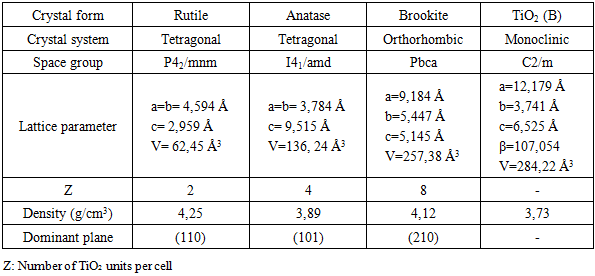
Among its crystalline forms, Rutile is the most stable form of titanium dioxide and is produced at high temperatures (600°C < T < 850°C), brookite forms at lower temperatures (T<450°C) and anatase at even lower temperatures (T 450°C) [68] [69]. Table 1 shows the different properties of the TiO2 polymorph [67] [70] [71].
Table 1. Crystal structure and physical parameters of TiO2 polymorph
     

3.2. Comparison Between Anatase and Rutile

In TiO2 applications, only anatase plays a more important role and this form is considered photoactive. Brookite and TiO2 (B) are not often used because its structure is more complex than that of anatase or rutile. Since it’s difficult to synthesize, it is rarely mentioned or applied as a photocatalyst [72].
In fact, when exposed to most organic pollutants, anatase TiO₂ generally shows higher photocatalytic efficiency than rutile TiO₂ [73].
A common explanation is that anatase TiO₂ has a much lower rate of electron–hole recombination, allowing the excited state to last longer [74]. Differences in band gap energy, exciton mobility, and the lifetime of electron–hole pairs may also contribute to this behaviour [75]. It’s also suggested that anatase and rutile differ in how reactive oxygen species form on their surfaces [76]. Factors such as the number of surface hydroxyl groups [77], the ability to adsorb pollutants [78], or how well oxygen is adsorbed [79] can all influence performance. The photocatalytic activity also depends on the crystal surface itself — for instance, the rutile (001) surface can generate •OH radicals as efficiently as the anatase (101) surface, while other rutile faces show much lower activity [80].
In rutile, the O²⁻ ions form a slightly distorted hexagonal close-packed arrangement, while in anatase they adopt a cubic packing. In anatase, each oxygen atom is trivalent, forming two short bonds and one long bond [81], whereas in rutile, each oxygen is bonded to three titanium atoms [82].
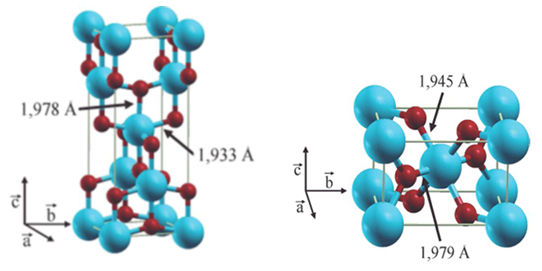
The anatase and rutile structures are both composed of TiO₆ octahedra, where each Ti⁴⁺ cation is surrounded by six oxygen atoms forming an octahedron [83] (figure 3). The two crystal forms mainly differ in the way these octahedra are arranged and in the extent of their distortion.
In the anatase structure, each octahedron is connected to eight neighbouring ones, whereas in rutile, each has ten neighbours. The Ti–Ti distances are longer in anatase than in rutile, while the Ti–O bonds are slightly longer in rutile [84]. As a result, anatase is less dense than rutile. These structural differences lead to variations in their physical and photocatalytic properties. For instance, rutile has a lower ability to adsorb oxygen compared to anatase, which makes electron trapping less efficient and increases electron–hole recombination. This could explain why rutile generally exhibits lower photocatalytic activity than anatase [60].
Figure 2. The schematic conventional cells for anatase (a), rutile (b) TiO2
The big blue spheres represent Ti atoms and the small red spheres represent O atoms [83].
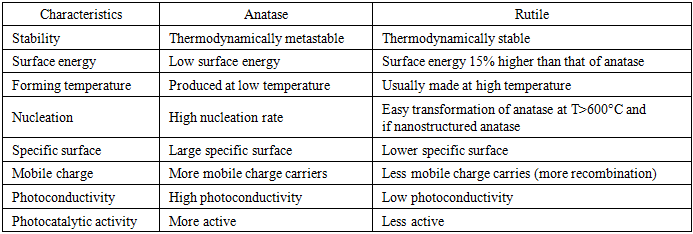
Given the important place held by anatase and rutile in the application of TiO2, we will summarize in the table 2, the characteristics that differentiate them [16].
Table 2. Characteristics of anatase and rutile
     

3.3. X-ray Diffraction Analysis of Anatase and Rutile Phases [85]

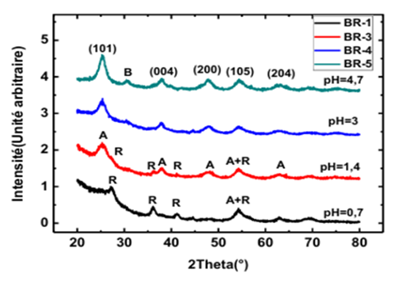
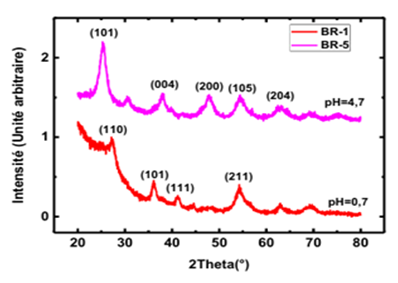
The TiO₂ samples were characterized by X-ray diffraction (XRD) in the 2θ range of 20° to 80°. The XRD patterns of the samples are shown in the following figures (figure 3, figure 4).
Figure 3. Diffractograms showing the evolution of the samples’ crystallinity as a function of pH during aging [85]
Figure 4. Comparison of the diffractograms of the samples, with BR 5 consisting mainly of the anatase phase and BR 1 consisting mainly of the rutile phase [85]
The BR-5 sample, synthesized at pH 4.7, exhibits diffraction peaks at (101), (004), (200), (105), and (204), which are characteristic of the tetragonal anatase phase. In contrast, the BR-1 sample, synthesized at pH 0.7, shows peaks at (110), (101), (111), and (211), corresponding to the rutile phase.
Overall, the results indicate that lowering the pH during aging favours the formation of the rutile phase, whereas higher pH values promote anatase. Specifically, pure anatase is obtained at pH ≥ 3, a mixed anatase–rutile phase appears at pH 1.4, and pure rutile is observed at pH 0.7. This is explained by its influence on surface chemical properties, the kinetics governing the nucleation and subsequent growth of titanium-containing phases, and the differential thermodynamic stability exhibited by the two distinct crystalline forms. A minor peak at 2θ = 30.6° suggests traces of brookite, which are more prominent at higher pH (4.7). This behaviour aligns with the literature: rutile is the thermodynamically stable phase, while anatase is kinetically favoured. Higher pH accelerates reaction kinetics, enabling anatase formation, whereas rutile appears only at very low pH values (pH < 1.4).
In addition to phase identification, the XRD patterns provide information on crystallinity and crystallite size.
The broadening of the XRD peaks indicates that the samples are nanocrystalline. The average crystallite size, estimated from the main peaks using the Scherrer equation, is approximately 5,35 nm for BR 5 and 10,47 nm for BR 1, showing that the rutile crystallites formed at low pH are slightly larger than the anatase ones.

4. TiO2 Doping

The photocatalytic efficiency of semiconductors can be greatly improved through surface modification and doping. In general, the role of dopants contributes to:
Narrowing the band gap of TiO₂ [86] [87],
Introduction mid-gap states [88] [89],
Improving charge carrier separation [90],
Increasing the density of surface-adsorbed species such as hydroxyl radicals [91].
It’s important to recognize that most TiO₂ samples naturally contain some impurities. Whether these are unintentional or deliberately added as dopants, they play a significant role in influencing the kinetics of the anatase-to-rutile transition [92].
Titanium dioxide particles that are modified or doped with other semiconductors or metals exhibit metastable states capable of trapping electrons, thereby reducing the rate of electron–hole recombination [93].

4.1. Cationic Doping

Cationic doping of TiO₂ involves substituting the Ti⁴⁺ ion with another atom [94]. According to the literature, various metals have been used to dope titanium dioxide through wet chemical methods [95], high-temperature treatments, or ion implantation [96]. These dopants can be grouped into three main families:
Lanthanides (Nd, Gd, Ce, Ho…) [97] [98] [99] introduce 4f electronic transitions that enhance the adsorption and separation of photogenerated electron–hole pairs, leading to improved photocatalytic activity [100].
Transition metals (Fe, Cu, V, W, Ni, Cr, Mn, Mo, Ru, …) [101] [102] [103]: doping with a transition metal generally enhances electron–hole separation, promotes interfacial electron transfer, modifies the band gap, and alters the surface catalytic properties [104].
Alkali metals: Li, Na, K [105].
The extent of cation substitution can significantly influence several properties of TiO₂, including photoreactivity, charge recombination rates [106], [95] thermal stability, crystal size, crystallinity, and surface defect concentration [107].
Cationic doping can produce both positive and negative effects. Some studies report that it lowers the energy threshold of TiO₂ by narrowing the band gap [108], while the majority of research indicates that such doping generally increases electron–hole recombination [109].

4.2. Anionic Doping

In anionic doping, the O²⁻ ions in the lattice are replaced by non-metallic atoms [94]. The incorporation of heteroatoms such as B, C, N, O, F, S, Cl, and Br has been extensively studied in the literature [110] [106].
Among non-metallic anionic dopants, nitrogen appears to be the most effective in improving the visible-light photocatalytic activity of TiO₂ because its 2p orbitals have an energy close to that of the oxygen 2p orbitals, to adapt the TiO₂ valence band in a relatively favourable manner [111].
As with metal-doped TiO₂ photocatalysts, the preparation method, type, and concentration of non-metal dopants strongly influence the resulting band structure and the catalyst’s activity under visible light [112].

5. Possible Competitor of TiO2

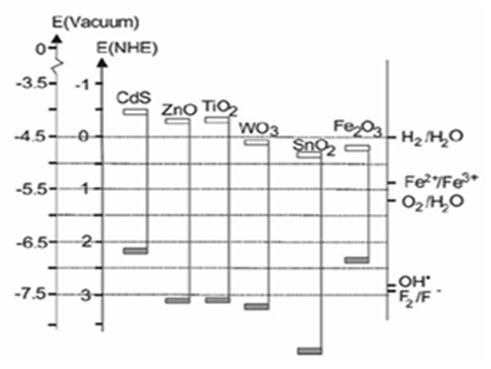
In the literature, several semiconducting minerals usable in heterogeneous photocatalysis have been reported. The key parameter in their efficiencies being the position of their conduction band (CB) and their valence band (VB). Indeed, their positions must allow the generation of hydroxyl and superoxide radicals which will subsequently react with the organic compounds and lead to the degradation of the latter. The figure 5 gives us the relative position of CB and VB of different semiconductors used in photocatalysis [28].
Figure 5. Example Comparison of relative positions of CB and VB of different semiconductors used in photocatalysis
According to Figure 5, zinc oxide (ZnO) could be a potential competitor to titanium dioxide, since its band gap is similar to that of TiO₂. This band structure makes ZnO an attractive alternative to TiO₂ [113].
ZnO is a type of semiconductor having a broad direct band gap (3.37 eV), with large excitation binding energy (60 meV) and deep violet/borderline ultraviolet (UV) absorption at room temperature [114]. It is an excellent semiconductor oxide that possesses favourable excellent electrical, mechanical and optical properties [115], similar to TiO2. In addition, ZnO not only has antifouling and antibacterial properties, but also good photocatalytic activity, since it is capable of generating, under illumination, reactive oxygen species that degrade organic pollutants and damage microorganisms. An effect that is also linked to the release of Zn2+ ions and to direct contact between ZnO particles and bacterial membranes [116]. Furthermore, the production cost of ZnO is up to 75% lower than that of TiO2 and Al2O3 nanoparticles [117]. Due to the advantages of ZnO over TiO2, ZnO has been suggested to be used in heterogeneous photocatalysis.
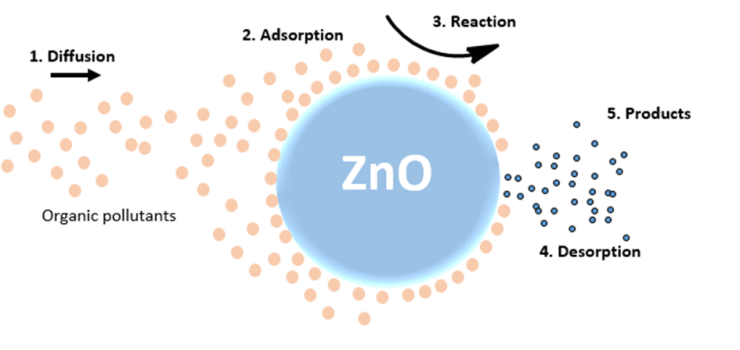
Figure 6 shows a simplified diagram of the heterogeneous oxidation steps in the photocatalytic reaction using ZnO nanoparticles. The process can be summarized as follows: (1) diffusion of organic impurities from the liquid phase onto the ZnO surface; (2) adsorption of organic impurities on the ZnO surface; (3) redox reaction in the adsorbed phase; (4) desorption of products and (5) removal of products from the interface area [118] [119].
Figure 6. Heterogeneous photocatalytic oxidation steps
The reactions can be written [119]:
(10)
(11)
(12)
(13)
(14)
(15)
(16)
(17)
(18)
(19)
(20)

6. Conclusions

Heterogeneous photocatalysis using TiO₂, especially in its anatase form, has proven to be a highly effective and environmentally friendly method for the degradation of organic pollutants in water. The photocatalytic efficiency depends strongly on multiple factors, including crystal structure, surface area, light intensity, pH, temperature, and the presence of dopants or co-catalysts. Among the polymorphs of TiO₂, anatase generally exhibits higher photocatalytic activity than rutile due to its lower electron–hole recombination rate, higher photoconductivity, and favourable surface characteristics. X-ray diffraction (XRD) analysis confirmed that synthesis conditions, such as pH and aging, significantly influence phase formation, crystallite size, and crystallinity.
Moreover, the performance of TiO₂ can be further improved through cationic or anionic doping, which enhances charge separation, modifies the band gap, and increases the generation of reactive oxygen species. Metal dopants, such as transition metals or lanthanides, and non-metal dopants, such as nitrogen or carbon, have been shown to enhance photocatalytic activity under UV or visible light. The Langmuir–Hinshelwood kinetic model adequately describes the reaction rates, demonstrating that pollutant concentration, catalyst loading, and light intensity all directly affect degradation efficiency. Additionally, the TiO₂ anatase surface provides an optimal balance between adsorption and desorption, enabling efficient interaction with pollutants and reactive species.
Alternative semiconductors, such as ZnO, have also been identified as potential competitors due to their similar band structure, strong photocatalytic activity, and lower production cost. These materials could provide cost-effective and efficient alternatives for large-scale water treatment. Overall, TiO₂-based heterogeneous photocatalysis remains a versatile, sustainable, and scalable solution for water purification. Future research focusing on optimizing synthesis conditions, understanding reaction mechanisms, and exploring new dopants or hybrid materials will continue to improve the practical applicability and efficiency of this promising technology.

References

[1]  Jinfeng Zhang, Peng Zhou, Jianjun Liu and Jiaguo Yu., «New understanding of the difference of photocatalytic activity among anatase, rutile and brookite TiO2,» Communication, 20382 | Chem. Phys., vol. 16, p. 20382—20386, 2014.
[2]  Carlos Montalvo, Claudia A. Aguilar, Rosa A. Martínez, Rosa M. Cerón, Alejandro Ruiz, Eric Houbron and Juan C. Robles, Purification of Rainwater Using a Photocatalysis Technique to be Applied to Communities in Ciudad del Carmen, Campeche, Mexico, 2023.
[3]  Rachel Fagan, Damian W. Synnott, Declan E. McCormack, Suresh C. Pillai, «An effective method for preparation of high temperature stable anatase TiO2 photocatalysts,» Applied Surface Science, vol. 371, pp. 447-452, 2016.
[4]  Braydich-Stolle L.K., Schaeublin N.M., Murdock R.C., Jiang J., Biswas P., Schlager J.J., Hussain S.M., «Crystal structure mediates mode of cell death in TiO2 nanotoxicity,» Journal of Nanoparticle Research, vol. 11(6), p. 1361–1374, 2009.
[5]  L. Zhang, H.H. Mohamed, R. Dillert, D. Bahnemann, «Kinetics and mechanisms of charge transfer processes in photocatalytic systems: A review,» Journal of Photochemistry and Photobiology C: Photochemistry Reviews, vol. 13, p. 263, 2012.
[6]  S. Banerjee, D.D. Dionysiou, S.C. Pillai, B Environ., «Self-cleaning applications of TiO2 by photo-induced hydrophilicity and photocatalysis,» Applied Catalysis B: Environmental, vol. 176–177, p. 396, 2015.
[7]  J.W. MacFarlane, H.F. Jenkinson, T.B. Scott, «Sterilization of microorganisms on jet spray formed titanium dioxide surfaces,» Applied Catalysis B: Environmental, vol. 106, p. 181, 2011.
[8]  K. Hashimoto, H. Irie, A. Fujishima, «TiO2 photocatalysis: A historical overview and future prospects,» Japanese Journal of Applied Physics, vol. 44, p. 8269, 2005.
[9]  T. Tatsuma, W. Kubo, A. Fujishima, «Patterning of solid surfaces by photocatalytic lithography based on the remote oxidation effect of TiO2,» Langmuir, vol. 18, p. 9632, 2002.
[10]  Z. Zsilák, E. Szabó-Bárdos, O. Fónagy, O. Horváth, K. Horváth, P. Hajós, «Degradation of benzenesulfonate by heterogeneous photocatalysis combined with ozonation,» Catalysis Today, vol. 230, p. 55, 2014.
[11]  V. Vamathevan, R. Amal, D. Beydoun, G. Low, S. McEvoy, «Photocatalytic oxidation of organics in water using pure and silver-modified titanium dioxide particles,» Journal of Photochemistry and Photobiology A: Chemistry, vol. 148, p. 233, 2002.
[12]  Y. Ohko, S. Saitoh, T. Tatsuma, A. Fujishima, «Photoelectrochemical anticorrosion and self-cleaning effects of a TiO2 coating for type 304 stainless steel,» Journal of the Electrochemical Society, vol. 148, p. B24, 2001.
[13]  T. Tatsuma, S. Saitoh, Y. Ohko, A. Fujishima, «TiO2-WO3 photoelectrochemical anticorrosion system with an energy storage ability,» Chemistry of Materials, vol. 13, p. 2838, 2001.
[14]  W. J. Ong, L. L. Tan, S. P. Chai, S. T. Yong and A. R. Mohamed, ChemSusChem, vol. 7, pp. 690-719, 2014.
[15]  Mingzheng Ge, Chunyan Cao, Jianying Huang, Shuhui Li, Zhong Chen, KeQin Zhang, S.S. Al-Deyab, and Yuekun Lai, «A Review of One-dimensional TiO2 Nanostructured Materials for Environmental and Energy Applications,» Journal of materials chemistry A, p. 2, 2012.
[16]  Christos SARANTOPOULOS, PHOTOCATALYSEURS A BASE DE TiO2 PREPARES PAR INFILTRATION, THESE, 2007.
[17]  Herrmann Jean-Marie, «Heterogeneous photocatalysis: fundamentals and applications to the removal of various types of aqueous pollutants,» Catalysis Today, vol. 53, p. 115–129, 1999.
[18]  Diana Rakhmawaty Eddy, Muhamad Diki Permana, Lintang Kumoro Sakti, Geometry Amal Nur Sheha, Solihudin, Sahrul Hidayat, Takahiro Takei, Nobuhiro Kumada, and Iman Rahayu, «Heterophase Polymorph of TiO2 (Anatase, Rutile, Brookite, TiO2 (B)) for Efficient Photocatalyst: Fabrication and Activity,» Review, Nanomaterials,13, 704, 2023 .
[19]  Tang H., Prasad K., Sanjines R., Schmid P.E. and Levy F., «Electrical and Optical Properties of TiO2 Anatase Thin Films,» Journal of Applied Physics, vol. 75, pp. 2042-2047, 1994.
[20]  J. Schneider., M. Matsuoka, M. Takeuchi, J. Zhang, Y. Horiuchi, M. Anpo et D. W. Bahnemann, «Understanding TiO2 photocatalysis: Mechanisms and materials,» Chemical Reviews, vol. 114, p. 9919–9986, 2014.
[21]  Mul, Kasper Wenderich and Guido, «Methods, Mechanism, and Applications of Photodeposition in Photocatalysis,» Chemical Reviews, vol. 114, p. 9919–9986, 2014.
[22]  G., Hagfeldt A. and Michael., «Light-Induced Redox Reactions in Nanocrystalline Systems,» Chemical Reviews, vol. 95, pp. 49-68, 1995.
[23]  Nanping Xu, Zaifeng Shi, Yiqun Fan, Junhang Dong, Jun Shi, Michael Z.C. Hu, «Effects of particle size of TiO2 on photocatalytic degradation of methylene blue in aqueous suspensions,» Industrial & Engineering Chemistry Research, vol. 38(2), pp. 373-379, 1999.
[24]  Xiaohui Feng, Haijuan Guo, Kunal Patel, Hong Zhou, Xia Lou, «High performance, recoverable Fe3O4 single bond ZnO nanoparticles for enhanced photocatalytic degradation of phenol,» Chemical Engineering Journal, vol. 244, pp. 327-334, 15 May 2014.
[25]  Andrzej Sobczyński, Łukasz Duczmal, Wojciech Zmudziński, «Phenol destruction by photocatalysis on TiO2: an attempt to solve the reaction mechanism,» Journal of Molecular Catalysis A: Chemical, vol. 213 (2), pp. 225-230, 4 May 2004.
[26]  Meng Nan Chonga, Bo Jina, Christopher W.K. Chow, Chris Saint, «Recent developments in photocatalytic water treatment technology,» Water Research, vol. 44, pp. 2997-3027, 2010.
[27]  A. Hussain, S. Ali, S. Wendy et S. Joan, «Advanced technology for water purification by heterogeneous photocatalysis,» International Journal of Environment and Pollution, vol. 1 (1), 1991.
[28]  O.Carp, C.L. Huisman, A. Reller, «Photoinduced reactivity of titanium dioxide,» Progress in Solid State Chemistry, vol. 32, p. 33–177, 2004.
[29]  Chong M.N., Lei S., Jin B., Saint C., Chow C.W.K., «Optimisation of an annular photoreactor process for degradation of Congo red using a newly synthesized titania impregnated kaolinite nano-photocatalyst,» Separation and Purification Technology, vol. 67, pp. 355-363, 2009.
[30]  Malato S., Fernandez-Ibanez P., Maldonado M.I., Blanco J., Gernjak W.,«Decontamination and disinfection of water by solar photocatalysis: recent overview and trends,» Catalysis Today, vol. 147, pp. 1-59, 2009.
[31]  S. Bakardjieva, J. Subrt, V. Stengl, M. J. Dianez, M. J. Sayagues, «Photoactivity of anatase-rutile TiO2 nanocrystalline mixtures obtained by heat treatment of homogeneously precipitated anatase,» Applied Catalysis B: Environmental, vol. 58, pp. 193- 202, 2005.
[32]  Zekri Mohamed El Mehdi, Mise au point d’un réacteur photocatalytique pour la dépollution de l’eau, THESE, 2012.
[33]  H. Gerischer, «Conditions for an eKicient photocatalytic activity of TiO2 particles,» In D. F. Ollis, and H. Al-Ekabi (Eds.), Photocatalytic purication and treatment of water and air, Amsterdam: Elsevier, p. 1, 1993.
[34]  ET K. Okamoto, Y. Yamamoto, H. Tanaka, M. Tanaka, and A. Itaya, «Heterogeneous photocatalytic decomposition of phenol over TiO2 powder,» Bulletin of the Chemical Society of Japan, vol. 58, p. 2015–2022, 1985.
[35]  Nazim Z. Muradov, Ali T-Raissi, Donald Muzzey, «Selective photocatalytic destruction of airborne VOCs,» Solar Energy, vol. 56(5), pp. 445-453, 1996.
[36]  Xianzhi Fu, Louis A. Clark, Walter A. Zeltner, Marc A. Anderson, «Effects of reaction temperature and water vapor content on the heterogeneous photocatalytic oxidation of ethylene,» Journal of Photochemistry and Photobiology A: Chemistry, vol. 97(3), pp. 181-186, 1996.
[37]  Evgenidou E., Fytianos K., & Poulios I.., «Semiconductor-sensitized photodegradation of dichlorvos in water using TiO2 and ZnO as catalysts,» Applied Catalysis B: Environmental, Vols. %1 sur %259(1-2), pp. 81-89, 2005.
[38]  Roumayssaa HAZIME, Les especes actives durant la degradation photocatalytique: application aux pesticides, DIPLÔME DE DOCTORAT, L’UNIVERSITE CLAUDE BERNARD LYON 1 ECOLE DOCTORALE DE CHIMIE DE LYON, 2012.
[39]  Umar Ibrahim Gaya, Abdul Halim Abdullah, «Heterogeneous photocatalytic degradation of organic contaminants over titanium dioxide: a review of fundamentals, progress and problems,» Journal of Photochemistry and Photobiology C: Photochemistry Reviews, vol. 9 (1), pp. 1-12, 2008.
[40]  B. S. e. G. Naziha, Synthèse, caractérisation et propriétés photocatalytiques de couches minces de TiO2, Mémoire de master, chimie des matériaux., 2021.
[41]  Naziha, BOURENANE Selma et GUERFI, « Influence of pH and chloride anion on the photocatalytic degradation of organic compounds: Part I. Effect on the benzamide and parahydroxybenzoic acid in TiO2 aqueous solution,» J.Applied Catalysis B: Environmental, vol. 35, pp. 117-124, 2001.
[42]  Konstantinou I. K., & Albanis T. A., «Photocatalytic transformation of pesticides in aqueous titanium dioxide suspensions using artificial and solar light: intermediates and degradation pathways,» Applied Catalysis B: Environmental, vol. 42(4), pp. 319-335, 2003.
[43]  Toor A. P., Verma A., Jotshi C. K., Bajpai P. K., & Singh V.,«Photocatalytic degradation of Direct Yellow 12 dye using UV/TiO2 in a shallow pond slurry reactor,» Dyes and Pigments, vol. 68(1), pp. 53-60, 2006.
[44]  Chong M. N., Jin B., Zhu H. Y., Chow C. W. K., & Saint C., «Application of H titanate nanofibers for degradation of Congo Red in an annular slurry photoreactor,» Chemical Engineering Journal, vol. 150(1), pp. 49-54, 2009.
[45]  Sauer G., Cesconeto Neto G., José H.J., Moreira R.F.P.M.., «Kinetics of photocatalytic degradation of reactive dyes in a TiO2 slurry reactor,» Journal of Photochemistry and Photobiology A: Chemistry, vol. 149(1–3), pp. 147-154, 2002.
[46]  So C.M., Cheng M.Y., Yu J.C., Wong P.K., «Degradation of azo dye Procion Red MX-5B by photocatalytic oxidation,» Chemosphere, vol. 46, pp. 905-912, 2002.
[47]  Senthilkumaar S., Porkodi K., Gomathi R., Geetha Maheswari A., Manonmani N., «Sol–gel derived silver doped nanocrystalline titania catalysed photodegradation of methylene blue from aqueous solution,» Dyes and Pigments, vol. 69, pp. 22-30, 2006.
[48]  K. Vasanth Kumar, K. Porkodi, A. Selvaganapathi, «Constrain in solving Langmuir–Hinshelwood kinetic expression for the photocatalytic degradation of Auramine O aqueous solutions by ZnO catalyst,» Dyes and Pigments, vol. 75(1), pp. 246-249, 2007.
[49]  J. Blanco, S. Malato, J. de las Nieves and P. Fernandez, «Method of sedimentation of colloidal semiconductor particles,» European patent application EP-1-101-737-A1, European Patent Office Bulletin 21, 2001.
[50]  Elsellami L., Vocanson F., Dappozze F., Puzenat E., Païsse O., Houas A., Guillard C.,«Kinetic of adsorption and of photocatalytic degradation of phenylalanine effect of pH and light intensity,» Applied Catalysis A: General, vol. 380, pp. 142-148, 2010.
[51]  B. Ibtissem, Contribution à l’élimination de colorants (Vert de méthyle et Bromocrésol pourpre) par procédés photochimiques en phase homogène (séparés et mélangés), en phase hétérogène en milieu aqueux et par adsorption (Vert de méthyle) sur ZnO., DOCTORAT EN SCIENCES EN CHIMIE, 2017.
[52]  Daneshvar N, Salari D, Khataee AR., «Photocatalytic Degradation of Azo Dye Acid Red 14 in Water on ZnO as an Alternative Catalyst to TiO2,» Journal of Photochemistry and Photobiology A: Chemistry, vol. 160, pp. 195-201, 2003.
[53]  A. Fernández, G. Lassaletta, V.M. Jiménez, A. Justo, A.R. González-Elipe, J.-M. Herrmann, H. Tahiri, Y. Ait-Ichou, «Preparation and characterization of TiO2 photocatalysts supported on various rigid supports (glass, quartz and stainless steel). Comparative studies of photocatalytic activity in water purification,» Applied Catalysis B: Environmental, vol. 7(1–2), pp. 49-63, 7 December 1995.
[54]  A. J. Nozik, R. J. Memming, «Physical chemistry of semiconductor liquid interface,» Physical Chemistry, vol. 100, pp. 1306-13078, 1996.
[55]  Bhatkhnade DS, Kamble SP, Sawant SB, «Photocatalytic and photochemical degradation of nitrobenzene using artificial ultraviolet light,» Chemical Engineering Journal, vol. 102, pp. 283-290, 2004.
[56]  Chin SS, Chiang K, Fane AG., «The stability of polymeric membranes in TiO2 photocatalysis process,» Journal of Membrane Science, vol. 275, pp. 202-211,, 2006.
[57]  Ochuma IJ, Fishwick RP, Wood J, et al., «Optimization of degradation conditions of 1,8 diazabicyclo [5.4.0] undec-7-ene in water and reaction kinetics analysis using a cocurrent down flow contactor photocatalytic reactor,» Journal Applied Catalysis B, vol. 73, pp. 259-268, 2007.
[58]  Ollis DF, «Solar-assisted photocatalysis for water purification: issues, data, questions, Photochemical Conversion and Storage of Solar Energy,» Kluwer Academic Publishers, 1991.
[59]  JM., Hermann, «Heterogeneous photocatalysis: an emerging discipline involving multiphase systems,» J. Catalysis Today, vol. 24, pp. 157,164, 1995.
[60]  I. Litter M., «Heterogeneous photocatalysis: Transition metal ions in photocatalytic systems,» Applied Catalysis B: Environmental, vol. 23(2–3), pp. 89-114, 1999.
[61]  Lair A., Ferronato C., Chovelon J.-M., & Herrmann J.-M., «Naphthalene degradation in water by heterogeneous photocatalysis: An investigation of the influence of inorganic anions,» Journal of Photochemistry and Photobiology A: Chemistry, vol. 193(2–3), pp. 193-203, 2008.
[62]  Damien Dambournet, Ilias Belharouak and Khalil Amine «Tailored preparation methods of TiO2 anatase, rutile, brookite: Mechanism of formation and electrochemical properties,» Chemistry of Materials, vol. 22, p. 1173–1179, 2010.
[63]  J.F., Banfield; D.R., Veblen; D.J., Smith, «The identification of naturally occurring TiO2 (B) by structure determination using high-resolution electron microscopy, image simulation, and distance-least-squares refinement,» Am. Mineral., vol. 76, p. 343–353, 1991.
[64]  K. Lemounes, Caractérisation des couches minces d’oxyde de titane(TiO2) élaborées par voie Sol-Gel (spin coating): L’effet des différents catalyseurs, mémoire de master, Université de Biskra, 2018.
[65]  Andreea CRISBASAN, Etude de croissances de nanostructures de TiO2 en réacteur MOCVD en présence de catalyseurs métalliques. Valorisation des nanostructures de TiO2, University of BOURGOGNE FRANCHE-COMTE,P 18-19, 2017.
[66]  Renate Rossmanith, Clemens K. Weiss,Jasmin Geserick, Nicola Hüsing, Ute Hörmann, Ute Kaiser, Katharina Landfester, «Porous Anatase Nanoparticles with High Specific Surface Area Prepared by Miniemulsion Technique,» Chemistry of Materials, vol. 20(18), pp. 5768-5780, 2008.
[67]  KERTESZ Christine, Structure et propriétés amphotères de gels de dioxyde de titane, THESE de DOCTORAT de !'UNIVERSITE PARIS VI, Chimie Analytique, 1991.
[68]  D Reyes-Coronado, G Rodrıguez-Gattorno, M E Espinosa-Pesqueira, C Cab, R de Coss and G Oskam, «Phase-pure TiO2 nanoparticles: anatase, brookite and rutile,» Nanotechnology, vol. 19, p. 145605 (10pp), 2008.
[69]  JOHAN VANDENBORRE, Etude multi-échelle des mécanismes d’interactions des ions aquo uranyle avec les surfaces de l’oxyde de titane (poudres et monocristaux), Grade de Docteur en Sciences de l’Université de Paris XI Orsay, 2005.
[70]  A. Rabah, Elaboration de nouveaux nanomatériaux photocatalytiques actifs sous rayonnement visible, Paris: Thèse de doctorat, Université Paris 13., 2010.
[71]  Opra, Denis P.; Gnedenkov, Sergey V.; Sinebryukhov, Sergey L., «Recent efforts in design of TiO2 (B) anodes for high-rate lithium-ion batteries,» Journal of Power Sources, vol. 442, p. 227225, 2019.
[72]  A. Beltran, L. Gracia and J. Andres, «Density functional theory study of the brookite surfaces and phase transitions between natural titania polymorphs,» J. Phys. Chem. B, vol. 110 (46), p. 23417, 2006.
[73]  Annika Holm, Marwa Hamandi, France Simonet, Bernadette Jouguet, Frederic Dappozze, Chantal Guillard, «Impact of Rutile and Anatase Phase on the Photocatalytic Decomposition of Lactic Acid,» Applied Catalysis B: Environmental, vol. 253, pp. 96-104, 2019.
[74]  C. Colbeau-Justin, M. Kunst, D. Huguenin, «Structural influence on charge-carrier lifetimes in TiO2 powders studied by microwave absorption,» Journal of Materials Science, vol. 38, p. 2429– 2437, 2003.
[75]  T. Luttrell, S. Halpegamage, J. Tao, A. Kramer, E. Sutter, M. Batzill,«Why Is Anatase a Better Photocatalyst than Rutile,» Scientific Report, vol. 4, p. 4043, 2014.
[76]  T. Hirakawa, K. Yawata, Y. Nosaka, «Photocatalytic reactivity for O2− and OH radical formation in anatase and rutile TiO2 suspension as the effect of H2O2 addition,» Appl Catal Gen., vol. 325, p. 105–111, 2007.
[77]  M. Qamar, M. Saquib, M. Muneer, «Titanium dioxide mediated photocatalytic degradation of two selected azo dye derivatives, chrysoidine R and acid red 29 (chromotrope 2R), in aqueous suspensions,» Desalination, vol. 186, p. 255–271, 2005.
[78]  JM. Kesselman, GA. Shreve, MR. Hoffmann, NS. Lewis, J Phys Chem., vol. 98, p. 13385– 13395, 1994.
[79]  M. Buchalska, M. Kobielusz, A. Matuszek, M. Pacia, S. Wojtyła, W..Macyk, ACS Catal., vol. 5, p. 7424–7431, 2015.
[80]  AY. Ahmed, TA. Kandiel, T. Oekermann, D. Bahnemann, J Phys Chem Lett., vol. 2, p. 2461, 2011.
[81]  T. D. Corner, K. Heerington, Journal of American Chemical Society, vol. 77, p. 4708, 1995.
[82]  L. Smart, E. Moore,chez Introduction à la Chimie du Solide, Ed. Masson, Paris, 1997.
[83]  U. Diebold, «The surface science of titanium dioxide,» Surface science reports, vol. 48, p. 53, 2003.
[84]  R. Sanjines, H. Tang, H. Berger, F. Gozzo, G. Margaritondo, F. Lévy, «Electronic structure of anatase TiO2 oxide,» J. Appl. Phys., 1994.
[85]  RAKOTOARISON Alain Bruno Nandrianina, Synthèse de nanoparticule de dioxyde de titane (TiO2) pour la photocatalyse: application à la décomposition des polluants organiques, Université d'Antananarivo, Septembre 2018.
[86]  N. Serpone, The Journal of Physical Chemistry B, vol. 110, p. 24287, 2006.
[87]  Nagaveni K, Hegde MS, Ravishankar N, Subbanna GN, Mad rass G, Langmuir Journal, vol. 20, p. 2900, 2004.
[88]  Nowotny J, Bak T, Sheppard LR, Sorrell CC, Advances in Solar Energy: An Annual Review of Research and Development, vol. 17, p. 169, 2007.
[89]  Ranjit KT, Cohen H, Willner I, Bossmann S, Braun AM, Journal of Materials Science, vol. 34, p. 5273, 1999.
[90]  Sun B, Vorontsov AV, Smirniotis PG, Langmuir Journal, vol. 19, p. 3151, 2003.
[91]  Franch M, Peral J, Domenech X, Ayllon JA, Chemical Communication, vol. 14, p. 1851, 2005.
[92]  Xia, B., Huang, H., and Xie, Y., «Heat Treatment on TiO2 Nanoparticles Prepared by Vapor-Phase Hydrolysis,» Journal of Materials Science and Engineering B, vol. 57, pp. 150-154, 1999.
[93]  S. Johnson jeyakumar, Deposition, characterization and theoretical analysis of industrially important In2O3 and TiO2 thin films, thèse de doctorat, université de bharathidasan. india, 2014.
[94]  S. Bouhadoun, Synthèse de nanoparticules de dioxyde de titane par pyrolyse laser et leur application en photocatalyse, Thèse de doctorat, Université Paris-Saclay, 2015.
[95]  W. Choi, A. Termin, M.R. Hoffmann, «The role of metal ion dopants in quantum-sized TiO2: Correlation between photoreactivity and charge carrier recombination dynamics,» J. Phys. Chem., vol. 98, pp. 13669-13679, 1994.
[96]  M. Takeuchi, H. Yamashita, M. Matsuoka, M. Anpo, T. Hirao, N. Itoh, «Photocatalytic decomposition of NO under visible light irradiation on the Cr-ion implanted TiO2 thin film photocatalyst,» Catal. Lett., vol. 67, pp. 135-137, 2000.
[97]  Z. El-Bahy, A. Ismail, and R. . Mohamed, «Enhancement of titania by doping rare earth for photodegradation of organic dye (Direct Blue),» J. Hazard. Mater., vol. 166, p. 138–143, Juillet 2009.
[98]  V. Štengl, S. Bakardjieva, and N. Murafa, «Preparation and photocatalytic activity of rare earth doped TiO2 nanoparticles,» Mater. Chem. Phys., vol. 114, pp. 217-226, Mars 2009.
[99]  Y. Wang, H. Cheng, Y. Hao, J. Ma, W. Li, S. Cai, «Photoelectrochemical properties of metal-ion-doped TiO2 nanocrystalline electrodes,» Thin Solid Films, vol. 349, pp. 120-125, 1999.
[100]  Umebayashi T, Yamaki T, Yamamoto S, et al., «Sulfur-doping of rutile-titanium dioxide by ion implantation: Photocurrent spectroscopy and first-principles band calculation studies,» J. Appl. Phys., vol. 93, p. 5156–5160, 2003.
[101]  T. Umebayashi, T. Yamaki, H. Itoh, and K. Asai, «Analysis of electronic structures of 3d transition metal-doped TiO2 based on band calculations,» J. Phys. Chem. Solids, vol. 63, p. 1909–1920, 2002.
[102]  Devi, S. G. Kumar and L. G., «Review on modified TiO2 photocatalysis under UV/visible light: selected results and related mechanisms on interfacial charge carrier transfer dynamics,» J. Phys. Chem. A, vol. 115, p. 13211–13241, Novembre 2011.
[103]  X.H. Wang, J.G. Li, H. Kamiyama, Y. Moriyoshi, T. Ishigaki«Wavelength-sensitive photocatalytic degradation of methyl orange in aqueous suspension over Iron (III)-doped TiO2 nanopowders under UV and visible light irradiation,» J. Phys. Chem. B., vol. 110 (13), pp. 6804-6809, 2006.
[104]  Guillard Chantal, Kartheuser Benoit, Lacombe Sylvie, «La photocatalyse: dépollution de l’eau ou de l’air et matériaux autonettoyants,» Techniques de l’Ingénieur, J 1270, vol. 1, pp. 1-13, 2011.
[105]  Y. Bessekhouad, D. Robert, J-V Weber, N. Chaoui, «Effect of alkaline-doped TiO2 on photocatalytic efficiency,» J. Photochem. Photobiol. A: Chem., vol. 167, pp. 49-57, 2004.
[106]  C.M. Teh, A.R. Mohamed, «Roles of titanium dioxide and ion-doped titanium dioxide on photocatalytic degradation of organic pollutants (phenolic compounds and dyes) in aqueous solutions,» J. Alloys. Compd., vol. 509, p. 1648−1660, 2011.
[107]  F.B. Li, X.Z. Li, M.F. Hou, «Photocatalytic degradation of 2- mercaptobenzothiazole in aqueous La3+ TiO2 suspension for odor control,» Appl. Catal. B: Environ., vol. 48, pp. 185-194, 2004.
[108]  H. Yam ashita, M. Harad a, J. Misaka, M. Takeuchi et al, J. Synchrotron Radiat., vol. 8, p. 569, 2001.
[109]  A. Di Paola, G. Marcı, L. Palmisano, M. Schiavello et al., J. Phys. Chem. B, vol. 106, p. 637, 2002.
[110]  R. Asahi, T. Morikawa, H. Irie, and T. Ohwaki, «Nitrogen-doped titanium dioxide as visible-light-sensitive photocatalyst: designs, developments, and prospects,» Chem. Rev., vol. 114 (19), p. 9824–9852, Octobre 2014.
[111]  T. Ohno, M. Akiyoshi, T. Umebayashi, K. Asai, T. Mitsui, M. Matsumura, «Preparation of S-doped TiO2 photocatalysts and their photocatalytic activities under visible light,» Appl. Catal. A: Gen., vol. 265, pp. 115-121, 2004.
[112]  R. Amraoui, Calculs des propriétés structurales, électroniques et optiques de l’oxyde de titane TiO2 dans sa phase rutile dopé par le nickel ou le cérium, Thèse de doctorat,Université 8 Mai 1945 Guelma, 2019.
[113]  Sakthivela S., Neppolian B., Shankar M.V., Arabindoo B., Palanichamy M., Murugesan V., Solar Energy Materials and Solar Cells, vol. 77, p. 65, 2003.
[114]  Kyeongmuk Choi, Taeho Kang, Seong-Geun Oh, «Preparation of disk shaped ZnO particles using surfactant and their PL properties,» Materials Letters, vol. 75, pp. 1-244, 2012.
[115]  Gharoy Ahangar E, Abbaspour-Fard MH, Shahtahmassebi N, Khojastehpour M, Maddahi P, «Preparation and characterization of PVA/ZnO nanocomposite,» Journal of Food Processing and Preservation, vol. 39, p. 1442–1451, 2015.
[116]  Al-Fori M, Dobretsov S, Myint MTZ, Dutta J., «Antifouling properties of zinc oxide nanorod coatings,» Biofouling, vol. 30, p. 871–882, 2014.
[117]  Liang S, Xiao K, Mo Y, Huang X., «A novel ZnO nanoparticle blended polyvinylidene fluoride membrane for anti-irreversible fouling,» Journal of Membrane Science, vol. 394, p. 184–192, 2012.
[118]  A., Kulis-Kapuscinska; M., Kwoka; M.A., Borysiewicz; T., Wojciechowski; N., Licciardello; M., Sgarzi; G., Cuniberti, «Photocatalytic Degradation of Methylene Blue at Nanostructured ZnO Thin Films,» Nanotechnology, vol. 34, p. 155702, 2023.
[119]  Chin Boon Ong, Law Yong Ng, Abdul Wahab Mohammad, «A Review of ZnO Nanoparticles as Solar Photocatalysts: Synthesis, Mechanisms and Applications,» Renewable and Sustainable Energy Reviews, vol. 81, p. 536–551, 2018.