
-
Paper Information
- Previous Paper
- Paper Submission
-
Journal Information
- About This Journal
- Editorial Board
- Current Issue
- Archive
- Author Guidelines
- Contact Us
International Journal of Materials and Chemistry
p-ISSN: 2166-5346 e-ISSN: 2166-5354
2026; 16(4): 85-88
doi:10.5923/j.ijmc.20261604.04
Received: Aug. 24, 2026; Accepted: Sep. 16, 2026; Published: Sep. 22, 2026

Biomarkers of Connective Tissue Metabolism in Brucellosis: Analysis of Clinical Forms and Treatment Dynamics
 Abstract
 Reference
 Full-Text PDF
 Full-text HTML
Mirzayeva Shaxodat Boynazar qizi1, Kasimov Ilhamdjan Asamovich2, Jo‘rayev Jamol Sirojiddin o‘g‘li1, Ro‘ziyevna Zebiniso Qurbonova1, Xodjamberdiyeva Dilbar Raimovna1
1Assistant of the Department of Infectious Diseases, Dermatovenerology, Phthisiology and Pulmonology, Termez Branch of Tashkent State Medical University, Uzbekistan
2Professor Department of Infectious Diseases and Pediatric Infectious Diseases, Phthisiology and Pulmonology, Tashkent State Medical University, Tashkent, Uzbekistan
Correspondence to: Mirzayeva Shaxodat Boynazar qizi, Assistant of the Department of Infectious Diseases, Dermatovenerology, Phthisiology and Pulmonology, Termez Branch of Tashkent State Medical University, Uzbekistan.
| Email: |  |
Copyright © 2026 The Author(s). Published by Scientific & Academic Publishing.
This work is licensed under the Creative Commons Attribution International License (CC BY).
http://creativecommons.org/licenses/by/4.0/

In brucellosis with osteoarticular involvement, it is important to evaluate not only clinical manifestations but also changes in connective tissue metabolism. The aim of this article was to analyze the clinical significance of collagen turnover and hyaluronic acid indicators in patients with subacute and chronic brucellosis. The study was conducted on data from 80 patients in whom biomarkers such as COL1, PICP, CTXI, NTXI, and HYAL1 were assessed at hospital admission, after treatment, and, in selected cases, during a 3-month follow-up period. The results showed that markers related to connective tissue metabolism were elevated in both clinical forms, but their increase was more pronounced in chronic brucellosis. In the subacute process, elevated collagen and its degradation products reflected active inflammation and destructive changes, whereas in the chronic process the persistence of abnormal values indicated ongoing destructive-remodeling activity. Mean serum hyaluronic acid at admission was 18.4±0.47 ng/ml and decreased to 14.2±0.68 ng/ml after treatment, while the healthy control value was 10.0±0.30 ng/ml. These data indicate that biomarker monitoring in brucellosis may be useful for assessing clinical severity, identifying the risk of chronicity, and planning dispensary follow-up. Biomarkers can be recommended as additional criteria complementing clinical signs.
Keywords: Brucellosis, Biomarker, Collagen, PICP, CTXI, NTXI, Hyaluronic Acid, Connective tissue metabolism
Cite this paper: Mirzayeva Shaxodat Boynazar qizi, Kasimov Ilhamdjan Asamovich, Jo‘rayev Jamol Sirojiddin o‘g‘li, Ro‘ziyevna Zebiniso Qurbonova, Xodjamberdiyeva Dilbar Raimovna, Biomarkers of Connective Tissue Metabolism in Brucellosis: Analysis of Clinical Forms and Treatment Dynamics, International Journal of Materials and Chemistry, Vol. 16 No. 4, 2026, pp. 85-88. doi: 10.5923/j.ijmc.20261604.04.
1. Introduction
- Brucellosis is a widespread zoonotic infection characterized by multisystem involvement, prolonged intoxication, and marked clinical polymorphism. Failure to diagnose the disease in a timely manner or to ensure adequate control may lead to chronic progression, relapses, and deterioration in patients’ functional status [1,2]. Therefore, in brucellosis, not only etiological confirmation but also indicators reflecting tissue-level activity are of major scientific and practical importance.Osteoarticular involvement is one of the most frequent and clinically significant manifestations of human brucellosis. Joint pain, limitation of movement, spondyloarthritis, sacroiliitis, and persistent myalgia directly affect a patient’s work capacity. The literature indicates that osteoarticular complications aggravate the clinical course of brucellosis, prolong treatment, and may persist even during remission [5,8].Brucella organisms are capable of persisting within macrophages, which promotes chronic inflammatory activity, cytokine imbalance, and remodeling processes in connective tissue. From the standpoint of immunopathogenesis, changes in collagen synthesis and degradation, extracellular matrix turnover, and serum hyaluronic acid may indirectly reflect the depth and duration of the pathological process [2,4].Recent proteomic and bioinformatic studies have shown that serum biomarkers may provide new opportunities for distinguishing subacute and chronic brucellosis. In particular, products of collagen metabolism and matrix components are being considered as promising indicators of disease activity, remodeling, and the risk of chronicity [6,7]. Such an approach allows integration of laboratory indicators with clinical manifestations.In this context, the present article analyzes the dynamics of connective tissue metabolism biomarkers in patients with subacute and chronic brucellosis, with attention to their differences between clinical forms, their changes during treatment, and their potential practical significance.
2. Materials and Methods
- The study material consisted of laboratory and clinical data from 80 patients with subacute and chronic brucellosis.The clinical form of the disease was confirmed on the basis of epidemiological history, characteristic symptoms, serological tests, and instrumental findings.In blood serum, the following indicators related to connective tissue metabolism were assessed: COL1, PICP, CTXI, NTXI, and HYAL1.Some biomarkers were measured at hospital admission, after completion of treatment, and again after 3 months of dispensary follow-up in selected cases. Values from a healthy control group were used for comparison when assessing hyaluronic acid.The relationship of biomarkers to clinical form, disease severity, and treatment dynamics was summarized using descriptive and comparative approaches. Statistical conclusions were interpreted descriptively and only within the limits of the available numerical data.
3. Results
- The observed data showed that biomarkers reflecting connective tissue metabolism were elevated in both clinical forms of brucellosis. However, these changes were more pronounced in the chronic process than in the subacute form. Comparative analysis of the available numerical indicators suggested that biomarkers related to collagen turnover in chronic brucellosis reflect deeper and more persistent remodeling processes.
|

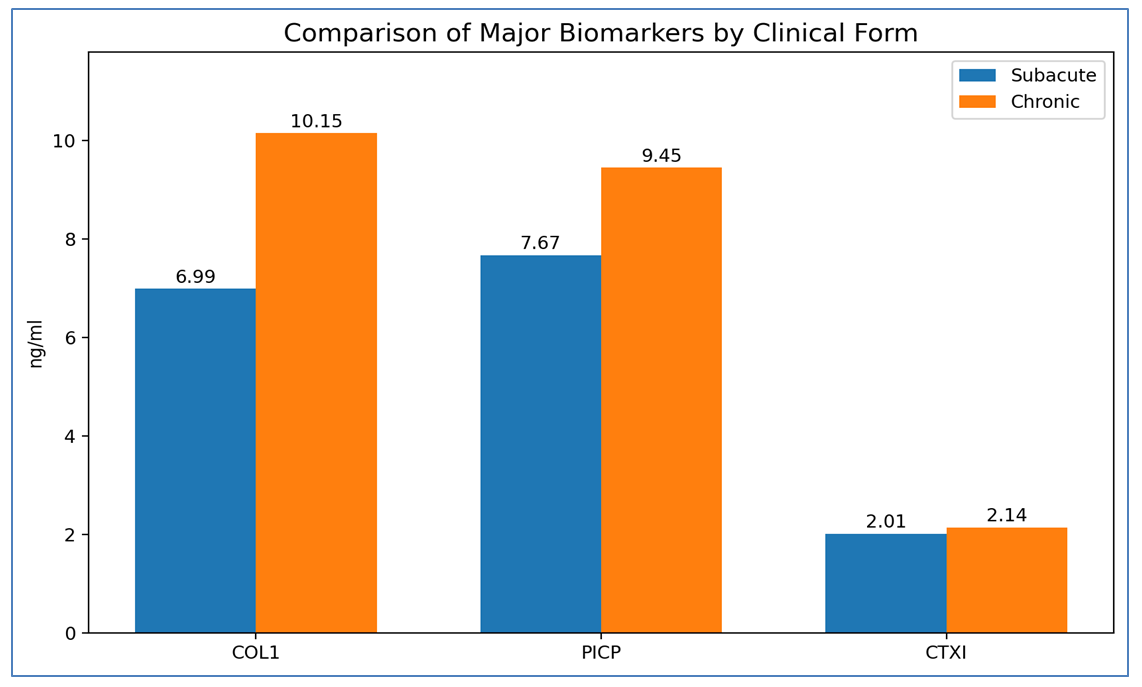 | Figure 1. COL1, PICP, and CTXI values by clinical form |
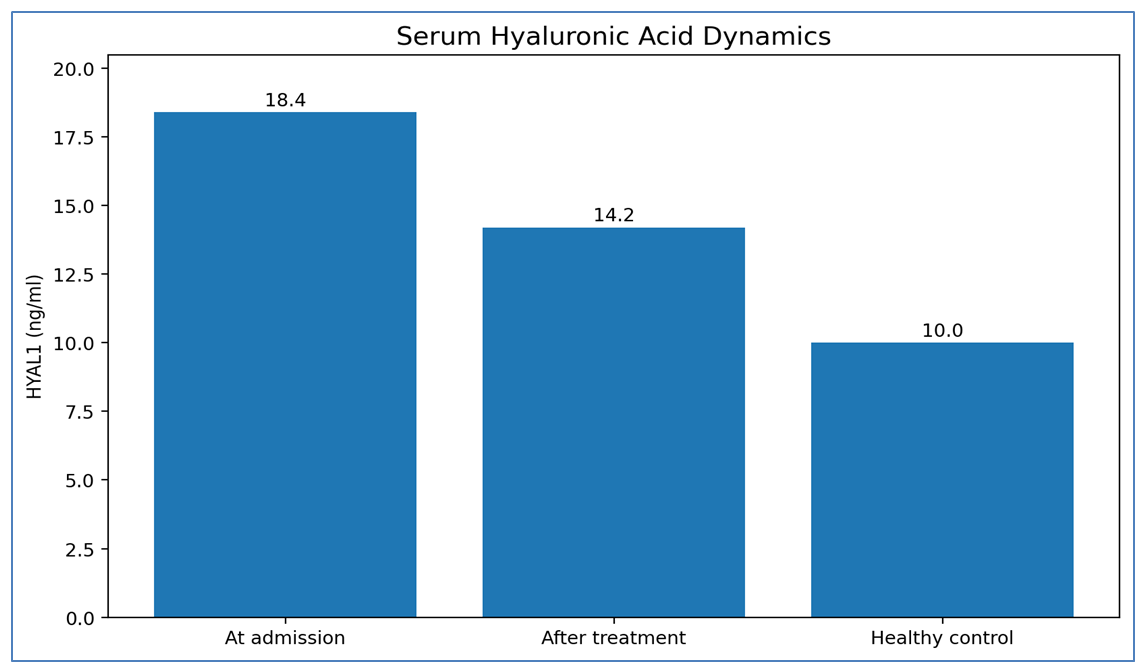 | Figure 2. Dynamics of serum hyaluronic acid (HYAL1) |
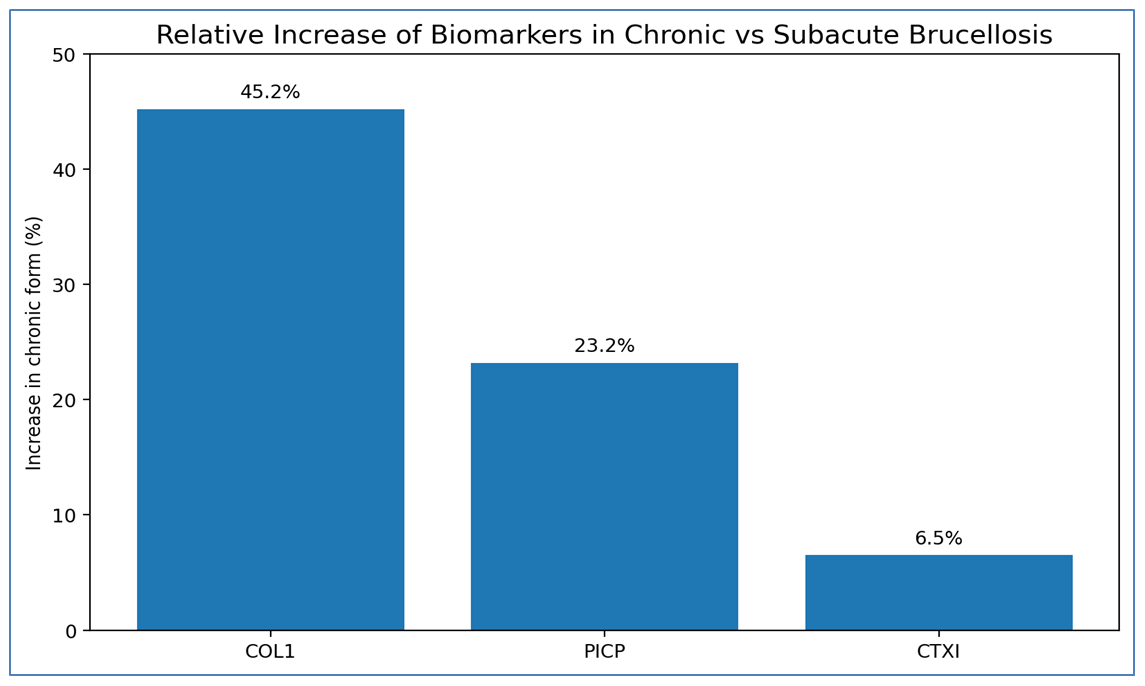 | Figure 3. Relative increase of biomarkers in chronic versus subacute brucellosis |
4. Discussion
- Interpretation of connective tissue biomarkers together with the clinical picture helps to clarify the mechanisms of chronic progression in brucellosis. In the subacute stage, increased collagen and hyaluronic acid probably reflect the coexistence of active inflammation and reparative response, whereas in the chronic form the imbalance between collagen synthesis and degradation is more closely associated with long-term degenerative and remodeling changes [2,4].From a clinical standpoint, these findings are highly relevant: normalization of temperature or favorable serological dynamics does not necessarily mean that the tissue-level pathological process has completely ended. In patients with persistent osteoarticular syndrome, biomarker monitoring may improve the assessment of treatment effectiveness, support decisions on rehabilitation, and help individualize dispensary follow-up [5,8].Recent proteomic studies indicate that serum biomarkers represent a promising direction for differentiating subacute and chronic brucellosis [6,7]. The clinical material analyzed in the present work supports this concept at the level of practical observation. Nevertheless, introduction of biomarkers into routine practice will require standardized cutoff values, prospective follow-up, and larger study populations.
5. Conclusions
- 1. Markers of connective tissue metabolism are elevated in both subacute and chronic brucellosis, but their increase is deeper and more persistent in the chronic form.2. Hyaluronic acid and collagen-related biomarkers may be considered laboratory reflections of musculoskeletal system involvement.3. Adding biomarker monitoring to clinical follow-up may help identify patients at high risk of chronicity, evaluate treatment effectiveness, and plan long-term dispensary supervision.