
-
Paper Information
- Paper Submission
-
Journal Information
- About This Journal
- Editorial Board
- Current Issue
- Archive
- Author Guidelines
- Contact Us
International Journal of Materials and Chemistry
p-ISSN: 2166-5346 e-ISSN: 2166-5354
2026; 16(4): 67-72
doi:10.5923/j.ijmc.20261604.02
Received: Aug. 12, 2026; Accepted: Sep. 6, 2026; Published: Sep. 9, 2026

Investigation of the Elemental Composition of "AS-MOMO" Medicinal Tea Ash Using Energy-Dispersive X-Ray Fluorescence Spectrometry
 Abstract
 Reference
 Full-Text PDF
 Full-text HTML
Yulbarsova Muattar Abdullajon daughter1, Khaidarov Eldor Rakhimjon son2, Khidarova Dilrabo Rakhimjonovna1, 2, Abdullayev Shavkat Vohidovich1, Turdaliyeva Sayyora Sherali qizi3
1Namangan State University, Namangan, Uzbekistan
2University of Business and Science, Uzbekistan
3Physician-laboratorian at the Namangan City Sanitary-Epidemiological Committee, Uzbekistan
Correspondence to: Abdullayev Shavkat Vohidovich, Namangan State University, Namangan, Uzbekistan.
| Email: |  |
Copyright © 2026 The Author(s). Published by Scientific & Academic Publishing.
This work is licensed under the Creative Commons Attribution International License (CC BY).
http://creativecommons.org/licenses/by/4.0/

The elemental composition of the “AS-MOMO” multicomponent herbal tea phytocomposition was investigated using energy-dispersive X-ray fluorescence (EDXRF) spectrometry. The phytocomposition consisted of the above-ground parts of Phlomoides brachystegia, flower buds of Sophora japonica, and tubers of Helianthus tuberosus at a mass ratio of 50:25:25. The plant materials were collected in June 2025 from the Qamchiq Pass area, Pop District, Namangan Region, Uzbekistan. The moisture content, total ash content, and extractive substance yield were 11.4%, 10.0%, and 21.0%, respectively. The ash obtained by incineration at 450–500 °C was analyzed using a Rigaku NEX CG EDXRF Analyzer with Polarization (Rigaku Corporation, Japan). The analysis revealed a complex elemental profile comprising major and trace constituents. Potassium (4.37 mg/g), sodium (3.53 mg/g), and chlorine (1.22 mg/g) were the predominant detected elements, followed by calcium (0.476 mg/g), phosphorus (0.356 mg/g), sulfur (0.322 mg/g), and silicon (0.137 mg/g). Among the biologically relevant trace elements, iron was detected at 0.0155 mg/g, while manganese, zinc, and copper were present at lower concentrations. The analysis also revealed zirconium, rubidium, silver, bromine, titanium, dysprosium, hafnium, tantalum, nickel, and arsenic. Nickel and arsenic were detected at 0.0005 and 0.0001 mg/g, respectively. The obtained elemental profile provides complementary information for the chemical characterization of the “AS-MOMO” phytocomposition. Since the measurements were performed on ash, the reported concentrations cannot be directly equated with elemental concentrations in the original herbal material or the corresponding tea infusion. Further studies are required to evaluate elemental transfer into the infusion and to confirm selected trace-element findings using validated complementary analytical methods.
Keywords: “AS-MOMO”, Herbal tea, Phlomoides brachystegia, Sophora japonica, Helianthus tuberosus, Elemental composition, Energy-dispersive X-ray fluorescence, EDXRF, Trace elements
Cite this paper: Yulbarsova Muattar Abdullajon daughter, Khaidarov Eldor Rakhimjon son, Khidarova Dilrabo Rakhimjonovna, Abdullayev Shavkat Vohidovich, Turdaliyeva Sayyora Sherali qizi, Investigation of the Elemental Composition of "AS-MOMO" Medicinal Tea Ash Using Energy-Dispersive X-Ray Fluorescence Spectrometry, International Journal of Materials and Chemistry, Vol. 16 No. 4, 2026, pp. 67-72. doi: 10.5923/j.ijmc.20261604.02.
Article Outline
1. Introduction
- Medicinal plants and multicomponent herbal preparations are important sources of biologically active compounds as well as essential and trace elements. In addition to secondary metabolites such as flavonoids, phenolic compounds, terpenoids, and essential oils, the elemental composition of plant materials may contribute to their chemical characteristics and nutritional properties. Mineral elements participate in a wide range of physiological and biochemical processes, including electrolyte and osmotic regulation, enzymatic reactions, cellular signaling, oxygen transport and metabolism, and antioxidant defense. Therefore, characterization of the elemental composition is an important component of the chemical profiling and quality assessment of medicinal plant materials and plant-based products [1,2].The major and trace elements present in plant-derived materials contribute to their mineral and physiological characteristics. Potassium and sodium are primarily associated with electrolyte and osmotic regulation, whereas calcium and phosphorus play important roles in mineral homeostasis, cellular signaling, and structural processes. Sulfur is an essential component of sulfur-containing amino acids and proteins, while silicon may contribute to structural and physiological processes in plants and may also reflect characteristics of the growing environment. Trace elements such as iron, manganese, zinc, and copper are involved in numerous enzymatic and redox processes. Iron is essential for electron-transfer reactions and oxygen-related metabolism, whereas manganese and copper participate in the activity of several antioxidant and metabolic enzymes. Zinc is involved in enzymatic catalysis, protein synthesis, and cellular regulation [2,3].The determination of elemental composition in medicinal plants and plant-derived products requires analytical approaches capable of providing reliable multielement information. Atomic absorption spectrometry (AAS) and inductively coupled plasma-based techniques, including ICP-OES and ICP-MS, offer high sensitivity and are widely used for elemental analysis; however, these methods commonly require digestion of the sample and additional chemical preparation. X-ray fluorescence (XRF) spectrometry provides an alternative approach for multielement analysis with relatively simple sample preparation. In particular, energy-dispersive X-ray fluorescence (EDXRF) enables the simultaneous determination of multiple elements over a broad analytical range and has been successfully applied to the characterization of medicinal plants and herbal teas [2–5].The “AS-MOMO” herbal tea is a multicomponent phytocomposition prepared from three plant-derived raw materials: the above-ground parts of Phlomoides brachystegia collected during the flowering stage, flower buds of Sophora japonica, and tubers of Helianthus tuberosus. These components were combined at a mass ratio of 50:25:25, respectively. The combination of botanically distinct plant materials results in a complex plant matrix containing diverse classes of primary and secondary metabolites as well as mineral elements. Therefore, characterization of the elemental profile of the final phytocomposition is relevant for establishing its overall chemical composition and supporting quality-oriented analytical assessment.Although the elemental composition of individual medicinal plant species and herbal tea materials has been investigated using various analytical techniques, information on the multielement profile of the “AS-MOMO” phytocomposition remains limited. In particular, the elemental composition of the ash obtained from the defined 50:25:25 mixture of Phlomoides brachystegia, Sophora japonica, and Helianthus tuberosus has not been systematically characterized using EDXRF. This represents an analytical gap, because the combination of different botanical materials may produce an elemental profile that cannot be inferred reliably from data obtained for individual plant species alone. Establishing the elemental profile of the final phytocomposition may therefore provide additional information for its chemical characterization and quality-oriented assessment.Accordingly, the aim of this study was to characterize the elemental composition of the “AS-MOMO” herbal tea phytocomposition ash using energy-dispersive X-ray fluorescence (EDXRF) spectrometry. The specific objectives were to identify the detected elements qualitatively and quantitatively, determine the predominant elements in the ash, and characterize selected trace elements of nutritional and safety-related interest, including iron, manganese, zinc, copper, nickel, and arsenic. The obtained results were intended to complement the chemical characterization of the “AS-MOMO” phytocomposition and provide baseline analytical information for further studies of its elemental transfer into tea infusions and its overall quality assessment.
2. Materials and Methods
2.1. Plant Materials and Preparation of the Phytocomposition
- The investigated “AS-MOMO” herbal tea phytocomposition consisted of three plant-derived raw materials: the above-ground parts of Phlomoides brachystegia collected during the flowering stage, flower buds of Sophora japonica, and tubers of Helianthus tuberosus. The components were combined at a mass ratio of 50:25:25, respectively.The plant materials were collected in June 2025 from the Qamchiq Pass area, Pop District, Namangan Region, Uzbekistan. The collected plant materials were botanically identified by a qualified specialist. After collection, the raw materials were dried under shade in a dry, well-ventilated environment protected from direct sunlight.The dried materials were separately ground using a laboratory mill and passed through a 2–4 mm sieve. The required amounts of the three components were then accurately weighed according to the specified 50:25:25 mass ratio and thoroughly mixed to obtain a homogeneous phytocomposition.The prepared phytocomposition was stored under dry conditions and protected from external contamination until physicochemical and elemental analyses were performed.
2.2. Physicochemical Characteristics and Ash Preparation
- The principal physicochemical characteristics of the “AS-MOMO” phytocomposition were determined using established pharmacopoeial procedures. Moisture content was determined gravimetrically, while the total ash content was determined by incinerating the sample in a muffle furnace at 450–500 °C until a constant mass was obtained. The content of extractive substances was evaluated based on the mass of the dry residue obtained from the corresponding extract.The moisture content, total ash content, and extractive substance yield of the “AS-MOMO” phytocomposition were 11.4%, 10.0%, and 21.0%, respectively.For elemental analysis, the phytocomposition was incinerated at 450–500 °C until a constant mass was achieved. The resulting ash was cooled and used as the analytical material for subsequent EDXRF analysis. The elemental concentrations reported in this study therefore refer specifically to the ash fraction and are expressed on an ash-mass basis.
2.3. Elemental Analysis by EDXRF Spectrometry
- The elemental composition of the “AS-MOMO” phytocomposition ash was determined using energy-dispersive X-ray fluorescence (EDXRF) spectrometry. Measurements were performed using a Rigaku NEX CG EDXRF Analyzer with Polarization (Rigaku Corporation, Japan).The ash sample obtained after incineration was subjected to X-ray fluorescence analysis, and the characteristic X-ray signals corresponding to the elements present in the sample were recorded. The acquired spectra were processed using the instrument’s analytical software, and the concentrations of the detected elements were calculated by the instrument software.The elemental concentrations were expressed as milligrams per gram of ash (mg/g). The analysis identified K, Na, Ca, P, S, Cl, Si, Fe, Mn, Zn, Cu, Sr, Zr, Rb, Ag, Dy, Br, Ni, As, Hf, and Ta.Because the analysis was performed on the ash fraction, the reported concentrations represent the elemental composition of the analyzed ash and should not be interpreted directly as concentrations in the original plant material or in the aqueous infusion of the herbal tea.
2.4. Data Processing and Analytical Considerations
- The quantitative elemental results obtained by EDXRF were expressed as milligrams per gram of ash (mg/g). The reported values were used to establish the elemental profile of the “AS-MOMO” phytocomposition ash and to identify the predominant and low-abundance elements detected under the applied analytical conditions.Particular attention was given to elements detected at very low concentrations, including nickel, arsenic, bromine, silver, hafnium, and tantalum. These results were interpreted as instrumental findings and were not used to establish toxicological safety or nutritional adequacy in the absence of method-specific detection limits, measurement uncertainty, and applicable regulatory reference values.The elemental concentrations obtained for the ash were not converted directly to concentrations in the original herbal material or tea infusion because such conversion requires consideration of the ash yield and, for infusion-based assessment, the extraction efficiency of individual elements. Therefore, the EDXRF results were interpreted specifically as the elemental composition of the analyzed ash fraction.
3. Results and Discussion
3.1. Elemental Composition of “AS-MOMO” Herbal Tea Ash
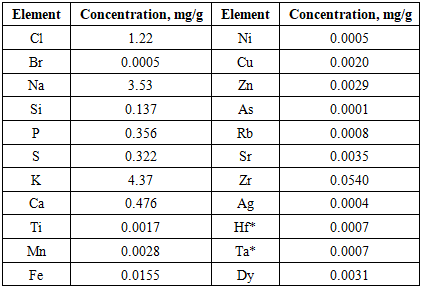
- The EDXRF analysis revealed a diverse elemental profile in the ash obtained from the “AS-MOMO” phytocomposition. The quantitative results for all detected elements are presented in Table 1.
|
3.2. Trace and Nutritionally Relevant Elements
- In addition to the predominant elements, several nutritionally relevant trace elements were detected in the “AS-MOMO” ash. Iron was present at 0.0155 mg/g, while manganese, zinc, copper, and strontium were detected at 0.0028, 0.0029, 0.0020, and 0.0035 mg/g, respectively.Iron, manganese, zinc, and copper are essential trace elements involved in numerous enzymatic, metabolic, and redox processes [1,2]. Iron participates in electron-transfer reactions and oxygen-related metabolism, whereas manganese and copper are components or cofactors of several enzymes involved in cellular metabolism and antioxidant defense. Zinc contributes to enzymatic catalysis, protein synthesis, and cellular regulation [1,2]. The detection of these elements in the “AS-MOMO” ash is therefore relevant to its overall elemental characterization.However, the concentrations determined in the present study should not be interpreted as evidence of a specific nutritional contribution of “AS-MOMO” tea. The reported values are expressed per gram of ash rather than per serving of the herbal material or infusion. Moreover, the transfer of individual elements from plant material into an aqueous infusion may vary considerably depending on the element, plant matrix, extraction conditions, and chemical form [2,4,5].Strontium was detected at 0.0035 mg/g. Although strontium is naturally present in many plant-derived materials, its detection in the present sample is reported primarily as part of the elemental profile rather than as an indicator of a specific nutritional or therapeutic effect.
3.3. Low-Abundance and Other Detected Elements
- In addition to the nutritionally relevant elements, the EDXRF analysis detected several elements at low concentrations, including zirconium (Zr), rubidium (Rb), silver (Ag), bromine (Br), titanium (Ti), dysprosium (Dy), hafnium (Hf), and tantalum (Ta). Zirconium was detected at 0.0540 mg/g, which was higher than the concentration of iron (0.0155 mg/g) and represented the highest concentration among the less abundant non-major elements detected in the analyzed ash.The presence of zirconium should be interpreted strictly as an analytical characteristic of the investigated ash and should not be considered evidence that Zr is an essential nutritional element for humans. Similarly, the detection of rubidium (0.0008 mg/g), silver (0.0004 mg/g), bromine (0.0005 mg/g), titanium (0.0017 mg/g), and dysprosium (0.0031 mg/g) contributes to the description of the multielement profile but does not, by itself, establish a biological or therapeutic role for these elements in the phytocomposition.Hafnium and tantalum were each recorded at 0.0007 mg/g. Because these concentrations were obtained directly from the instrumental analysis and the available dataset does not provide sufficient information on element-specific detection limits, measurement uncertainty, or spectral identification criteria, these values should be regarded as reported instrumental findings rather than as evidence of a biologically meaningful concentration.The occurrence of multiple low-abundance elements may reflect differences in elemental uptake among the three plant components, their growing environment, soil characteristics, and other environmental factors. However, the present study cannot determine the individual contribution of P. brachystegia, S. japonica, and H. tuberosus to these elemental findings because only the final 50:25:25 phytocomposition was analyzed. Separate analysis of each botanical component would therefore be required to clarify their respective contributions.
3.4. Safety-Related Elements: Nickel and Arsenic
- Nickel (Ni) and arsenic (As) were detected in the “AS-MOMO” ash at concentrations of 0.0005 and 0.0001 mg/g, respectively. Their detection is relevant from an analytical and quality-control perspective because both elements may require monitoring in plant-derived materials and herbal products [7,8].The presence of Ni and As in the analyzed ash does not, by itself, indicate that the product poses a health risk or, conversely, that it meets applicable safety requirements. Such an assessment requires comparison with the regulatory limits applicable to the specific product category, together with consideration of the analytical basis, units, serving size, and exposure scenario. Therefore, the present results are interpreted only as measured elemental concentrations in the analyzed ash.The occurrence of trace levels of potentially undesirable elements in medicinal plants may be influenced by plant species, plant organ, soil and substrate composition, geographical origin, environmental conditions, and anthropogenic inputs [1,8,11]. Since “AS-MOMO” is a multicomponent phytocomposition, the present analysis cannot establish which botanical component contributed to the detected Ni and As concentrations.Further investigation using validated complementary analytical techniques, such as ICP-MS or ICP-OES, would be useful for independent confirmation of these low-concentration findings. In addition, analysis of the corresponding tea infusion would be necessary to determine the extent to which Ni and As are transferred from the plant material into the aqueous extract.
3.5. Comparison with Previous Studies
- The elemental profile obtained for the “AS-MOMO” phytocomposition is generally consistent with the occurrence of potassium, calcium, phosphorus, sulfur, sodium, iron, manganese, zinc, and copper previously reported in medicinal plants and herbal tea materials [1,2,4,5,10–14]. However, the relative concentrations of individual elements may vary substantially among plant species and samples because elemental accumulation is influenced by botanical characteristics, plant organ, geographical origin, soil composition, environmental conditions, and analytical methodology [10,11,15].The predominance of potassium in the present study is consistent with previous investigations of herbal tea materials. Nunes et al. reported potassium as one of the major elements in commercial herbal tea plants and their corresponding infusions, although the concentrations varied among botanical species and between plant material and infusion [13]. Similarly, studies based on X-ray fluorescence and other spectrometric techniques have demonstrated that K, Ca, Fe, Mn, Zn, Cu, and other elements can occur at substantially different concentrations in medicinal plants and herbal products [10–12,14].The present study detected K at 4.37 mg/g ash, followed by Na at 3.53 mg/g and Cl at 1.22 mg/g. Calcium, phosphorus, sulfur, and silicon were detected at 0.476, 0.356, 0.322, and 0.137 mg/g, respectively. These findings confirm the multielement nature of the analyzed ash; however, direct numerical comparison with published values requires caution because previous studies have used different sample bases, including fresh or dried plant material, ash, and aqueous infusions [11–14].The detection of Fe, Mn, Zn, and Cu in the present “AS-MOMO” sample is also in agreement with their frequent occurrence in medicinal plants and herbal teas. Pohl et al. emphasized that the elemental composition of medicinal plants is affected by both plant-related and environmental factors and that reliable interpretation requires consideration of the analytical method and sample matrix [10]. Studies employing XRF-based approaches have likewise demonstrated the usefulness of multielement profiling for the characterization of herbal materials and herbal teas [12,14,15].The detection of Ni and As at 0.0005 and 0.0001 mg/g, respectively, further demonstrates the value of multielement screening for plant-derived materials. Previous studies have reported the occurrence of potentially undesirable elements in medicinal plants and herbal products, emphasizing the importance of monitoring their presence and, where appropriate, confirming low-level findings using validated analytical procedures [11,16,17].Overall, the elemental composition of “AS-MOMO” is broadly comparable in terms of the types of elements detected with profiles reported for medicinal plants and herbal teas, while the specific concentration pattern reflects the particular botanical composition and origin of the investigated phytocomposition. Because the present analysis was performed on ash, the results should be considered an elemental fingerprint of the analyzed ash fraction rather than a direct measure of elemental concentrations in the herbal infusion. Further comparative studies involving the individual plant components and their aqueous infusions would help clarify the contribution and transfer of individual elements.
3.6. Study Limitations and Analytical Considerations
- Several analytical considerations should be taken into account when interpreting the present results. First, all elemental concentrations were determined in the ash fraction and expressed as mg/g of ash. Consequently, these values cannot be directly converted into elemental concentrations of the original herbal material or the prepared tea infusion without accounting for the ash yield and, in the case of infusion studies, the extraction efficiency of individual elements.Second, “AS-MOMO” is a multicomponent phytocomposition containing P. brachystegia, S. japonica, and H. tuberosus in a 50:25:25 mass ratio. The analysis of the final mixture does not allow the contribution of each botanical component to the observed elemental profile to be determined. Separate elemental analysis of the individual raw materials would therefore be required to establish their respective contributions.Third, quantitative interpretation of EDXRF data depends on factors such as calibration procedure, matrix effects, instrumental sensitivity, detection limits, measurement uncertainty, and measurement repeatability. These parameters are particularly important for elements detected at very low concentrations. Therefore, where available, detailed instrumental validation data should accompany the reported concentrations.The low concentrations observed for As, Ni, Ag, Br, Hf, and Ta should consequently be interpreted with appropriate analytical caution. Independent confirmation using a complementary technique such as ICP-MS or ICP-OES may be useful, particularly for trace-level elements of safety-related interest.The present study did not investigate the chemical speciation, water solubility, transfer of elements into the tea infusion, or their bioavailability. Therefore, the measured total elemental concentrations cannot be used to estimate dietary intake, physiological effects, or toxicological risk from consumption of the herbal tea. Future studies should include replicate measurements, appropriate reference materials and analytical validation, together with separate analysis of the individual botanical components and the corresponding aqueous infusion.
4. Conclusions
- The elemental composition of the “AS-MOMO” multicomponent herbal tea phytocomposition ash was characterized using energy-dispersive X-ray fluorescence (EDXRF) spectrometry. A total of 21 elements, including K, Na, Cl, Ca, P, S, Si, Fe, Mn, Zn, Cu, Sr, Zr, Rb, Ag, Dy, Br, Ni, As, Hf, and Ta, were detected under the applied analytical conditions.Potassium (4.37 mg/g), sodium (3.53 mg/g), and chlorine (1.22 mg/g) were the predominant detected elements, while calcium, phosphorus, sulfur, and silicon were present at intermediate concentrations. Iron, manganese, zinc, and copper were detected at lower concentrations. Nickel and arsenic were detected at 0.0005 and 0.0001 mg/g, respectively, highlighting the relevance of multielement screening in the analytical characterization of plant-derived products.The obtained results demonstrate that the “AS-MOMO” phytocomposition ash possesses a diverse elemental profile. However, because the measurements were performed on ash, the reported concentrations cannot be directly interpreted as elemental concentrations in the original herbal material or in the corresponding tea infusion. The present findings therefore provide elemental characterization of the analyzed ash fraction rather than a direct estimate of nutritional intake or toxicological risk.Overall, EDXRF was applied as a practical analytical approach for characterizing the multielement composition of “AS-MOMO” herbal tea ash. Further studies involving separate analysis of the individual botanical components, validated complementary analytical techniques, and assessment of elemental transfer into the aqueous infusion are warranted to clarify the origin, extractability, and potential nutritional or safety significance of the detected elements.