
-
Paper Information
- Previous Paper
- Paper Submission
-
Journal Information
- About This Journal
- Editorial Board
- Current Issue
- Archive
- Author Guidelines
- Contact Us
International Journal of Materials and Chemistry
p-ISSN: 2166-5346 e-ISSN: 2166-5354
2026; 16(3): 51-58
doi:10.5923/j.ijmc.20261603.03
Received: May 20, 2026; Accepted: Jun. 19, 2026; Published: Jun. 26, 2026

Selection and Evaluation of Functional Vegetable Oils for Mayonnaise Formulation
 Abstract
 Reference
 Full-Text PDF
 Full-text HTML
Shakhnozakhon Gaipova, Akbarali Ruzibayev, Shakhnozakhon Salijonova
Tashkent institute of Chemical-Technology, Tashkent, Uzbekistan
Correspondence to: Shakhnozakhon Gaipova, Tashkent institute of Chemical-Technology, Tashkent, Uzbekistan.
| Email: |  |
Copyright © 2026 The Author(s). Published by Scientific & Academic Publishing.
This work is licensed under the Creative Commons Attribution International License (CC BY).
http://creativecommons.org/licenses/by/4.0/

Background: Mayonnaise is a widely consumed oil-in-water emulsion in which vegetable oils constitute 20–65% of the formulation. The nutritional quality of mayonnaise is largely determined by the fatty acid composition of the oil phase, particularly the ratio of omega-6 to omega-3 polyunsaturated fatty acids (PUFAs). Current dietary guidelines recommend an omega-6:omega-3 ratio between 3:1 and 10:1 for optimal health benefits. Objective: This study aimed to evaluate the physicochemical properties and fatty acid profiles of four vegetable oils commonly available in Uzbekistan—corn, sesame, soybean, and sunflower oils—to identify suitable candidates for developing nutritionally balanced mayonnaise formulations. Methods: Physicochemical parameters including density, viscosity, refractive index, iodine value, saponification value, acid value, and peroxide value were determined using standard analytical methods. Fatty acid composition was analyzed by gas chromatography, and omega-6:omega-3 ratios were calculated for each oil. Results: All four oils met quality standards for edible oils. Density ranged from 0.920 to 0.923 g/cm³, viscosity from 32.5 to 37.4 mm²/s, and iodine values from 108.1 to 136.1 g I₂/100g. Fatty acid analysis revealed that linoleic acid (omega-6) was the predominant PUFA in all oils (45.3–57.9%), while linolenic acid (omega-3) content varied dramatically (0.1–8.3%). Only soybean oil achieved an omega-6:omega-3 ratio within the recommended range (6.6:1), whereas corn, sesame, and sunflower oils exhibited substantially higher ratios (256:1, 453:1, and 579:1, respectively). However, soybean oil's high linolenic acid content (8.3%) renders it susceptible to oxidative deterioration. Conclusion: While soybean oil alone provides a favorable omega-6:omega-3 ratio, its oxidative instability necessitates blending with more stable oils. The development of optimized oil blends combining soybean oil with corn, sesame, or sunflower oils represents a promising strategy for formulating mayonnaise products with balanced fatty acid profiles and enhanced oxidative stability.
Keywords: Mayonnaise, Vegetable oil blends, Omega-3 fatty acids, Omega-6 fatty acids, Fatty acid composition, Oxidative stability, Soybean oil, Sunflower oil, Functional foods
Cite this paper: Shakhnozakhon Gaipova, Akbarali Ruzibayev, Shakhnozakhon Salijonova, Selection and Evaluation of Functional Vegetable Oils for Mayonnaise Formulation, International Journal of Materials and Chemistry, Vol. 16 No. 3, 2026, pp. 51-58. doi: 10.5923/j.ijmc.20261603.03.
Article Outline
1. Introduction
- Mayonnaise is one of the most widely consumed condiments globally, characterized as a semi-solid oil-in-water emulsion stabilized by egg yolk lecithin and other emulsifying agents. The oil phase typically constitutes 20–65% of the total formulation, making vegetable oils the primary determinant of mayonnaise's physicochemical, organoleptic, and nutritional properties [1]. Unlike many food products that undergo thermal processing, mayonnaise is consumed without heat treatment, which preserves the nutritional integrity of heat-sensitive components such as polyunsaturated fatty acids (PUFAs) and fat-soluble vitamins [2].The selection of appropriate vegetable oils for mayonnaise production is governed by multiple considerations, including oxidative stability, sensory characteristics, cost-effectiveness, and increasingly, nutritional value. Liquid vegetable oils are universally preferred over solid fats (such as palm oil, hydrogenated fats, or animal fats) because solid fats reduce shelf life and accelerate emulsion phase separation [3]. Among liquid oils, those rich in PUFAs have gained particular attention due to their established cardiovascular and anti-inflammatory health benefits [4].In recent decades, considerable research has focused on the physiological roles of specific fatty acids, particularly omega-3 (n-3) and omega-6 (n-6) PUFAs. Omega-6 fatty acids, primarily linoleic acid (C18:2), and omega-3 fatty acids, particularly alpha-linolenic acid (ALA, C18:3), are essential fatty acids that must be obtained through diet. While both families are necessary for human health, their balance is critical: excessive omega-6 intake relative to omega-3 promotes pro-inflammatory pathways, whereas a balanced ratio supports cardiovascular health, reduces chronic inflammation, and may lower the risk of metabolic disorders [5], [6]. Current dietary guidelines recommend an omega-6:omega-3 ratio between 3:1 and 10:1, yet typical Western diets often exhibit ratios exceeding 15:1 [7].No single natural vegetable oil possesses an ideal fatty acid profile that meets these recommendations. Consequently, blending oils with complementary compositions has emerged as a practical strategy to achieve nutritionally balanced fat bases for food products [8], [9]. This approach is particularly relevant for mayonnaise, where the product's flavor profile can effectively mask the distinctive tastes and aromas of specialty oils that consumers might otherwise find unpalatable when used alone [10].In Uzbekistan, sunflower oil dominates the edible oil market and is the most widely consumed oil for both cooking and food preparation. However, sunflower oil contains minimal omega-3 fatty acids, resulting in a highly imbalanced omega-6:omega-3 ratio. Other oils such as corn, sesame, and soybean oils are available but remain underutilized in the local diet. Sesame oil, despite its ancient cultivation history in the region, is more commonly consumed as whole seeds rather than extracted oil. Corn and soybean oils have only recently gained market presence and are often sold in blended forms [11].The objective of this study was to systematically evaluate the physicochemical properties and fatty acid compositions of four vegetable oils readily available in Uzbekistan—corn, sesame, soybean, and sunflower oils—to identify suitable candidates for developing nutritionally optimized mayonnaise formulations. By characterizing these oils comprehensively, this research provides a scientific foundation for formulating oil blends that achieve favorable omega-6:omega-3 ratios while maintaining oxidative stability and sensory acceptability.
2. Materials and methods
2.1. Oil Selection and Sample Preparation
- Four commercially available vegetable oils were selected for this study based on their local availability, high PUFA content, and suitability for mayonnaise production: corn oil, sesame oil, soybean oil, and sunflower oil. All oils were purchased from local markets in Uzbekistan and were of food-grade quality intended for direct human consumption. Samples were stored in their original sealed containers at room temperature (20 ± 2°C) in the dark until analysis to minimize oxidative degradation. Prior to analysis, oil samples were allowed to equilibrate to room temperature and were gently mixed to ensure homogeneity.
2.2. Physicochemical Analysis
- Physicochemical parameters were determined using standard analytical methods for edible oils and fats. All measurements were performed in triplicate, and results are reported as mean values.Density was measured at 20°C using a calibrated pycnometer according to standard procedures. Results are expressed in g/cm³.Kinematic viscosity was determined at 20°C using a calibrated capillary viscometer. Results are expressed in mm²/s.Refractive index was measured at 20°C using an Abbe refractometer calibrated with distilled water.Iodine value (a measure of unsaturation) was determined by the Wijs method and expressed as g I₂/100 g oil.Saponification value (an indicator of average molecular weight) was determined by titration and expressed as mg KOH/g oil.Acid value (a measure of free fatty acid content and oil quality) was determined by titration with standardized potassium hydroxide solution and expressed as mg KOH/g oil.Peroxide value (an indicator of primary oxidation products) was determined by iodometric titration and expressed as mmol O₂/kg oil.
2.3. Organoleptic Evaluation
- Organoleptic characteristics including color, clarity, odor, taste, and presence of sediment were evaluated by a trained sensory panel consisting of five experienced assessors. Evaluations were conducted under standardized conditions with adequate lighting and at room temperature. Panelists assessed each oil independently and recorded descriptive observations.
2.4. Fatty Acid Composition Analysis
- Fatty acid composition was determined by gas chromatography following conversion of triacylglycerols to fatty acid methyl esters (FAMEs). Oil samples (approximately 50 mg) were transesterified using a methanolic sodium hydroxide solution followed by boron trifluoride-methanol reagent. The resulting FAMEs were extracted with hexane and analyzed using a gas chromatograph equipped with a flame ionization detector (FID) and a capillary column suitable for FAME separation (e.g., 30 m × 0.25 mm i.d., 0.25 μm film thickness). Fatty acids were identified by comparison of retention times with authentic standards and quantified by peak area normalization. Results are expressed as percentage of total fatty acids.
2.5. Calculation of Omega-6:Omega-3 Ratios
- The omega-6:omega-3 ratio was calculated for each oil based on the fatty acid composition data. Omega-6 fatty acids were represented primarily by linoleic acid (C18:2), while omega-3 fatty acids were represented by alpha-linolenic acid (C18:3). The ratio was calculated as:Omega-6:Omega-3 ratio = (% Linoleic acid) / (% Linolenic acid)These ratios were compared against the recommended range of 3:1 to 10:1 established by nutritional guidelines.
3. Results and Discussion
3.1. Physicochemical and Organoleptic Properties
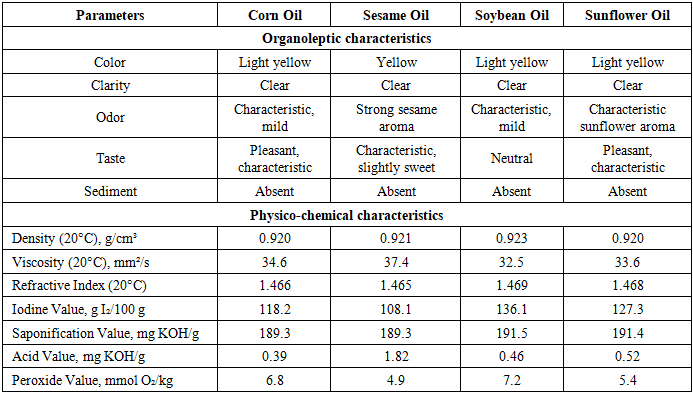
- The physicochemical and organoleptic characteristics of the four vegetable oils are presented in Table 3.1. All oils exhibited acceptable organoleptic properties, appearing clear and free from sediment. Color ranged from light yellow (corn, soybean, and sunflower oils) to yellow (sesame oil). Odor and taste characteristics were distinctive for each oil type, with sesame oil displaying the most pronounced aroma and a slightly sweet taste, while soybean oil exhibited a neutral taste profile.
|
3.2. Fatty Acid Composition
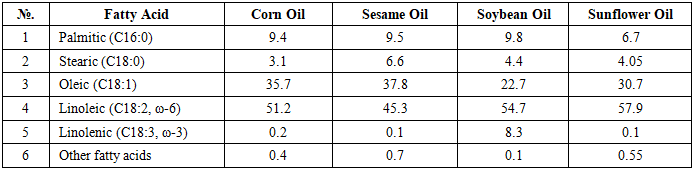
- The fatty acid compositions of the four oils are summarized in Table 3.2. All oils contained predominantly unsaturated fatty acids, with total unsaturation ranging from 83.2% to 88.7%.
|
3.3. Omega-6 and Omega-3 Content
- Figure 3.1 illustrates the comparative content of omega-6 and omega-3 fatty acids in the four oils. Sunflower oil exhibited the highest omega-6 content (57.9%), followed by soybean oil (54.7%), corn oil (51.2%), and sesame oil (45.3%). In stark contrast, omega-3 content was negligible in corn, sesame, and sunflower oils (0.1–0.2%), while soybean oil contained a substantially higher level (8.3%).
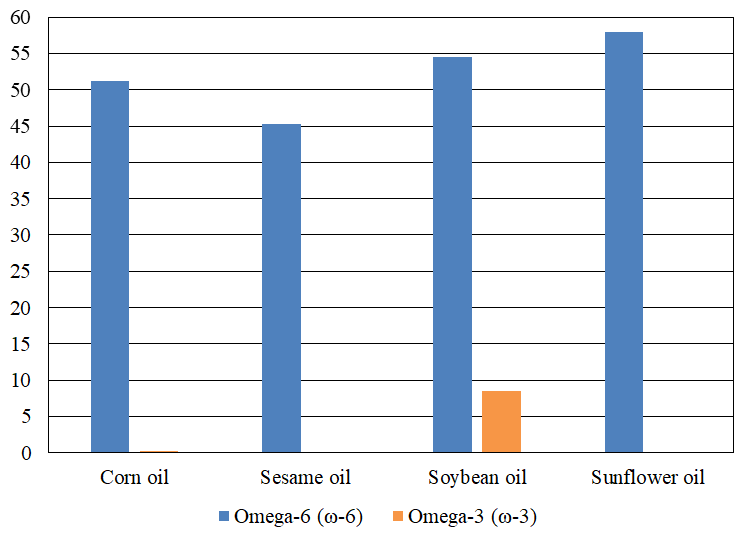 | Figure 3.1. Content of Omega-6 (ω-6) and Omega-3 (ω-3) Fatty Acids in Selected Vegetable Oils |
3.4. Omega-6:Omega-3 Ratios
- The calculated omega-6:omega-3 ratios for each oil are presented in Figure 3.2 and compared against the recommended range of 3:1 to 10:1. Soybean oil exhibited a ratio of 6.6:1, falling within the recommended range. In contrast, corn oil (256:1), sesame oil (453:1), and sunflower oil (579:1) all exhibited ratios far exceeding the recommended upper limit.
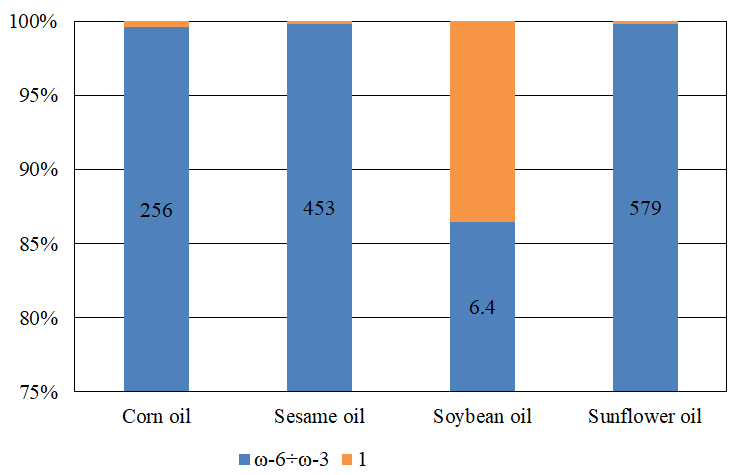 | Figure 3.2. Omega-6:Omega-3 Fatty Acid Ratios in Selected Vegetable Oils Compared to Recommended Range |
4. Discussion
4.1. Interpretation of Physicochemical Properties
- The physicochemical analysis confirmed that all four vegetable oils met established quality standards for edible oils. The relatively narrow range of density values (0.920–0.923 g/cm³) is consistent with the similar molecular weights of the predominant triacylglycerols in these oils. Viscosity differences, while modest, reflect variations in fatty acid chain length, degree of unsaturation, and temperature-dependent molecular interactions. Sesame oil's higher viscosity (37.4 mm²/s) may contribute to enhanced emulsion stability in mayonnaise formulations, as higher viscosity oils can improve the structural integrity of oil-in-water emulsions [12].The iodine values observed in this study align with literature values for these oil types and directly correlate with the degree of unsaturation. Soybean oil's highest iodine value (136.1 g I₂/100 g) reflects its elevated content of polyunsaturated fatty acids, particularly linolenic acid. While high unsaturation is nutritionally desirable, it also increases susceptibility to oxidative degradation, as discussed in Section 4.4.Acid values for all oils were low, indicating minimal hydrolytic rancidity and good initial quality. Sesame oil's slightly elevated acid value (1.82 mg KOH/g) remained well within acceptable limits and may reflect natural variations in processing or storage conditions. Peroxide values, while higher than acid values, were also within acceptable ranges for fresh oils. The relatively higher peroxide values in soybean oil (7.2 mmol O₂/kg) and corn oil (6.8 mmol O₂/kg) suggest incipient oxidation, consistent with their higher PUFA content [13].
4.2. Fatty Acid Profiles and Nutritional Implications
- The fatty acid composition data reveal significant differences among the four oils that have important nutritional implications. All oils contained high proportions of unsaturated fatty acids (83.9–89.25%), consistent with their classification as liquid vegetable oils. However, the distribution of specific fatty acids varied considerably.Linoleic acid (omega-6) was the predominant fatty acid in all samples, accounting for 45.3–57.9% of total fatty acids. This finding is consistent with previous studies on these oil types [14], [15]. While linoleic acid is an essential fatty acid with important physiological functions, excessive intake relative to omega-3 fatty acids has been associated with pro-inflammatory states and increased risk of chronic diseases [16].The most striking difference among the oils was in linolenic acid (omega-3) content. Soybean oil's linolenic acid content (8.3%) was 41–83 times higher than that of the other three oils (0.1–0.2%). This finding is consistent with the known fatty acid profiles of these oils and explains soybean oil's unique position as the only oil in this study with a favorable omega-6:omega-3 ratio [17], [18].Oleic acid, a monounsaturated fatty acid associated with cardiovascular health benefits, was present in moderate amounts in all oils (22.7–37.8%). Sesame oil contained the highest proportion (37.8%), which may contribute to its oxidative stability despite containing substantial PUFAs [19].
4.3. Omega-6:Omega-3 Ratios and Health Recommendations
- The omega-6:omega-3 ratios calculated in this study reveal a critical nutritional limitation of corn, sesame, and sunflower oils when used as sole fat sources. With ratios ranging from 256:1 to 579:1, these oils are profoundly imbalanced relative to the recommended range of 3:1 to 10:1 [20], [21]. This imbalance reflects the near-absence of omega-3 fatty acids in these oils.Soybean oil was the only oil that achieved a ratio (6.6:1) within the recommended range, making it nutritionally superior from the perspective of essential fatty acid balance. This finding is consistent with recent studies demonstrating that soybean oil can contribute to improved omega-3 status when incorporated into the diet [22], [23]. Several recent studies have successfully developed mayonnaise formulations with balanced omega-6:omega-3 ratios using oil blends. For example, mayonnaise formulated with flaxseed and chia seed oils achieved omega-6:omega-3 ratios within the recommended 1–5 range while maintaining acceptable sensory properties [2]. Similarly, a blend of rapeseed, corn, and walnut oils produced mayonnaise with a 1:5 omega-3:omega-6 ratio, with a 50-gram serving providing approximately 73% of the daily omega-3/omega-6 requirement for women and 59% for men aged 18-29 [4].The health implications of omega-6:omega-3 imbalance are well-documented. Excessive omega-6 intake promotes the production of pro-inflammatory eicosanoids, while adequate omega-3 intake supports the synthesis of anti-inflammatory mediators [24]. Epidemiological studies have linked high omega-6:omega-3 ratios to increased risk of cardiovascular disease, metabolic syndrome, inflammatory disorders, and certain cancers [25]. Conversely, balanced ratios are associated with reduced inflammation, improved cardiovascular health, and better metabolic outcomes [26].
4.4. Oxidative Stability Concerns
- While soybean oil's favorable omega-6:omega-3 ratio is nutritionally advantageous, its high linolenic acid content (8.3%) presents a significant challenge for oxidative stability. Linolenic acid, with three double bonds, is highly susceptible to oxidation—approximately 2.5 times more reactive than linoleic acid (two double bonds) and 10 times more reactive than oleic acid (one double bond) [27]. This heightened reactivity can lead to the formation of off-flavors, loss of nutritional value, and accumulation of potentially harmful oxidation products during storage.The peroxide value data from this study support this concern: soybean oil exhibited the highest peroxide value (7.2 mmol O₂/kg) among the four oils, despite being a fresh commercial sample. This suggests that oxidation had already begun, even under normal storage conditions. Previous research has demonstrated that mayonnaise formulated with high-linolenic oils requires careful attention to oxidative stability through the use of antioxidants, protective packaging, and controlled storage conditions [28], [29].In contrast, corn, sesame, and sunflower oils, with their minimal linolenic acid content, exhibit superior oxidative stability. Sesame oil, in particular, demonstrated the lowest peroxide value (4.9 mmol O₂/kg) and contains natural antioxidants such as sesamol and sesamin that provide additional protection against oxidation [30]. Studies have shown that blending oils with different oxidative stabilities can result in synergistic protective effects, with more stable oils helping to preserve the nutritional quality of more vulnerable oils [31], [32].
4.5. Rationale for Oil Blending
- The findings of this study clearly demonstrate that no single oil among those evaluated possesses both an optimal omega-6:omega-3 ratio and high oxidative stability. Soybean oil achieves the desired fatty acid balance but is oxidatively vulnerable, while corn, sesame, and sunflower oils are more stable but nutritionally imbalanced. This dichotomy provides a compelling rationale for developing blended oil formulations that combine the nutritional advantages of soybean oil with the stability characteristics of the other oils.Oil blending strategies have been successfully employed in numerous studies to achieve balanced fatty acid profiles while maintaining product quality. Research has demonstrated that blending sunflower oil with flaxseed oil in appropriate proportions can achieve omega-6:omega-3 ratios within the recommended range while maintaining acceptable oxidative stability and sensory properties [33], [34]. Similarly, blends of sunflower, linseed, and safflower oils have been used to develop functional mayonnaise products with balanced omega-3 and omega-6 content that meet regulatory requirements [1].For mayonnaise applications specifically, oil blending offers additional advantages beyond nutritional optimization. The distinctive flavors of specialty oils (such as sesame or flaxseed) can be moderated by blending with more neutral oils, improving consumer acceptability [35]. Furthermore, the emulsifying properties and rheological behavior of mayonnaise can be fine-tuned by adjusting the fatty acid composition of the oil phase through strategic blending [36].In the context of Uzbekistan, where sunflower oil dominates the market and consumer preferences are well-established, blending soybean oil with sunflower oil represents a particularly practical approach. Such blends could improve the nutritional profile of widely consumed mayonnaise products while maintaining familiar sensory characteristics and leveraging existing supply chains. The addition of sesame oil to such blends could provide both oxidative protection and distinctive flavor notes that may appeal to local preferences [30].Based on the findings of this study, we recommend the development and evaluation of oil blends combining soybean oil (to provide omega-3 fatty acids) with one or more of the other oils studied (to enhance oxidative stability and sensory acceptability). Optimal blend ratios should be determined through systematic experimentation, considering not only fatty acid balance but also oxidative stability, emulsion properties, sensory characteristics, and cost-effectiveness.
5. Conclusions
- This study provides a comprehensive physicochemical and nutritional characterization of four vegetable oils commonly available in Uzbekistan for potential use in mayonnaise formulation. All four oils—corn, sesame, soybean, and sunflower—met quality standards for edible oils and exhibited high levels of unsaturated fatty acids. However, significant differences were observed in their fatty acid profiles, particularly with respect to omega-3 content and omega-6:omega-3 ratios.Soybean oil was the only oil that achieved an omega-6:omega-3 ratio (6.6:1) within the recommended range of 3:1 to 10:1, owing to its substantial linolenic acid content (8.3%). In contrast, corn, sesame, and sunflower oils exhibited highly imbalanced ratios (256:1, 453:1, and 579:1, respectively) due to their minimal omega-3 content. However, soybean oil's high linolenic acid content renders it susceptible to oxidative deterioration, as evidenced by its elevated peroxide value and iodine value.These findings demonstrate that no single oil possesses both optimal nutritional balance and high oxidative stability, providing a clear rationale for developing blended oil formulations. By combining soybean oil with more oxidatively stable oils such as corn, sesame, or sunflower oil, it should be possible to formulate mayonnaise products that achieve favorable omega-6:omega-3 ratios while maintaining acceptable shelf life and sensory quality.Future research should focus on: (1) developing and optimizing specific oil blend formulations with targeted omega-6:omega-3 ratios; (2) evaluating the oxidative stability, emulsion properties, and sensory characteristics of mayonnaise prepared with these blends; (3) conducting shelf-life studies under various storage conditions; and (4) assessing consumer acceptance of mayonnaise products formulated with optimized oil blends. Such research will contribute to the development of functional mayonnaise products that support public health objectives while meeting consumer expectations for quality and taste.