
-
Paper Information
- Next Paper
- Paper Submission
-
Journal Information
- About This Journal
- Editorial Board
- Current Issue
- Archive
- Author Guidelines
- Contact Us
International Journal of Materials and Chemistry
p-ISSN: 2166-5346 e-ISSN: 2166-5354
2026; 16(3): 44-50
doi:10.5923/j.ijmc.20261603.02
Received: May 27, 2026; Accepted: Jun. 22, 2026; Published: Jun. 26, 2026

Formulation and Evaluation of Functional Oil Blends with a Balanced Omega-6 and Omega-3 Fatty Acid Ratio for Mayonnaise Production
 Abstract
 Reference
 Full-Text PDF
 Full-text HTML
Shakhnozakhon Gaipova, Akbarali Ruzibayev, Shakhnozakhon Salijonova
Tashkent institute of Chemical-Technology, Tashkent, Uzbekistan
Correspondence to: Shakhnozakhon Gaipova, Tashkent institute of Chemical-Technology, Tashkent, Uzbekistan.
| Email: |  |
Copyright © 2026 The Author(s). Published by Scientific & Academic Publishing.
This work is licensed under the Creative Commons Attribution International License (CC BY).
http://creativecommons.org/licenses/by/4.0/

This study investigated the impact of functional vegetable oil blends on the oxidative stability and quality characteristics of mayonnaise during 180-day storage. Four vegetable oils (corn, sesame, soybean, and sunflower) were analyzed for physicochemical properties, fatty acid composition, and biologically active compounds. Fourteen oil blends with varying proportions were formulated to optimize the omega-6 to omega-3 (ω-6:ω-3) fatty acid ratio while maintaining oxidative stability. Results showed that all individual oils contained 83.2%–88.7% unsaturated fatty acids, with only soybean oil achieving the recommended ω-6:ω-3 ratio of 6.4:1. Corn oil exhibited the highest phytosterol content (870.9 mg/100 g), while sesame oil was the exclusive source of lignans (514.2 mg/100 g). Mayonnaise samples prepared with oil blends were evaluated for peroxide and anisidine values throughout storage. The optimal blend composition of 60:30:10 (soybean:sesame:corn) achieved a ω-6:ω-3 ratio of approximately 10:1 with acceptable oxidative stability (peroxide value 6.8 mmol O₂/kg after 180 days). Increasing soybean oil content enhanced tocopherol levels but reduced phytosterols, squalene, and lignans, resulting in decreased oxidative stability due to higher polyunsaturated fatty acid concentration.
Keywords: Mayonnaise, Functional oils, Oxidative stability, Omega-3 fatty acids, Oil blends, Phytosterols, Tocopherols
Cite this paper: Shakhnozakhon Gaipova, Akbarali Ruzibayev, Shakhnozakhon Salijonova, Formulation and Evaluation of Functional Oil Blends with a Balanced Omega-6 and Omega-3 Fatty Acid Ratio for Mayonnaise Production, International Journal of Materials and Chemistry, Vol. 16 No. 3, 2026, pp. 44-50. doi: 10.5923/j.ijmc.20261603.02.
Article Outline
1. Introduction
- Mayonnaise is one of the most widely consumed oil-in-water emulsion products globally, with vegetable oils constituting approximately 70–80% of its composition [5]. The nutritional quality and oxidative stability of mayonnaise are primarily determined by the type and composition of oils used in its formulation. Contemporary consumer demand for functional foods has driven research toward developing mayonnaise products with enhanced nutritional profiles [1,2], particularly regarding essential fatty acid balance and bioactive compound content.The ratio of omega-6 to omega-3 (ω-6:ω-3) polyunsaturated fatty acids (PUFAs) in the human diet has received considerable attention due to its implications for cardiovascular health, inflammatory responses, and chronic disease prevention [20,21]. Current Western diets typically exhibit ω-6:ω-3 ratios ranging from 15:1 to 20:1 [20], substantially higher than the recommended ratio of 5:1 to 10:1 [21]. Vegetable oils represent a primary dietary source of these essential fatty acids, making them critical targets for nutritional optimization in processed foods.Beyond fatty acid composition, vegetable oils contain various biologically active compounds including tocopherols, phytosterols, carotenoids, phospholipids, squalene, and lignans [9]. These compounds contribute not only to the nutritional value of oil-based products but also serve as natural antioxidants that influence oxidative stability during processing and storage. Tocopherols function as primary chain-breaking antioxidants [10], while phytosterols have been associated with cholesterol-lowering effects [14,16]. Lignans, particularly abundant in sesame oil, exhibit antioxidant and potential anticancer properties [15].However, a fundamental challenge exists in formulating mayonnaise with optimized fatty acid profiles: oils rich in omega-3 fatty acids and other PUFAs are inherently more susceptible to oxidative degradation [4,6]. Lipid oxidation in mayonnaise leads to the formation of hydroperoxides, aldehydes, ketones, and other secondary oxidation products [13] that compromise sensory quality, nutritional value, and safety. The peroxide value and anisidine value serve as key indicators of primary and secondary oxidation products [19], respectively.Previous studies have explored various strategies to enhance mayonnaise stability, including the use of natural antioxidants, modified processing conditions, and alternative oil sources [1,5,13]. However, limited research has systematically investigated the relationship between functional oil blend composition, bioactive compound profiles, and long-term oxidative stability in mayonnaise systems. Understanding these relationships is essential for developing mayonnaise products that simultaneously meet nutritional recommendations and maintain acceptable shelf life without excessive reliance on synthetic additives.The objectives of this study were to: (1) characterize the physicochemical properties, fatty acid composition, and bioactive compound content of four functional vegetable oils (corn, sesame, soybean, and sunflower); (2) develop and evaluate oil blends with optimized ω-6:ω-3 ratios; (3) assess the physicochemical properties and bioactive compound profiles of selected oil blends.
2. Materials and Methods
2.1. Materials
- Four refined vegetable oils were obtained from commercial sources: corn oil, sesame oil, soybean oil, and sunflower oil. All oils met quality standards for refined edible oils according to international specifications.
2.2. Oil Blend Preparation
- Fourteen oil blends were prepared by mixing soybean, sesame, corn, and sunflower oils in varying proportions to achieve target ω-6:ω-3 fatty acid ratios. Oils were weighed using an analytical balance (precision ±0.01 g) and thoroughly mixed at room temperature (20 ± 2°C) using a magnetic stirrer for 30 minutes to ensure homogeneity. Blend compositions ranged from equal proportions (25:25:25:25) to soybean-dominant formulations (up to 90% soybean oil). Based on preliminary fatty acid analysis and oxidative stability screening, four blends were selected for detailed characterization: 60:30:10:0, 70:20:10:0, 80:10:10:0, and 90:5:5:0 (soybean:sesame:corn:sunflower, % w/w).
2.3. Analytical Methods
- Physicochemical properties: Density was determined at 20°C using a pycnometer according to standard methods. Kinematic viscosity was measured at 20°C using a calibrated Ubbelohde viscometer. Refractive index was determined at 20°C using an Abbe refractometer. Iodine value was determined by the Wijs method. Saponification value was measured by standard alkaline hydrolysis. Acid value was determined by titration with standardized potassium hydroxide solution. Peroxide value was measured by the iodometric method and expressed as mmol O₂/kg oil. Anisidine value was determined spectrophotometrically at 350 nm.Fatty acid composition: Fatty acid methyl esters (FAMEs) were prepared by transesterification with methanolic sodium hydroxide followed by boron trifluoride-methanol reagent. FAMEs were analyzed by gas chromatography using a capillary column (30 m × 0.25 mm i.d., 0.25 μm film thickness) with flame ionization detection. Fatty acids were identified by comparison with authentic standards and quantified as percentage of total fatty acids.Biologically active compounds: Total tocopherol content was determined by high-performance liquid chromatography (HPLC) with fluorescence detection following saponification and extraction. Phytosterol content was measured by gas chromatography-mass spectrometry (GC-MS) after derivatization. Carotenoid content was determined spectrophotometrically at 450 nm after extraction with petroleum ether. Phospholipid content was determined by phosphorus analysis following acid digestion. Squalene content was measured by HPLC with UV detection at 210 nm. Lignan content (sesamin and sesamolin) was determined by HPLC with UV detection at 280 nm.
2.4. Statistical Analysis
- All analyses were performed in triplicate, and results are expressed as mean ± standard deviation. Data were analyzed using analysis of variance (ANOVA) followed by Tukey's post-hoc test for multiple comparisons. Statistical significance was set at p < 0.05. Correlation analysis was performed to assess relationships between oil blend composition, bioactive compound content, and oxidative stability parameters.
3. Result and Discussion
3.1. Biologically Active Compounds in Individual Oils
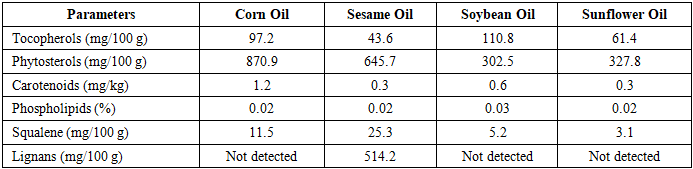
- The biologically active compound profiles of the four vegetable oils are presented in Table 1. Substantial differences were observed among the oils, reflecting their distinct botanical origins and processing histories.
|
3.2. Oil Blend Development and Fatty Acid Ratios
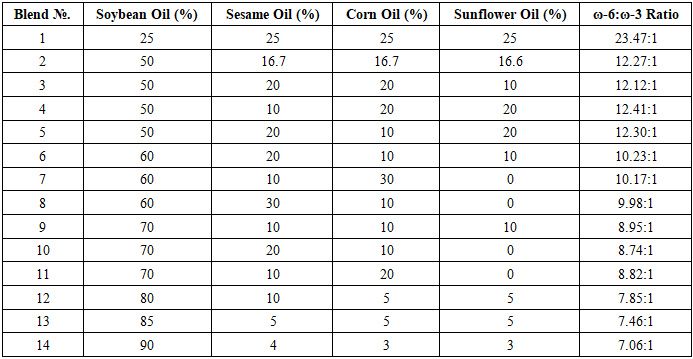
- The data presented in Table 2 indicate that increasing the proportion of soybean oil in the blend from 25% to 90% resulted in a decrease in the ω-3:ω-6 ratio from 23.47:1 to 7.06:1. When the soybean oil content exceeded 60%, the ω-3:ω-6 ratio fell below 10:1.
|
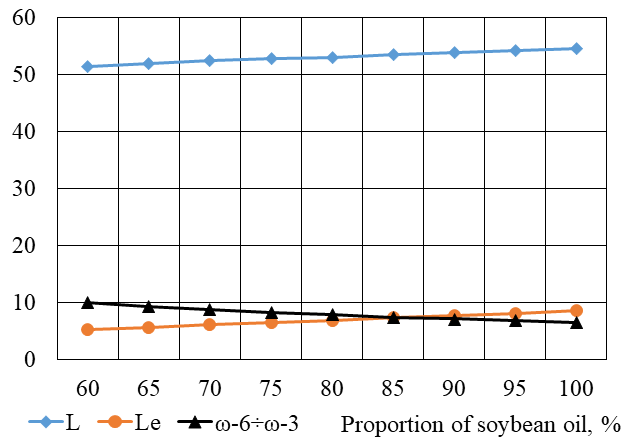 | Figure 1. Changes in the Contents of ω-3 and ω-6 Fatty Acids and their Ratio as a Function of the Proportions of Oils in the Blend |
3.3. Physicochemical Properties of Selected Oil Blends
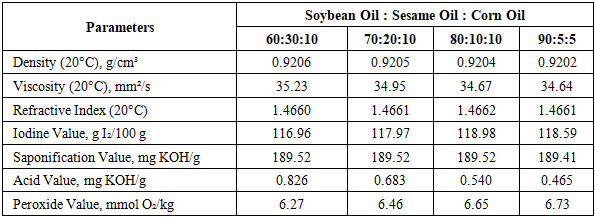
- The physicochemical properties of the four selected oil blends are presented in Table 3. All blends exhibited properties within acceptable ranges for refined vegetable oils.
|
3.4. Fatty Acid Composition of Oil Blends
- The fatty acid composition of the four selected oil blends is presented in Table 4. Systematic changes in fatty acid profile were observed as a function of blend composition.
|
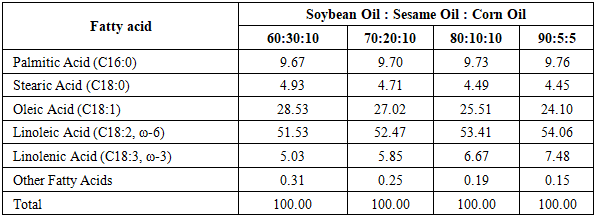
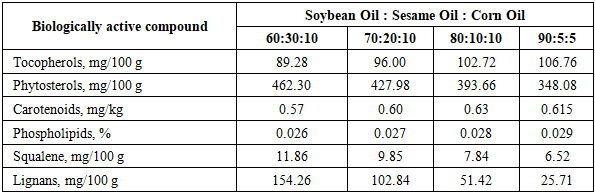
3.5. Biologically Active Compounds in Oil Blends
- The content of biologically active compounds in the four selected oil blends is presented in Table 5. Blend composition had substantial effects on the profiles of these health-promoting and stability-influencing compounds.
|
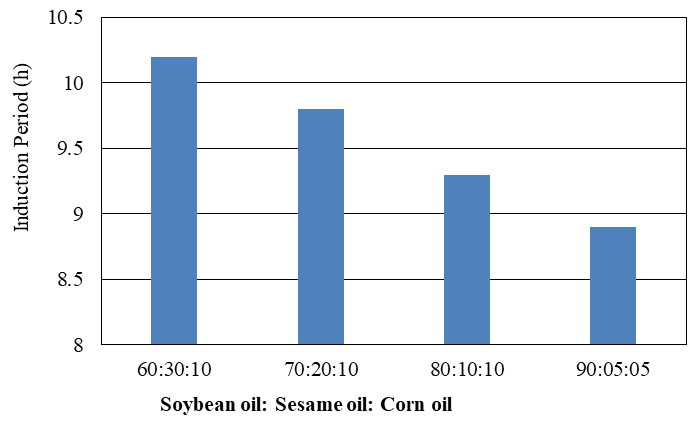 | Figure 2. Oxidative Stability of the Oil Blends Prepared for Mayonnaise Formulation |
3.6. Oxidative Stability During Storage
- The data presented in Figure 2 indicate that the oxidative stability of the oil blends decreased as the proportion of soybean oil increased [4,6,13]. This phenomenon can be attributed to the reduction in the concentration of natural antioxidants and the simultaneous increase in the content of highly unsaturated fatty acids [4,6,24] within the blends.Based on the above analysis, the following conclusions were drawn:Analysis of various blends of soybean, sesame, corn, and sunflower oils revealed that the ω-3:ω-6 ratio decreased below 10:1 when the proportion of soybean oil exceeded 60%.Since the functional properties provided by sunflower oil were also present in corn oil and sunflower oil did not play a significant role in reducing the ω-3:ω-6 ratio, it was excluded from the functional oil blend developed for mayonnaise formulation.As the proportion of soybean oil increased in the functional oil blends, the contents of palmitic, linoleic, and linolenic acids increased, whereas the proportions of stearic, oleic, and other fatty acids decreased.Increasing the soybean oil content resulted in higher concentrations of tocopherols, carotenoids, and phospholipids, while the levels of phytosterols, squalene, and lignans decreased. Consequently, the reduction in naturally occurring antioxidant compounds led to a decline in the oxidative stability of the oil blends.
4. Conclusions
- This study successfully developed and characterized functional vegetable oil blends for mayonnaise production, systematically evaluating the relationship between blend composition, bioactive compound profiles, and oxidative stability. The following conclusions can be drawn:Individual vegetable oils exhibited substantial differences in bioactive compound content, with corn oil showing the highest phytosterol content (870.9 mg/100 g) [14,16], soybean oil the highest tocopherol content (110.8 mg/100 g) [10], and sesame oil uniquely containing lignans (514.2 mg/100 g) [7,12,15].Soybean oil content was the primary determinant of ω-6:ω-3 fatty acid ratio in blends, with proportions exceeding 60% required to achieve ratios below 10:1. Only soybean oil among the tested oils met recommended ω-6:ω-3 ratios (6.4:1) in its pure form [20,21].Increasing soybean oil content in blends improved the ω-6:ω-3 ratio and increased tocopherol content but simultaneously reduced phytosterols, squalene, and lignans [14,15,16], resulting in decreased oxidative stability despite higher antioxidant vitamin content [4,6].The optimal oil blend composition of 60:30:10 (soybean:sesame:corn) achieved a favorable ω-6:ω-3 ratio of approximately 10:1 [20,21] while maintaining acceptable oxidative stability (peroxide value 6.8 mmol O₂/kg after 180 days) without additional antioxidant supplementation [19,22].Blends with higher soybean oil content (70:20:10 and 80:10:10) achieved more favorable ω-6:ω-3 ratios (8.7:1 and 7.9:1, respectively) but showed reduced oxidative stability, suggesting that additional antioxidant supplementation would be necessary for commercial applications requiring extended shelf life.Sesame oil played a critical dual role in blend formulations, contributing both to fatty acid profile optimization and providing potent natural antioxidants (lignans) that substantially enhanced oxidative stability [7,12,15,25].The development of nutritionally optimized mayonnaise with favorable omega-3 fatty acid content requires careful balancing of nutritional targets with oxidative stability considerations [1,5,13], potentially necessitating strategic use of natural antioxidants or antioxidant-rich oils like sesame oil [7,15,25].These findings provide practical guidance for developing functional mayonnaise products that meet contemporary nutritional recommendations while maintaining acceptable quality and shelf life. The systematic approach employed in this study can be applied to other oil-based emulsion products, contributing to the broader goal of improving the nutritional quality of processed foods.