
-
Paper Information
- Paper Submission
-
Journal Information
- About This Journal
- Editorial Board
- Current Issue
- Archive
- Author Guidelines
- Contact Us
International Journal of Materials and Chemistry
p-ISSN: 2166-5346 e-ISSN: 2166-5354
2026; 16(2): 32-36
doi:10.5923/j.ijmc.20261602.03
Received: Apr. 26, 2026; Accepted: May 22, 2026; Published: May 28, 2026

Analytical Differentiation of Milk, Kefir Curd and Cottage Cheese by Physico-Chemical Profile
 Abstract
 Reference
 Full-Text PDF
 Full-text HTML
Malika Adilxanova1, Khulkar Usmonjonova2, Rano Akramova3
1Doctoral Student, Department of Functional Products Technology, Tashkent Institute of Chemical Technology, Tashkent, Uzbekistan
2PhD in Technical Sciences, Tashkent Institute of Chemical Technology, Tashkent, Uzbekistan
3PhD in Technical Sciences, Professor, Tashkent Institute of Chemical Technology, Tashkent, Uzbekistan
Correspondence to: Malika Adilxanova, Doctoral Student, Department of Functional Products Technology, Tashkent Institute of Chemical Technology, Tashkent, Uzbekistan.
| Email: |  |
Copyright © 2026 The Author(s). Published by Scientific & Academic Publishing.
This work is licensed under the Creative Commons Attribution International License (CC BY).
http://creativecommons.org/licenses/by/4.0/

The work carried out a comparative physico-chemical assessment of milk, cottage cheese obtained from kefir, and traditional cottage cheese in order to determine their nutritional value and potential for obtaining a low-lactose dairy product. The experimental analysis included the determination of the mass fraction of protein, fat, moisture, titrated acidity and lactose. It was found that the source milk was characterized by a low protein content of 3.12%, fat content of 4.2% and a relatively high lactose content of 3.87%. In cottage cheese obtained from kefir, the protein content increased to 14.54%, however, this sample was characterized by the highest percentage of fat by mass - 18.1% and humidity 67.91%. The lactose content in kefir cottage cheese decreased to 1.03%, which confirms the effect of fermentation and separation of whey on reducing the carbohydrate fraction. The most pronounced positive indicators were found in traditional cottage cheese: the protein content was 21.61%, fat - 8.5%, moisture - 64.91%, and the lactose level was the lowest among the studied samples - 0.76%. At the same time, the titrated acidity of traditional cottage cheese reached 275.04 ° T, which indicates the intensive development of acid coagulation and the formation of a dense protein matrix. The data obtained indicate that traditional cottage cheese has the most balanced composition: high protein content, moderate fat content, lower moisture content and the lowest level of residual lactose. Therefore, traditional cottage cheese can be considered the most promising basis for the development of a low-lactose functional dairy product with increased nutritional value.
Keywords: Milk, Traditional cottage cheese, Kefir cottage cheese, Lactose, Low-lactose products, Physico-chemical analysis
Cite this paper: Malika Adilxanova, Khulkar Usmonjonova, Rano Akramova, Analytical Differentiation of Milk, Kefir Curd and Cottage Cheese by Physico-Chemical Profile, International Journal of Materials and Chemistry, Vol. 16 No. 2, 2026, pp. 32-36. doi: 10.5923/j.ijmc.20261602.03.
1. Introduction
- In recent years, interest in low-lactose and lactose-free dairy products has increased markedly, due to the prevalence of lactase deficiency, changes in the dietary habits of the population, and the desire to maintain high-grade milk proteins in the diet without significant discomfort from the gastrointestinal tract. Lactose is the main carbohydrate in milk, but in some consumers, its digestion is limited due to the reduced activity of the enzyme lactase. In such cases, the consumption of regular milk and some fresh dairy products may be accompanied by bloating, abdominal discomfort, nausea, and other symptoms. Therefore, the development of dairy products with a reduced lactose content is considered an urgent area of food technology and nutrition. Low-lactose and lactose-free dairy products allow people with lactose intolerance to keep dairy products in their diet and thereby reduce the risk of deficiency of important nutrients [1]. Fermented milk and cottage cheese products occupy a special place in this direction. Unlike whole milk, they undergo a fermentation stage during which lactic acid microorganisms partially use lactose as a substrate and convert it into lactic acid. As a result, the acidity, the structure of the protein clot, the moisture retention capacity, the content of residual lactose, and the general nutritional characteristics of the product change. However, fresh cottage cheese products may not always be automatically considered low-lactose, since some of the lactose remains in the aqueous phase and may be retained in the product along with the whey. In a number of fresh dairy products, including fermented foods and young cheeses, the lactose content may remain noticeable, whereas in aged cheeses it is usually lower due to the removal of whey and further microflora activity [2]. In this regard, it is of scientific interest to produce cottage cheese with a reduced lactose content based on kefir fermentation. Kefir has a complex microbial system, including lactic acid bacteria and yeast, which are involved in the transformation of the milk matrix, increasing acidity and partially reducing lactose. Therefore, cottage cheese obtained from kefir can be considered not just a variety of ordinary cottage cheese, but an independent fermented protein matrix with a potentially lower lactose content. Kefir is formed under the influence of a complex consortium of microorganisms, and its properties are determined not only by the composition of milk but also by the nature of fermentation [3,4]. The relevance of this topic is especially significant for Uzbekistan, as dairy and fermented milk products traditionally occupy an important place in the nutrition of the population, and milk production in the country is on a large scale. According to the National Statistics Committee of the Republic of Uzbekistan, in January–December 2023, all categories of farms produced 11,968.7 thousand tons of milk, which is 2.9% higher than in 2022. In January–March 2024, milk production amounted to 1,986,907 tons, an increase of 3.3% compared to the corresponding period in 2023 [5,6]. These data show that the dairy industry is an important part of the country's agro-food sector, and expanding the range of functional and specialized dairy products, including low-lactose cottage cheese, may be of practical importance. In addition, Central Asia has historically had a culture of eating fermented dairy products. Researchers of traditional dairy products in Central Asia note that fermentation and drying of milk were important ways to preserve perishable raw materials in a nomadic and semi-nomadic lifestyle. This makes the development of low-lactose cottage cheese not artificially borrowed but logically linked to regional food traditions [7]. The purpose of this study is to compare milk, kefir cottage cheese, and traditional cottage cheese according to their physico-chemical profile, with an emphasis on lactose content, acidity, protein, fat, and moisture. This approach allows us to determine how kefir fermentation and the subsequent production of curd can contribute to the formation of a product with a reduced lactose content while maintaining high nutritional value.
2. Literary Review
- Milk is a complex biological system in which proteins, fats, carbohydrates, minerals, and water are in a relatively stable but not constant ratio. Its chemical composition depends on the type of animal, breed, diet, season, stage of lactation, and conditions of primary processing. Differences in the composition of milk can be caused not only by the production system but also by a variety of biological and technological factors. Therefore, when developing cottage cheese and low-lactose products, milk should be considered as the initial matrix, the quality of which directly determines the properties of the final product [8]. The analysis of lactose in milk and dairy products requires methodological accuracy, since the results may depend on the method used and the method of expressing the lactose content. This is especially important for research on low-lactose products, where even small differences in the residual lactose content have scientific and practical significance [9]. The modern technology of low-lactose dairy products is developing in two main directions. The first is associated with the enzymatic hydrolysis of lactose using lactase, as a result of which lactose is broken down into glucose and galactose, and the second direction is based on the use of fermentation, in which lactic acid bacteria partially consume lactose and form organic acids. The industrial production of lactose-free products is most often based on the use of neutral lactases, but fermented products are also important for consumers with lactose sensitivity. It is important to understand that fermentation usually reduces, but does not always completely remove, lactose; therefore, it is more correct to call a product low-lactose only after analytical confirmation [2]. Kefir is of particular interest as the basis for the production of low-lactose cottage cheese, and unlike conventional fermented milk products, kefir is formed under the influence of a complex microbial consortium, including lactic acid bacteria, acetic acid bacteria and yeast [3]. The quality of kefir products depends on the type of milk, the composition of the starter culture, fermentation and storage conditions. Therefore, kefir fermentation can be used as a technological step for preliminary reduction of the lactose content before obtaining a curd clot [4]. In the production of cottage cheese, the key process is the acid coagulation of milk proteins, as lactic acid accumulates, the pH decreases, the casein micelles lose stability, a clot forms, and part of the whey separates. Together with the whey, a significant proportion of soluble components is removed, including a portion of lactose, which may remain in the product, especially if the cottage cheese has high humidity or an insufficiently pronounced separation of the whey. Therefore, when developing low-lactose cottage cheese, it is not enough to evaluate only the acidity: it is necessary to simultaneously determine moisture, protein, fat and residual lactose [9]. From this point of view, kefir cottage cheese may have a technological advantage. When the product is produced, it includes two successive stages: first, the fermentation of milk to a kefir base, then the formation and separation of a curd clot. At the first stage, part of the lactose is used by the microflora, and at the second stage, part of the water-soluble lactose is removed along with the whey, which can lead to a lower lactose content obtained without prior kefir fermentation. However, this assumption requires experimental confirmation, since the final result depends on the fermentation time, temperature, activity of the starter culture, degree of separation of the whey, and moisture content of the finished product. Kefir produced in domestic conditions is characterized by changing physico-chemical and nutritional parameters, and its stability depends on the conditions of production and storage [10]. The chemical composition, microstructure, texture, and moisture distribution are interrelated, which are important for the study of kefir cottage cheese since the moisture in such a product is not only a technological indicator: it reflects the state of the protein structure and the degree of retention of whey, which means it can be associated with the residual lactose content [11]. By its nature, traditional cottage cheese is close to the group of fresh acid-coagulated cheeses such as quark-type cheese and cottage cheese. In the international literature, these products are often used as analogues of cottage cheese. The fat content of the source milk, homogenization, and heat treatment affect the properties of quark-type cheese, including moisture retention and the composition of the finished product [12]. Cottage cheese is a relatively under-researched fermented milk product, despite its potential nutritional and functional value, reinforcing the relevance of research aimed at evaluating the composition of cottage cheese products, especially when it comes to reducing lactose content. For scientific novelty, it is important not only to determine protein, fat, moisture, and acidity, but also to show the relationship between fermentation, whey removal, and residual lactose [13]. In the context of Uzbekistan, the development of low-lactose cottage cheese may be of particular importance. Firstly, the country has a significant raw material base for the production of dairy products, which is confirmed by official data on multimillion – volume milk production. Secondly, fermented dairy products are part of the regional food culture of Central Asia, so low-lactose cottage cheese based on kefir fermentation may be closer to familiar consumer models than completely new artificial products. Thirdly, there is potential in the local market to expand the range of functional dairy products aimed at people who do not tolerate regular milk well but do not want to completely eliminate milk proteins and calcium from the diet.
3. Methods and Materials
- Milk, cottage cheese obtained from kefir, and traditional cottage cheese were used as research objects. The samples were analyzed by mass fraction of moisture, protein, fat, titrated acidity, and lactose content. Before the analysis, the milk was thoroughly mixed, and the curd samples were homogenized to a homogeneous state. The samples were prepared in accordance with the general requirements for sampling and preparation of milk and dairy products [14]. The mass fraction of moisture was determined by the gravimetric method of drying the sample to a constant mass according to GOST 3626-73, “Milk and dairy products. Methods for determining moisture and dry matter”; the standard is based on drying the product sample at a constant temperature [15]. The mass fraction of protein was determined by the Kjeldahl method based on the total nitrogen content, followed by conversion to milk protein by a coefficient of 6.38 according to GOST 23327-98, “Milk and dairy products. The Kjeldahl method for measuring the mass fraction of total nitrogen and determining the mass fraction of protein” [16]. The mass fraction of fat was determined by the acid method using fat meters according to GOST 5867-2023, “Milk and dairy products. Methods of fat determination” [17]. The method is based on the release of fat under the action of concentrated sulfuric acid and isoamyl alcohol, followed by centrifugation and reading of the fat layer on the fat meter scale. The titrated acidity was determined by the titrimetric method according to GOST 3624-92, “Milk and dairy products [18]. Titrimetric methods for determining acidity”. Titration was performed with a sodium hydroxide solution in the presence of phenolphthalein, and the results were expressed in Turner degrees. A coefficient of 10 was used for milk and fermented milk products and a coefficient of 20 for cottage cheese and cottage cheese products. The lactose content was determined by the enzymatic method according to GOST 34304-2017, “Milk and dairy products [19]. Method for the determination of lactose and galactose”. This standard specifies a method for determining the mass fractions of lactose and galactose in the presence of other sugars and is more suitable for low-lactose dairy products than the old methods for determining total sugar. After preliminary deproteinization and filtration of the samples, an enzymatic reaction was performed, followed by photometric determination and calculation of the mass fraction of lactose. All measurements were performed in at least three repetitions. The results were expressed as percentages for moisture, protein, fat, and lactose, and the acidity was expressed in Turner degrees. The data obtained were used to compare milk, kefir cottage cheese, and traditional cottage cheese as potential bases for producing a low-lactose dairy product.
4. Results
- The study conducted a comparative physico-chemical assessment of milk, cottage cheese obtained from kefir, and traditional cottage cheese by mass fraction of protein, fat, moisture, titrated acidity, and lactose content. Special attention was paid to the content of residual lactose, as the study was aimed at assessing the possibility of obtaining a low-lactose curd product. The results are shown below in Diagram 1 (a), (b), (c).
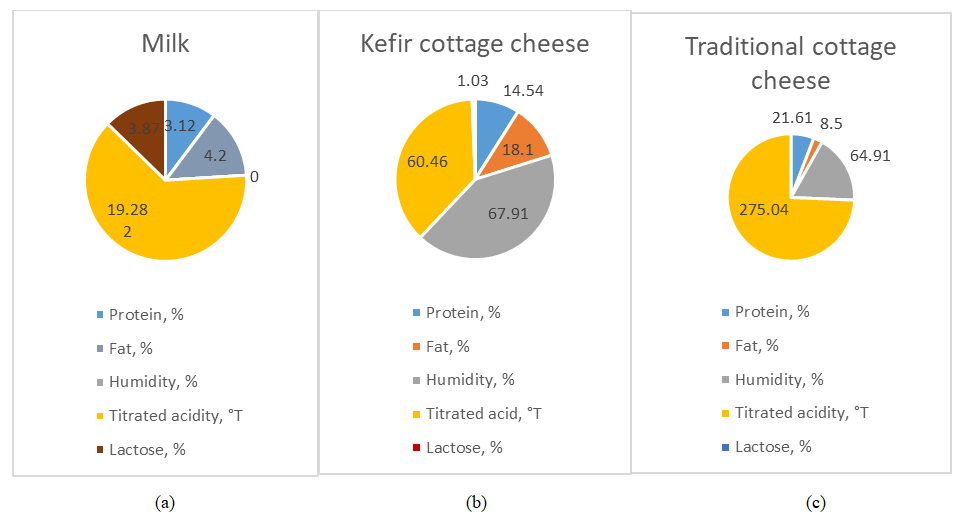 | Diagram 1. (a), (b), (c). Differences in physico-chemical parameters between the studied samples |
5. Conclusions
- The study made it possible to establish that a directed change in the milk matrix during coagulation is accompanied by a significant restructuring of its physico-chemical composition and a decrease in the residual lactose content. A comparison of the three samples showed that the source milk retains the profile characteristic of the liquid milk system: low protein concentration, moderate fat content and the highest lactose level. This confirms the need for technological processing of dairy raw materials to obtain a product that is more acceptable to consumers with sensitivity to milk sugar. Kefir cottage cheese showed a marked decrease in lactose compared to milk, which indicates the positive effect of fermentation and subsequent separation of the whey phase.However, its increased fat content and higher humidity indicate the need for further optimization of the technological regime, especially the conditions of fermentation, the degree of dehydration, and standardization of the feedstock. Therefore, this sample can be considered promising but requires additional technological refinement. The most convincing results were obtained for traditional cottage cheese. It was characterized by maximum protein saturation, lower humidity, moderate fat content, and minimal lactose levels among the studied samples. This combination of indicators allows us to consider it the most rational basis for the development of a low-lactose curd product with increased nutritional value. The high acidity of this sample probably contributed to a more intense coagulation of the casein complex, the consolidation of the protein structure, and the effective removal of some of the soluble components along with the whey. Thus, the results of the study confirm that the decrease in lactose in cottage cheese products is associated not only with the enzymatic transformation of the carbohydrate fraction, but also with the peculiarities of protein clot formation and moisture removal. The practical significance of the work lies in the possibility of using traditional cottage cheese as an affordable technological basis for creating a functional low-lactose product relevant to the dairy industry of Uzbekistan and focused on the modern needs of healthy nutrition.