
-
Paper Information
- Paper Submission
-
Journal Information
- About This Journal
- Editorial Board
- Current Issue
- Archive
- Author Guidelines
- Contact Us
International Journal of Materials and Chemistry
p-ISSN: 2166-5346 e-ISSN: 2166-5354
2026; 16(1): 11-13
doi:10.5923/j.ijmc.20261601.03
Received: Mar. 19, 2026; Accepted: Apr. 1, 2026; Published: Apr. 3, 2026

Chemical Composition and Quality Indicators of Water-Ethanol Extracts from Juniper and Thuja Needles
 Abstract
 Reference
 Full-Text PDF
 Full-text HTML
Yodgorova Ma’mura Orifovna
Bukhara State Technical University, Uzbekistan
Correspondence to: Yodgorova Ma’mura Orifovna, Bukhara State Technical University, Uzbekistan.
Copyright © 2026 The Author(s). Published by Scientific & Academic Publishing.
This work is licensed under the Creative Commons Attribution International License (CC BY).
http://creativecommons.org/licenses/by/4.0/

This article presents the results of a study of the chemical composition and physicochemical indicators of aqueous ethanol extracts of juniper needles (Juniperus virginiana) and thuja (Smaragd). The content of biologically active substances (flavonoids, organic acids, polysaccharides, essential oils, vitamin C) was determined, as well as quality indicators: dry matter mass fraction, density, pH, ethanol content, and microbiological purity. It has been established that the extracts meet regulatory requirements and possess a complex of properties that allow them to be considered as promising raw materials for the pharmaceutical and cosmetic industries.
Keywords: Arch, Thuja, Water-ethanol extract, Biologically active substances, Flavonoids, Organic acids, Polysaccharides, Essential oils, Physicochemical indicators
Cite this paper: Yodgorova Ma’mura Orifovna, Chemical Composition and Quality Indicators of Water-Ethanol Extracts from Juniper and Thuja Needles, International Journal of Materials and Chemistry, Vol. 16 No. 1, 2026, pp. 11-13. doi: 10.5923/j.ijmc.20261601.03.
1. Introduction
- In recent decades, there has been a steady increase in interest in the study and application of plant raw materials as a source of biologically active substances (BAV). This is due to the increasing attention to natural components with a wide spectrum of pharmacological activity and minimal side effects. Among such sources, coniferous plants occupy a special place, which are distinguished by their rich chemical composition and are traditionally used in folk and scientific medicine. [1]Juniper and thuja needles contain significant amounts of flavonoids, polysaccharides, organic acids, vitamins, and residual amounts of essential oils. These compounds have antioxidant, anti-inflammatory, antimicrobial, and immunomodulatory effects, making them promising for use in the pharmaceutical and cosmetic industries. [2] In particular, the extracts of coniferous plants are used as components of medicinal preparations, skin and hair care products, as well as biologically active additives. [3]One of the most effective methods for extracting surfactants from plant materials is water-ethanol extraction. This method ensures a high yield of phenolic compounds and vitamins, and also contributes to maintaining the stability of the active substances. Furthermore, the ethanol in the extract performs the function of a preservative, which positively affects the microbiological purity and shelf life of the resulting product.Despite the known value of coniferous plants, comparative studies of the chemical composition and quality indicators of juniper and thuja needle extracts under standardized water-ethanol extraction conditions are not common. Therefore, conducting such research seems relevant and in demand both from a scientific and practical point of view. [4]The purpose of this work is to conduct a comparative analysis of the chemical composition and physicochemical quality indicators of water-ethanol extracts of juniper needles and thuja, as well as to determine their compliance with the requirements of current regulatory documents. The obtained data can serve as a basis for further development of medicines and cosmetic preparations based on plant extracts.
2. Materials and Methods
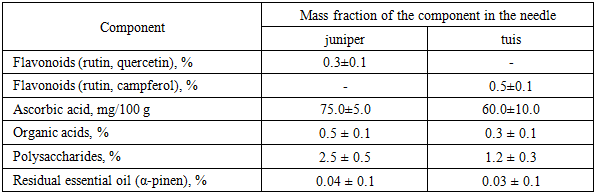
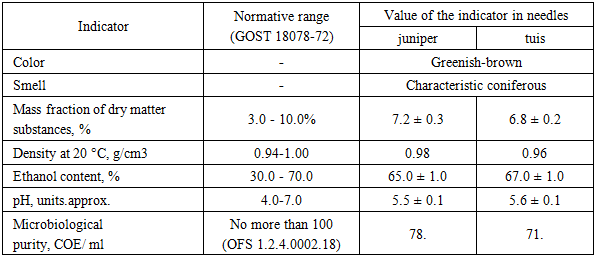
- The composition and properties of water-ethanol extracts of juniper and thuja needles were investigated. Data on the content of biologically active substances, density, pH, and other indicators are presented.The needles of coniferous plants are an important source of biologically active substances (BAS), including flavonoids, organic acids, polysaccharides, and traces of essential oils. Water-ethanol-based extracts provide a high yield of polyphenols and good stability of active substances. [5]The research results are presented in Tables 1 and 2.
|
|
3. Results and Discussions
- The thuja extract has a sweeter and softer aroma compared to juniper, with a slight woody notes. The color of the extract is usually yellowish or light green. Contains essential oils, organic acids, vitamin C, and antioxidants. It has anti-inflammatory and strengthening properties. It is used in cosmetology for skin and hair care, and in phytotherapy to maintain health and improve metabolism.It was established that the studied aqueous-ethanol extracts comply with ГОСТ 18078-72 "Fruit and Berry Extracts. Technical conditions", as the regulatory quality indicators for coniferous plant extracts are regulated not by a separate, but by a general standard, but by the requirements of OFS 1.2.4.0002.18. for microbiological safety. [7]Thus, the obtained extracts of juniper needles and thuja can be used both in the production of medicines and in cosmetology. The results obtained indicate that extracts of juniper and thuja needles can be successfully applied in various fields. They are advisable to use as a source of flavonoids, polysaccharides, and vitamin C in the development of phytopreparations and biologically active supplements. In cosmetic practice, these extracts can serve as natural antioxidants and preservatives, which opens prospects for their introduction into creams, masks, and hair care products. In the pharmaceutical industry, they may be considered as auxiliary components in the formulation of complex preparations with antimicrobial and anti-inflammatory properties. [8]
4. Conclusions
- A promising direction is the further study of the pharmacological activity of the extracts, including antioxidant, immunomodulatory, and anti-inflammatory effects. It is of interest to investigate various extraction methods (ultrasonic, microwave, pulsed) to increase the yield of biologically active substances and improve the stability of the final products. It is also important to develop standardized approaches to quality control of the extracts, including the determination of the content of key active components, which will ensure their reproducibility and safety.Future studies may focus on evaluating the toxicological characteristics and determining the optimal dosages of the extracts for long-term use. Moreover, the application of coniferous extracts in combined medicinal products and functional foods appears promising, which may expand the possibilities of their use in the medical, pharmaceutical, and food industries.