
-
Paper Information
- Paper Submission
-
Journal Information
- About This Journal
- Editorial Board
- Current Issue
- Archive
- Author Guidelines
- Contact Us
International Journal of Information Science
p-ISSN: 2163-1921 e-ISSN: 2163-193X
2026; 15(1): 1-6
doi:10.5923/j.ijis.20261501.01
Received: Apr. 16, 2026; Accepted: May 12, 2026; Published: Jun. 5, 2026

Role of Soil Conditions and Agronomic Practices on Disease Incidence and Yield of Pineapple (Ananas comosus L.) in Hoa Luu Commune, Can Tho City, Vietnam
 Abstract
 Reference
 Full-Text PDF
 Full-text HTML
La Cao Thang, Nguyen Hong Hue, Huynh Phuoc Thien, Le Vinh Thuc
Faculty of Crop Science, College of Agriculture, Can Tho University, Vietnam
Correspondence to: Nguyen Hong Hue, Faculty of Crop Science, College of Agriculture, Can Tho University, Vietnam.
| Email: |  |
Copyright © 2026 The Author(s). Published by Scientific & Academic Publishing.
This work is licensed under the Creative Commons Attribution International License (CC BY).
http://creativecommons.org/licenses/by/4.0/

This study investigated the influence of soil conditions and agronomic practices on disease incidence and yield of pineapple (Ananas comosus (L.) Merr.) grown on acid sulfate soils in Hoa Luu commune, Can Tho City, Vietnam. A survey of 78 farming households was conducted from December 2024 to March 2025, collecting data on drainage systems, fertilization practices, disease occurrence, and yield. Descriptive statistics and Chi-square tests were used to analyze relationships among variables. Results showed substantial variation in cultivation practices. About 33.3% of orchards had poor drainage due to low ridge height and shallow ditches, while 66.7% of households applied imbalanced fertilization, mainly deficient in phosphorus and potassium. Waterlogged acidic soil was significantly associated with higher disease incidence, with 76.9% of affected orchards reporting soil-related diseases, compared to 35.3% in well-drained systems (p < 0.05). Similarly, nutrient imbalance was linked to increased disease occurrence (p < 0.05). Yield analysis indicated that poorly drained orchards had a higher proportion of low yields, whereas well-drained systems achieved greater productivity (p < 0.01). Balanced fertilization also contributed to improved yields (p < 0.05). These findings highlight the importance of improving drainage systems and adopting balanced fertilization to enhance pineapple productivity and sustainability.
Keywords: Acid sulfate soils, Agronomic practices, Pineapple productivity
Cite this paper: La Cao Thang, Nguyen Hong Hue, Huynh Phuoc Thien, Le Vinh Thuc, Role of Soil Conditions and Agronomic Practices on Disease Incidence and Yield of Pineapple (Ananas comosus L.) in Hoa Luu Commune, Can Tho City, Vietnam, International Journal of Information Science, Vol. 15 No. 1, 2026, pp. 1-6. doi: 10.5923/j.ijis.20261501.01.
Article Outline
1. Introduction
- Pineapple (Ananas comosus (L.) Merr.) is an important tropical fruit crop widely cultivated in many countries and plays a significant role in the livelihoods of farmers, particularly in areas with constrained agricultural conditions. In the Mekong Delta of Vietnam, pineapple is commonly grown in low-lying regions where acid sulfate soils are prevalent. These soils provide opportunities for agricultural production but also present considerable challenges in soil and water management [1,2].Acid sulfate soils are characterized by low pH, high concentrations of active iron and aluminum, and seasonal fluctuations in groundwater levels. These conditions adversely affect plant growth, especially for species with shallow root systems and sensitivity to anaerobic conditions [3,4]. Under climate change conditions, the frequency and intensity of waterlogging in lowland areas are increasing, further exacerbating the constraints of these soils and negatively impacting perennial fruit production systems [5].For pineapple cultivation, soil conditions and water management play a fundamental role in shaping the root environment, influencing nutrient uptake, and determining the occurrence of physiological disorders and soil-related diseases. Previous studies have indicated that inappropriate ridge-ditch systems, particularly low ridges and poor drainage, are strongly associated with increased root diseases and reduced yields [1,6]. In addition, fertilization practices in acidic and acid sulfate soils often tend to favor nitrogen while lacking a balanced supply of essential nutrients such as phosphorus and potassium, leading to reduced fertilizer efficiency and weakened plant resilience [7].Although the effects of soil conditions and agronomic practices on pineapple growth and productivity have been widely discussed, field-based studies that simultaneously integrate soil conditions, farming practices, disease incidence, and yield at the household scale remain limited, particularly under acid sulfate soil conditions in the Mekong Delta. Therefore, a comprehensive assessment of these interacting factors is necessary to provide a scientific basis for improving pineapple production systems.Based on this context, the present study was conducted to: (i) evaluate soil conditions and pineapple farming systems in Hoa Luu commune, Can Tho City; (ii) analyze the relationships between soil conditions, agronomic practices, and soil-related disease incidence; and (iii) assess the relationships between these factors and pineapple yield. The findings are expected to contribute to the development of appropriate soil management and agronomic strategies, thereby improving the efficiency and sustainability of pineapple production on acid sulfate soils.
2. Materials and Methods
2.1. Time and Location
- The study was conducted in pineapple-growing areas in Thanh Thang hamlet, Hoa Luu commune, Can Tho City. This area is characterized by acid sulfate soils and a ridge-ditch farming system adapted to seasonal hydrological fluctuations. Within this system, ridge structure and drainage capacity are considered fundamental factors influencing the root environment, thereby affecting pineapple growth and the occurrence of soil- and moisture-related diseases.Data were collected from December 2024 to May 2025.
2.2. Research Design and Sampling
- The study targeted households cultivating pineapple (Ananas comosus (L.) Merr.) in the selected area. A total of 78 households were included in the survey, representing the most recent production cycle. Households were selected using purposive sampling to ensure variability in orchard age, ridge height, drainage conditions, and applied agronomic practices.A sample size of 78 households was considered sufficient for descriptive analysis and group comparisons using Chi-square tests. In farm-level survey studies, such a sample size is generally acceptable when the objective is to describe patterns and analyze relationships among variables rather than estimate population parameters [8,9,10].
2.3. Data Collection on Soil Conditions and Agronomic Practices
- Information related to soil conditions and agronomic practices was collected through direct interviews with farmers. The recorded data included ridge height, characteristics of the drainage system, fertilizer use history, and application rates during the production year.Fertilizer inputs were standardized to kg/ha/year. Based on the types of fertilizers used, nutrient balance was classified into two groups: imbalanced (deficient in phosphorus and/or potassium) and relatively balanced.Based on ridge height relative to water level and drainage ditch depth, drainage capacity was classified into three levels: poor, moderate, and good. Specifically, the poor drainage group included orchards with ridge height ≤ 0.4 m and/or ditch depth ≤ 1.0 m; the moderate group had ridge height from 0.4–0.6 m and ditch depth from 1.0–1.5 m; and the good drainage group had ridge height > 0.6 m and ditch depth > 1.5 m.
2.4. Disease Assessment
- The status of diseases in pineapple was recorded through farmer surveys at the time of investigation. Disease assessment was based on farmers’ descriptions of field symptoms collected during interviews and field observations. Reported symptoms were cross-checked using common symptom descriptions provided in pineapple disease diagnostic references and extension documents, particularly for leaf tip dieback and root rot symptoms associated with poorly drained soils and prolonged moisture conditions [11,12]. However, no laboratory-based pathogen identification was conducted; therefore, the results should be interpreted as indicative rather than definitive disease diagnosis.
2.5. Determination of Pineapple Yield
- Pineapple yield was recorded based on the number of fruits harvested per unit area in one year, reflecting the production performance of orchards under low-pH environments. This indicator was used to classify yield levels and compare among groups of households with different soil conditions and agronomic practices. Yield categories were established based on the observed distribution of production levels among surveyed households and local cultivation practices in the study area. Orchards producing fewer than 5,000 fruits/ha/year were classified as low yield, those producing 5,000–15,000 fruits/ha/year as medium yield, and those exceeding 15,000 fruits/ha/year as high yield. This classification was intended to facilitate comparative analysis among cultivation conditions rather than to define universal production standards.
2.6. Data Processing and Analysis
- After collection, data were compiled and processed using descriptive statistical methods to determine the distribution of cultivation factors, disease incidence, and pineapple yield levels in the study area. In addition, the Chi-square (χ²) test was used to evaluate the relationships between drainage capacity and nutrient balance with disease incidence and pineapple yield. Before conducting Chi-square analysis, contingency tables were examined to ensure that expected frequencies satisfied the assumptions required for categorical analysis. All analyzed tables met the minimum expected frequency requirements for application of the Chi-square test.Data were initially compiled using Microsoft Excel and subsequently analyzed using R software (R Core Team).
3. Results and Discussion
3.1. Characteristics of Soil Conditions and Pineapple Farming Systems
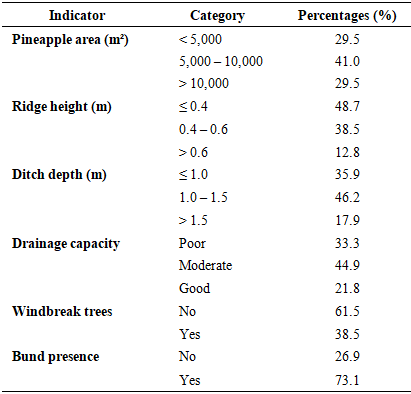
- The survey results indicated that soil conditions and ridge-ditch systems in pineapple orchards in Hoa Luu commune varied markedly (Table 1). Although most households had medium to large production scales, ridge structure and drainage capacity, two factors determining the root environment, differed considerably among orchards.
|
3.2. Fertilization Practices and Technical Management
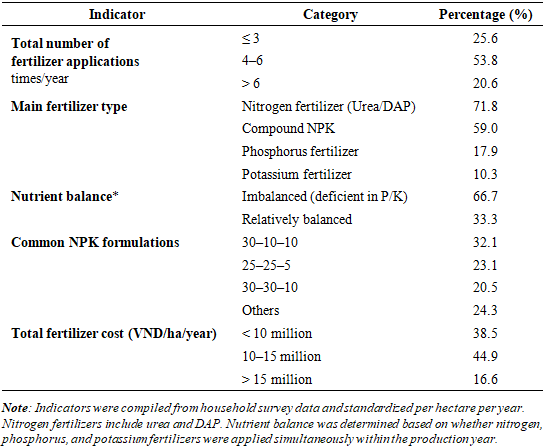
- The survey results indicated that fertilization practices and the application of agronomic measures in pineapple cultivation in the study area varied markedly among households (Table 2), reflecting differences in nutrient management and technical investment. Most households applied fertilizers 4–6 times per year, indicating a tendency to split fertilizer applications to meet the nutrient requirements of pineapple at different growth stages.
|
3.3. Disease Status in Pineapple
3.3.1. Effect of Drainage Capacity on Disease Status
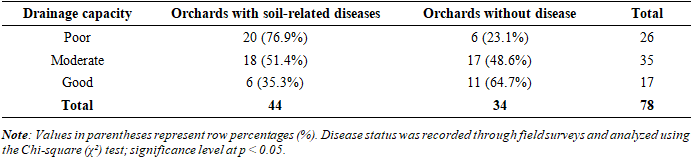
- The proportion of orchards reporting disease incidence was markedly higher in the group with poor drainage compared to those with moderate and good drainage (Table 3). The Chi-square test indicated that the relationship between drainage capacity and disease occurrence was statistically significant (p < 0.05), suggesting that soil conditions and water management play an important role in the disease status of pineapple. Under prolonged waterlogged conditions, the root zone becomes oxygen-deficient, resulting in reduced root respiration and poorer nutrient uptake. Anaerobic soil conditions may also increase the accumulation of toxic reduced compounds such as Fe²⁺ and Al³⁺ in acid sulfate soils, thereby impairing root growth and weakening plant physiological stability [4,5].
|
3.3.2. Effect of Nutrient Balance on Disease Status
- In addition to drainage conditions, nutrient management also showed a significant relationship with disease status. Orchards with imbalanced nutrient management (deficient in phosphorus and/or potassium) exhibited a higher incidence of disease compared to those with relatively balanced nutrition (Table 4). The Chi-square test indicated that the relationship between nutrient balance and disease occurrence was statistically significant (p < 0.05).
|

3.4. Pineapple Yield and Its Relationship with Cultivation Conditions
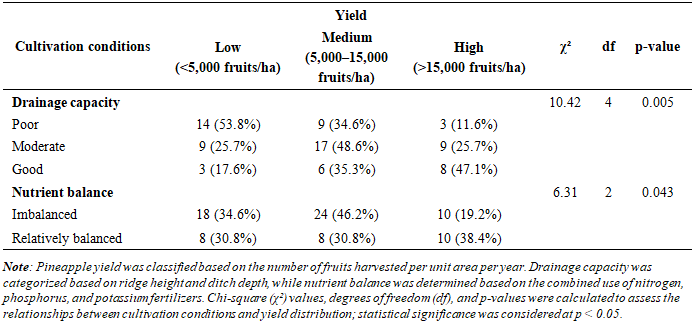
- The survey results indicated that pineapple yield in the study area varied considerably among households, reflecting differences in soil conditions and cultivation practices (Table 5). Yield was distributed into three categories, with the medium-yield group accounting for the highest proportion, while a considerable proportion of orchards still recorded low yields.
|
4. Conclusions and Technical Implications
4.1. Conclusions
- The study shows that soil conditions and agronomic practices are closely associated with disease incidence and pineapple yield in Hoa Luu commune, Can Tho City. Among these, drainage capacity and nutrient balance are the two most influential cultivation factors.Orchards with low ridge-ditch systems and poor drainage recorded higher disease incidence and lower yields compared to those with moderate and good drainage conditions. In addition, imbalanced nutrient management, mainly characterized by deficiencies in phosphorus and/or potassium, was significantly associated with increased disease occurrence and reduced yield. These relationships were statistically significant, indicating that they reflect common trends in the pineapple farming system of the study area.
4.2. Management Implications and Recommendations
- The results indicate that the effectiveness of pineapple cultivation on acid sulfate soils is influenced by both inherent soil conditions and agronomic practices. Therefore, management strategies should focus on factors that can be adjusted at the farm level.First, for orchards with suboptimal drainage conditions, improving ridge-ditch structure should be prioritized to create a more favorable root environment for pineapple plants. Adjusting ridge height and maintaining appropriate drainage ditches are important for reducing the risk of soil-related diseases, rather than relying solely on disease control after symptoms appear.Second, given that most farmers apply fertilizers based on experience, promoting nutrient-balanced fertilization is necessary to improve fertilizer use efficiency. Technical recommendations should focus on identifying and correcting phosphorus and potassium deficiencies rather than increasing nitrogen application, thereby enhancing plant growth under acidic soil conditions.Finally, the results suggest that improving pineapple production efficiency requires an integrated approach combining soil management and improved agronomic practices. This approach is consistent with the characteristics of farming on acid sulfate soils and may contribute to improving the sustainability of pineapple production systems at the household level.This study was based primarily on household survey data and field observations; therefore, the identified relationships should be interpreted as associative rather than causal. Disease assessment relied on symptom observation without laboratory confirmation, and fertilizer practices were evaluated based on farmer-reported information. Future studies should incorporate controlled field experiments, soil analyses, and pathogen identification to validate the mechanisms linking soil conditions, nutrient management, disease development, and pineapple yield under acid sulfate soil conditions.