
-
Paper Information
- Next Paper
- Paper Submission
-
Journal Information
- About This Journal
- Editorial Board
- Current Issue
- Archive
- Author Guidelines
- Contact Us
International Journal of Genetic Engineering
p-ISSN: 2167-7239 e-ISSN: 2167-7220
2026; 14(11): 388-393
doi:10.5923/j.ijge.20261411.09
Received: Oct. 19; Accepted: Nov. 12, 2026; Published: Nov. 23, 2026

Effect of Different Kinetin Concentrations on Primary Callus Induction in the Cotton Genotype Coker-312 (Gossypium Hirsutum L.)
 Abstract
 Reference
 Full-Text PDF
 Full-text HTML
Bozorov I. E.1, Darmanov M. M.2, Mukhammadiev O. A.3
1Center of Genomics and Bioinformatics, Tashkent, Uzbekistan
2Ministry of Agriculture of the Republic of Uzbekistan, Tashkent, Uzbekistan
3Tashkent State Medical University, Tashkent, Uzbekistan
Correspondence to: Mukhammadiev O. A., Tashkent State Medical University, Tashkent, Uzbekistan.
| Email: |  |
Copyright © 2026 The Author(s). Published by Scientific & Academic Publishing.
This work is licensed under the Creative Commons Attribution International License (CC BY).
http://creativecommons.org/licenses/by/4.0/

Callus formation in cotton is an important step in tissue culture, plant regeneration, and genetic transformation. The efficiency of callus induction depends on the explant type and the composition of the culture medium, especially the concentrations of plant growth regulators. Therefore, determining the optimal concentrations of these regulators is important for improving the efficiency of cotton tissue culture. This study investigated the effects of different kinetin concentrations on callus induction in hypocotyl and cotyledon explants of the Coker-312 cotton genotype. MS0–MS5 culture media were used, with the 2,4-D concentration kept constant at 0.1 mg/L and the kinetin concentration varied from 0 to 1.0 mg/L. Callus induction frequency (CIF), callus induction time (CIT), and callus fresh weight (CFW) were evaluated. The results were compared across different culture media and explant types. The highest callus induction frequency was observed on MS3 medium containing 0.1 mg/L 2,4-D and 0.5 mg/L kinetin. Both lower and higher kinetin concentrations resulted in lower callus induction frequencies in hypocotyl and cotyledon explants compared with MS3 medium. These results indicate that the balance between 2,4-D and kinetin affects callus induction efficiency in cotton. MS3 medium was the most suitable medium for callus induction in Coker-312 explants under the conditions tested. It may be useful for improving cotton tissue culture and genetic transformation.
Keywords: Gossypium hirsutum, Coker-312, Callus induction, Kinetin, 2,4-D, Tissue culture
Cite this paper: Bozorov I. E., Darmanov M. M., Mukhammadiev O. A., Effect of Different Kinetin Concentrations on Primary Callus Induction in the Cotton Genotype Coker-312 (Gossypium Hirsutum L.), International Journal of Genetic Engineering, Vol. 14 No. 11, 2026, pp. 388-393. doi: 10.5923/j.ijge.20261411.09.
1. Introduction
- Cotton is one of the important crops that provides cottonseed oil, fiber, and other agricultural products, and it plays a major role in global agriculture. In the 2024/25 season, global cotton production and consumption were approximately 25.39 and 25.1 million metric tons, respectively. Uzbekistan is one of the major cotton-producing and exporting countries. In the 2022/2023 marketing year, its cotton production reached approximately 740,000 metric tons. [1]. However, the combined effects of abiotic and biotic stress factors can considerably reduce cotton yield. Therefore, developing cotton lines and varieties with improved resistance to external stress factors through genetic engineering is an important research priority.Plant tissue culture is an important technique that allows plant cells, tissues, and organs to be grown under controlled, aseptic in vitro conditions and used for biotechnological purposes. The development of in vitro plant culture techniques has provided a basis for detailed studies of callus induction and somatic embryogenesis. Callus induction plays an important role in plant tissue culture because it provides starting biological material for somatic embryogenesis and genetic transformation. In recent years, significant work has been carried out regarding callusogenesis and somatic embryogenesis with the aim of improving the genetic transformation process [2–7]. Therefore, establishing optimal and effective conditions for callus induction is an important step in improving in vitro plant propagation and genetic transformation techniques [8,9].In cotton (Gossypium hirsutum L.), the efficiency of plant regeneration and genetic transformation varies depending on the genotype, explant type, and culture medium. In particular, previous studies have shown that hypocotyl and cotyledon explants can differ in their callus induction responses even when grown on the same culture medium [8,10,11]. In addition, the concentrations and combinations of plant growth regulators added to the culture medium can strongly affect callus induction. These regulators include 2,4-D (2,4-dichlorophenoxyacetic acid), BAP (6-benzylaminopurine), ZT (zeatin), NAA (1-naphthaleneacetic acid), and IAA (indole-3-acetic acid) [12–16].Evaluating callus induction only by measuring callus induction frequency may not be sufficient to fully describe the effectiveness of a culture medium. The time required for callus formation, biomass accumulation, and callus morphological characteristics should also be considered. In addition, it is important to study how different concentrations of plant growth regulators used to promote plant growth in tissue culture affect explant responses. In this study, we investigated the effects of different kinetin concentrations on callus induction frequency (CIF), callus induction time (CIT), and callus fresh weight (CFW) in hypocotyl and cotyledon explants of the Coker-312 cotton genotype grown under in vitro conditions. The results may help improve callus induction conditions for Coker-312 and provide a scientific basis for increasing the efficiency of plant regeneration and genetic transformation in subsequent stages.
2. Materials and Methods
- Plant materials and sterilizationIn this study, the Coker-312 cotton line, which is capable of producing embryos through somatic embryogenesis, was obtained from the germplasm collection of the Center of Genomics and Bioinformatics, Academy of Sciences of the Republic of Uzbekistan, and used as the study material.For the in vitro study, seed sterilization was performed as described by [10] with some modifications. Coker-312 seeds were first delinted using an H2SO4 solution, treated with 70% ethanol for 10 seconds, and then treated with 3% hydrogen peroxide for 5 minutes. The seeds were subsequently rinsed 3–4 times with running water for 10 minutes. After sterilization, the seeds were germinated in a climate incubator (BJPX-A400E, made in China). The seedlings were then transferred to 700 mL test bottles (75 × 110 mm) containing a growth medium composed of MS salts, B5 vitamins, 100 mg/L myo-inositol, and 15 g/L sucrose (pH 5.6). The temperature (25–28°C), photoperiod (16 hours of light and 8 hours of darkness), and light intensity (60 µmol/m2/s) were maintained at suitable levels for normal seedling growth.Preparation of explants and culture mediumEight to ten days after germination, 5–6 mm long hypocotyl segments and cotyledon explants measuring 1 cm2 were collected for callus induction. The explants were placed on fresh callus induction media containing 4.31 g/L MS mineral salts (Murashige and Skoog, 1962), 30 g/L sucrose, and 10 g/L phyto-agar [17]. The plant growth regulators 2,4-dichlorophenoxyacetic acid (2,4-D) and kinetin were used for callus induction. The 2,4-D concentration was kept constant at 0.1 mg/L in all treatments, while kinetin concentrations were set at 0, 0.1, 0.25, 0.5, 0.75, and 1.0 mg/L.To evaluate the effect of kinetin concentration on callus induction, six culture media were prepared: MS0, the control medium without kinetin; MS1, 0.1 mg/L kinetin; MS2, 0.25 mg/L kinetin; MS3, 0.5 mg/L kinetin; MS4, 0.75 mg/L kinetin; and MS5, 1.0 mg/L kinetin. The pH of each culture medium was adjusted to 5.5–5.8 before autoclaving. The media were sterilized in an autoclave (BIOBASE BKQ-B50V, made in China) at 121°C for 15 minutes. Plant growth regulators were also added to the culture media before autoclaving.Statistical analysisStatistical analyses were performed using analysis of variance (ANOVA) and the t-test. The experiments included three biological replicates, each consisting of 10 technical replicates.
3. Results
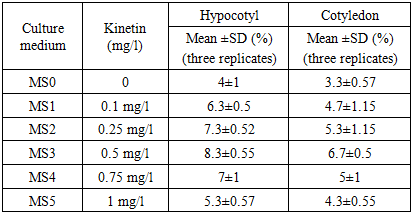
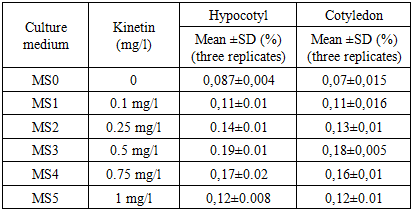
- To evaluate callus induction in hypocotyl and cotyledon explants of the Coker-312 cotton genotype, the explants were cultured on MS0–MS5 media containing different kinetin concentrations. Callus tissue formation was observed from days 8–10 after the explants were placed on the culture media. The callus-forming ability of the explants was evaluated based on callus induction frequency, callus induction time, and the fresh weight of the resulting callus tissue. Callus induction frequency was calculated using the formula described by [18].Callus induction frequency varied among the culture media and explant types depending on the kinetin concentration. In hypocotyl explants, the highest callus induction frequency was recorded on MS3 medium, with a mean value of 83%. The lowest value was observed on MS5 medium, with a mean of 53%. In the control medium without kinetin (MS0), callus induction frequency was 40%. Callus induction frequency was also found to be lower in cotyledon explants than in hypocotyl explants. These results suggest that kinetin concentration may affect callus induction efficiency in Coker-312 explants (Table 1 and Figure 1).
|
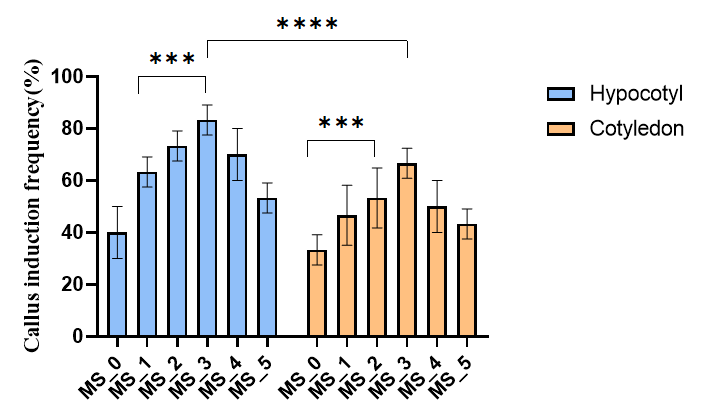 | Figure 1. Statistical analysis of the effect of kinetin concentration on callus induction frequency (CIF) in hypocotyl and cotyledon explants of the Coker-312 cotton genotype. Statistical significance levels were defined as follows: p < 0,05 (*), p < 0,01 (**), p < 0,001 (***) and p < 0,0001 (****) |
|
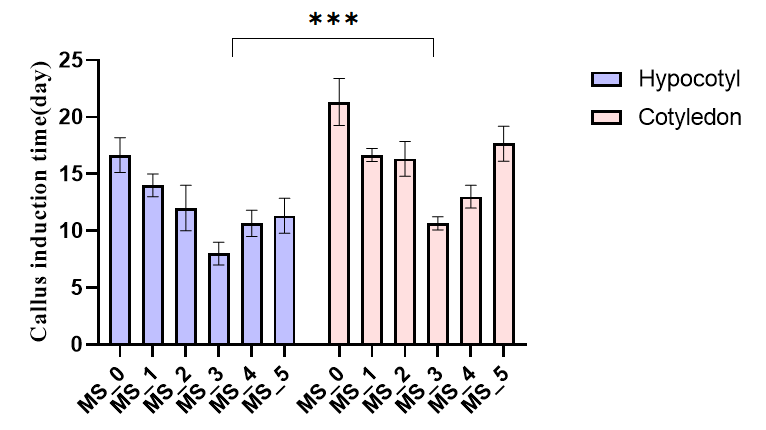 | Figure 2. Statistical analysis of the effect of kinetin concentration on callus induction time (CIT) in hypocotyl and cotyledon explants of the Coker-312 cotton genotype. Statistical significance levels were defined as follows: p < 0,05 (*), p < 0,01 (**), p < 0,001 (***) and p < 0,0001 (****) |
|
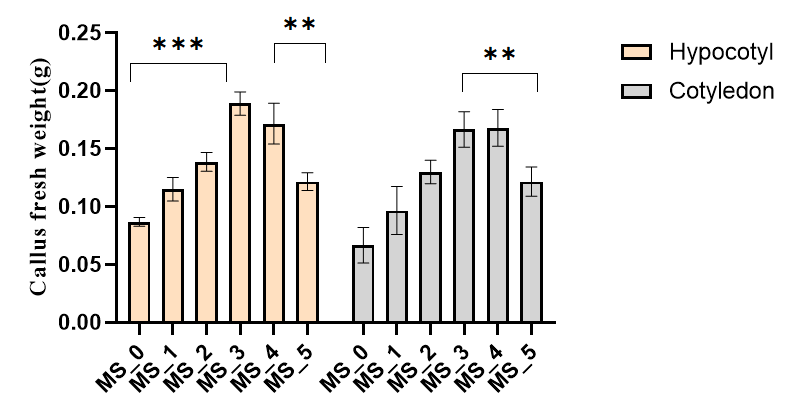 | Figure 3. Statistical analysis of the effect of kinetin concentration on callus fresh weight (CFW) in hypocotyl and cotyledon explants of the Coker-312 cotton genotype. Statistical significance levels were defined as follows: p < 0,05 (*), p < 0,01 (**), p < 0,001 (***) and p < 0,0001 (****) |
4. Discussion
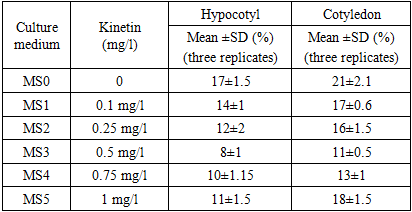
- Callus induction and somatic embryogenesis in cotton are strongly affected by the explant type and the composition of the culture medium. Previous studies have reported that combinations of kinetin with different plant growth regulators can lead to different responses in callus induction and somatic embryogenesis [10,19–22]. In this study, the effect of kinetin concentration on callus induction in the Coker-312 cotton genotype was evaluated in hypocotyl and cotyledon explants based on callus induction frequency (CIF), callus induction time (CIT), and callus fresh weight (CFW). Previous studies on cotton tissue culture have shown that different concentrations and ratios of 2,4-D and kinetin in the culture medium affect callus induction and proliferation. Studies in Gossypium hirsutum have also reported that different combinations of 2,4-D and kinetin can support high callus induction in both hypocotyl and cotyledon explants. In particular, culture media containing 0.1 mg/L 2,4-D and 0.5 mg/L kinetin have been associated with high CIF values [12,23]. In agreement with these findings, our study showed that the MS3 medium containing 0.1 mg/L 2,4-D and 0.5 mg/L kinetin resulted in higher callus induction frequency in both hypocotyl and cotyledon explants than the other culture media. In contrast, both lower and higher kinetin concentrations resulted in lower CIF values than MS3 (Tables 1 and 2).Previous studies have also shown that different concentrations and ratios of 2,4-D and kinetin can affect not only CIF but also CIT and CFW [12,22,23]. In the present study, differences in CIT and CFW were also observed between hypocotyl and cotyledon explants grown on media containing different kinetin concentrations (Tables 2 and 3).Overall, the results showed that the culture medium containing 0.1 mg/L 2,4-D and 0.5 mg/L kinetin was the most effective treatment for hypocotyl explants based on the combined results for CIF, CIT, and CFW. In addition, hypocotyl explants showed a stronger callus induction response than cotyledon explants under the conditions tested.
5. Conclusions
- The results showed that callus induction in hypocotyl and cotyledon explants of the Coker-312 cotton genotype depended on the concentrations of plant growth regulators in the culture medium. The MS3 medium containing 0.1 mg/L 2,4-D and 0.5 mg/L kinetin resulted in a higher callus induction frequency than the other treatments. Lower and higher kinetin concentrations were associated with reduced callus induction frequency. These findings indicate that selecting a suitable ratio of 2,4-D and kinetin is important for improving callus induction efficiency. MS3 medium may be useful for improving cotton tissue culture, plant regeneration, and genetic transformation protocols.