
-
Paper Information
- Previous Paper
- Paper Submission
-
Journal Information
- About This Journal
- Editorial Board
- Current Issue
- Archive
- Author Guidelines
- Contact Us
International Journal of Genetic Engineering
p-ISSN: 2167-7239 e-ISSN: 2167-7220
2026; 14(11): 373-380
doi:10.5923/j.ijge.20261411.07
Received: Oct. 31; Accepted: Nov. 10, 2026; Published: Nov. 12, 2026

Early Growth Response of Wheat Cultivars to Seed Bacterization with Azotobacter chroococcum XH2018: Preliminary Results from a Pot Experiment
 Abstract
 Reference
 Full-Text PDF
 Full-text HTML
Jasurbek B. Nizomov1, Bakhtiyor A. Rasulov2, Mohichehra A. Pattaeva2
1Andijan State Technical Institute, 56 Babur Shah Street, Andijan, Republic of Uzbekistan
2Institute of Genetics and Plant Experimental Biology, Uzbekistan Academy of Sciences, Kybray District, Tashkent Province, Uzbekistan
Correspondence to: Jasurbek B. Nizomov, Andijan State Technical Institute, 56 Babur Shah Street, Andijan, Republic of Uzbekistan.
| Email: |  |
Copyright © 2026 The Author(s). Published by Scientific & Academic Publishing.
This work is licensed under the Creative Commons Attribution International License (CC BY).
http://creativecommons.org/licenses/by/4.0/

The effect of seed bacterization with a suspension of Azotobacter chroococcum XH2018 (approximately 1×10⁸ CFU/mL, 1 h) on emergence and early seedling growth was evaluated in a laboratory pot experiment with 11 wheat cultivars. The study covered the emergence and early seedling stage only: seedling height was measured on each plant 5 and 8 days after sowing (99 pots, 495 seeds). Two-way analysis of variance showed that cultivar (confounded with seed stock) accounted for most of the variation in seedling height (F = 19.5–22.2; p < 0.001; 66–69% of the total sum of squares). Bacterization did not stimulate seedling growth: the difference from the control was not significant on day 5 (p = 0.22), and by day 8 the mean seedling height across cultivars was 2.9% lower than in the control (−0.5 cm; 95% CI −1.0 to −0.05; p = 0.03). That reduction was not robust and was driven mainly by the response of cultivar Andijon-2; when this cultivar was excluded, the difference was not significant (p = 0.27). After correction for multiple comparisons, seedling height was significantly lower than in the control only in Andijon-2 (−14.7%). Emergence also did not differ significantly (−3.0 percentage points; 95% CI −6.7 to +0.6). Because pots were not randomized, only one strain was tested without a reference PGPR strain, and the experiment was short, these results are preliminary. They suggest that the effect of strain XH2018 on wheat cultivars should be studied in longer, randomized experiments that include roots, biomass, yield traits and a reference strain.
Keywords: Azotobacter chroococcum, Seed Bacterization, Winter Bread Wheat, Cultivar, Emergence, Seedling Growth, PGPR
Cite this paper: Jasurbek B. Nizomov, Bakhtiyor A. Rasulov, Mohichehra A. Pattaeva, Early Growth Response of Wheat Cultivars to Seed Bacterization with Azotobacter chroococcum XH2018: Preliminary Results from a Pot Experiment, International Journal of Genetic Engineering, Vol. 14 No. 11, 2026, pp. 373-380. doi: 10.5923/j.ijge.20261411.07.
Article Outline
1. Introduction
- Wheat is the main grain crop in Uzbekistan, and its yield depends largely on mineral fertilizers, especially nitrogen. High rates of mineral fertilizer increase production costs and can harm soil and water resources. For this reason, biological preparations based on plant growth-promoting rhizobacteria (PGPR) are widely studied as an environmentally safe way to partially replace mineral fertilizers [1,2].Azotobacter chroococcum is a free-living aerobic diazotrophic soil bacterium. Besides fixing atmospheric nitrogen, it synthesizes auxin-, gibberellin- and cytokinin-like growth substances, solubilizes sparingly soluble phosphates, and produces compounds that enhance tolerance to osmotic stress [3–6]. A. chroococcum colonizes wheat roots, particularly the root tip zone, and can increase nitrogen and phosphorus uptake and plant biomass [7,8].Treating seeds with a bacterial suspension before sowing—bacterization, or biopriming—is the simplest and cheapest way to deliver an inoculant to the rhizosphere. In many studies, this method has increased the rate of emergence and seedling vigor [9]. Inoculation outcomes are inconsistent, however: for Azospirillum, a substantial proportion of multi-year field trials showed no significant effect [10], and the size of the effect depended on the strain and growing conditions [11].Host plant genotype is an important factor in interactions with beneficial microorganisms [12,13]. Under the conditions of Uzbekistan, wheat cultivar Turon responded markedly to inoculation with Pseudomonas strains, whereas cultivar Residence was only slightly affected [14]. Studies have shown that ancient and modern wheat varieties differ in the degree of colonization by PGPR and in the growth-promoting effect, and that this trait is under genetic control [15,16]. For arbuscular mycorrhiza, the response of wheat cultivars to the same inoculant ranged from positive to negative [17]. In a study on cotton with A. chroococcum strain K2020, the effect was also cultivar-dependent [18].A. chroococcum strain XH2018 was isolated at the Institute of Genetics and Plant Experimental Biology of the Academy of Sciences of the Republic of Uzbekistan and is characterized by exopolysaccharide production and the ability to support plants under stress conditions [19,20]. However, the response of local wheat cultivars to seed bacterization with this strain, especially at the earliest stage of growth, has not been studied comparatively.Studies of PGPR in wheat often emphasize root colonization and root traits, and fluorescent pseudomonads such as Pseudomonas putida and members of the P. fluorescens complex are among the best-studied wheat-colonizing PGPR and biocontrol agents [21–23]. The present study addresses a narrower question: whether seed bacterization with a single Azotobacter strain changes emergence and early shoot growth, and whether this depends on the cultivar. Strain XH2018 was chosen because it is the strain on which the authors’ ongoing research with winter wheat is based. Mezon, the main cultivar of that research, was therefore included together with ten comparison cultivars. No Pseudomonas reference strain was included, so XH2018 was not compared with these bacteria (see Section 4.1).The aim of this study was to evaluate the effect of seed bacterization with A. chroococcum XH2018 on emergence and early seedling growth (up to 8 days after sowing) of 11 wheat cultivars and to make a preliminary assessment of how cultivar responses differed.
2. Materials and Methods
2.1. Plant Material
- Eleven wheat cultivars were studied: Mezon, Gurt, Xisorak, Asr, Andijon-4, O‘zbekiston-25, Zamin-1, Yog‘du, Qadr, Andijon-2, and E’zoz. Of these, Gurt, Xisorak, Asr, Andijon-4, O‘zbekiston-25, Zamin-1 (listed in the register as “Jayxun (Zamin 1)”), Yog‘du, and Andijon-2 are included in the State Register as winter bread wheat (Triticum aestivum L.) [24]. Mezon, Qadr, and E’zoz are new wheat cultivars not yet included in the State Register. The seeds had been kept in storage for one year. Mezon is the main cultivar of the authors’ ongoing research with strain XH2018 and was therefore included as the principal cultivar; the other ten cultivars were included for comparison. The cultivars were not chosen as a random sample of wheat germplasm, so conclusions about differences among them apply only to the cultivars studied. Seeds of each cultivar came from a single seed stock; therefore, in this experiment the cultivar effect cannot be separated from differences between seed stocks (seed source, size and vigor).
2.2. Bacterial Strain and Inoculum Preparation
- The experiment used A. chroococcum strain XH2018 [19,20]. The bacterium was grown in Ashby medium (g/L: sucrose, 20; NaCl, 0.2; MgSO4·7H2O, 0.2; K2HPO4, 0.2; CaCO3, 5) at 30 °C on a rotary shaker at 150 rpm for 3 days [18]. Cells were harvested by centrifugation, washed twice, and resuspended in sterile 0.85% NaCl solution. The suspension was adjusted to approximately 1×10⁸ colony-forming units (CFU)/mL by optical density at 600 nm, and the cell concentration was verified by plate counting on Ashby agar.
2.3. Soil
- Pot soil was collected from the 0–20 cm layer of the “Do‘rmon” experimental field of the Institute of Genetics and Plant Experimental Biology (Qibray district, Tashkent region) and sieved; it was not sterilized. The soil is an irrigated typical sierozem (grey soil) of medium loamy texture. Table 1 lists its agrochemical characteristics.
|

2.4. Experimental Design and Growth Conditions
- Seeds were surface-sterilized in 1% sodium hypochlorite (NaOCl) solution for 2 min, rinsed with sterile distilled water, and air-dried [18]. Seeds assigned to the XH2018 treatment were then soaked in the bacterial suspension, and control seeds in tap water, for 1 h. On 20 March 2025, seeds were sown 3 cm deep in pots 8.5 cm high and 6.5 cm in diameter, with 5 seeds per pot. For each cultivar, the control had 3 replicates and the XH2018 treatment 6 replicates; each replicate was one pot. In total, 495 seeds were sown in 99 pots. The experiment ran in a laboratory room at approximately 25 °C under natural light through a window. Pots were arranged in rows by cultivar (no randomization was applied) and watered as the soil dried.
2.5. Measurements
- Seedling height (the distance from the soil surface to the tip of the longest leaf) was measured on each plant 5 days (25 March 2025) and 8 days (28 March 2025) after sowing, with 0.5 cm accuracy. The day of sowing (20 March 2025) was taken as day 0. This 8-day period covers emergence and the first days of seedling growth and is comparable to the duration of the standard germination test for wheat, in which the first count is made on day 4 and the final count on day 8 [25]. The experiment was not designed to evaluate later growth stages. Because plants were not individually tagged, the mean value per pot was analyzed. The number of emerged plants was recorded at both dates, and emergence was calculated as a percentage of the number of seeds sown. Absolute growth between days 5 and 8 (ΔH, cm) was calculated only for seedlings that had emerged by day 5. The six seedlings that emerged late, between days 5 and 8, were the shortest and were therefore excluded from the day 8 mean.
2.6. Statistical Analysis
- The pot served as the experimental unit. For each variable (seedling height on days 5 and 8, ΔH), a two-way “cultivar × treatment” analysis of variance (ANOVA) was performed. Because the numbers of replicates were unequal, type III sums of squares were used [26]. The overall treatment effect was estimated as the mean difference across cultivars with its 95% confidence interval (CI). Within each cultivar, the control and XH2018 treatments were compared using contrasts based on the ANOVA residual error. P values for the 11 comparisons were adjusted using the Holm method. The robustness of the results was checked by leave-one-out exclusion of cultivars. The contribution of each factor to the variation in seedling height was expressed as its share of the total sum of squares (calculated as F × residual mean square × df; the cell sizes were proportional, so the sums of squares are additive). To show the precision of the cultivar-level contrasts, Bonferroni-adjusted 95% CIs for the 11 comparisons were calculated from the residual error (Figure 1), and the smallest difference detectable with this design (80% power, two-sided α = 0.05, without correction for multiple comparisons) was calculated from the residual mean square. The difference in emergence was estimated in percentage points with a 95% CI, and tested with Fisher’s exact test and with the Mann–Whitney test on pots. The relationship between cultivar means in the two treatments was assessed with Pearson (r) and Spearman (ρ) correlation. Results are presented as mean ± standard deviation (SD); the significance level was set at p ≤ 0.05. Calculations were performed in Python 3 (NumPy, SciPy).
3. Results
3.1. Effects of Factors on Seedling Height
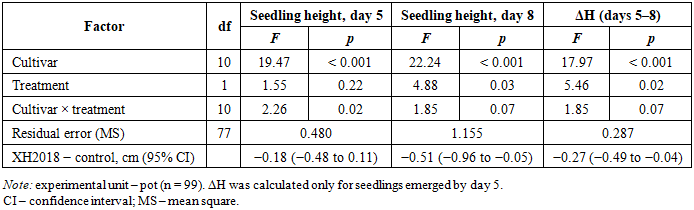
- Table 2 shows the analysis of variance results. At both dates, most of the variation in seedling height was attributable to the cultivar factor (p < 0.001): cultivar accounted for 65.8% (day 5) and 68.9% (day 8) of the total sum of squares, treatment for 0.5% and 1.5%, the “cultivar × treatment” interaction for 7.6% and 5.7%, and residual error for 26.0% and 23.9%. Five days after sowing, the overall treatment effect was not significant (p = 0.22). By day 8, the mean seedling height across cultivars was 17.7 cm in the control and 17.2 cm in the XH2018 treatment (difference −0.5 cm; 95% CI −1.0 to −0.05; −2.9%; p = 0.030). ΔH also showed a small reduction in the XH2018 treatment (−0.3 cm; 95% CI −0.5 to −0.04; −3.2%; p = 0.022). The “cultivar × treatment” interaction was significant on day 5 (p = 0.023) and close to the threshold on day 8 and for ΔH (p = 0.065 and 0.066).
|
3.2. Cultivar-Level Responses
- Results for individual cultivars are given in Table 3 and Figure 1. Five days after sowing, seedlings in the XH2018 treatment were slightly taller than control seedlings in Gurt (+8.6%), Mezon (+5.6%), Xisorak (+4.1%), O‘zbekiston-25 (+3.0%) and Asr (+2.0%), but none of these differences was significant. After correction for multiple comparisons, only Andijon-2 showed significantly shorter seedlings than the control (−15.7%; adjusted p = 0.007). The reduction in E’zoz (−9.8%) was not significant after correction.
|
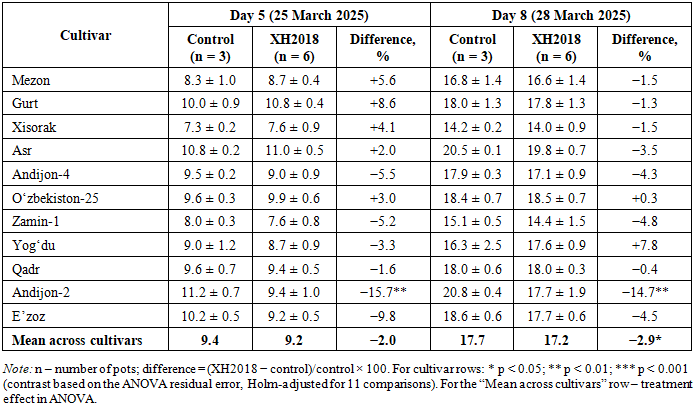
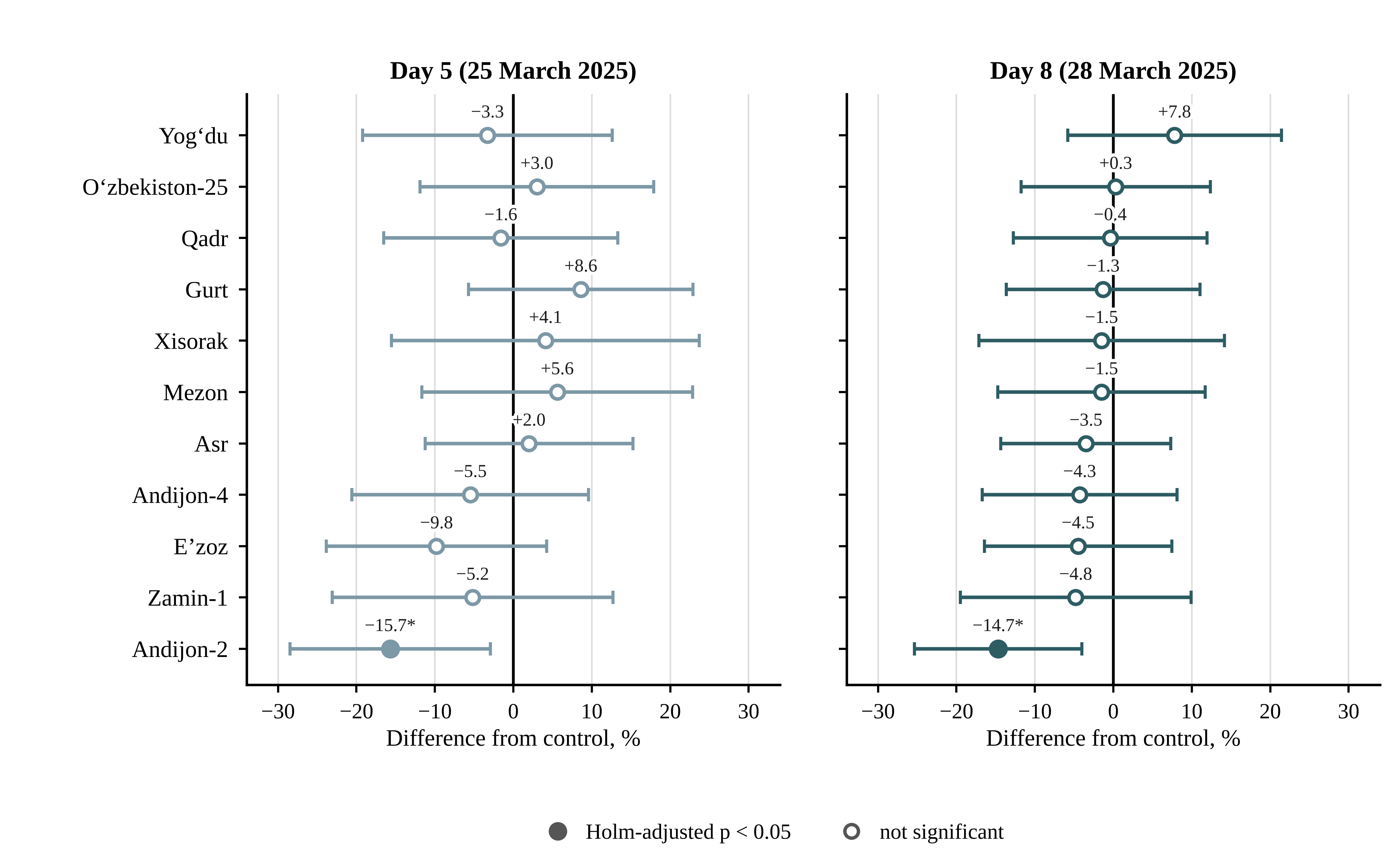 | Figure 1. Difference in seedling height of wheat cultivars in the XH2018 treatment relative to the control on day 5 (left) and day 8 (right), % of the control mean. Bars show Bonferroni-adjusted 95% confidence intervals for the 11 cultivar contrasts (cultivars ordered by the day 8 difference; filled marker – Holm-adjusted p < 0.05; open marker – not significant) |
3.3. Emergence and Growth Between Days 5 and 8
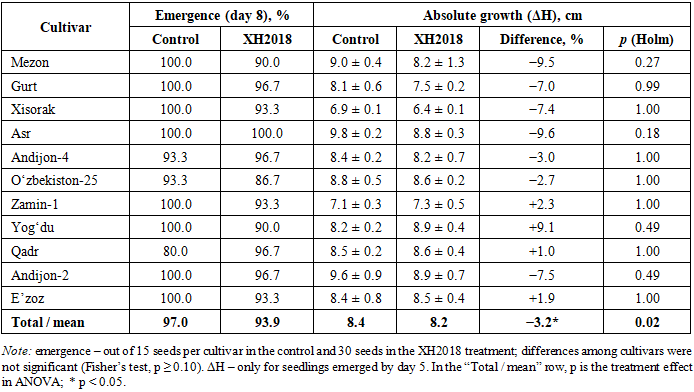
- Five days after sowing, emergence was 95.8% in the control and 92.7% in the XH2018 treatment (p = 0.24). By day 8, it was 97.0% (160 of 165 seeds) and 93.9% (310 of 330 seeds), respectively (Table 4). The day-8 difference was −3.0 percentage points (95% CI −6.7 to +0.6) and was not statistically significant (Fisher’s test: p = 0.19; pot-based test: p = 0.10). The confidence interval does not rule out a moderate reduction in emergence. Across cultivars, emergence ranged from 80.0% to 100.0%. Between days 5 and 8, six seeds emerged late (two in the control and four in the XH2018 treatment).Between days 5 and 8, seedlings grew by an average of 8.4 cm in the control and 8.2 cm in the XH2018 treatment (Table 4). Across cultivars, the difference in absolute growth ranged from −9.6% (Asr) to +9.1% (Yog‘du), but no cultivar showed a significant difference after correction. The reductions in Mezon (−9.5%) and Asr (−9.6%) were significant before correction (p = 0.027 and 0.016), but they lost significance after Holm correction.
|
3.4. Cultivar Ranking
- Mean seedling heights of the cultivars in the control and XH2018 treatments were strongly positively correlated (day 8: r = 0.86, p < 0.001; ρ = 0.78, p = 0.005; Figure 2). This shows that the cultivar effect was much stronger than the treatment effect. On day 8, control means ranged from 14.2 cm (Xisorak) to 20.8 cm (Andijon-2), a 1.5-fold difference, whereas the overall difference between the treatments was only 0.5 cm. Asr was among the tallest cultivars in both treatments, while Xisorak and Zamin-1 were among the shortest. The most marked change was in Andijon-2, which ranked first in the control and sixth in the XH2018 treatment.
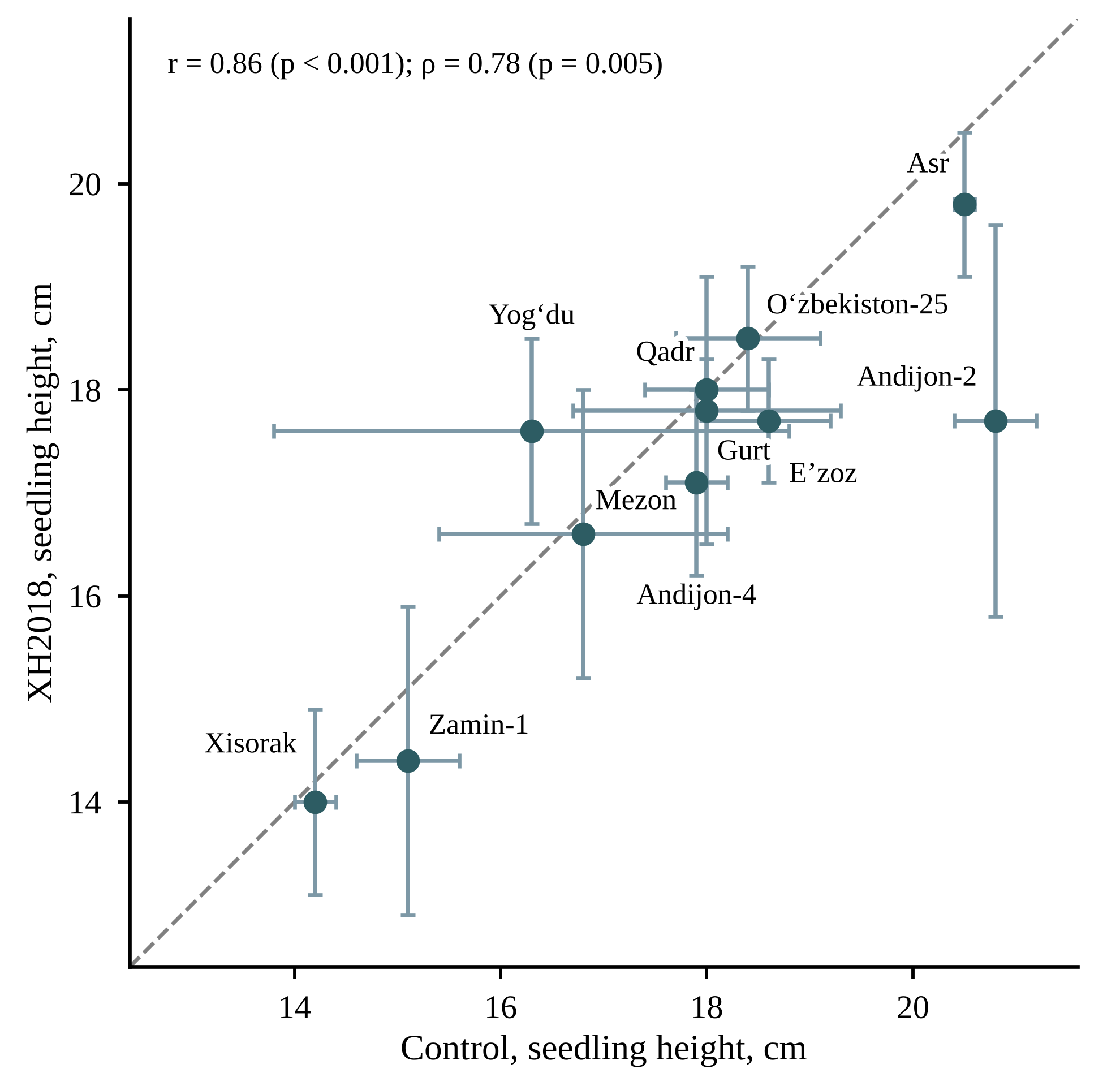 | Figure 2. Mean seedling height (± SD) of wheat cultivars in the control and XH2018 treatments 8 days after sowing. Dashed line – 1:1 line |
4. Discussion
- In this preliminary pot experiment, seed bacterization with A. chroococcum XH2018 did not stimulate early growth of wheat seedlings. Most variation in seedling height was attributable to cultivar, while the overall treatment effect was small (−2.9%) and lost significance when a single cultivar (Andijon-2) was excluded. Such inconsistency in inoculation outcomes has been reported frequently [10,11].The 8-day observation period should be understood as a study of emergence and early seedling growth, not of seedling vigor over the whole seedling stage. It corresponds to the duration of the standard germination test for wheat, in which seedlings are counted on day 4 and day 8 [25], and emergence was almost complete by day 5 (95.8% in the control and 92.7% in the XH2018 treatment) and changed little afterwards. Seed bacterization is expected to act first at this stage [9]. However, 8 days are not sufficient to judge whether bacterization changes seedling vigor later, or tillering and yield: effects based on root colonization, nitrogen fixation or phosphate solubilization may appear only after seed reserves are exhausted and the root system has developed [3,6,7]. Our results therefore show no early effect and do not exclude a later one.On day 5, the “cultivar × treatment” interaction was significant, but it also arose mainly from Andijon-2. The conclusion that cultivars differ in their response to the strain should therefore be treated with caution. Nevertheless, the pattern is consistent with published data. The role of host genotype in interactions with beneficial bacteria has been demonstrated in many studies [12,13]. Egamberdieva [14] found that only one of two wheat cultivars responded markedly to inoculation and recommended selecting responsive cultivars before applying inoculants. Valente et al. [15,16] showed that wheat genotypes differ sharply in the degree of PGPR colonization and in the growth-promoting effect. In a study of six wheat cultivars with arbuscular mycorrhiza, the response to the same inoculant was positive in one cultivar and negative in another, while the overall effect was small [17]. A. chroococcum strain K2020 also had different effects in cotton cultivars [18]. The clear negative response of Andijon-2 may reflect a cultivar-specific difference, but an effect of pot position or of the seed stock cannot be ruled out; its three control pots were the tallest of all control groups (Table 3).Differences among cultivars in seedling height were much larger than any effect of the treatment. On day 8, control means ranged from 14.2 cm (Xisorak) to 20.8 cm (Andijon-2), cultivar accounted for 66–69% of the total variation (Section 3.1), and the cultivar ranking was largely preserved in the XH2018 treatment (Figure 2). Such differences in early seedling height may be related to seed size and reserves, seed vigor and the history of the seed stock, none of which was measured here; they cannot be attributed to genotype alone. The cultivars responded to bacterization in four different ways (Section 3.2): a transient, non-significant advantage (Gurt, Mezon, Xisorak, Asr), a non-significant advantage on day 8 only (Yog‘du), no difference (O‘zbekiston-25, Qadr) or a reduction (Andijon-4, Zamin-1, E’zoz, Andijon-2). With three control pots per cultivar and a smallest detectable difference of about 2.2 cm (12%) at the cultivar level, these patterns are descriptive; they should be tested in a randomized experiment with several seed stocks per cultivar. For Mezon, the main cultivar of the authors’ research, the early advantage on day 5 (+5.6%) was not significant and had disappeared by day 8 (−1.5%).Several factors may explain why the non-significant positive difference seen on day 5 in several cultivars had disappeared by day 8. A. chroococcum produces auxin-, gibberellin- and cytokinin-like substances [4,5]. The effect of auxin depends on concentration: low concentrations stimulate growth, while high concentrations may inhibit root and shoot growth [27,28]. In addition, during the first days after sowing, seedlings grow mainly on reserves stored in the endosperm [29]. Nutrition-related mechanisms such as nitrogen fixation may therefore not yet be evident during this period [3,30]. Because phytohormone levels and root colonization were not measured directly, these explanations should be tested in further studies.Because studies of PGPR in wheat often emphasize the roots, a shoot-based assessment such as ours gives only a partial picture. Pseudomonads are among the best-studied wheat-colonizing bacteria: seed-applied strains of P. putida colonized winter wheat roots at 104–108 CFU per gram of roots and increased grain yield by about 11% at two field sites, although the effects differed among sites [21]. Four novel Pseudomonas species recently described from wheat roots, three of them in the P. fluorescens complex, antagonized fungal phytopathogens, and inoculation of wheat roots with them enhanced plant growth, with two strains doubling shoot biomass [22]; biocontrol of soilborne pathogens by Pseudomonas has been studied for decades [23]. Our experiment did not include a Pseudomonas reference strain and did not measure roots or root colonization; therefore, we cannot say whether XH2018 is more or less effective than these bacteria, and the possibility that XH2018 acts mainly through the roots was not tested. We studied XH2018 first because it is the strain on which the authors’ research is based; a comparison with Pseudomonas strains in the same cultivars is a logical next step.Emergence did not differ significantly, but the difference was negative (−3.0 percentage points), and its confidence interval does not rule out a moderate reduction. A larger sample is therefore needed before drawing a firm conclusion about how bacterization affects emergence.
4.1. Limitations
- The study has several limitations that restrict the conclusions. (1) Pots were arranged in rows by cultivar and were not randomized. As a result, cultivar and treatment effects cannot be fully separated from position effects (e.g., proximity to the window and uneven lighting); this is especially relevant to the interaction. (2) Each cultivar was represented by a single seed stock, so the cultivar effect is confounded with differences between seed stocks, and the 11 cultivars are not a random sample. (3) All seeds were soaked in one batch of suspension. (4) Control seeds were soaked in non-sterile tap water; no control with inactivated cells or sterile buffer was included. (5) The number of control replicates was small (n = 3). With the residual variation observed on day 8 (SD = 1.07 cm), the smallest difference that could be detected (80% power, two-sided α = 0.05, without correction for multiple comparisons) was about 2.2 cm (12% of the control mean) for a single cultivar and about 0.65 cm (3.7%) for the overall treatment effect; smaller effects could have been missed, so the results show no detectable effect rather than proof of no effect. (6) Because measurements were accurate only to 0.5 cm, differences smaller than 0.5 cm are difficult to interpret.(7) The experiment was short (8 days) and covered emergence and early seedling growth only. Only seedling height and emergence were measured; roots, biomass, root colonization by the bacterium and later traits (tillering, spike length, grain yield and grain quality) were not determined, so the results cannot be extrapolated to later growth stages. (8) Only one strain was tested, and no reference PGPR strain (for example, a Pseudomonas strain) was included, so the effect of XH2018 could not be compared with that of other bacteria. (9) The experiment was carried out once, in one non-sterilized soil and under laboratory conditions, so the results may not be transferable to field conditions.
4.2. Future Work
- Further studies should address these limitations and evaluate the traits that could not be measured in this short experiment. They should (i) use a randomized complete block design with equal and larger numbers of replicates and, for each cultivar, more than one seed stock; (ii) include a sterile-buffer or inactivated-cell control and at least one reference PGPR strain, such as a Pseudomonas strain, together with XH2018; (iii) follow the plants through the whole season, in pots and in the field, and measure root length and biomass, shoot weight, number of stems (tillers), spike length, grain yield and grain quality; (iv) determine root colonization by the inoculant; (v) test the biocontrol activity of XH2018 against important wheat pathogens; and (vi) include cultivars with contrasting characteristics so that differences in response can be linked to specific traits.
5. Conclusions
- In this preliminary pot experiment, bacterizing seeds with A. chroococcum XH2018 did not stimulate emergence or wheat seedling growth during the first 8 days after sowing. Variation in early seedling growth was determined mainly by cultivar (confounded with seed stock), which accounted for about two-thirds of the total variation. The overall treatment effect was small (−2.9% on day 8) and not robust because it depended mainly on how Andijon-2 responded. After correction for multiple comparisons, seedling height was significantly lower than the control only in Andijon-2; differences in the other cultivars were not significant. Emergence showed no significant difference (−3.0 percentage points; 95% CI −6.7 to +0.6). Because the experiment was short, was not randomized and tested a single strain, it does not allow conclusions about later growth stages, roots, yield or biocontrol, or about XH2018 relative to other PGPR such as Pseudomonas. These results suggest that the effect of strain XH2018 on wheat cultivars should be examined in randomized, longer-term experiments with a reference strain, including root colonization, biomass and yield traits.
ACKNOWLEDGEMENTS
- The authors thank the staff of the Institute of Genetics and Plant Experimental Biology of the Academy of Sciences of the Republic of Uzbekistan for access to the “Do‘rmon” experimental field and for technical assistance during the experiment.