
-
Paper Information
- Next Paper
- Paper Submission
-
Journal Information
- About This Journal
- Editorial Board
- Current Issue
- Archive
- Author Guidelines
- Contact Us
International Journal of Genetic Engineering
p-ISSN: 2167-7239 e-ISSN: 2167-7220
2026; 14(11): 359-363
doi:10.5923/j.ijge.20261411.05
Received: Oct. 11; Accepted: Nov. 8, 2026; Published: Nov. 12, 2026

Selected Physiological and Stress-Tolerance Traits of Sunflower Cultivars Under Water-Deficit Conditions in the Bukhara Region
 Abstract
 Reference
 Full-Text PDF
 Full-text HTML
Askar Kholliyev, Gulnoza Rahimova
Bukhara State University, Bukhara, Uzbekistan
Correspondence to: Askar Kholliyev, Bukhara State University, Bukhara, Uzbekistan.
| Email: |  |
Copyright © 2026 The Author(s). Published by Scientific & Academic Publishing.
This work is licensed under the Creative Commons Attribution International License (CC BY).
http://creativecommons.org/licenses/by/4.0/

Field experiments in the Bukhara region evaluated physiological responses of seven sunflower cultivars (Helianthus annuus L.)—Diyor, Dilbar, Alomat, VNIIMK-888, Jahongir, Navruz, and Sur—at soil-moisture levels of 70% and 50% of full water-holding capacity (FWHC). Measurements at budding, flowering, and ripening covered leaf total water content, protoplasmic viscosity, tissue water-suction activity, and albumin and globulin fractions. Reported mean viscosity increased from 19.25 min at budding to 42.49 min at ripening, while water-suction activity rose from 13.14 to 17.21 atm. At each stage, water-suction activity was higher under 50% than under 70% FWHC. Diyor, Dilbar, and Alomat retained more leaf water than Sur, while albumin and globulin readings under reduced soil moisture, particularly during flowering. These findings indicate that cultivar identity and developmental stage are associated with different physiological responses to water deficit. Diyor and Dilbar are reported as promising cultivars for moisture-limited conditions.
Keywords: Sunflower, Water deficit, Cultivar response, Leaf water relations, Protoplasmic viscosity, Water-suction activity, Albumins, Globulins
Cite this paper: Askar Kholliyev, Gulnoza Rahimova, Selected Physiological and Stress-Tolerance Traits of Sunflower Cultivars Under Water-Deficit Conditions in the Bukhara Region, International Journal of Genetic Engineering, Vol. 14 No. 11, 2026, pp. 359-363. doi: 10.5923/j.ijge.20261411.05.
Article Outline
1. Introduction
- Photosynthesis is one of the principal biological processes during plant growth. It converts carbon dioxide and water into organic compounds using light energy. Green leaves absorb an estimated 80–90% of solar radiation, but only 1–2% of this energy is used in photosynthesis; the remainder is directed mainly to transpiration. In some cases, the proportion used for photosynthesis reaches 5–8% [1].A well-developed photosynthetic apparatus with an adequate leaf area and activity over time is one of the factors supporting stable crop yields. The optimal leaf area reported for maximum productivity in agricultural crops is approximately 40,000 m² ha⁻¹ [2]. Sunflower (Helianthus annuus L.) is an important oilseed crop worldwide and ranks fourth in production after palm, soybean, and rapeseed oils [3]. Its tolerance to low temperatures, salinity, and drought allows it to adapt to a range of environments [4].Sunflower is relatively well adapted to arid and semi-arid conditions because its extensive root system can extract water from deeper soil layers during water stress. Severe water deficit, however, can markedly restrict vegetative growth, particularly the development of aboveground organs. Reduced aboveground biomass may, in turn, limit the production of photosynthetic assimilates [5].Crop sensitivity to water stress also varies across growth stages. Previous studies report particular sensitivity from the onset of flowering through ripening, when deficit irrigation may substantially reduce yield. Water shortage during flowering has been associated with lower sunflower yield, whereas a deficit imposed during early seed formation has in some cases increased it [6].Water deficit during early reproductive development may increase assimilate accumulation in the sunflower head; a reduction in seed number can then be partly offset by greater seed size, stabilizing yield. A moderate reduction in irrigation before sowing has also been reported to support later biomass accumulation, whereas water deficit between budding and flowering can substantially reduce economic yield [7]. Other studies indicate that reducing water supply by 20–40% relative to adequate irrigation does not always affect yield significantly. Multi-year field trials are therefore needed to determine how the intensity, timing, and duration of water deficit affect sunflower growth and productivity in a particular region [8].Sunflower drought adaptation is associated with osmoregulation, the accumulation of sugars and other osmotically active compounds, the development of small xeromorphic leaves in the upper and partly middle canopy, and a reduction in transpiring surface through the senescence of lower and, later, upper leaves. A decline in actual transpiration relative to potential transpiration can reduce yield. Water requirements vary with developmental stage; sunflower uses 1,200–1,800 t of water to produce one metric ton of seed [9].To clarify how sunflower cultivars differ under limited soil moisture, this study evaluated seven cultivars in the Bukhara region. The physiological traits assessed were leaf water content, protoplasmic viscosity, tissue water-suction activity, and albumin and globulin fractions.
2. Materials and Methods
2.1. Plant Material and Soil-Moisture Treatments
- Seven sunflower cultivars were studied: Diyor, Dilbar, Alomat, VNIIMK-888, Jahongir, Navruz, and Sur. Soil moisture was assessed at 70% and 50% of full water-holding capacity (FWHC).
2.2. Sampling and Phenological Stages
- Physiological measurements and phenological observations were made at budding, flowering, and ripening. For each cultivar, ten plants were selected for individual assessment. The sampled material consisted of three to four moderately developed leaves from the upper part of the stem. Soil samples for agrochemical analysis were collected from layered intervals within the 0–50 cm soil depth, with three repeated samples, and analyzed in the laboratory using generally accepted methods.
2.3. Physiological Measurements
- Total water content in the leaves was determined by the thermostat (oven-drying) method [10]. Protoplasmic viscosity was assessed by the plasmolytic method [11]. Leaf-tissue water-suction activity was measured using the V. S. Shardakov method [12].
2.4. Albumin and Globulin Fractions
- Albumin and globulin fractions were determined volumetrically by assessing precipitation after salting the solution with sodium chloride. The described procedure used sequential protein extraction. A weighed leaf sample was ground, mixed with distilled water, and centrifuged. Water-soluble proteins (albumins) were collected in the supernatant. The remaining precipitate was extracted again with 5–10% NaCl to recover salt-soluble globulins. Protein in the extracts was measured spectrophotometrically, and the amount of each fraction was calculated from its concentration and extract volume [13].
2.5. Experimental Design and Statistical Analysis
- Treatment variants were arranged systematically by tier. One description reports three replications per treatment; another gives four biological and three analytical replications. Observations and biometric measurements were made on model plants in odd-numbered replications. Data were processed using MS Excel 2003 and Sigma Stat, and correlation coefficients were used to assess relationships among traits, growth stage, and soil moisture.
3. Results
3.1. Leaf Total Water Content
- Leaf total water content varied with soil moisture, cultivar, and developmental stage. It was higher at 70% FWHC than at 50% FWHC across the cultivars and declined from budding through flowering to ripening. This pattern was attributed to the transition from vegetative growth to reproductive development and ripening, when dry-matter accumulation and leaf senescence increase. Numerical values for total leaf water content are not available.Diyor, Dilbar, and Alomat retained comparatively more water as soil moisture declined, whereas Sur showed a sharper decrease under low moisture and at later stages. The relationship between soil moisture and leaf water content was also apparent in Jahongir and VNIIMK-888. Cultivar-level values for these comparisons are qualitative.
3.2. Protoplasmic Viscosity
- Protoplasmic viscosity increased from budding to flowering and from flowering to ripening across the cultivars. The reported overall stage means were 19.25 min at budding, 29.18 min at flowering, and 42.49 min at ripening. The correlation between growth stage and viscosity was strongly positive (r = 0.92). Figure 1 presents these reported means.
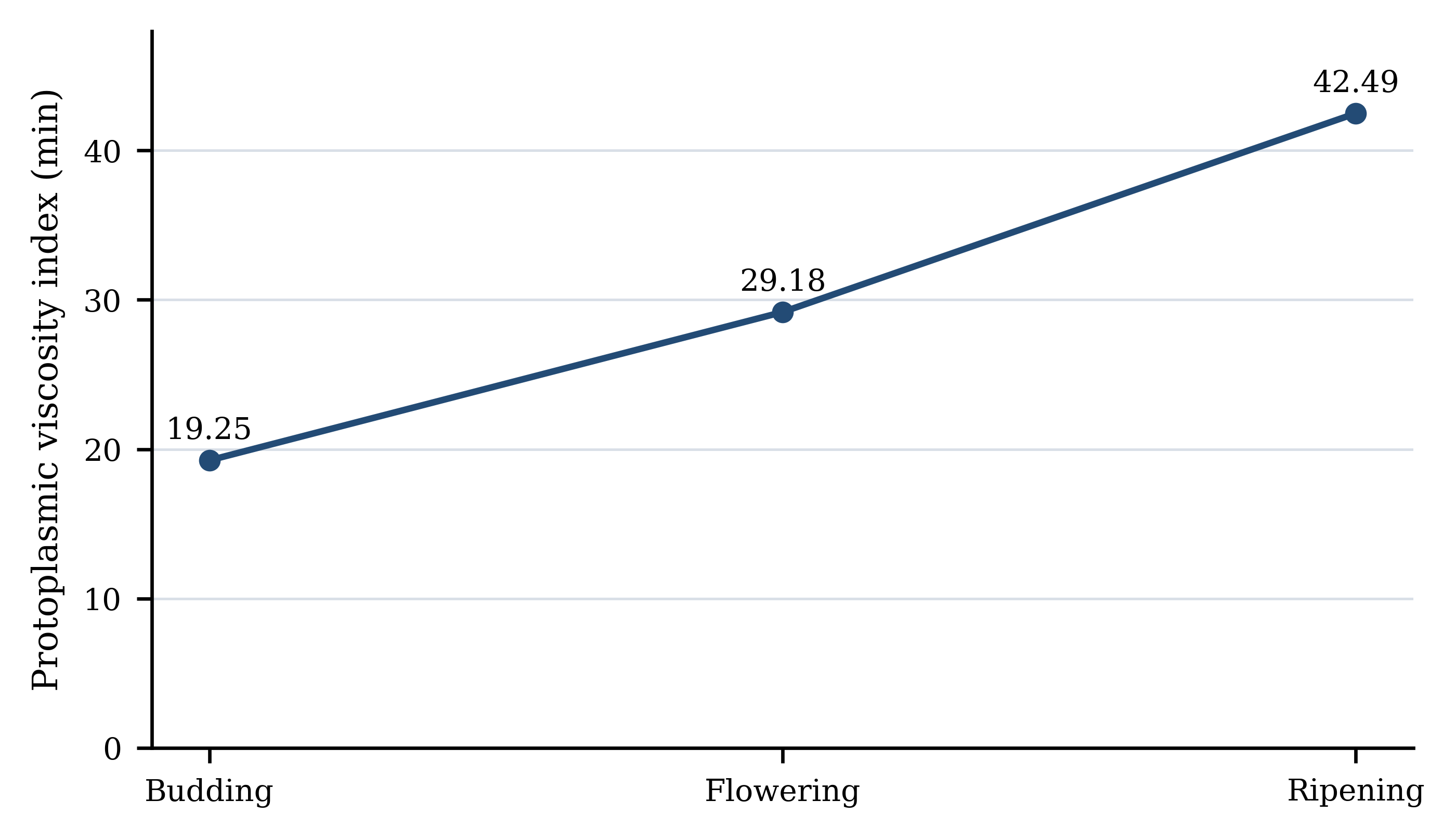 | Figure 1. Reported Mean Protoplasmic Viscosity Index across Growth Stages. Error bars are omitted because replicate-level dispersion estimates are unavailable |
3.3. Leaf-Tissue Water-Suction Activity
- Water-suction activity increased across the growth stages. The reported overall means were 13.14 atm at budding, 15.47 atm at flowering, and 17.21 atm at ripening. The correlation between stage and water-suction activity was positive (r ≈ 0.40). At the two soil-moisture levels, the overall means were 14.48 atm at 70% FWHC and 16.07 atm at 50% FWHC.The reported stage-specific values were higher at 50% FWHC than at 70% FWHC at every stage: 12.41 and 13.86 atm at budding, 14.44 and 16.50 atm at flowering, and 16.57 and 17.86 atm at ripening, respectively. The reported correlation between soil moisture and water-suction activity was weakly negative (r = −0.19). Figure 2 shows the stage-specific values.
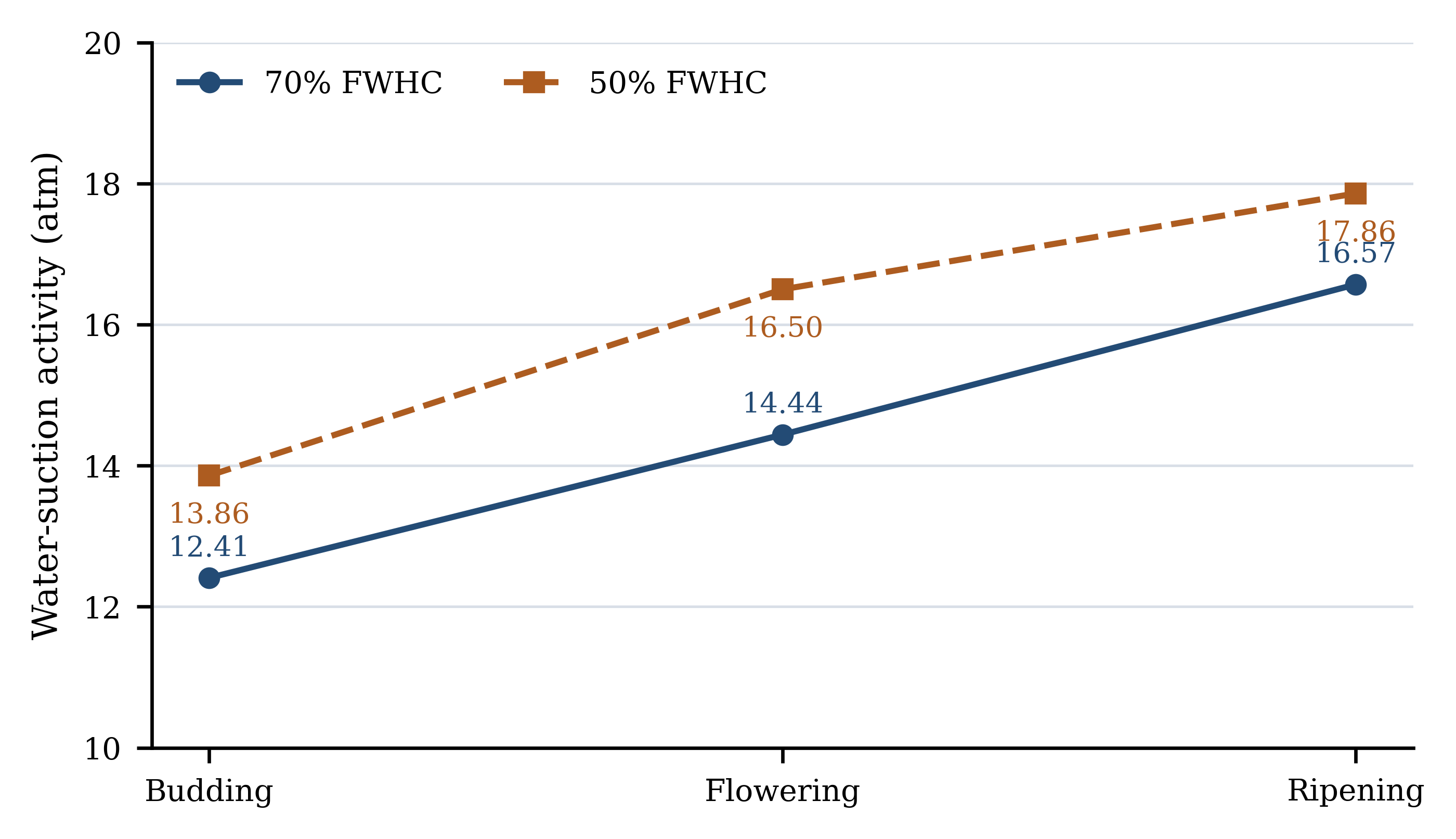 | Figure 2. Reported Water-Suction Activity at 70% and 50% FWHC. Error bars are omitted because replicate-level dispersion estimates are unavailable |
3.4. Albumin and Globulin Fractions
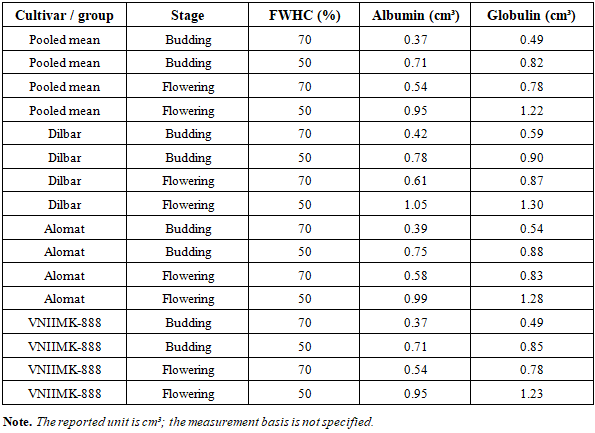
- Albumin and globulin readings increased from budding to flowering and were higher at 50% FWHC than at 70% FWHC. Table 1 presents the reported pooled means and the cultivar-specific values available for Dilbar, Alomat, and VNIIMK-888.
|
4. Discussion
- The results point to a consistent developmental pattern: mean protoplasmic viscosity and water-suction activity both increased from budding to ripening. Between these stages, the reported viscosity mean rose from 19.25 to 42.49 min (about 120.7%), while water-suction activity rose from 13.14 to 17.21 atm (about 31.0%). This parallel direction suggests that developmental stage was associated with changes in both measured leaf traits. The different scales and methods, however, mean that their percentage changes should not be read as directly comparable measures of physiological response. Nor can the correlations alone establish that development caused the changes, particularly without replicate-level observations and estimates of variation.Soil-moisture treatment was most clearly reflected in water-suction activity: its reported mean was about 11.0% higher at 50% FWHC than at 70% FWHC, and the value under the drier treatment exceeded the corresponding value at every sampled stage. Mean protoplasmic viscosity was also higher at 50% FWHC, by about 6.6%. Together with the reported lower leaf-water content under reduced soil moisture, these observations are consistent with a change in leaf water relations under the drier regime. The pattern is descriptive, however, and does not identify a specific mechanism. Because quantitative leaf-water values, leaf or soil water potential, and concentrations of particular osmolytes were not reported, the measurements cannot establish osmotic adjustment or distinguish it from other processes that may affect the indices.The stage-related pattern is broadly compatible with previous reports that sunflower responses vary with irrigation regime and crop development [6–8]. It also highlights why observations at a single stage or season-wide averages may not capture the full response. In this study, the increase in water-suction activity from budding to ripening occurred under both moisture treatments, while the size of the treatment contrast varied by stage. These findings add a leaf-level description to the cited irrigation literature, but they cannot be extended to seed yield, biomass production, or water-use efficiency because those outcomes were not measured here.The cultivar observations provide preliminary leads for further testing. Diyor, Dilbar, and Alomat were reported to retain more leaf water than Sur, and Diyor and Dilbar were highlighted for their protein-fraction readings. Such patterns may help prioritize cultivars for a complete comparative trial, but they do not yet support a definitive ranking for drought tolerance. Values for all seven cultivars are not available for each trait, and the reported rankings cannot be checked against replicate-level data or uncertainty estimates. In addition, physiological indicators alone do not show whether any apparent advantage is maintained through flowering and seed filling or translates into higher yield under water limitation.The albumin and globulin readings were numerically higher under 50% FWHC, particularly during flowering, with globulin readings exceeding albumin readings in the reported comparisons. This may reflect a treatment- or stage-related change in the measured soluble fractions, but the present measurements do not demonstrate increased protein synthesis or accumulation. The unit cm³ is a volume, and the basis of the reported values—extract volume, tissue mass, or concentration—is not defined. The extraction and normalization procedures therefore need clarification before these readings can be interpreted biologically or compared with protein concentrations from other studies. Similarly, the viscosity result is reported as a time-based index rather than an absolute viscosity and requires an operational definition for cross-study comparison.Several reporting gaps limit the strength of all these interpretations: the replication description is internally inconsistent; numerical leaf-water and cultivar-level results are incomplete; and variability estimates and inferential tests are absent. A follow-up report should identify the experimental unit and independent replicate count, provide the complete values for every cultivar and treatment, and state the statistical model with uncertainty intervals or dispersion measures. Repeating the trial across seasons and linking the physiological measurements to biomass and seed yield would show whether the observed patterns are reproducible and agronomically meaningful.
5. Conclusions
- Leaf water content was higher at 70% than at 50% FWHC and declined from budding to ripening. Diyor, Dilbar, and Alomat showed comparatively greater water retention, whereas Sur was more sensitive to low soil moisture and later growth stages. Mean protoplasmic viscosity increased from 19.25 min at budding to 42.49 min at ripening; water-suction activity rose from 13.14 to 17.21 atm and was higher at 50% FWHC at each stage. Albumin and globulin readings were also higher under reduced soil moisture, particularly during flowering, with Diyor and Dilbar highlighted in the cultivar comparison.These patterns warrant further evaluation of cultivar-specific responses to water deficit in the Bukhara region. The replication scheme, full cultivar-level results, variability estimates, statistical procedures, and protein-fraction units should be clarified before the findings are generalized.