
-
Paper Information
- Previous Paper
- Paper Submission
-
Journal Information
- About This Journal
- Editorial Board
- Current Issue
- Archive
- Author Guidelines
- Contact Us
International Journal of Genetic Engineering
p-ISSN: 2167-7239 e-ISSN: 2167-7220
2026; 14(11): 352-358
doi:10.5923/j.ijge.20261411.04
Received: Oct. 17; Accepted: Nov. 6, 2026; Published: Nov. 9, 2026

Inheritance of Yield Components and Stem Internodes in Inter-Varietal and Inter-Biotype F1 Hybrids of Bread Wheat
 Abstract
 Reference
 Full-Text PDF
 Full-text HTML
G. M. Ismoilova1, D. E. Qulmamatova2, S. K. Baboev2, 3
1Assistant Researcher, Institute of Genetics and Plant Experimental Biology, Academy of Sciences of the Republic of Uzbekistan, Kibray District, Tashkent Region, Uzbekistan
2DSc in Biological Sciences, Institute of Genetics and Plant Experimental Biology, Academy of Sciences of the Republic of Uzbekistan, Tashkent, Uzbekistan
3Professor, Institute of Genetics and Plant Experimental Biology, Academy of Sciences of the Republic of Uzbekistan, Tashkent, Uzbekistan
Correspondence to: G. M. Ismoilova, Assistant Researcher, Institute of Genetics and Plant Experimental Biology, Academy of Sciences of the Republic of Uzbekistan, Kibray District, Tashkent Region, Uzbekistan.
| Email: |  |
Copyright © 2026 The Author(s). Published by Scientific & Academic Publishing.
This work is licensed under the Creative Commons Attribution International License (CC BY).
http://creativecommons.org/licenses/by/4.0/

The correct choice of parents is one of the main factors determining the efficiency of breeding high-yielding wheat cultivars, and the assessment of heterosis and the type of inheritance in first-generation hybrids allows promising combinations to be identified early. Heterosis and the degree of dominance were studied in six F1 hybrids of winter bread wheat (Triticum aestivum L.) representing three types of crosses: between Uzbek cultivars (Ilg‘or × O‘zbekiston-25, Qayroqtosh × E’zoz), between biotypes of the cultivar Oq Marvarid identified by gliadin proteins (1C × 2C, 1C × 3C), and between the Russian cultivar Bezostaya and these biotypes (Bezostaya × 2C, Bezostaya × 3C). The hybrids and parents were grown in Tashkent region in 2022–2023 and evaluated for spike productivity and stem internode length. Both inter-cultivar hybrids showed significant positive heterosis, based on positive overdominance, for spike weight (17.0 and 21.2%) and grain weight per spike (19.1 and 25.7%). In Ilg‘or × O‘zbekiston-25 heterosis was expressed through a higher grain number, and in Qayroqtosh × E’zoz through larger grains. In the inter-biotype hybrids, heterosis for these two traits ranged from −6.7 to 8.8%, whereas Bezostaya × 2C showed negative overdominance for spike weight (−23.9%), grain weight per spike (−29.8%) and 1000-kernel weight (−20.9%). The results showed that the expression of heterosis for spike productivity depends on the type of cross and on the parental combination.
Keywords: Bread wheat, F1 hybrids, Heterosis, Degree of dominance, Biotypes, Spike productivity, Plant height
Cite this paper: G. M. Ismoilova, D. E. Qulmamatova, S. K. Baboev, Inheritance of Yield Components and Stem Internodes in Inter-Varietal and Inter-Biotype F1 Hybrids of Bread Wheat, International Journal of Genetic Engineering, Vol. 14 No. 11, 2026, pp. 352-358. doi: 10.5923/j.ijge.20261411.04.
Article Outline
1. Introduction
- Bread wheat (Triticum aestivum L.) is grown on about 220 million ha worldwide, with a production of nearly 800 million t in 2024 [1]. In Uzbekistan, the wheat area increased from 0.63 million ha in 1991 to 1.24 million ha, and the average yield from 1.66 to 4.55 t ha⁻¹ in 2023. Nevertheless, on-farm yields remain about 42% (3.25 t ha⁻¹) below the attainable level, and nitrogen fertiliser, irrigation, rainfall and cultivar have been identified as the key yield determinants [2]. An evaluation of winter wheat cultivars and advanced lines showed that the best genotypes differed between the desert, middle and foothill zones [3]. This underlines the need to develop cultivars adapted to specific conditions and to choose parents on a sound basis in crossing programmes.Hybridisation is the main way to combine useful traits of different cultivars in one plant, and it shows how a given trait is inherited and which parental combination is promising for breeding. Two indicators are usually assessed in the F1 generation to evaluate the outcome of hybridisation: mid-parent heterosis (Ht), which shows how much the hybrid exceeds the parental mean, and heterobeltiosis (Hbt), which shows how much it exceeds the better parent [4]. F1 data therefore make it possible to select the most promising material at the earliest stages. In half-diallel crosses, F1 hybrids showed positive heterosis for grain number and grain weight per spike and 1000-kernel weight, and overdominance for grain number per spike and 1000-kernel weight [5]. In 45 F1 hybrids, mid-parent heterosis for spike productivity traits reached 14–38% [6], and the best combinations differed from trait to trait [7]. These studies show that heterosis depends on the parental combination.Hybrids may excel in spike productivity through different components. In elite cultivars, breeding progress was achieved mainly through an increase in grain number per spike (+19%) [8], whereas in hybrids heterosis was associated mostly with grain size (1000-kernel weight +7.7% on average) [9]. Heterosis is complemented by the degree of dominance (hp), which classifies the F1 as intermediate, partially dominant or overdominant [10]. The type of inheritance and the expression of heterosis may vary with the conditions of the year [11].Plant height is an important trait in breeding, and negative heterosis for this trait is considered highly useful because it allows short-statured cultivars to be developed [6,7]; in one study it reached −10.6% [6]. Plant height is the sum of internode lengths, and the internodes are under partly independent genetic control [12,13]. As plant height was reduced in modern cultivars, the internodes did not shorten equally: the uppermost internode shortened faster than the others [14]. Plants of the same height may therefore differ in internode lengths, and measuring each internode separately reveals changes that plant height alone does not show. Although much information on heterosis in wheat F1 is available, it mainly concerns crosses between genetically distinct cultivars. Data on how heterosis is expressed when biotypes of one cultivar are crossed with each other or with distant cultivars are limited, and because stem traits are usually evaluated only as plant height, little is known about the inheritance of individual internodes.The aim of this study was to evaluate the inheritance of spike productivity and stem traits in winter wheat F1 hybrids whose parents differ in genetic relatedness, and to identify promising combinations.
2. Materials and Methods
2.1. Plant Material
- Six F1 hybrids of winter bread wheat (Triticum aestivum L.) belonging to three types of crosses were studied: (i) crosses between cultivars developed in Uzbekistan, Ilg‘or × O‘zbekiston-25 and Qayroqtosh × E’zoz; (ii) crosses between biotypes of the Uzbek cultivar Oq Marvarid, 1C × 2C and 1C × 3C; and (iii) crosses between the Russian cultivar Bezostaya and these biotypes, Bezostaya × 2C and Bezostaya × 3C. In each cross, the first-named form was used as the female parent.
2.2. Experimental Site and Field Trial
- The experiment was conducted at the Do‘rmon experimental field of the Institute of Genetics and Plant Experimental Biology, Academy of Sciences of the Republic of Uzbekistan, in Kibray district, Tashkent region (Chirchiq river valley, 300–400 m above sea level), on irrigated sierozem soil. The climate is sharply continental, with a mean temperature of 27–29 °C in July and about −2 °C in January and an annual precipitation of 300–400 mm.Crosses were made in 2022 by emasculation and hand pollination, and the F1 hybrids were grown in the 2022–2023 season under irrigation. Each F1 was sown on a 1 m² plot between its female and male parents (♀–F1–♂). Parents involved in several crosses were sown separately next to each hybrid, and each hybrid was compared with its adjacent parental plots.
2.3. Measured Traits
- At full maturity, 10–30 plants per genotype were measured for spike weight (SW, g), spike length (SL, cm), spikelets per spike (SPS), grains per spike (GPS), grain weight per spike (GWS, g) and 1000-kernel weight (TKW, g), as well as for the lengths of the first to fourth internodes from the base (IN1–IN4, cm), the peduncle (PED, cm) and plant height (PH, cm).
2.4. Statistical Analysis
- Mean, standard error and coefficient of variation were calculated for each genotype. Mid-parent heterosis was estimated as Ht (%) = (F1 − MP)/MP × 100, where MP = (P1 + P2)/2 [15], and heterobeltiosis as Hbt (%) = (F1 − BP)/BP × 100, where BP is the better parent [4]. The significance of Ht was tested with t = (F1 − MP)/√(SE²F1 + (SE²P1 + SE²P2)/4), and that of Hbt with Welch’s t-test between the F1 and the better parent. The degree of phenotypic dominance was calculated as hp = (F1 − MP)/(Pmax − MP) and classified as positive overdominance (hp > 1), positive dominance (0.5 < hp ≤ 1), intermediate inheritance (−0.5 ≤ hp ≤ 0.5), negative dominance (−1 ≤ hp < −0.5) or negative overdominance (hp < −1) [10]. Calculations were performed in Python (SciPy, pandas) and Microsoft Excel.
3. Results
3.1. Mean Performance of Parents and Hybrids
- The parents differed considerably in spike productivity (Table 1). Spike weight of the parents ranged from 3.14 g (3C) to 4.13 g (E’zoz), grains per spike from 52.0 (Ilg‘or) to 62.1 (E’zoz), and 1000-kernel weight from 40.1 g (3C) to 50.0 g (E’zoz). Among the hybrids, Qayroqtosh × E’zoz stood out with the highest spike weight (4.41 g), grain weight per spike (3.45 g) and 1000-kernel weight (54.0 g), whereas Ilg‘or × O‘zbekiston-25 had the largest grain number (68.3) and the longest spike (13.1 cm). Bezostaya × 2C had the lowest spike weight (2.54 g), grain weight per spike (1.85 g) and 1000-kernel weight (34.6 g). The within-genotype coefficient of variation for spike traits was below 15% in 94% of cases (maximum 22.5%).
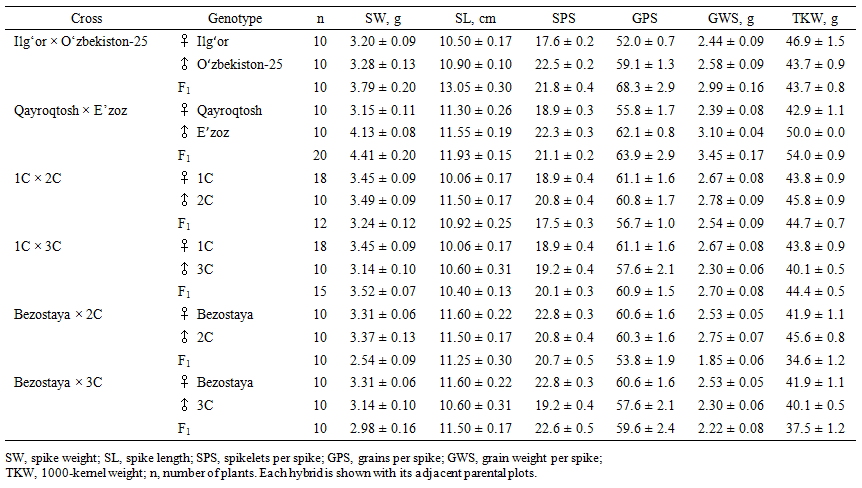 | Table 1. Means (± SE) of Spike Productivity Traits in Parents and F1 Hybrids |
3.2. Heterosis for Spike Productivity
- The level of heterosis for spike productivity depended on the type of cross (Table 2; Figures 1 and 2). Both crosses between Uzbek cultivars showed significant positive heterosis for spike weight and grain weight per spike: 17.0% and 19.1% in Ilg‘or × O‘zbekiston-25 and 21.2% and 25.7% in Qayroqtosh × E’zoz. In Ilg‘or × O‘zbekiston-25, heterosis resulted from grain number (Ht = 23.0%) and spike length (22.0%), while 1000-kernel weight did not change (−3.6%, not significant). In Qayroqtosh × E’zoz, heterosis was due mainly to 1000-kernel weight (Ht = 16.3%, Hbt = 8.0%, both p < 0.001), and no significant heterosis was found for grain number.
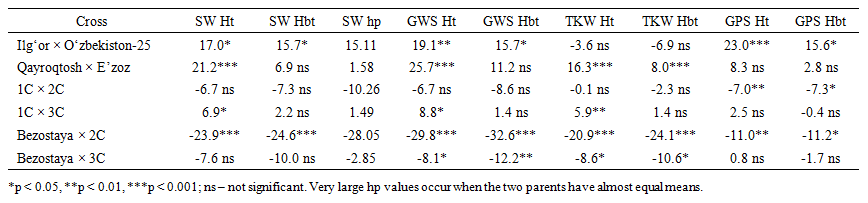 | Table 2. Mid-Parent Heterosis (Ht, %), Heterobeltiosis (Hbt, %) and Degree of Dominance (hp) for Spike Productivity Traits |
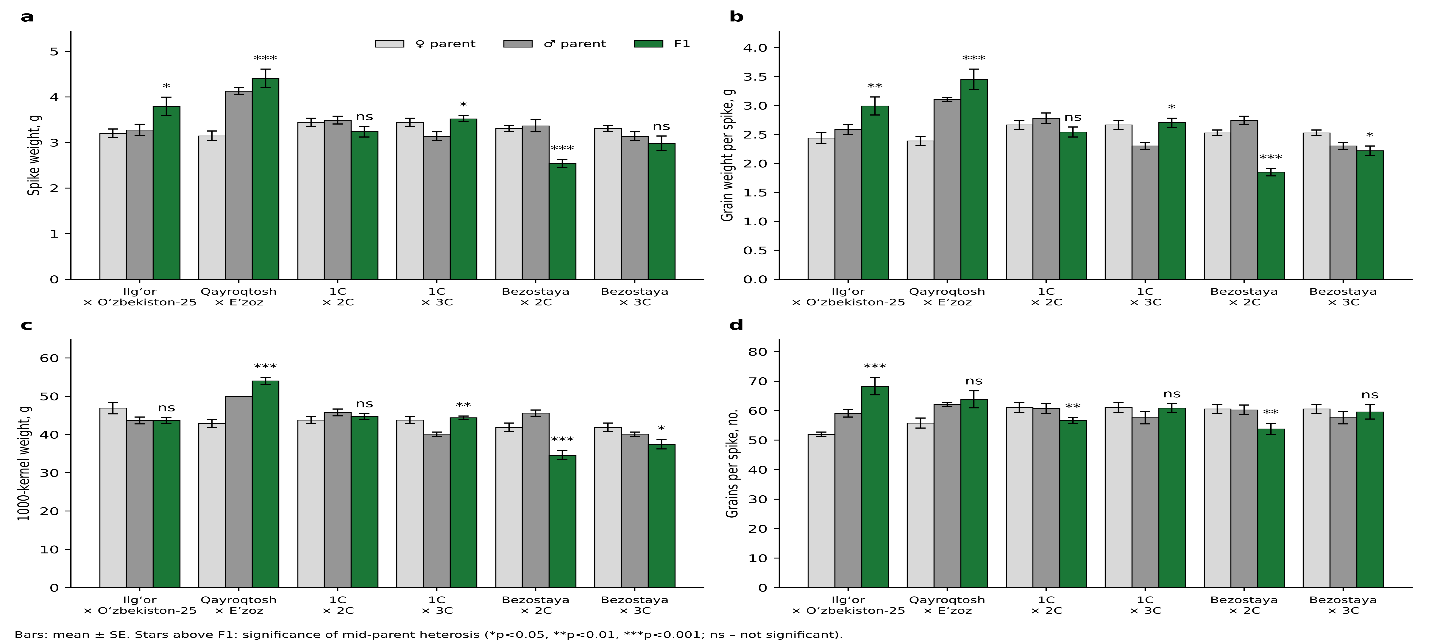 | Figure 1. Spike weight (a), grain weight per spike (b), 1000-kernel weight (c) and grains per spike (d) in parents and F1 hybrids. Bars show mean ± SE; stars above F1 bars show the significance of mid-parent heterosis (*p < 0.05, **p < 0.01, ***p < 0.001; ns – not significant) |
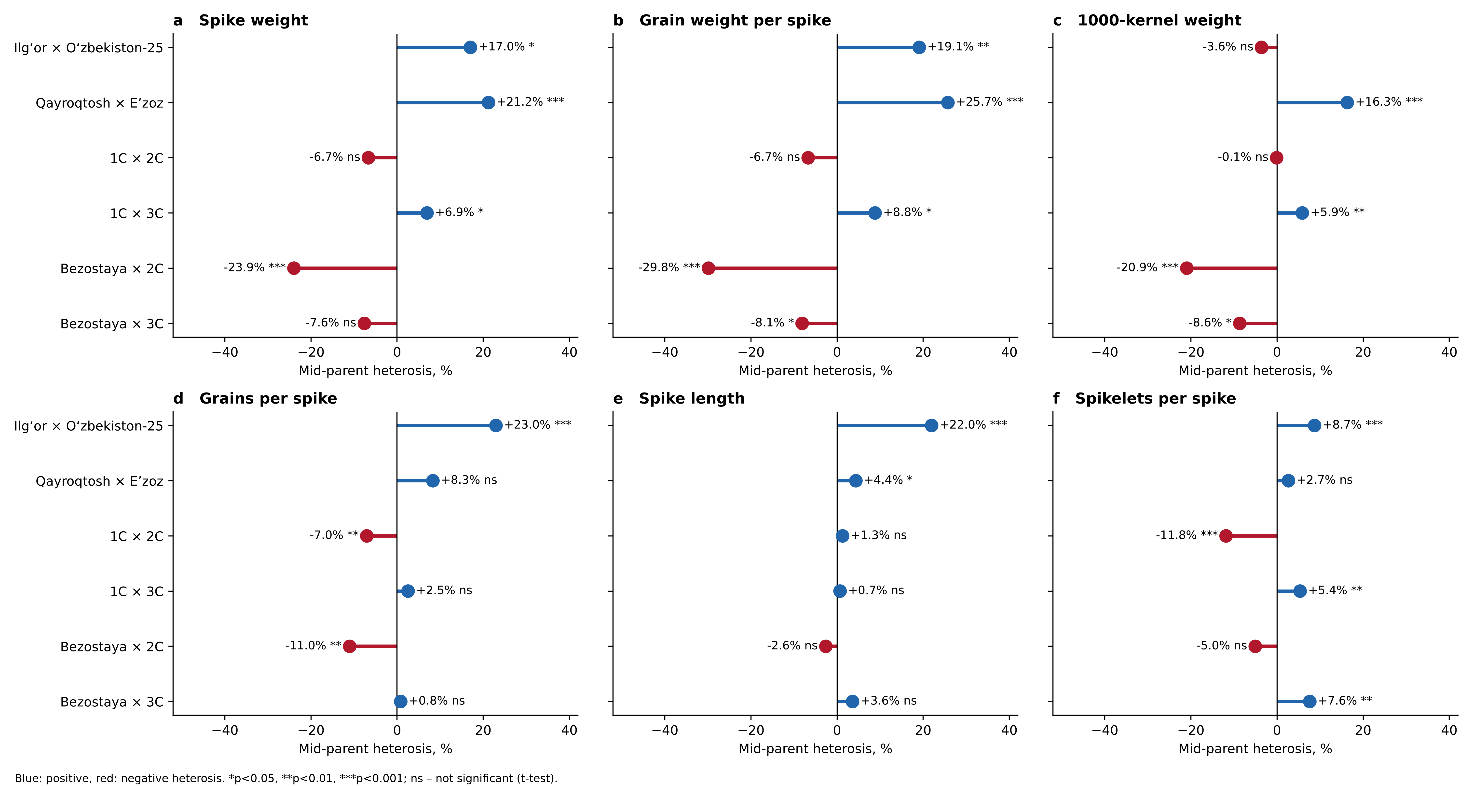 | Figure 2. Mid-parent heterosis (%) in F1 hybrids for spike weight (a), grain weight per spike (b), 1000-kernel weight (c), grains per spike (d), spike length (e) and spikelets per spike (f). Blue, positive; red, negative heterosis; *p < 0.05, **p < 0.01, ***p < 0.001; ns – not significant |
3.3. Stem Traits
- Plant height ranged from 83.9 cm (O‘zbekiston-25) to 113.8 cm (Bezostaya) in the parents and from 89.4 to 109.0 cm in the hybrids (Table 3, Figure 3). Heterosis for plant height was small in all crosses (Ht from −2.7 to 3.8%). The internodes changed differently. In Ilg‘or × O‘zbekiston-25, IN1–IN4 were shorter than the mid-parent value (Ht from −8.6 to −19.3%), whereas the peduncle was longer (16.6%, p < 0.001), so plant height hardly changed (3.1%). In all four crosses without Bezostaya, the third internode was shorter than the mid-parent value (Ht from −6.6 to −11.5%). In contrast, in both Bezostaya crosses the lower internodes were longer than the mid-parent value (IN1: 20.3% and 19.7%, p < 0.01; IN2: 10.2% and 8.7%, p < 0.05), and in Bezostaya × 3C the peduncle was also longer (15.9%, p < 0.001). Nevertheless, both Bezostaya hybrids remained shorter than Bezostaya (Hbt −5.1% and −4.2%, p < 0.01).
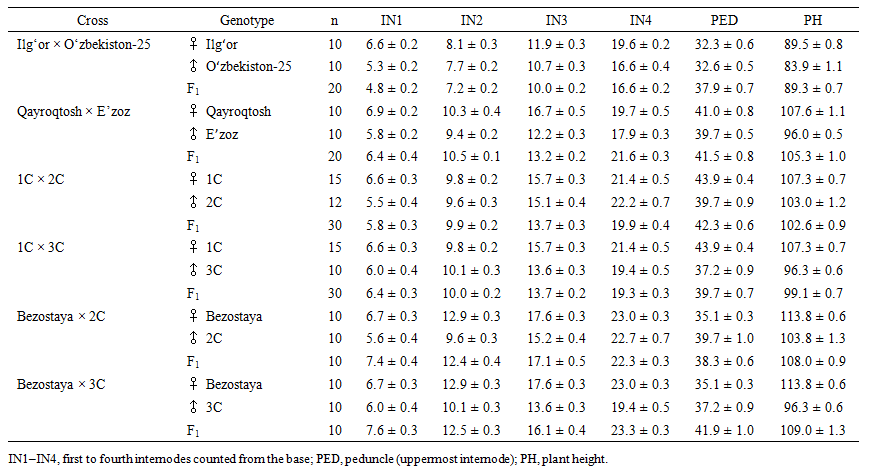 | Table 3. Means (± SE) of Stem Traits in Parents and F1 Hybrids, cm |
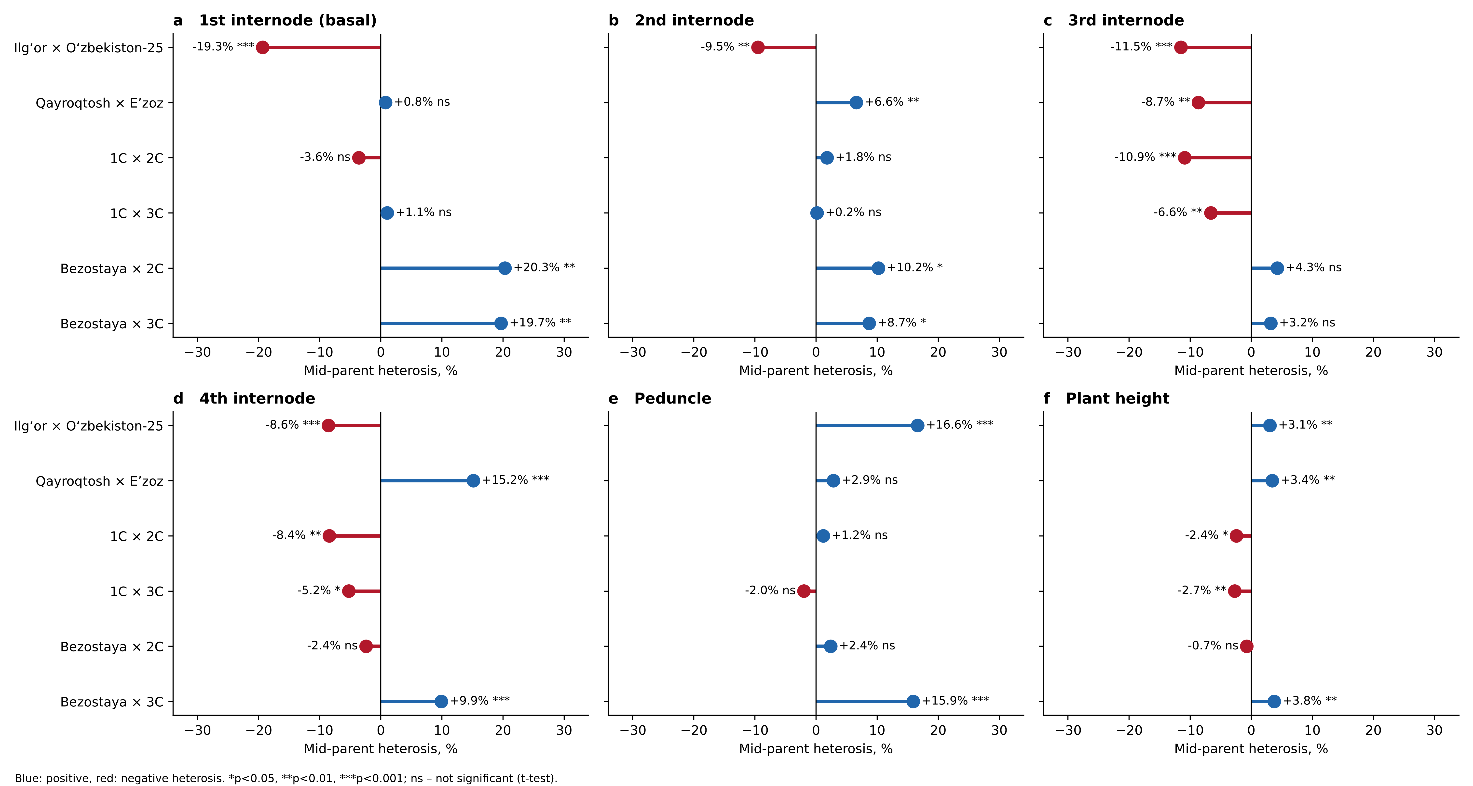 | Figure 3. Mid-parent heterosis (%) in F1 hybrids for the first (a), second (b), third (c) and fourth (d) internodes from the base, the peduncle (e) and plant height (f). Blue, positive; red, negative heterosis; *p < 0.05, **p < 0.01, ***p < 0.001; ns – not significant |
4. Discussion
- The main results of the study showed that heterosis for spike productivity varied according to the type of cross. Hybrids between genetically distinct Uzbek cultivars showed 17–26% positive heterosis for spike weight and grain weight per spike, hybrids between biotypes of one cultivar showed small heterosis, and hybrids of Bezostaya with the biotypes showed depression. Because closely related forms share most of their alleles, little heterosis is expected in crosses between them, whereas depression in some combinations indicates an unfavourable combination of parental genes rather than a lack of genetic differences. The wide variation of heterosis among crosses agrees with other wheat F1 studies, in which heterosis for spike traits was negative in some crosses and positive in others [6].The two inter-cultivar crosses with positive heterosis reached the same result in different ways. In Ilg‘or × O‘zbekiston-25 heterosis arose from a higher grain number, and in Qayroqtosh × E’zoz from larger grains. Two similar routes have been described in wheat: yield progress in elite cultivars came mainly from more grains per spike [8], whereas heterosis in a large set of hybrids was associated mainly with larger grains [9]. Positive heterosis and overdominance for grain number, grain weight per spike and kernel weight have also been reported in other F1 studies [5,6,11].The low heterosis between 1C, 2C and 3C is consistent with their origin from one cultivar. These biotypes share most of their genetic background, so their hybrids mainly combine similar alleles. The strong depression in Bezostaya × 2C, in contrast, shows that crossing a high-quality cultivar with a local biotype does not guarantee a productive hybrid. Biotypes 2C and 3C also responded differently when crossed with the same cultivar Bezostaya, which indicates that the outcome was determined by the specific parental combination rather than by the general value of the parents.Heterosis for plant height was slight, and no hybrid exceeded its taller parent. Low or negative heterosis for plant height is regarded as desirable in wheat breeding [6,7], because shorter plants are less prone to lodging. In Ilg‘or × O‘zbekiston-25 the lower internodes became shorter while the peduncle became longer, so plant height hardly changed. This agrees with reports that individual internodes are under partly independent genetic control [12,13] and that the uppermost internode responds strongly to breeding [14].Qayroqtosh × E’zoz had the highest spike weight, grain weight per spike and 1000-kernel weight of all genotypes, and its 1000-kernel weight (54.0 g) was 4 g higher than that of its better parent E’zoz. Ilg‘or × O‘zbekiston-25 had the largest grain number (68.3) and the longest spike at a moderate plant height (89 cm), which is favourable for lodging resistance under irrigation. These two combinations thus unite two complementary routes to higher spike productivity, grain number and grain size, and could be intercrossed in later generations or used as sources of transgressive forms. In contrast, Bezostaya, a cultivar known for its high grain quality, produced a low-yielding hybrid with biotype 2C. This shows that parents should be evaluated in specific combinations rather than by their own performance alone, and it agrees with the large differences in heterosis among crosses observed in other wheat studies [6].The study has limitations. The type of inheritance in wheat F1 may vary from year to year [11]. The results should therefore be confirmed in replicated trials and in the F2 generation.
5. Conclusions
- Heterosis for spike productivity in winter wheat F1 depended on the type of cross. The crosses between the Uzbek cultivars Ilg‘or × O‘zbekiston-25 and Qayroqtosh × E’zoz showed 17–26% heterosis for spike weight and grain weight per spike, mostly in the form of positive overdominance, without exceeding the taller parent in plant height. Heterosis in crosses between biotypes of Oq Marvarid was small, whereas Bezostaya × 2C showed strong depression (−24 to −30%). Ilg‘or × O‘zbekiston-25 and Qayroqtosh × E’zoz are recommended for selection in segregating generations.