
-
Paper Information
- Next Paper
- Paper Submission
-
Journal Information
- About This Journal
- Editorial Board
- Current Issue
- Archive
- Author Guidelines
- Contact Us
International Journal of Genetic Engineering
p-ISSN: 2167-7239 e-ISSN: 2167-7220
2026; 14(11): 347-351
doi:10.5923/j.ijge.20261411.03
Received: Sep. 26; Accepted: Oct. 17, 2026; Published: Nov. 9, 2026

Distribution, Morphometry, and Taxonomic Characteristics of the Genital Structure of the Adventive Stictocephala Bisonia (Hemiptera: Membracidae) in the Agrobiocenoses of Andijan Region
 Abstract
 Reference
 Full-Text PDF
 Full-text HTML
Alijon K. Khusanov, Saidakhon T. Tillaeva, Zafarbek S. Turdiev, Nuriddin G. Shamsiddinov
Department of Biology, Andijan State University, Andijan, Uzbekistan
Correspondence to: Alijon K. Khusanov, Department of Biology, Andijan State University, Andijan, Uzbekistan.
| Email: |  |
Copyright © 2026 The Author(s). Published by Scientific & Academic Publishing.
This work is licensed under the Creative Commons Attribution International License (CC BY).
http://creativecommons.org/licenses/by/4.0/

The distribution and selected morphological characteristics of Stictocephala bisonia were examined in Andijan Region, Uzbekistan, during 2025–2026. A total of 52 specimens were collected. These comprised two nymphs collected by hand from Salix sp. in 2025 and 50 adults collected by sweep net at six sites in 2026. The adult sample included 35 females and 15 males. At each adult sampling site, 100 sweep-net strokes were made. Seven morphological characters were measured in ten adult females. Their mean total length was 9.48 ± 0.48 mm, with a range of 8.87–10.08 mm. Body length was measured in ten males and ranged from 6.50 to 7.50 mm. The male genital apparatus of one adult was examined descriptively. This single observation was not used to assess variation within the local population. The study documents the occurrence of S. bisonia at the surveyed sites and provides morphological data relevant to its identification in the region.
Keywords: Stictocephala bisonia, Andijan region, Agrobiocenoses, Distribution, Morphometry, Genital structure, Taxonomy, Invasive species
Cite this paper: Alijon K. Khusanov, Saidakhon T. Tillaeva, Zafarbek S. Turdiev, Nuriddin G. Shamsiddinov, Distribution, Morphometry, and Taxonomic Characteristics of the Genital Structure of the Adventive Stictocephala Bisonia (Hemiptera: Membracidae) in the Agrobiocenoses of Andijan Region, International Journal of Genetic Engineering, Vol. 14 No. 11, 2026, pp. 347-351. doi: 10.5923/j.ijge.20261411.03.
Article Outline
1. Introduction
- Global climate change and the intensification of international trade and economic relations may contribute to the introduction and spread of insect species into new regions [17]. One such invasive, polyphagous species is Stictocephala bisonia Kopp & Yonke, 1977, commonly known as the buffalo treehopper [17,26]. In some regions, S. bisonia has been reported to damage agricultural crops and fruit orchards [7,17,24,26].Under the conditions of intensive agriculture in Andijan Region, documenting the occurrence and morphological characteristics of this species is relevant. S. bisonia has been recorded in Uzbekistan and neighbouring regions [9,15,17].The Fergana Valley is characterised by intensive agriculture, including fruit growing, viticulture and nursery production. These agricultural settings provide a relevant context for documenting the occurrence of S. bisonia in the region.In addition to feeding, females may damage young shoots during oviposition by making incisions in the bark. Such damage can cause shoots to dry out [7,17,24].Investigating the distribution of S. bisonia in the agrocenoses of Andijan Region and documenting its morphological and morphometric characteristics are therefore of scientific and practical interest. Male genital structures are also considered in taxonomic identification [2,6,15]. In the present study, the genital apparatus of one male was examined descriptively.Stictocephala bisonia (synonym: Ceresa bubalus Fabricius, 1794) has been studied by international and local entomologists with regard to its taxonomy, morphology and ecology [10].The species is native to North America. Kopp and Yonke studied its morphology and systematics and established its taxonomic status [10]. Records of the species in Europe date to the beginning of the twentieth century [17,24]. Researchers from Central and Southern Europe have documented its distribution and reported economic damage to fruit orchards [7,17,24]. These studies also report that the species overwinters in the egg stage and uses a broad range of host plants [8,11,24].Within the former Soviet Union and CIS region, the ecology and damaging effects of this invasive species have been reported from Ukraine, Moldova and southern Russia [17]. The works of Emeljanov [6], Mityaev [15], and Anufriev and Emeljanov [2] provide an important taxonomic and faunistic background. Male genital structures, particularly the aedeagus and parameres, are among the characters considered in taxonomic identification [2,6,15]. Russian researchers have also documented the expansion of the species’ range towards northern and eastern regions, with climate change discussed as one of the contributing factors [17,21].In Uzbekistan, local researchers have made significant contributions to the study of Auchenorrhyncha fauna and ecology, including Dubovskiy [5], Muminov [16], Sulaymonov [20], Bayonov [4], Xasanov [25] and Abdullaev [1].Although representatives of the family Membracidae were recorded in Dubovskiy’s studies of the Fergana Valley, S. bisonia was not reported there [5]. Jononova and Xaytmuratov subsequently recorded the species for the first time in the fauna of Uzbekistan [9].In view of these records, the present study documents the occurrence of S. bisonia at the surveyed sites in Andijan Region. It presents morphometric measurements of ten females and body-length measurements of ten males, and provides a descriptive examination of the genital apparatus of one male.
2. Materials and Methods
2.1. Study Area and Specimen Collection
- The study was conducted in Andijan Region, Uzbekistan, during 2025–2026. On 25 May 2025, two nymphs were collected by hand directly from willow (Salix sp.) in Yangi Andijan, Andijan city (40.79893° N, 72.44488° E). During the 2026 growing season, 50 adults were collected at six sampling points using an entomological sweep net. At each point, 100 sweep-net strokes were made, giving a total of 600 strokes.The occurrence of the egg stage was also recorded during field observations, and these records were included in the phenological calendar (Table 2).On 21 June 2026, 10 adults (6 females and 4 males) were collected in Qo‘rg‘ontepa District (40.74301° N, 72.91598° E). In Xo‘jaobod District, 10 adults (7 females and 3 males) were collected on 27 June (40.59249° N, 72.63358° E), 8 adults (6 females and 2 males) on 30 June (40.59894° N, 72.67346° E), and 10 adults (7 females and 3 males) on 7 July (40.59204° N, 72.63101° E). On 3 July, 4 females were collected in Andijan District (40.77721° N, 72.40778° E). On 7 July, 8 adults (5 females and 3 males) were collected in Jalaquduq District (40.79904° N, 72.76384° E). In total, 52 specimens were collected: 2 nymphs and 50 adults, comprising 35 females and 15 males.Adults were collected by sweep net from vegetation in agrocenoses where Medicago sativa was present. Feeding on alfalfa was not observed. The two nymphs were collected directly from Salix sp. Coordinates were recorded using a mobile-phone GPS and checked in Google Earth Pro.The specimens were placed in 70% ethyl alcohol in the field and transported to the laboratory on the same day. The nymphs were preserved in 70% ethyl alcohol. Adult specimens were removed from the alcohol, pinned, and air-dried at room temperature. Each specimen was labelled with its collection locality, coordinates, collection date, and specimen number. The prepared specimens were deposited in the entomological collection of the Department of Biology, Andijan State University.
2.2. Morphological Identification
- Specimens were examined under a stereomicroscope, and identification was based on external morphological characters. The identification followed the original taxonomic description by Kopp and Yonke (1977) and diagnostic characters described by Świerczewski and Stroiński (2011) and Walczak et al. (2018). The shape and posterior extension of the pronotum, the median carina, the suprahumeral processes, and the structures of the head and metopidium were examined.
2.3. Preparation and Examination of Male Genitalia
- The genital apparatus of one adult male was dissected to document its morphology. The alcohol-preserved specimen was examined under a stereomicroscope, and the terminal abdominal segments containing the genital capsule (pygofer) were separated using an entomological needle. The genital capsule was placed in 10% potassium hydroxide (KOH) to clear soft tissues and heated in a water bath at 60–70°C for 5–10 minutes.After maceration, the genital structures were washed several times in distilled water to remove residual KOH and transferred to glycerol. The cleared genital apparatus was mounted in a drop of anhydrous glycerol on a microscope slide, covered with a coverslip, and examined under a microscope. The preparation procedure followed the cited taxonomic literature [2,6,10,15]. The genital examination was descriptive and based on one specimen.
2.4. Morphometric Analysis and Statistical Procedures
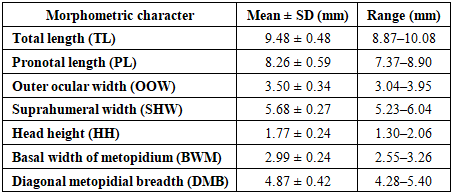
- Ten intact, undamaged adults previously selected for morphometric analysis were re-examined. Their sex had not been determined at the time of the initial measurements; subsequent examination showed that all ten were females. The specimens had been selected based on their intact condition, not on sex. Digital images were analysed using ImageJ version 1.54g (Schneider et al., 2012).Images used for morphometric measurements were calibrated individually in ImageJ version 1.54g using a 1 mm scale. For each image, a reference distance of 1 mm was set before measurements were taken. Total length (TL), pronotal length (PL), outer ocular width (OOW), suprahumeral width (SHW), head height (HH), basal width of metopidium (BWM), and diagonal metopidial breadth (DMB) were measured in ten females using the landmarks described by Kopp and Yonke (1977). Body length was also measured in ten males from calibrated digital images.Measurements were taken once by one observer. Descriptive statistics were calculated in PAST version 5.2.1 (Hammer et al., 2001). For each measured character, the arithmetic mean, standard deviation, minimum, and maximum values were calculated. Results were expressed in millimetres as mean ± SD and range.
3. Results and Discussion
- Field collections yielded 52 specimens: two nymphs and 50 adults. The adult sample comprised 35 females and 15 males. By district, 10 adults were collected in Qo‘rg‘ontepa (6 females and 4 males), 28 in Xo‘jaobod across three sampling dates (20 females and 8 males), four females in Andijan District, and eight adults in Jalaquduq (5 females and 3 males). Each adult sampling site was surveyed with 100 sweep-net strokes, for a total of 600 strokes. Site-specific dates and coordinates are provided in Materials and Methods.
3.1. Adult Morphology
- The collected specimens belong to the family Membracidae. Adults were bright green when alive. After death and drying, their colour changed to yellowish-brown or light brown. The external morphological characters and male genital apparatus of Stictocephala bisonia are shown in Figure 1.
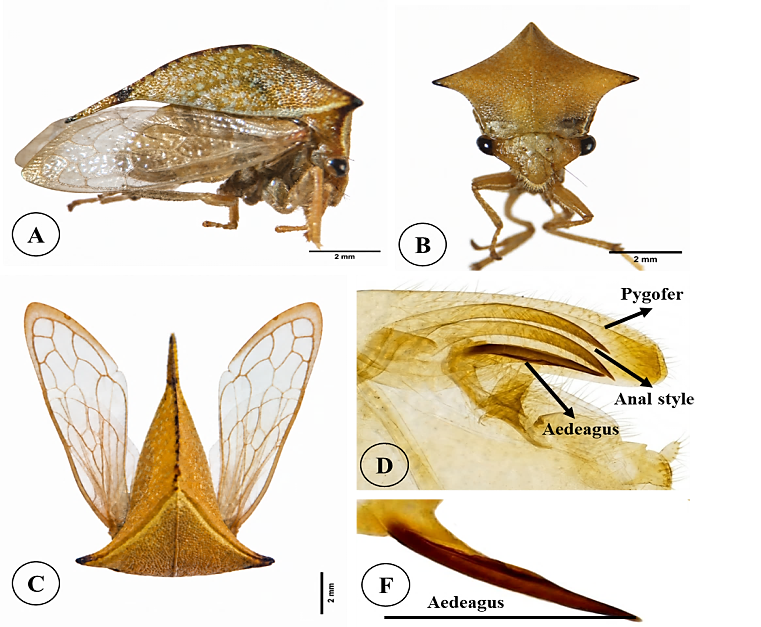 | Figure 1. Morphological characters and male genital apparatus of Stictocephala bisonia. A – lateral view; B – frontal view; C – dorsal view; D – lateral view of the male genital apparatus showing the pygofer, anal styli, and aedeagus; F – enlarged view of the aedeagus |
3.2. Morphometric Results
- Morphometric measurements of seven characters were taken from ten adult females. Their mean total length was 9.48 ± 0.48 mm, with a range of 8.87–10.08 mm. The mean, standard deviation and range for each measured female character are presented in Table 1. Body length in ten males was 6.96 ± 0.30 mm (range 6.50–7.50 mm).
|
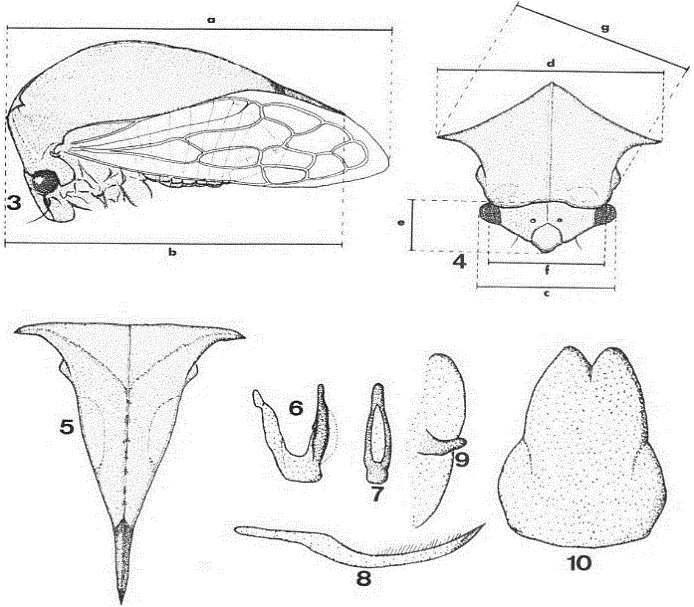 | Figure 2. Stictocephala bisonia : 3, lateral view (a, total body length; b, pronotal length); 4, frontal view (c, outer ocular width; d, suprahumeral width; e, head height; f, basal width of the metopidium; g, diagonal width of the metopidium); 5, dorsal view of the pronotum; 6, lateral view of the aedeagus; 7, posterior view of the aedeagus; 8, lateral view of the style; 9, lateral plate with tooth; 10, ventral view of the subgenital plate (after Kopp and Yonke, 1977) |
3.3. Male Genital Structure
- The genital apparatus of one adult male was dissected and examined. The pygofer had broad lateral sides and processes along the posterior margin. The aedeagus was elongate, tubular and arcuately curved, with a broad basal part and a distal part directed upwards and forwards. The paired styles were hook-shaped and tapered towards their apices. The anal tube was cylindrical and composed of two segments (Figure 1). The description is based on the single examined specimen.
3.4. Phenology and Field Observations
- The species is reported in the literature as univoltine and as overwintering in the egg stage [11,24]. In Slovakia, adults were observed from August to November at ambient temperatures ranging from −1 to +36 °C. The highest number of individuals was recorded in September, and oviposition was reported at approximately 22 °C [11]. These published records provide context for the seasonal development of the species.During field observations in Andijan Region, the egg stage was recorded. Two nymphs were collected on 25 May 2025, and 50 adults were collected between 21 June and 7 July 2026. The seasonal occurrence of the egg, nymphal and adult stages is summarised in Table 2.
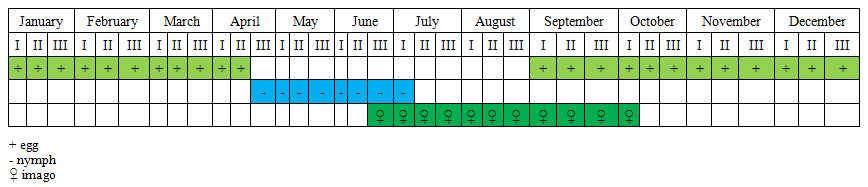 | Table 2. Phenological Calendar of the Seasonal Development of Stictocephala bisonia |
3.5. Reported Host Plants and Economic Importance
- The literature records S. bisonia on several dozen plant species, including Acer spp., Alcea rosea, Alnus glutinosa, Armeniaca vulgaris, Aristolochia spp., Artemisia vulgaris, Carpinus betulus, Castanea sativa, Cerasus vulgaris, Chrysanthemum indicum, Cirsium arvense, Clematis vitalba, Convolvulus arvensis, Cornus sanguinea, Crataegus laevigata, Erigeron annuus, Fraxinus excelsior, F. ornus, Humulus lupulus, Juglans regia, Galega officinalis, Gossypium spp., Ligustrum vulgare, Malus pumila, Medicago sativa, Melilotus alba, Morus alba, M. nigra, M. rubra, Onobrychis viciifolia, Padus avium, Plantago major, Persica vulgaris, Polygonum aviculare, P. persicaria, Populus alba, P. nigra, P. tremula, Prunus amygdalus, P. domestica, P. spinosa, Pyrus spp., Quercus spp., Ribes nigrum, R. rubrum, Rhamnus spp., Robinia pseudacacia, Rosa canina, Rubus caesius, R. idaeus, Rumex acetosa, R. acetosella, R. crispus, Salix alba, S. caprea, S. fragilis, S. purpurea, Solanum tuberosum, Solidago canadensis, S. gigantea, Tanacetum vulgare, Taraxacum officinale, Tilia spp., Trifolium repens, Ulmus minor, Urtica dioica, Vicia faba, V. sativa, V. labrusca and Vitis vinifera [8,11,14,18,24,26].In the present study, two nymphs were collected directly from Salix sp. Adults were collected by sweep net from vegetation in agrocenoses where Medicago sativa was present. Feeding on alfalfa was not observed.Yothers [26] reported that S. bisonia was regarded as a serious pest in the United States during the first half of the twentieth century. Studies in Southern Europe have reported yield losses in orchards and vineyards, particularly during population outbreaks [24]. Published reports also describe damage to young shoots during oviposition. Such incisions may cause shoots to dry out and may facilitate fungal or bacterial infection [3,12,13,19,24]. Damage associated with adult and nymphal feeding on grapevine and alfalfa has also been reported [22–24]. These reports refer to observations from other regions.
4. Conclusions
- Fieldwork in Andijan Region yielded 52 specimens of Stictocephala bisonia: two nymphs collected from Salix sp. on 25 May 2025 and 50 adults collected between 21 June and 7 July 2026. Adults were collected in agrocenoses where Medicago sativa was present, although feeding on this plant was not observed. The egg stage was also recorded during field observations. Morphometric measurements were obtained from ten adult females, and body length was measured in ten males. The male genital apparatus was examined in one specimen. These findings document the occurrence and selected morphological and seasonal characteristics of S. bisonia in Andijan Region and provide a local reference for further monitoring.