
-
Paper Information
- Paper Submission
-
Journal Information
- About This Journal
- Editorial Board
- Current Issue
- Archive
- Author Guidelines
- Contact Us
International Journal of Genetic Engineering
p-ISSN: 2167-7239 e-ISSN: 2167-7220
2026; 14(11): 337-339
doi:10.5923/j.ijge.20261411.01
Received: Oct. 6; Accepted: Oct. 28, 2026; Published: Nov. 6, 2026

Ecological and Physiological Status of Adolescents in Different Climatic and Geographical Zones of Uzbekistan
 Abstract
 Reference
 Full-Text PDF
 Full-text HTML
1Institute of Retraining and Advanced Training of Specialists in Physical Culture and Sports, Uzbek State Sports Academy, Tashkent, Uzbekistan
2Eurasian Medical University, Tashkent, Uzbekistan
Correspondence to: Gulnara Ilyasova, Institute of Retraining and Advanced Training of Specialists in Physical Culture and Sports, Uzbek State Sports Academy, Tashkent, Uzbekistan.
| Email: |  |
Copyright © 2026 The Author(s). Published by Scientific & Academic Publishing.
This work is licensed under the Creative Commons Attribution International License (CC BY).
http://creativecommons.org/licenses/by/4.0/

Background: The study of the ecological and physiological status of adolescents in various climatic and geographical zones represents an important area of modern human physiology and ecology, as adolescence is characterized by intensive growth, development, and high sensitivity to environmental factors. Methods: The study included 600 adolescents residing in Toshkent Region, Bukhoro Region, and the Republic of Karakalpakstan. Anthropometric parameters (body length, body mass, chest circumference, BMI) and functional characteristics (heart rate, blood pressure, respiratory rate, vital capacity) were assessed alongside a climate load index. Results: In 17-year-old males, mean height was 174.6 ± 1.9 cm in Toshkent Region, 169.8 ± 1.9 cm in Bukhoro Region, and 165.8 ± 1.8 cm in Karakalpakstan (for females: 162.8 ± 1.4, 160.2 ± 1.6, and 157.4 ± 1.5 cm, respectively). Climate load index values were 9.5, 58.5, and 80.0, showing an inverse relationship with body length. Adolescents in Karakalpakstan exhibited higher resting heart rates and lower vital capacity compared to those in Toshkent Region. Conclusions: Comprehensive evaluation of the ecological and physiological status provides a solid rationale for regional assessment of adolescent physical development, adaptive capacity, and the development of targeted health-preserving measures.
Keywords: Adolescents, Ecological and physiological status, Climatic and geographical zones, Environmental factors, Physical development, Anthropometry, Functional state, Adaptation, Uzbekistan
Cite this paper: Gulnara Ilyasova, Ecological and Physiological Status of Adolescents in Different Climatic and Geographical Zones of Uzbekistan, International Journal of Genetic Engineering, Vol. 14 No. 11, 2026, pp. 337-339. doi: 10.5923/j.ijge.20261411.01.
Article Outline
1. Introduction
- The ecological and physiological status of humans is formed under the influence of complex interactions between internal regulatory mechanisms and external environmental factors [1,3]. Particular importance is attached to this relationship during adolescence, a period marked by intensive growth, puberty, neuroendocrine restructuring, and the development of adaptive mechanisms [3].Environmental factors including temperature, humidity, and atmospheric characteristics significantly influence physiological processes and functional reserves [4,5]. Uzbekistan’s diverse climate across the Toshkent Region, Bukhoro Region, and the Republic of Karakalpakstan (especially the Aral Sea region) creates distinct conditions that impact adolescent physical development and cardiovascular and respiratory systems [6,7].The objective of this study is to identify regional features of the ecological and physiological status of adolescents living in various climatic and geographical zones of Uzbekistan based on a comprehensive assessment of anthropometric and physiological parameters [8,9].Rapid technological advancement, urbanization, and distinct regional anthropogenic pressures further compound the natural climatic variations across these territories. Evaluating how growing organisms manage these stressors is critical for establishing regional pediatric health baselines.
2. Materials and Methods
- The study included 600 adolescents residing in three climatic and geographical zones of Uzbekistan: Toshkent Region, Bukhoro Region, and the Republic of Karakalpakstan [4]. All participants underwent standardized medical and physiological screening under clinical protocol guidelines.
2.1. Anthropometric Assessment Methods
- Physical development was evaluated by measuring body length, body mass, chest circumference, and calculating body mass index
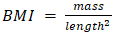 [6]. Measurements were obtained using calibrated medical instruments following standard anthropometric protocols in the morning hours.
2.2. Functional Assessment of Physiological Status
- Physiological status was characterized by resting heart rate (HR, bpm), systemic arterial pressure (SBP and DBP, mmHg), respiratory rate, vital capacity of the lungs (VC, L), and the vital index (
 , mL/kg) [2,7]. Cardiovascular reserve parameters were recorded via automated tonometry and electrocardiographic screening.
2.3. Climate Load Index Integration
- To characterize environmental stress, the climate load index was utilized, showing values of 9.5 for Toshkent Region, 58.5 for Bukhoro Region, and 80.0 for the Republic of Karakalpakstan [10]. This index incorporates ambient temperature fluctuations, relative humidity coefficients, and solar radiation loads.
2.4. Statistical Processing
- Descriptive statistics
 were calculated, and group differences were evaluated using Student's t-test with a significance threshold of p < 0.05 [2]. All calculations were performed using statistical software packages with double data verification.
3. Results and Discussion
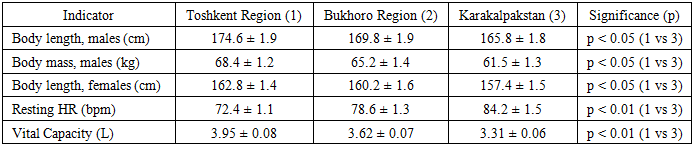
- The regional analysis revealed distinct variations in anthropometric and functional indicators among 17-year-old adolescents [6]. For instance, mean male body length was 174.6 ± 1.9 cm in Toshkent Region, 169.8 ± 1.9 cm in Bukhoro Region, and 165.8 ± 1.8 cm in Karakalpakstan. For females, heights were 162.8 ± 1.4 cm, 160.2 ± 1.6 cm, and 157.4 ± 1.5 cm, respectively [6], [9].
|
4. Detailed Regional Comparisons
- An in-depth evaluation of the three selected regions highlights distinct physiological trajectories. Toshkent Region, characterized by milder climatic loads and moderate environmental pressures, displays optimal parameters within standard normative pediatric ranges.Conversely, Bukhoro Region demonstrates moderate shifts in thermoregulatory stability, reflecting arid climatic conditions and elevated summer temperatures. The Republic of Karakalpakstan presents the most pronounced deviations, combining high climate load index ratings with environmental stressors characteristic of the Aral Sea basin.Analysis of variance across gender lines indicates that male adolescents display greater amplitude in absolute anthropometric changes relative to environmental gradients, whereas female cohorts show notable stability in proportional body mass index distributions.
5. Physiological Adaptations and Systemic Response
- The systemic response of growing adolescents to regional environments involves complex neuroendocrine adjustments. Autonomic regulation, evaluated via resting heart rate variability and blood pressure levels, reveals heightened sympathetic tone among participants in higher climatic load zones.Vascular tone adjustments maintain systemic perfusion despite thermal stress, but functional reserves experience progressive depletion under prolonged exposure. This physiological cost underscores the necessity of continuous medical monitoring in ecologically fragile territories.Physical work capacity and recovery kinetics further illustrate these differences. Standardized functional tests indicate prolonged heart rate recovery times following moderate exertion in high-stress zones, pointing to lowered functional efficiency.
6. Practical Implications
- The practical significance of this research lies in the establishment of regional normative reference tables for adolescent physical development. Healthcare providers and educational institutions can leverage these insights to design targeted preventive health programs.Nutritional support, optimized hydration strategies during hot seasons, and structured physical training programs tailored to regional climatic demands are vital components of mitigating environmental stress effects on the younger generation.
7. Limitations and Future Directions
- While the present study encompasses a robust sample of 600 participants across three diverse zones, further longitudinal tracking is required to evaluate developmental trajectories into early adulthood. Incorporating dietary logs, precise micronutrient status evaluations, and expanded spirometric profiles will enhance future investigations. Inter-individual variability and socioeconomic factors also warrant deeper regression modeling to isolate pure environmental contributions from lifestyle variables.
8. Conclusions
- 1. Comprehensive evaluation of the ecological and physiological status enables effective monitoring of regional features in adolescent physical development and functional states [3,6].2. Anthropometric indicators of 17-year-olds differ significantly across Toshkent Region, Bukhoro Region, and the Republic of Karakalpakstan [6,9].3. Variations in the climate load index correlate with regional physical growth patterns, highlighting the impact of environmental conditions on adaptive capacity [4,10].4. Integrating individual data, age, and gender variables is essential to isolate the specific contributions of ecological stress factors [1,2].5. The study's results can serve as a scientific foundation for regionally tailored health-preservation recommendations and preventive measures for adolescents [8,9].
ACKNOWLEDGEMENTS
- The author expresses sincere gratitude to the administrative and academic staff of the Institute of Retraining and Advanced Training of Specialists in Physical Culture and Sports under the Uzbek State Sports Academy, as well as the Eurasian Medical University, for their invaluable support in facilitating this multicenter study. Special thanks are extended to participating medical personnel and secondary school administration teams across Toshkent, Bukhara, and Karakalpakstan for their diligence during field data collection.
Conflict of Interest Statement
- The author declares that there are no conflicts of interest regarding the publication of this manuscript. No financial grants or commercial sponsorships influenced the study design, data collection, or interpretation of results.