
-
Paper Information
- Previous Paper
- Paper Submission
-
Journal Information
- About This Journal
- Editorial Board
- Current Issue
- Archive
- Author Guidelines
- Contact Us
International Journal of Genetic Engineering
p-ISSN: 2167-7239 e-ISSN: 2167-7220
2026; 14(10): 334-336
doi:10.5923/j.ijge.20261410.12
Received: Sep. 20; Accepted: Oct. 16, 2026; Published: Oct. 30, 2026

Improving the Organizational Model of Nursing Care in Palliative Services: Analysis of Current Practice and Optimization Approaches
 Abstract
 Reference
 Full-Text PDF
 Full-text HTML
Muminova Dono Fakhriddinovna1, Rizayev Jasur Alimjanovich2
1Independent Researcher, Samarkand State Medical University, Samarkand, Uzbekistan
2Professor, Rector, Samarkand State Medical University, Samarkand, Uzbekistan
Correspondence to: Muminova Dono Fakhriddinovna, Independent Researcher, Samarkand State Medical University, Samarkand, Uzbekistan.
| Email: |  |
Copyright © 2026 The Author(s). Published by Scientific & Academic Publishing.
This work is licensed under the Creative Commons Attribution International License (CC BY).
http://creativecommons.org/licenses/by/4.0/

Palliative care is an essential part of contemporary healthcare, with its primary focus on preserving and improving the quality of life of people living with incurable and progressive diseases and on supporting their families. This study examines the existing organization of nursing care in palliative settings, identifies organizational and functional constraints, and considers practical directions for its improvement. Particular emphasis is placed on the nurse’s contribution to multidisciplinary care, professional preparation, communication with patients and relatives, and the use of standardized and innovative approaches, including digital tools. The proposed model is intended to strengthen continuity of care, improve the organization of nursing activities, and support a patient-centered approach.
Keywords: Palliative care, Nursing care, Healthcare organization, Quality of life, Optimization
Cite this paper: Muminova Dono Fakhriddinovna, Rizayev Jasur Alimjanovich, Improving the Organizational Model of Nursing Care in Palliative Services: Analysis of Current Practice and Optimization Approaches, International Journal of Genetic Engineering, Vol. 14 No. 10, 2026, pp. 334-336. doi: 10.5923/j.ijge.20261410.12.
1. Introduction
- Palliative care forms an important component of modern healthcare because it addresses not only the clinical needs of patients with incurable and progressive diseases, but also the needs of their families [1]. The World Health Organization defines palliative care as an approach that can be introduced early in the course of illness and used alongside pathogenetic treatment [2]. Within this framework, nurses occupy a central position in everyday care: they monitor symptoms, coordinate routine interventions, and provide psycho-emotional support [3]. Nevertheless, the organizational role of nursing personnel in palliative settings is not always fully realized, which may weaken the continuity and overall effectiveness of care and, consequently, affect patients’ quality of life [4-6].The relevance of the present study is determined by the need to strengthen the scientific basis of organizational models of nursing care in palliative services in accordance with current requirements of medical science, demographic changes, and the growing demands placed on healthcare systems [7].The aim of the study was to develop and scientifically substantiate an optimized organizational model of nursing care within the palliative care system, with the intention of improving patients’ quality of life and increasing the effectiveness of nursing staff activities.
2. Materials and Methods
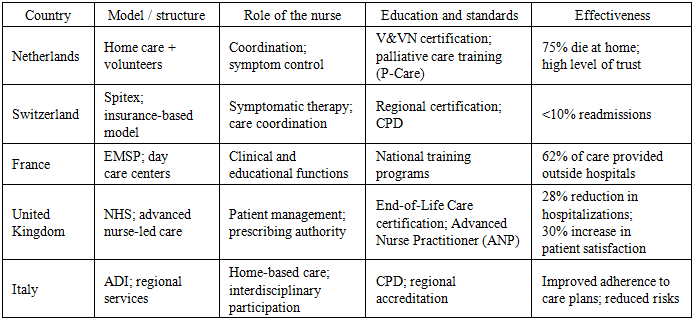
- The research was designed as a prospective cohort interventional study assessing the effectiveness of an integrated nursing care model in palliative practice. A before-and-after comparison was performed within a single cohort of patients and healthcare personnel; no separate control group was established. The study lasted 16 months, from September 2023 through December 2024.The principal clinical sites were the Samarkand Interregional Hospice and the hospice of the Republican Specialized Scientific and Practical Medical Center of Oncology and Radiology. The study population was additionally broadened by questionnaire data obtained from fourth-year students of the Faculty of Pedagogy and Psychology at the Tashkent State Pedagogical University named after Nizami.The methodological toolkit combined general scientific and specialized approaches. These included systems analysis, structural-functional analysis, content analysis of scientific publications and regulatory legal documents, and comparative assessment of national and international approaches to the organization of nursing care in palliative settings.The study was grounded in evidence-based medicine, the biopsychosocial model of health, and patient-centered care. The object of analysis was the organization of nursing care in palliative institutions; the subject comprised the organizational and functional components of nursing activity [8-9].
3. Results and Discussion
- To obtain an integrated assessment of perceived quality of palliative care, the researchers developed and validated a questionnaire containing 20 structured statements. The instrument addressed four principal domains: ethical and communicative interaction between healthcare professionals and patients, practical nursing care, satisfaction with physician-provided medical care, and access to psychological and spiritual support.Data collection was conducted individually and adapted to the physical and cognitive capabilities of each respondent. Participants completed the questionnaire in writing, while an oral interview was used when motor or cognitive limitations made written completion difficult. Each statement was rated on a five-point Likert scale, from 1 (“strongly disagree”) to 5 (“strongly agree”). This approach made it possible to quantify overall satisfaction and identify areas requiring organizational improvement.Assessment was performed at two time points: before introduction of the integrated nursing care model and not earlier than one month after its implementation in inpatient departments. Participants were eligible if they were aged 18 years or older, had been hospitalized for at least 14 days, and were able to understand and provide meaningful responses. In total, 78 respondents were included, providing a basis for statistical analysis of changes in the principal indicators.
|
|
4. Conclusions
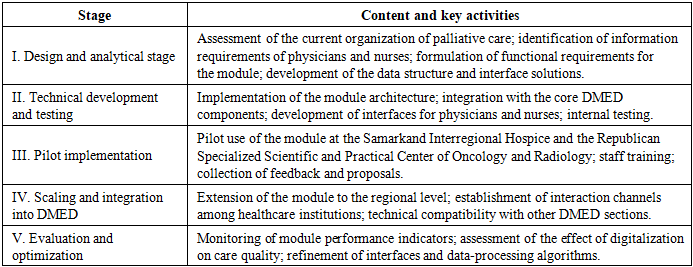
- According to the study results, integration of the digital module into DMED was associated with an 18% reduction in staff workload and a 22% increase in data accuracy, while continuity of palliative care was maintained. Patient satisfaction increased by 15–40%; staff burnout decreased by 21%, and distress levels declined by 19%.The pilot implementation demonstrated technical compatibility of the proposed solution and its readiness for broader deployment. The authors recommend considering the developed digital solution within the national healthcare digitalization strategy as part of a patient-centered, multidisciplinary standard for palliative care.Further improvement of the organizational model of nursing care remains an important task for healthcare systems. A comprehensive and scientifically grounded approach to nursing practice can strengthen the effectiveness of palliative services, contribute to better quality of life for patients, and support sustainable development of healthcare.