
-
Paper Information
- Next Paper
- Previous Paper
- Paper Submission
-
Journal Information
- About This Journal
- Editorial Board
- Current Issue
- Archive
- Author Guidelines
- Contact Us
International Journal of Genetic Engineering
p-ISSN: 2167-7239 e-ISSN: 2167-7220
2026; 14(10): 330-333
doi:10.5923/j.ijge.20261410.11
Received: Sep. 14; Accepted: Oct. 22, 2026; Published: Oct. 30, 2026

Effects of Gallic and Glycyrrhizic Acids Applied at Different Ratios on the Micronutrient Composition of Milk Thistle (Silybum Marianum) Seeds
 Abstract
 Reference
 Full-Text PDF
 Full-text HTML
Abdurakhimov Umarbek Kuranbanbaevich1, Kadamova Gulrukh Ravshanbek2
1PhD in Biological Sciences, Junior Research Fellow, Khorezm Mamun Academy, Khorezm, Uzbekistan
2Independent Researcher (PhD), Khorezm Mamun Academy, Khorezm, Uzbekistan
Correspondence to: Abdurakhimov Umarbek Kuranbanbaevich, PhD in Biological Sciences, Junior Research Fellow, Khorezm Mamun Academy, Khorezm, Uzbekistan.
| Email: |  |
Copyright © 2026 The Author(s). Published by Scientific & Academic Publishing.
This work is licensed under the Creative Commons Attribution International License (CC BY).
http://creativecommons.org/licenses/by/4.0/

Milk thistle (Silybum marianum (L.) Gaertn.) is a medicinal crop whose seed quality is determined not only by specialized metabolites but also by the mineral composition of the harvested product. This study evaluated the response of four milk thistle cultivars (Debut, Start, Panacea, and Amulet) to pre-sowing treatment with gallic acid and glycyrrhizic acid applied at ratios of 1:2, 1:4, 1:8, and 1:10, with distilled-water-treated seeds serving as the control. Seeds were soaked for 24 h at 25 ± 2 °C, and harvested seed samples were subjected to microwave-assisted wet digestion with concentrated HNO₃ and H₂O₂. Eight elements (Fe, Mn, Zn, Cu, Cr, Co, Se, and Mo) were evaluated. Across all cultivars, the 1:4 treatment produced the highest concentrations of the measured elements, whereas responses declined at 1:8 and 1:10 while generally remaining above control values. The strongest response occurred in Amulet, where the 1:4 treatment increased Fe, Mn, Zn, Cu, Cr, Co, Se, and Mo by approximately 49.4–50.2% relative to the control. Panacea showed increases of approximately 47.9–48.9%, while Debut and Start showed smaller but consistent responses. The results indicate a pronounced cultivar- and ratio-dependent response and identify the 1:4 gallic acid:glycyrrhizic acid treatment as the most effective among the tested combinations for enhancing seed micronutrient concentration under the experimental conditions.
Keywords: Silybum marianum, Milk thistle, Gallic acid, Glycyrrhizic acid, Biostimulant, Seed priming, Micronutrients, Mineral composition
Cite this paper: Abdurakhimov Umarbek Kuranbanbaevich, Kadamova Gulrukh Ravshanbek, Effects of Gallic and Glycyrrhizic Acids Applied at Different Ratios on the Micronutrient Composition of Milk Thistle (Silybum Marianum) Seeds, International Journal of Genetic Engineering, Vol. 14 No. 10, 2026, pp. 330-333. doi: 10.5923/j.ijge.20261410.11.
Article Outline
1. Introduction
- Milk thistle (Silybum marianum (L.) Gaertn.) is a medicinal species valued primarily as a source of silymarin, but its seeds also contain nutritionally and physiologically relevant mineral elements. Recent work has confirmed that mineral profiles vary among Silybum species and plant organs, demonstrating that genotype and tissue type can substantially influence elemental accumulation [1]. A 2026 investigation of aqueous milk thistle seed extracts further showed that Fe, Zn, Mn, Cu, Cr, Co, and Mo occur in measurable quantities and can be characterized using modern elemental-analysis approaches [2].Micronutrient acquisition and partitioning in plants depend on tightly coordinated processes of root uptake, membrane transport, chelation, xylem loading, phloem redistribution, intracellular sequestration, and remobilization to reproductive organs. Iron and zinc homeostasis, in particular, are controlled by interacting regulatory networks, and the final concentration of minerals in seeds reflects both uptake from the growth medium and subsequent source-to-sink transport [3,4]. Adequate micronutrient status supports photosynthesis, enzyme function, antioxidant defense, crop productivity, and the nutritional quality of plant-derived products [4].Seed priming and the application of biologically active compounds are increasingly studied as practical approaches for modifying early metabolism, improving stress preparedness, and influencing later plant performance. Meta-analytical evidence indicates that seed priming can alter plant performance depending on the priming agent, plant species, and treatment conditions [5]. The two compounds evaluated in the present work are more accurately described as bioactive or biostimulatory substances rather than classical plant hormones: gallic acid is a naturally occurring phenolic acid [6], whereas glycyrrhizic acid is a triterpenoid saponin characteristic of Glycyrrhiza species [7]. Their combined use may therefore elicit physiological responses through antioxidant, membrane, signaling, or metabolic effects, although the exact mechanism governing mineral accumulation in milk thistle remains to be established.Previous field work with the same milk thistle cultivars under Khorezm conditions reported a favorable response of seed yield to combined gallic acid and glycyrrhizic acid treatment, with the 1:4 ratio identified as the most effective among the tested combinations [8]. However, information on whether this treatment pattern is also reflected in the micronutrient composition of the harvested seeds is limited.Accordingly, the objective of this study was to determine the effect of different gallic acid:glycyrrhizic acid ratios on the concentrations of Fe, Mn, Zn, Cu, Cr, Co, Se, and Mo in seeds of the Debut, Start, Panacea, and Amulet milk thistle cultivars and to identify the most effective treatment ratio under the experimental conditions of the Khorezm region.
2. Materials and Methods
2.1. Plant Material and Experimental Design
- The biological material consisted of four cultivars of milk thistle (Silybum marianum (L.) Gaertn.): Debut, Start, Panacea, and Amulet. The cultivars were reported in the source study as originating from breeding material of the All-Russian Scientific Research Institute of Medicinal and Aromatic Plants (VILAR), Russian Federation. Experimental and laboratory work was conducted in 2026. The source manuscript also reports field trials on moderately saline soils at the Karakum Scientific Experimental Station of the Forestry Scientific Research Institute, Khiva district, Khorezm region, Uzbekistan.
2.2. Preparation and Application of Bioactive Treatments
- Gallic acid (C₇H₆O₅; 99.5%) and glycyrrhizic acid (C₄₂H₆₂O₁₆; 98%) were used to prepare the treatment solutions. The tested gallic acid:glycyrrhizic acid ratios were 1:2, 1:4, 1:8, and 1:10. A control treatment without the bioactive mixture was included. According to the original protocol, seeds were soaked for 24 h at 25 ± 2 °C in 1% treatment solutions; control seeds were soaked in distilled water. The same treatment structure was applied to all four cultivars.
2.3. Sample Preparation for Micronutrient Determination
- For elemental analysis, a 0.1000 g portion of seed material was quantitatively transferred to a Teflon digestion vessel. Purified concentrated nitric acid (3 mL HNO₃) and purified hydrogen peroxide (2 mL H₂O₂) were added. The vessels were sealed and subjected to microwave-assisted wet digestion in a Berghof Speedwave Xpert system or an equivalent microwave digestion unit. The digestion program operated from approximately 50 °C to a maximum of 230 °C, with pressure up to 40 bar, for 35–45 min. The concentrations of Fe, Mn, Zn, Cu, Cr, Co, Se, and Mo reported by the analytical laboratory were expressed as mg/10 g seed material.
2.4. Statistical Analysis
- The experiment was conducted in three replicates for each cultivar and treatment. The obtained data were expressed as mean values of three replicates. Treatment responses were evaluated by comparing each treatment with the corresponding cultivar-specific control. The percentage change for the 1:4 treatment relative to the control was calculated as: [(value at 1:4 − control value) / control value] × 100.
3. Results
3.1. General Treatment Pattern
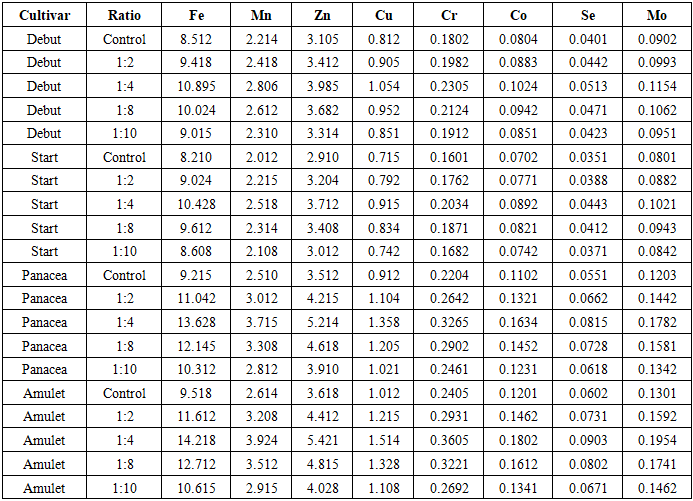
- A consistent ratio-dependent pattern was observed across all four cultivars. In every cultivar, the concentration of each measured element increased from the control to the 1:2 treatment and reached its maximum at the 1:4 ratio. At 1:8, concentrations decreased relative to 1:4 but remained above the control. A further decline occurred at 1:10, although most values were still higher than the untreated control (Table 1). This response indicates that increasing the proportion beyond 1:4 did not provide additional benefit under the conditions of the experiment.
|
3.2. Cultivar-Specific Responses
- The Debut cultivar showed a moderate but uniform response. At 1:4, Fe increased from 8.512 to 10.895 mg/10 g, Zn from 3.105 to 3.985 mg/10 g, and Cu from 0.812 to 1.054 mg/10 g. Percentage increases across the eight elements ranged from 26.7% to 29.8% relative to the control. Start displayed a similar response, with 1:4 increases of approximately 25.1–28.0% across the measured elements (Table 2).
|

4. Discussion
- The most notable feature of the dataset is the reproducible optimum at the 1:4 ratio across all cultivars and all eight measured elements. Such a response is consistent with the general concept that priming and biostimulant effects are dose- and context-dependent rather than simply increasing in proportion to treatment intensity [5]. The lower values at 1:8 and 1:10 therefore suggest that the physiological response reached an optimum at 1:4 and then diminished as the treatment ratio was increased.The coordinated increase in Fe, Mn, Zn, Cu, Cr, Co, Se, and Mo suggests that the treatment influenced a broad process affecting mineral acquisition, transport, or deposition rather than a single element-specific pathway. Micronutrient homeostasis is governed by transporters, chelators, redox processes, and source-to-sink redistribution, and these processes can interact strongly during vegetative growth and seed filling [3,4]. However, the present experiment measured final seed concentrations only; it did not directly measure root uptake, transporter expression, xylem or phloem flux, or element speciation. Therefore, a causal mechanism should not be inferred solely from the concentration data.The stronger response of Panacea and especially Amulet indicates a clear genotype-dependent component. At the same 1:4 treatment, the increase in the measured elements was approximately 48% in Panacea and approximately 50% in Amulet, compared with roughly 25–30% in Debut and Start. This may reflect cultivar differences in root architecture, nutrient uptake efficiency, translocation capacity, seed sink strength, or metabolic responsiveness to the applied compounds. Such genotypic variation is consistent with broader evidence that mineral accumulation is strongly controlled by plant genotype and organ-specific physiology [1,4].The chemical terminology is also important for interpreting the results. Gallic acid is a phenolic acid with recognized antioxidant and redox-active properties [6], whereas glycyrrhizic acid is a triterpenoid saponin [7]. Thus, describing the mixture as a biostimulatory or bioactive treatment is more precise than classifying both compounds as phytohormones. Their effect may involve modulation of oxidative status, membrane processes, signaling, or metabolism, but targeted physiological and molecular experiments would be required to distinguish among these possibilities.From an applied perspective, the 1:4 treatment is notable because the same ratio has also been associated with improved seed yield in the same milk thistle cultivar set under Khorezm conditions [8]. If confirmed in replicated trials, the combined improvement in yield and seed micronutrient concentration would make this treatment particularly relevant for medicinal-crop production. Future work should include replicated field designs, soil micronutrient characterization, standardized elemental quantification (e.g., ICP-OES, ICP-MS, or AAS with certified reference materials), and formal statistical analysis. Such additions would allow separation of treatment effects from environmental variation and would strengthen conclusions concerning cultivar × treatment interactions.
5. Conclusions
- Pre-sowing treatment with gallic acid and glycyrrhizic acid altered the micronutrient composition of milk thistle seeds in a clear ratio- and cultivar-dependent manner. Among the tested ratios, 1:4 consistently produced the highest concentrations of Fe, Mn, Zn, Cu, Cr, Co, Se, and Mo in Debut, Start, Panacea, and Amulet. The response was strongest in Amulet, where the 1:4 treatment produced approximately 49.4–50.2% higher values than the control, followed by Panacea with approximately 47.9–48.9% increases. Debut and Start showed smaller but consistent gains. These findings identify the 1:4 gallic acid:glycyrrhizic acid treatment as the most promising combination within the tested range. Confirmation through replicated experiments with variance estimates and a fully documented instrumental elemental-analysis method is recommended before broad agronomic recommendations are made.