
-
Paper Information
- Next Paper
- Paper Submission
-
Journal Information
- About This Journal
- Editorial Board
- Current Issue
- Archive
- Author Guidelines
- Contact Us
International Journal of Genetic Engineering
p-ISSN: 2167-7239 e-ISSN: 2167-7220
2026; 14(10): 319-329
doi:10.5923/j.ijge.20261410.10
Received: Oct. 5; Accepted: Oct. 23, 2026; Published: Oct. 30, 2026

Early Growth Responses of Cotton and Wheat to Azotobacter chroococcum Depend on Bacterial Strain, Host Genotype, and Salinity
 Abstract
 Reference
 Full-Text PDF
 Full-text HTML
Mukambar Abdug‘affor qizi Soliyeva, Dadamirza Sultonmurod o‘g‘li Rayimberdiyev, Mohichehra Abdusattarovna Pattayeva, Baxtiyor Abdug‘afurovich Rasulov
Institute of Genetics and Plant Experimental Biology, Academy of Sciences of the Republic of Uzbekistan, Uzbekistan
Correspondence to: Mukambar Abdug‘affor qizi Soliyeva, Institute of Genetics and Plant Experimental Biology, Academy of Sciences of the Republic of Uzbekistan, Uzbekistan.
| Email: |  |
Copyright © 2026 The Author(s). Published by Scientific & Academic Publishing.
This work is licensed under the Creative Commons Attribution International License (CC BY).
http://creativecommons.org/licenses/by/4.0/

Salinity restricts crop establishment, while plant growth-promoting bacteria can modify early stress responses in strain- and host-dependent ways. We evaluated Azotobacter chroococcum XH2018 and K2020 in two cotton genotypes and two wheat cultivars across Ashby-based treatments containing 0–3% added NaCl; a bacteria-free distilled-water treatment was retained only as a descriptive reference. Root length was analysed from independent Petri-dish means using factorial models and Holm-adjusted contrasts, whereas germination was analysed as grouped-binomial data with overdispersion sensitivity assessment. In cotton, bacterial strain (F = 7.378, p = 0.00915), salinity (F = 3.305, p = 0.01208), and the strain × salinity interaction (F = 3.259, p = 0.01298) significantly affected root length. At 1% added NaCl, K2020 produced 1.066 cm greater mean root length than XH2018 (Holm-adjusted p = 0.00673); no other concentration-specific strain contrast remained significant after correction. In wheat, cultivar identity (F = 37.256, p < 0.001) and salinity (F = 2.827, p = 0.02571) significantly affected root length, whereas strain × salinity was non-significant. E'zoz exceeded Sharaf at 1% (adjusted p = 0.01358) and 3% NaCl (adjusted p = 0.000061). Cotton germination retained a genotype × strain × NaCl interaction after Pearson-scale adjustment for moderate overdispersion, whereas wheat germination showed no significant effects. These results demonstrate that early A. chroococcum-associated plant responses depend on bacterial strain, host genetic background, and salinity intensity.
Keywords: Azotobacter chroococcum, Salinity stress, Cotton, Wheat, Root elongation, Plant growth-promoting bacteria
Cite this paper: Mukambar Abdug‘affor qizi Soliyeva, Dadamirza Sultonmurod o‘g‘li Rayimberdiyev, Mohichehra Abdusattarovna Pattayeva, Baxtiyor Abdug‘afurovich Rasulov, Early Growth Responses of Cotton and Wheat to Azotobacter chroococcum Depend on Bacterial Strain, Host Genotype, and Salinity, International Journal of Genetic Engineering, Vol. 14 No. 10, 2026, pp. 319-329. doi: 10.5923/j.ijge.20261410.10.
Article Outline
1. Introduction
- Soil salinity constrains crop establishment and productivity by imposing osmotic stress, ion imbalance, nutrient disruption, and oxidative injury, with particularly strong consequences during germination and early seedling development. The magnitude of these effects is strongly genotype dependent. In wheat, screening of 334 diverse genotypes revealed wide variation in biomass, root length, osmotic adjustment, Na+/K+ balance, and antioxidative capacity under salt stress, while genome-wide association analysis further demonstrated a complex genetic architecture for salt-tolerance-related traits [1,2]. Cotton likewise exhibits substantial genetic variation in salinity response: Zafar et al. [3] detected significant genotype × salinity interactions across agronomic, ion-homeostasis, antioxidant, and fiber-related traits. These findings indicate that host genetic background must be treated as an explicit biological variable when evaluating interventions intended to improve crop performance under salinity.Plant growth-promoting rhizobacteria (PGPR) can modify crop responses to salinity, but their effects are not uniform across host genotypes or bacterial treatments. Nawaz et al. [4] compared three salt-tolerant PGPR, applied individually and as a consortium, in salt-tolerant Aas-11 and salt-sensitive Galaxy-13 wheat and found that the bacterial treatment associated with the strongest response differed between the two genotypes. Similarly, Nawaz et al. [5] evaluated AHL-producing Aeromonas strains in two wheat genotypes with contrasting inherent salt tolerance and documented genotype-dependent growth and physiological responses under salinity. More recently, Albdaiwi et al. [6] showed that two halotolerant endophytic bacteria significantly improved growth of a salt-sensitive durum wheat genotype, whereas comparable growth benefits were not observed in the tolerant genotype. Together, these primary studies demonstrate that the outcome of bacterial inoculation under salinity can depend on host genetic background rather than representing a universal PGPR effect.Mechanistically resolved experiments reinforce this context dependence. Yuan et al. [7] used Pseudomonas chlororaphis 30-84 and isogenic derivatives differing in phenazine production across four winter-wheat varieties. Salinity reduced germination, relative water content, and seedling productivity and increased reactive oxygen species, whereas bacterial effects varied among varieties and phenazine-producing derivatives were associated with reduced redox stress. Importantly, this study evaluated germination together with subsequent seedling growth and physiology, illustrating that early developmental endpoints can provide non-equivalent information about plant–microbe responses to salinity. In cotton, Saleem et al. [8] showed that salt-tolerant, IAA-producing bacterial isolates improved germination and seedling growth of Gossypium hirsutum under saline conditions and modified K+ and Na+ acquisition. Thus, both wheat and cotton provide experimental evidence that microbial effects under salinity are shaped by host and phenotype.Within the broader PGPR group, Azotobacter chroococcum is especially relevant because plant-growth-promoting functions coexist with substantial metabolic plasticity. Biełło et al. [9] characterized biological nitrogen fixation and phosphorus mobilization in A. chroococcum NCIMB 8003 using physiological assays, quantitative proteomics, gene-expression analysis, and enzyme activity measurements, demonstrating coordinated changes extending beyond nitrogenase itself. More recently, Elakkya et al. [10] combined comparative genomics, in vitro assays, and metabolomics to characterize A. chroococcum W5. Experimental assays confirmed auxin and gibberellic acid production, phosphate solubilization, nitrogen fixation, and ACC utilization, while salt and osmotic stress induced marked metabolic reprogramming involving osmoprotective and stress-associated metabolites. These studies provide strain-level evidence for multiple traits that could contribute to plant association and bacterial persistence under stressful environments.Primary plant experiments further show that A. chroococcum can remain biologically relevant under salinity. In maize, Abdel Latef et al. [11] found that A. chroococcum inoculation improved growth and physiological performance under saline conditions, with effects involving pigments, osmolytes, nutrient acquisition, K+/Na+ balance, and antioxidant responses. In canola grown in saline soil, Abdel Latef et al. [12] evaluated A. chroococcum both individually and together with Alcaligenes faecalis and reported improvements in growth and photosynthetic traits, reduced Na accumulation, increased mineral acquisition, and altered osmolyte and antioxidant responses. In soybean, Yaghoubian et al. [13] likewise demonstrated that A. chroococcum inoculation influenced physiological traits, antioxidant enzymes, and nutrient uptake across increasing NaCl levels. Collectively, these experiments establish that Azotobacter-associated responses under salinity extend across several crop species, although the magnitude and mechanisms of benefit cannot be assumed to be identical among strains or hosts.Evidence directly relevant to wheat has expanded. Kumar et al. [14] characterized the halotolerant A. chroococcum strain W4ii and showed that inoculation improved wheat germination and seedling development under salt stress, linking bacterial halotolerance with plant-growth-promoting traits. Elakkya et al. [10] further demonstrated that A. chroococcum W5 enhanced wheat germination metrics and seedling vigor while exhibiting salt- and osmotic-stress-responsive metabolism. Zhou et al. [15] reported improved wheat growth and saline-alkali soil properties in experiments using Azotobacter beijerinckii and Chlorella pyrenoidosa, with the strongest responses occurring under combined application; this study is relevant at the genus level but does not provide A. chroococcum-specific evidence. Because the latter treatment was a bacteria–microalga combination, its full effect cannot be attributed to Azotobacter alone; nevertheless, it provides additional evidence that nitrogen-fixing Azotobacter can function within saline wheat production systems.Extracellular polymer production provides another experimentally supported mechanism by which A. chroococcum may adapt to saline environments. Rasulov and Pattaeva [16] demonstrated pronounced stress- and substrate-dependent metabolic plasticity in A. chroococcum XU1 and showed that NaCl exposure stimulated exopolysaccharide production capable of Na+ biosorption. This observation is particularly relevant to the concept of strain-specific salt adaptation because extracellular polymer production and other stress-responsive traits can differ among bacterial isolates. However, such mechanisms should not be transferred automatically to untested strains: EPS-mediated Na+ binding, phytohormone production, nutrient mobilization, and osmoprotectant metabolism remain mechanistic hypotheses for XH2018 and K2020 until directly measured in these strains.Plant-side responses to microbial inoculation also span several physiological layers. The A. chroococcum experiments in maize, canola, and soybean reported changes in ion relations, osmolytes, photosynthetic traits, and antioxidant activity under salinity [11,12,13]. Al Khallaf et al. [17] extended this framework in spring wheat by measuring physiological, biochemical, and stress-responsive gene-expression traits after application of a three-species biofertilizer containing A. chroococcum, Bacillus megaterium, and B. circulans across a salinity gradient. Because that study used a three-species consortium, its molecular responses cannot be assigned specifically to A. chroococcum; it nevertheless demonstrates that microbial treatments can influence ion-homeostasis-, osmotic-adjustment-, and antioxidant-related responses in saline wheat.Despite this growing evidence, the available primary literature remains fragmented across individual bacterial isolates, different crop species, microbial consortia, and restricted salinity regimes. Studies with wheat clearly demonstrate host-genotype-dependent responses to PGPR [4,5,7,6], while Azotobacter studies demonstrate strain-level physiological and metabolic diversity and plant-growth-promoting activity under salinity [11,12,9,14,16,10]. What remains insufficiently resolved is whether distinct A. chroococcum strains generate equivalent or divergent plant responses across a graded NaCl environment and whether those strain-dependent responses are conserved across crop species and cultivars.A second unresolved issue concerns phenotypic resolution. Germination percentage is an important measure of establishment, but successful germination does not necessarily imply maintenance of post-germination root growth. Yuan et al. [7] resolved bacterial effects across germination and subsequent seedling physiological traits in multiple wheat varieties; Saleem et al. [8] assessed both germination and seedling growth in cotton using salt-tolerant IAA-producing PGPR (not A. chroococcum); and Kumar et al. [14] examined germination together with wheat seedling development following A. chroococcum inoculation. These primary studies support simultaneous evaluation of germination and root elongation as complementary, rather than interchangeable, indicators of early plant performance under salinity.Against this background, the present study evaluated two A. chroococcum strains, XH2018 and K2020, across cotton and wheat cultivars exposed to a graded NaCl regime. We hypothesized that (i) XH2018 and K2020 would differ in their associations with root growth across the salinity gradient; (ii) the magnitude and direction of these strain-dependent responses would vary with crop species and cultivar; and (iii) germination and post-germination root elongation would not necessarily display equivalent response patterns. Accordingly, the objectives were to quantify salinity-dependent changes in root elongation and germination, resolve strain × salinity and host-genotype × salinity responses, and identify strain–host combinations that maintain early growth under elevated salinity. By integrating bacterial strain identity, host genetic background, salinity intensity, and two early-development phenotypes within one factorial framework, the study tests a level of context dependence that remains comparatively underexplored for A. chroococcum without assuming a universal bioinoculant effect.
2. Materials and Methods
2.1. Bacterial Strains and Plant Material
- Two Azotobacter chroococcum strains, XH2018 (GenBank accession no. PQ862345.1) and K2020 (GenBank accession no. PV803539.1), were used in this study. Their effects on seed germination and early root growth under increasing salinity were evaluated using cotton and wheat as host plants.Two cotton genotypes, O‘zRFA-709 and O‘zRFA-710, and two wheat cultivars, E'zoz and Sharaf, were included in the experiment. Seeds were obtained from the seed collection of the Institute of Genetics and Plant Experimental Biology, Academy of Sciences of the Republic of Uzbekistan. The two genotypes/cultivars within each crop were evaluated separately to determine whether plant responses to bacterial treatment and salinity varied with host genetic background.
2.2. Bacterial Cultivation and Inoculum Preparation
- Azotobacter chroococcum strains XH2018 and K2020 were cultivated separately in 100 mL of Ashby broth containing (g L⁻¹): sucrose, 20.0; MgSO₄·7H₂O, 0.2; KH₂PO₄, 0.2; NaCl, 0.1; and CaCO₃, 10.0. The initial pH of the medium was adjusted to 7.0 before sterilization. Cultures were incubated at 30 °C for 72 h on a rotary shaker at 150 rpm.Following incubation, the cultures were centrifuged at 10,000 rpm for 5 min to harvest the bacterial biomass. The supernatant was discarded, and the resulting cell pellets were not subjected to an additional washing step. The pellets of XH2018 and K2020 were separately resuspended directly in equal volumes of distilled water. The same cultivation, biomass-harvesting, and resuspension procedures were applied to both bacterial strains.The final bacterial cell density was not quantitatively determined by optical density, colony-forming unit enumeration, or McFarland standardization. The exact resuspension volume was not recorded. Consequently, the use of equal resuspension volumes represents standardization of the inoculum-preparation procedure but does not establish identical viable cell concentrations for XH2018 and K2020.
2.3. Experimental Design and Salinity Treatments
- Experiments were conducted separately for cotton and wheat. The bacterial salinity experiment comprised two host genotypes/cultivars, two A. chroococcum strains, and six Ashby-based salinity conditions (0, 0.5, 1.0, 1.5, 2.0, and 3.0% added NaCl). Three independent Petri-dish replicates were established for each genotype/cultivar × strain × Ashby-salinity combination, with 10 seeds in each Petri dish. A bacteria-free distilled-water treatment (DIS) was included independently as a reference control; because no bacterial strain was applied to DIS, strain labels associated with DIS records were not interpreted as biological treatment levels.The inferential salinity series consisted of standard Ashby medium without additional NaCl supplementation (0% added NaCl) and five treatments prepared by supplementing Ashby medium with 0.5, 1.0, 1.5, 2.0, or 3.0% (w/v) NaCl. This corresponded to addition of 0.5, 1.0, 1.5, 2.0, or 3.0 g NaCl per 100 mL of Ashby medium, respectively. DIS contained distilled water without bacterial inoculation and was used only as a descriptive/reference control.Because standard Ashby medium already contained 0.1 g L⁻¹ NaCl as part of its basal formulation, the 0% treatment denotes standard Ashby conditions without additional NaCl supplementation rather than complete absence of NaCl. DIS and the 0% Ashby condition therefore represent biologically distinct controls: DIS is bacteria-free distilled water, whereas the 0% condition belongs to the bacterial Ashby treatment series.DIS was excluded from all factorial strain × genotype/cultivar × salinity inferential models because bacterial strain was not applied in that control. Inferential analyses were restricted to the six Ashby-based salinity conditions (0, 0.5, 1.0, 1.5, 2.0, and 3.0% added NaCl). DIS was retained only for descriptive/reference presentation where relevant.
2.4. Seed Preparation, Bacterial Treatment, and Incubation
- Prior to treatment, seeds were surface-sterilized with 70% (v/v) ethanol for 60 s and subsequently rinsed three times with distilled water to remove residual ethanol.Each Petri dish was prepared with a cotton layer covered by sterile filter paper. Ten surface-sterilized seeds were placed on the filter paper in each Petri dish. Each Petri dish represented one independent experimental unit.For the bacterial treatments, the resuspended biomass of XH2018 or K2020 was incorporated into the corresponding Ashby-based treatment containing 0, 0.5, 1.0, 1.5, 2.0, or 3.0% (w/v) added NaCl. A total volume of 10 mL of the corresponding treatment preparation was applied to each Petri dish. The exact bacterial-suspension: Ashby mixing ratio was not recorded and therefore cannot be reported retrospectively. Thus, bacterial inoculation and the respective salinity treatment were applied simultaneously to the seeds.For each genotype/cultivar × bacterial strain × Ashby-salinity combination, three independent Petri-dish replicates were prepared, corresponding to 30 seeds per bacterial treatment combination. DIS Petri dishes were bacteria-free reference controls and were not considered strain-specific experimental combinations.Petri dishes were maintained for 3 days (72 h) at room temperature, approximately 27–28 °C, under the natural day–night light regime of the laboratory. No controlled artificial photoperiod was imposed.
2.5. Assessment of Seed Germination and Root Elongation
- Seed germination and root elongation were assessed after 72 h of incubation. A seed was classified as germinated when visible emergence of the radicle was observed. The number of germinated seeds was recorded separately for each Petri dish relative to the 10 seeds initially included in that experimental unit.Root length was measured for each germinated seed using a standard ruler and recorded in centimetres (cm). Individual root-length measurements obtained from seedlings within the same Petri dish were considered subsamples of that experimental unit and were not treated as independent biological replicates. The mean root length of germinated seedlings within each Petri dish was therefore calculated and used as the replicate-level response variable for inferential statistical analysis.Accordingly, each genotype/cultivar × strain × treatment combination had three independent experimental replicates (n = 3 Petri dishes), whereas the individual seedlings measured within a Petri dish represented within-unit subsampling. Germination data were retained as binomial counts (number germinated out of 10 seeds) for each independent Petri-dish replicate.
2.6. Data Structure and Quality Control
- The cleaned dataset contained 168 experimental units. Data-entry consistency was checked by comparing the recorded number of germinated seeds with the number of individual root-length observations for every experimental unit. Four entries were corrected against the original laboratory record before analysis. The final dataset contained matching germination counts and root-measurement counts for all units. Crop species were analysed separately because cultivar identity was nested within species (cotton: O‘zRFA-709 and O‘zRFA-710; wheat: E'zoz and Sharaf) and therefore cultivar levels were not shared between crops.
2.7. Statistical Analysis
- All inferential analyses used the Petri dish as the independent experimental unit. Individual root measurements from germinated seedlings within a Petri dish were treated as subsamples and averaged to obtain one replicate-level mean root length. For the bacterial salinity series, each genotype/cultivar × strain × NaCl combination had n = 3 independent Petri-dish replicates. Cotton and wheat were analysed separately because host-genotype levels were crop specific. The bacteria-free DIS control was excluded from factorial inference and retained only as a descriptive/reference control.For root length, replicate-level means from the six Ashby-based salinity conditions were analysed using ordinary least-squares factorial models with genotype/cultivar, bacterial strain, and NaCl level (0, 0.5, 1.0, 1.5, 2.0, and 3.0% added NaCl) as fixed categorical effects, including all two-way and three-way interactions. DIS was not included because no bacterial strain was applied to that control. Omnibus effects were evaluated using Type II sums of squares, and effect magnitude was reported as partial eta-squared (partial η²). Model residual normality was assessed using the Shapiro-Wilk test, and homogeneity of variance was evaluated using the median-centred Levene (Brown-Forsythe) test. No strong departures from these assumptions were detected (Shapiro-Wilk: cotton p = 0.209, wheat p = 0.051; Brown-Forsythe: cotton p = 0.992, wheat p = 0.528).To resolve biologically relevant root-length effects, model-based marginal contrasts were calculated from the same six-level factorial models. Within each NaCl concentration, K2020 versus XH2018 contrasts were marginalised over the two host genotypes/cultivars, whereas host-genotype/cultivar contrasts were marginalised over the two bacterial strains. Contrast standard errors were obtained from the fitted model covariance matrix, and multiplicity across the six concentration-specific tests within each contrast family was controlled using the Holm procedure. Hedges' g was used as a descriptive standardized effect-size measure for host-genotype/cultivar contrasts; statistical significance was determined from the model-based Holm-adjusted contrasts.Germination was analysed as grouped binomial data using the number of germinated seeds out of 10 in each Petri dish. DIS was excluded from salinity-response modelling. Separate binomial generalized linear models with a logit link were fitted for cotton and wheat, with genotype/cultivar, strain, and NaCl concentration (0, 0.5, 1.0, 1.5, 2.0, and 3.0% added NaCl) entered as categorical fixed effects together with all two-way and three-way interactions. Model terms were evaluated using Wald chi-square tests. Pearson dispersion estimates were 1.694 for cotton and 0.812 for wheat. Because the cotton model showed moderate overdispersion, a Pearson-scale covariance adjustment was used as a sensitivity analysis. Under this adjustment, the cotton genotype/cultivar × strain × NaCl interaction remained significant (scaled Wald χ² = 12.437, df = 5, p = 0.0293), whereas the corresponding interaction in wheat remained non-significant (scaled Wald χ² = 2.118, df = 5, p = 0.8327). Cotton germination interaction effects were therefore interpreted cautiously because of the modest replication (n = 3 Petri dishes per cell) and moderate extra-binomial variation.Descriptive means and standard errors were calculated from independent Petri-dish replicates. Root-length retention at a given NaCl concentration was expressed relative to the corresponding 0% added-NaCl mean within the same genotype/cultivar. All tests were two-sided, and p < 0.05 was considered statistically significant after multiplicity correction where applicable. Analyses were implemented in Python 3.13.5 using statsmodels 0.14.6, SciPy 1.17.0, NumPy 2.3.5, and Patsy 1.0.2.
2.8. Reproducibility Considerations
- The final bacterial inoculum density was not quantified by OD, CFU enumeration, or McFarland standardization. Although both strains were cultivated, harvested, and resuspended using the same procedure and equal resuspension volumes, identical viable cell concentrations cannot be assumed. This limitation was considered when interpreting strain-dependent effects.
2.9. Human and Animal Rights Statement
- This study involved plant seeds and bacterial cultures only. No human participants or animals were involved; therefore, approval related to research involving humans or animals was not applicable.
2.10. AI-assisted Manuscript Preparation
- During manuscript preparation, ChatGPT (OpenAI) was used to assist with language refinement, structural organization, and drafting support. All experimental data, statistical results, scientific interpretations, literature citations, and the final manuscript text were reviewed and approved by the authors, who take full responsibility for the content.
3. Results
3.1. Salinity-dependent Root Growth Responses in Cotton
- In cotton, root elongation was significantly affected by bacterial strain (F = 7.378, p = 0.00915, partial η² = 0.133), NaCl level (F = 3.305, p = 0.01208, partial η² = 0.256), and the strain × NaCl interaction (F = 3.259, p = 0.01298, partial η² = 0.253). The genotype main effect (p = 0.207), genotype × strain interaction (p = 0.279), genotype × NaCl interaction (p = 0.563), and three-way interaction (p = 0.713) were not significant. DIS was not included in this factorial model because it was a bacteria-free distilled-water reference control.Model-based strain contrasts across the Ashby salinity series showed the clearest divergence at 1% added NaCl. K2020 produced a mean root length of 4.193 cm compared with 3.127 cm for XH2018, corresponding to a model-based difference of 1.066 cm (SE = 0.308, t = 3.467, raw p = 0.00112, Holm-adjusted p = 0.00673). The K2020–XH2018 differences at 0% (adjusted p = 0.1939) and 0.5% NaCl (adjusted p = 0.1227) did not remain significant after Holm correction, and no contrast at 1.5–3% NaCl was significant after correction (adjusted p ≥ 0.873).Model-based contrasts between O‘zRFA-709 and O‘zRFA-710 were not significant at any tested NaCl concentration after Holm correction (all adjusted p = 1.000). Thus, cotton showed an overall strain effect together with a strain × salinity interaction, while the only concentration-specific strain difference surviving multiplicity correction occurred at 1% added NaCl.
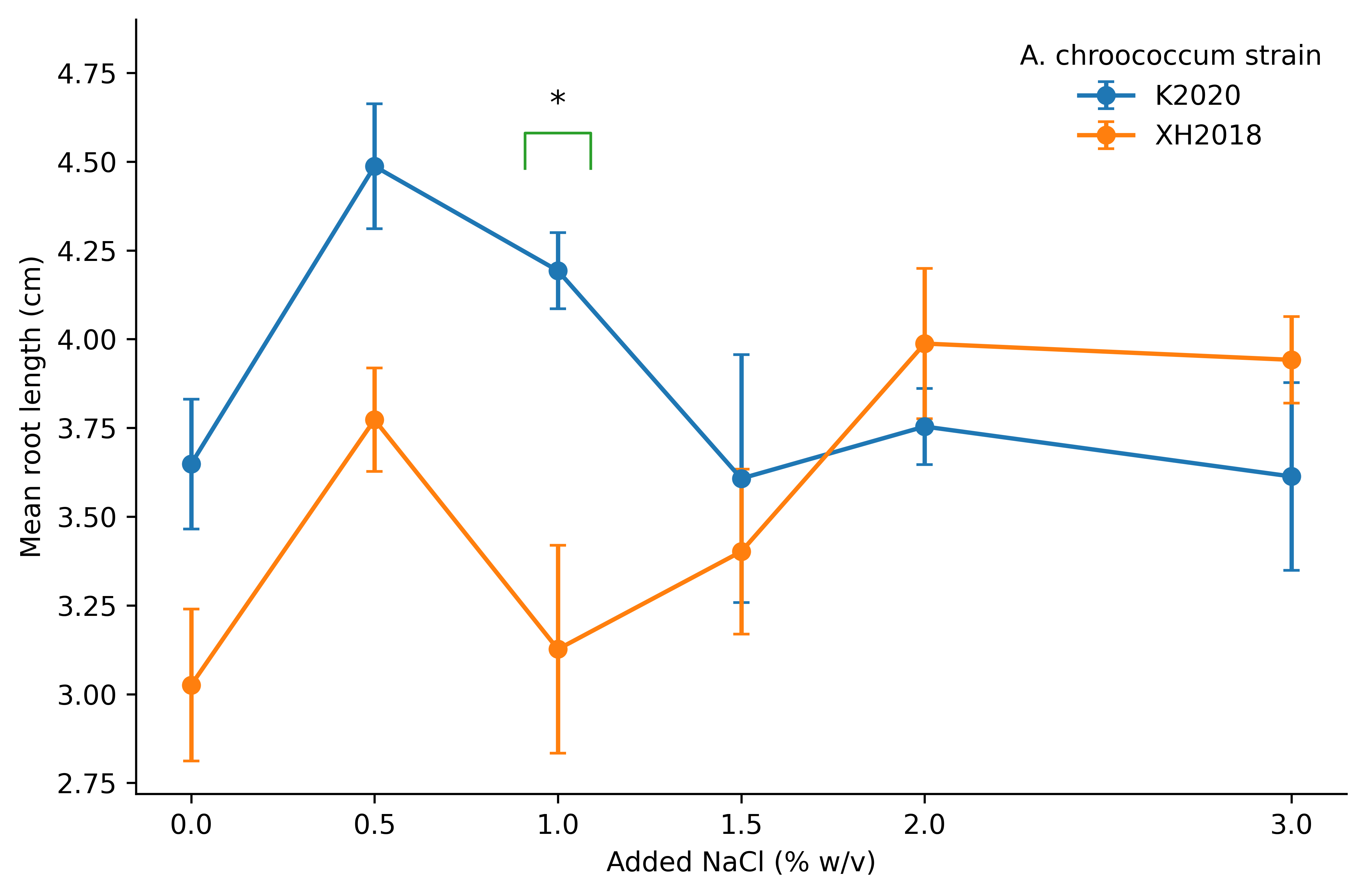 | Figure 1. Salinity-dependent root-length response of cotton to Azotobacter chroococcum strains K2020 and XH2018. Points show mean Petri-dish root length pooled across O‘zRFA-709 and O‘zRFA-710; error bars indicate SE (n = 6 Petri-dish replicates per strain × concentration, three per genotype). The bacteria-free DIS reference control was excluded from the factorial salinity analysis and numeric NaCl axis. * Significant model-based K2020–XH2018 contrast at 1% added NaCl after Holm correction (adjusted p = 0.00673) |
3.2. Cultivar-dependent Salinity Response in Wheat
- In wheat, cultivar identity was the dominant source of variation in root length (F = 37.256, p = 1.74 × 10⁻7, partial η² = 0.437), and NaCl level also had a significant effect (F = 2.827, p = 0.02571, partial η² = 0.227). In contrast, the strain main effect (p = 0.682) and strain × NaCl interaction (p = 0.569) were not significant. The cultivar × NaCl interaction did not reach significance in the omnibus Type II test (p = 0.0789), and the three-way interaction was non-significant (p = 0.798).Model-based cultivar contrasts nevertheless identified concentration-specific differences. At 1% added NaCl, E'zoz had a mean root length of 5.123 cm compared with 4.290 cm in Sharaf (difference = 0.833 cm, SE = 0.263, t = 3.162, Hedges' g = 1.81, Holm-adjusted p = 0.01358). At 3% NaCl, E'zoz maintained 4.858 cm compared with 3.559 cm in Sharaf (difference = 1.299 cm, SE = 0.263, t = 4.930, Hedges' g = 3.11, Holm-adjusted p = 0.000061). The numerical difference at 1.5% NaCl (0.627 cm; Hedges' g = 3.14) did not remain significant after model-based Holm adjustment (adjusted p = 0.08510). The 0.5% contrast was also non-significant after correction (adjusted p = 0.08768). No wheat strain contrast was significant at any NaCl concentration after Holm correction (all adjusted p = 1.000).Relative to the corresponding 0% added-NaCl mean, root-length retention at 3% NaCl was approximately 104.8% for E'zoz and 79.9% for Sharaf. These descriptive retention values are consistent with the concentration-specific model contrast at 3% NaCl and indicate stronger maintenance of early root elongation by E'zoz under the highest tested salinity.
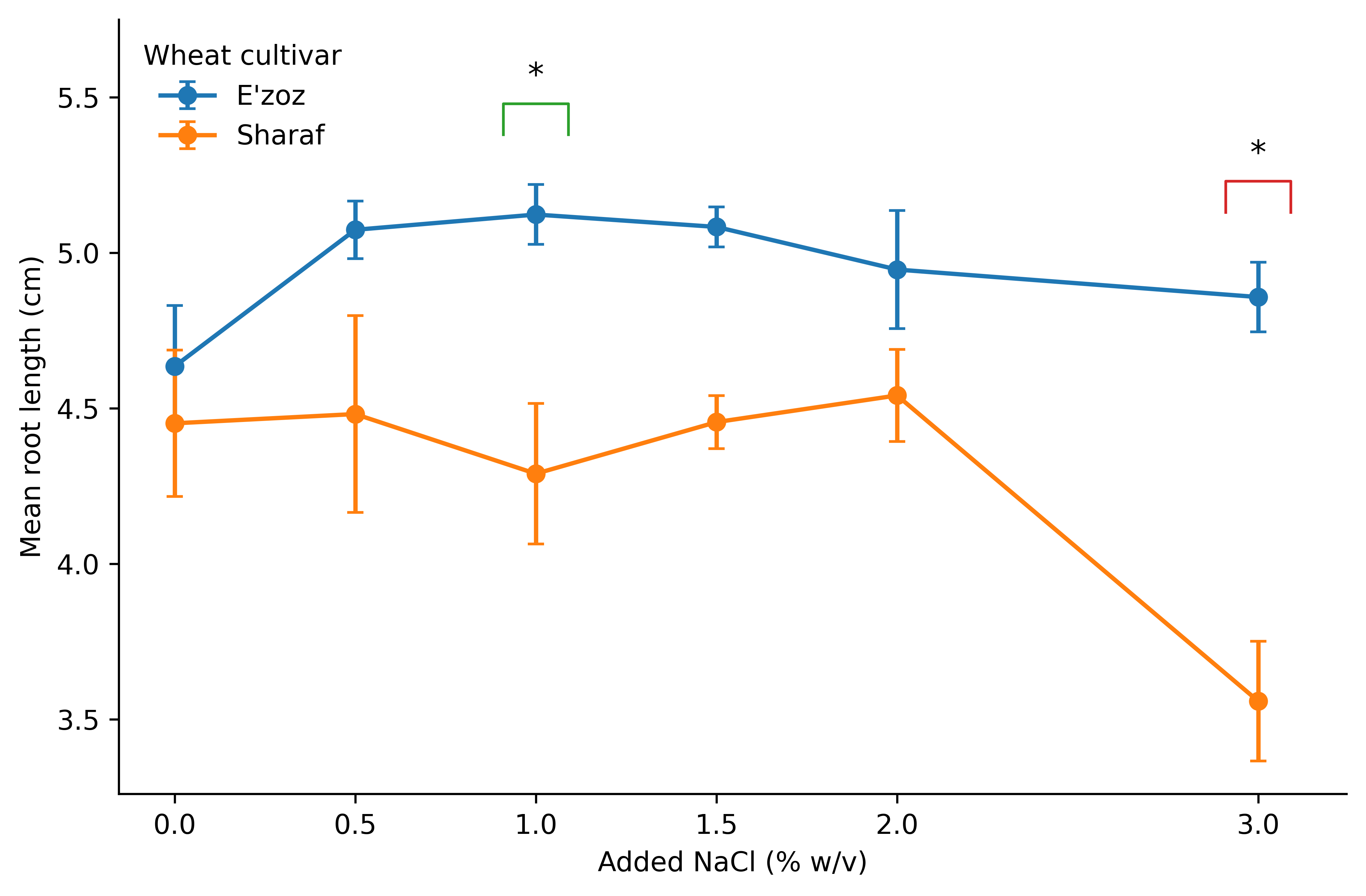 | Figure 2. Cultivar-specific wheat root-length response across the salinity gradient. Points show mean Petri-dish root length pooled across K2020 and XH2018; error bars indicate SE (n = 6 Petri-dish replicates per cultivar × concentration, three per bacterial strain). The bacteria-free DIS reference control was excluded from the factorial salinity analysis and numeric NaCl axis. * Significant model-based E'zoz–Sharaf contrasts after Holm correction at 1% (adjusted p = 0.01358) and 3% added NaCl (adjusted p = 0.000061). The 1.5% contrast was not significant after Holm adjustment (p = 0.08510) |
3.3. Salinity-dependent Germination Responses
- Germination responses differed from root-length responses. In cotton, the grouped-binomial model showed moderate overdispersion (Pearson dispersion = 1.694). In the nominal binomial model, NaCl and several interaction terms were significant; however, Pearson-scale sensitivity analysis reduced the strength of this evidence. After dispersion adjustment, the genotype × strain × NaCl interaction remained significant (scaled Wald χ² = 12.437, df = 5, p = 0.0293), while the genotype × NaCl (p = 0.108) and strain × NaCl (p = 0.130) interactions were no longer significant. The NaCl main effect remained marginally significant (scaled Wald χ² = 11.268, df = 5, p = 0.0463). Given n = 3 independent Petri dishes per cell and the observed extra-binomial variation, the higher-order cotton germination interaction was interpreted cautiously.In wheat, the grouped-binomial model showed no evidence of overdispersion (Pearson dispersion = 0.812), and the Pearson-scaled sensitivity analysis did not identify significant effects of cultivar, strain, NaCl, or their interactions. The three-way interaction was non-significant (scaled Wald χ² = 2.118, df = 5, p = 0.8327). Descriptively, germination at 3% NaCl averaged 95.0% in E'zoz and 76.7% in Sharaf, but the absence of significant germination-model effects indicates that the strongest statistically supported wheat differentiation occurred in post-germination root elongation rather than germination itself.
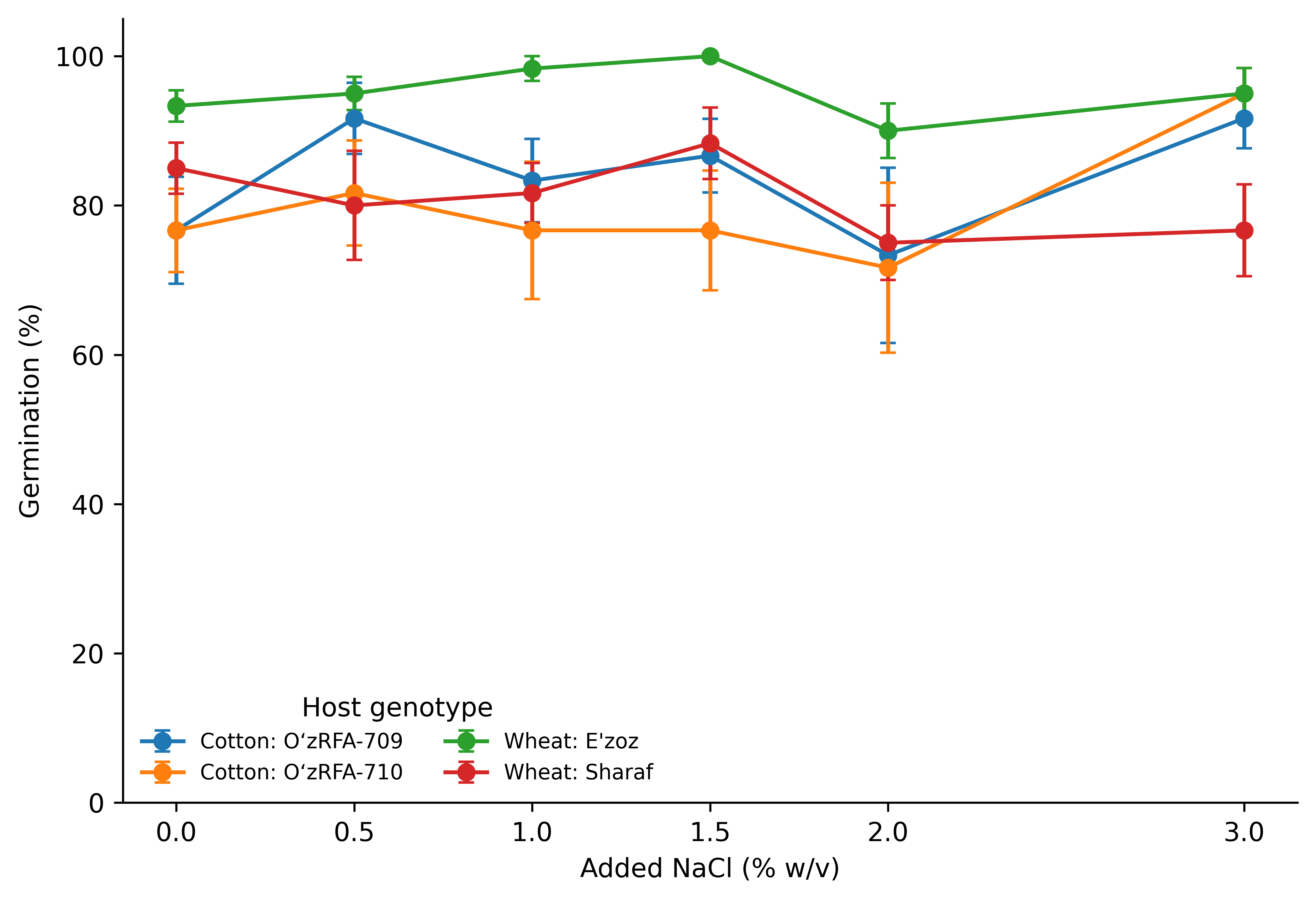 | Figure 3. Germination responses of cotton and wheat genotypes across increasing salinity. Points show mean germination percentage pooled across K2020 and XH2018 for each host genotype; error bars indicate SE (n = 6 Petri-dish replicates per genotype × concentration, three per bacterial strain; 10 seeds per Petri dish). The bacteria-free DIS reference control was excluded from factorial salinity modelling and the numeric NaCl axis. Pairwise significance symbols are not shown because germination was evaluated using factorial grouped-binomial models with interaction terms; cotton inference was additionally checked using Pearson-scale adjustment for moderate overdispersion |
4. Discussion
4.1. Salinity Reshapes Azotobacter-associated Root Growth in a Strain-dependent Manner
- The present study demonstrates that early plant responses associated with A. chroococcum were conditional on salinity rather than uniform across the tested Ashby-based environments. In cotton, bacterial strain (F = 7.378, p = 0.00915, partial η² = 0.133), NaCl level (F = 3.305, p = 0.01208, partial η² = 0.256), and the strain × NaCl interaction (F = 3.259, p = 0.01298, partial η² = 0.253) significantly affected root length. The clearest concentration-specific divergence occurred at 1% NaCl, where K2020 was associated with a 1.066-cm greater mean root length than XH2018 and the difference remained significant after Holm correction (adjusted p = 0.00673). No other concentration-specific strain contrast survived multiplicity correction. Thus, although an overall strain effect was present across the six Ashby salinity conditions, the data do not support generalized superiority of K2020 at every NaCl level.This conditional pattern is consistent with primary PGPR studies showing that bacterial effects under salinity depend on the specific strain–host–environment combination. Nawaz et al. [4] found that different halotolerant PGPR treatments maximized different growth, water-relation, osmolyte, mineral and antioxidant traits in salt-tolerant Aas-11 and salt-sensitive Galaxy-13 wheat. Yuan et al. [7], using Pseudomonas chlororaphis 30-84 and isogenic derivatives across four winter-wheat varieties, likewise showed that the magnitude of bacterial benefit under salinity varied among host varieties. These studies do not establish the mechanism operating in cotton here, but they support interpreting the K2020–XH2018 divergence as context dependent rather than as a fixed strain ranking.Direct Azotobacter evidence also supports the biological plausibility of salinity-conditioned performance. Kumar et al. [14] showed that the halotolerant A. chroococcum W4ii improved wheat germination and seedling development under salt stress, whereas the same study reported little effect under non-saline conditions. Elakkya et al. [10] further demonstrated that A. chroococcum W5 undergoes marked metabolic reprogramming under salt and osmotic stress while retaining multiple plant-growth-promoting traits. Together, these strain-level studies show that the functional phenotype of A. chroococcum can be strongly environment dependent, although neither study permits direct mechanistic inference for K2020 or XH2018.
4.2. Potential Microbial Mechanisms Underlying Strain-specific Responses Under Salinity
- The present experiment measured plant phenotypes rather than the bacterial processes responsible for them; therefore, the cotton strain × treatment interaction is an observed response pattern, not evidence for a specific mechanism. Primary evidence from other A. chroococcum strains identifies testable hypotheses. Rasulov and Pattaeva [16] showed that A. chroococcum XU1 altered its metabolite profile under abiotic stress and produced extracellular polymeric material under NaCl exposure with Na+ biosorption capacity. This finding supports EPS/alginate-associated salt adaptation as a plausible mechanism to test, but EPS production, alginate abundance, root-surface polymer accumulation and Na+ sequestration were not measured for K2020 or XH2018 in the present study.Nutrient acquisition and phytohormone-related activity provide additional literature-supported hypotheses. Biełło et al. [9] demonstrated biological nitrogen fixation and phosphorus mobilization in A. chroococcum NCIMB 8003 using physiological, proteomic, gene-expression and enzyme-level evidence. Elakkya et al. [10] experimentally confirmed auxin and gibberellic acid production, phosphate solubilization, moderate nitrogen fixation and ACC utilization in A. chroococcum W5; the same study documented salt- and osmotic-stress-associated metabolic changes, including increased proline and glycerol under specific stress conditions. These studies establish that such functions can occur in A. chroococcum, but the present experiment did not quantify phytohormones, nitrogen fixation, phosphorus mobilization, ACC-related activity or compatible solutes in K2020 or XH2018. They should therefore be treated as candidate mechanisms rather than explanations demonstrated here.Plant ion relations and oxidative-stress responses are likewise plausible downstream components rather than measured mechanisms in this experiment. Primary plant studies with A. chroococcum have reported salinity-associated changes in mineral acquisition, Na+/K+ relations, osmolytes, antioxidant enzymes and related physiological traits in maize, canola and soybean [11,12,13]. These findings justify targeted measurement of ion homeostasis and oxidative-stress markers in the present strain–host system. However, Na+, K+, osmolytes, reactive-oxygen-related damage and antioxidant activity were not measured here, so none of these pathways can be invoked as the demonstrated cause of the observed root-length differences.
4.3. Host Genotype Is a Dominant Determinant of the Wheat Response
- Wheat displayed a response architecture distinct from cotton. Cultivar explained a substantial fraction of root-length variation (F = 37.256, p < 0.001, partial η² = 0.437), while NaCl level also contributed significantly (F = 2.827, p = 0.02571, partial η² = 0.227). In contrast, the strain × NaCl interaction was not significant (p = 0.569). Model-based cultivar contrasts showed that E'zoz maintained significantly greater root length than Sharaf at 1 and 3% NaCl after Holm correction. The numerical differences at 0.5 and 1.5% NaCl did not remain significant after multiplicity adjustment. At 3% NaCl, mean root-length retention relative to the 0% condition was approximately 104.8% for E'zoz and 79.9% for Sharaf. These results identify host cultivar, rather than bacterial strain identity, as the dominant source of wheat root-growth differentiation in this experiment.This interpretation is supported by several independent wheat–PGPR experiments. Nawaz et al. [4] showed that salt-tolerant Aas-11 and salt-sensitive Galaxy-13 differed in which PGPR treatments produced the strongest physiological, nutritional and growth responses. Yuan et al. [7] observed variety-dependent responses across four winter-wheat varieties inoculated with P. chlororaphis derivatives. Nawaz et al. [5] further documented bacterial effects on two wheat genotypes with contrasting inherent salt tolerance, including genotype-associated differences in root, physiological and yield responses. Albdaiwi et al. [6] provided a particularly relevant demonstration: two halotolerant endophytic bacteria improved growth of a salt-sensitive durum wheat genotype, whereas comparable growth promotion was not observed in the tolerant genotype. Collectively, these primary studies support the broader conclusion that host genetic background can strongly modify the phenotype produced by beneficial bacteria under salinity.The maintenance of root elongation by E'zoz across the tested gradient should nevertheless not be interpreted as proof that NaCl stimulated this cultivar. Such a claim would require formal within-cultivar contrasts of each salt concentration against the 0% condition. The present data more securely support differential maintenance of early root growth between E'zoz and Sharaf, particularly at the higher NaCl levels.
4.4. Germination and Post-germination Root Elongation Resolve Different Components of the Response
- The wheat results also show why germination and post-germination root development should not be treated as interchangeable endpoints. The binomial germination model detected no significant cultivar, strain, NaCl or interaction terms in wheat, whereas root length showed a strong cultivar effect. Thus, the major E'zoz–Sharaf differentiation emerged after germination rather than at the binary establishment stage. Descriptively, germination at 3% NaCl remained relatively high in both cultivars (95.0% in E'zoz and 76.7% in Sharaf), while root-length retention separated them more strongly.Primary studies support evaluating these stages separately. Yuan et al. [7] quantified seed germination together with later seedling biomass, relative water content, reactive oxygen species and antioxidant activity and found variety-dependent bacterial responses across these phenotypes. Kumar et al. [14] assessed both wheat germination and subsequent seedling development following A. chroococcum W4ii inoculation under salt stress. Saleem et al. [8] similarly evaluated germination and seedling growth in cotton inoculated with salt-tolerant IAA-producing PGPR; this study supports the phenotypic framework but is not Azotobacter-specific. Together, these experiments support the use of germination and root elongation as complementary indicators: successful radicle emergence does not necessarily imply equivalent maintenance of subsequent root growth.Cotton presented a different germination pattern, but the strength of inference depended on accounting for extra-binomial variation. The nominal binomial model indicated NaCl-related and interaction effects; however, the cotton Pearson dispersion estimate was 1.694. After Pearson-scale adjustment, the three-way genotype × strain × NaCl interaction remained significant (scaled Wald χ² = 12.437, df = 5, p = 0.0293), whereas the genotype × NaCl (p = 0.108) and strain × NaCl (p = 0.130) interactions were no longer significant; the NaCl main effect was marginally significant (p = 0.0463). Thus, the robust conclusion is limited to evidence for context dependence in cotton germination, with the higher-order interaction interpreted cautiously because only three independent Petri dishes were available per cell and several combinations approached extreme germination proportions.
4.5. Integrating the Mechanistic Evidence Without Over-attribution
- The primary literature defines a coherent set of candidate mechanisms for future testing, but the present data do not identify any of them as causal. At the bacterial level, salt-responsive EPS and Na+ biosorption have been demonstrated in A. chroococcum XU1 [16]; biological nitrogen fixation and phosphorus mobilization have been resolved in NCIMB 8003 [9]; and W5 has been shown experimentally to produce phytohormones, solubilize phosphate, fix nitrogen and remodel its metabolome under salt and osmotic stress [10]. At the plant level, A. chroococcum treatments have been associated with changes in ion relations, osmolytes and antioxidant systems in other crop–salinity experiments [11,12,13]. None of these measurements was made for the K2020/XH2018 × cotton/wheat combinations used here. Accordingly, these findings are literature-supported hypotheses for mechanistic follow-up, not mechanistic evidence generated by the present experiment.Two additional studies broaden this framework but require explicit attribution limits. Al Khallaf et al. [17] reported improved spring-wheat physiological performance, antioxidant activity, osmotic adjustment, ion-homeostasis-related traits and stress-responsive gene expression after treatment with a consortium containing A. chroococcum, Bacillus megaterium and B. circulans. Because all three bacteria were applied together, those molecular responses cannot be assigned specifically to A. chroococcum. Likewise, Zhou et al. [15] found that A. beijerinckii improved wheat performance in saline-alkali soil, but the strongest effects occurred in combination with live Chlorella pyrenoidosa. These studies support the broader relevance of microbial modulation in saline wheat systems while illustrating why single-strain attribution is essential when interpreting mechanisms.Accordingly, EPS/alginate production, bacterial salt adaptation, phytohormone-related activity, nutrient acquisition, plant Na+/K+ regulation, osmotic adjustment and antioxidant defence are explicitly treated as hypotheses for XH2018 and K2020. The present study provides no direct measurement showing that either strain expressed these traits under the experimental conditions. A mechanistic follow-up should quantify them in the same strain × host genotype × salinity combinations, thereby testing whether microbial traits covary with the plant phenotype instead of inferring causation from unrelated strains or host systems.
4.6. Biological Implications, Limitations and Future Validation
- The principal contribution of this study is the resolution of context dependence across bacterial strain, host genotype and salinity intensity within the inoculated Ashby treatment series. Cotton showed both an overall strain effect and a strain-dependent salinity response, with the only concentration-specific K2020–XH2018 difference surviving Holm correction at 1% NaCl, whereas wheat variation was dominated by cultivar-specific maintenance of root elongation. This contrast argues against selecting an A. chroococcum inoculant solely on the basis of performance in one host genotype or at one salt concentration.The factorial design provides a useful screening framework, but several limitations constrain interpretation. First, the Petri dish was the independent experimental unit; individual roots within a dish were subsamples and were not treated as independent biological replicates. Second, only three independent Petri dishes were available per genotype/cultivar × strain × Ashby-salinity cell, limiting precision and making complex germination interactions sensitive to sparse or extreme binomial outcomes. Third, the bacteria-free DIS treatment was an independent reference control and therefore could not be incorporated as a strain-specific level in the factorial models; inferential conclusions concern the six inoculated Ashby-based salinity conditions. Fourth, the final bacterial inoculum density was not measured or standardized by OD, CFU or a McFarland-type reference; the exact resuspension volume and bacterial-suspension: Ashby mixing ratio were also not recorded. K2020 and XH2018 pellets were resuspended separately in equal volumes of distilled water, but equal resuspension volume does not establish equal viable-cell concentration; therefore, part of an observed strain-associated difference could reflect unequal delivered cell numbers as well as intrinsic strain biology. Fifth, the study measured early phenotypes under controlled conditions and did not quantify root colonization, in planta nitrogen fixation, EPS/alginate accumulation, phytohormones, nutrient mobilization, plant ion composition, osmotic adjustment or oxidative damage. Finally, the design identifies association and interaction patterns but does not establish the molecular cause of those patterns.A logical next step is greenhouse validation of the most informative combinations, including K2020 and XH2018 in cotton and the contrasting E'zoz and Sharaf wheat responses, using saline soil and increased biological replication. Measurements should include root and shoot biomass, Na+/K+ balance, chlorophyll, relative water content, osmolytes, lipid peroxidation and antioxidant activity, accompanied by quantitative assessment of root colonization and strain-specific EPS/alginate, phytohormone and nutrient-mobilization traits. Such measurements would directly test the mechanisms supported by the primary literature and determine whether the salinity-dependent phenotypes observed here persist beyond early seedling assays.Overall, the results support a strain × host × environment framework for A. chroococcum-associated early plant responses under salinity. The key implication is not that one strain is universally superior, but that the observed response depends on bacterial identity, plant genetic background and stress intensity. Because DIS was bacteria-free, this inference is restricted to comparisons within the inoculated Ashby salinity series. This framework provides a defensible basis for prioritizing strain–host combinations for subsequent standardized and mechanistically resolved validation.
5. Conclusions
- The present study demonstrates that early crop responses associated with A. chroococcum are not uniform across bacterial strains, host genetic backgrounds and salinity levels. In cotton, strain, NaCl level and their interaction significantly affected root elongation, while the only concentration-specific K2020–XH2018 contrast surviving Holm correction occurred at 1% added NaCl (adjusted p = 0.00673). This supports a context-dependent strain response rather than general superiority of either isolate across the salinity gradient. In wheat, cultivar identity was the dominant determinant of root elongation, with E'zoz maintaining significantly greater root length than Sharaf at 1% and 3% added NaCl, while bacterial strain effects were not significant. Germination and post-germination root elongation resolved different components of the stress response: wheat cultivar differentiation was pronounced for root growth despite the absence of significant germination-model effects, whereas cotton germination retained evidence of a higher-order genotype × strain × NaCl interaction after adjustment for moderate overdispersion. The bacteria-free DIS treatment served only as a descriptive/reference control and was excluded from factorial strain × genotype/cultivar × salinity inference. The experiment does not establish the mechanisms responsible for these patterns. EPS/alginate production, phytohormone-related activity, nutrient acquisition, ion homeostasis, osmotic adjustment and antioxidant responses remain hypotheses requiring direct measurement in XH2018 and K2020. Moreover, because final inoculum density was not standardized by OD, CFU or an equivalent viable-cell metric, future experiments should standardize inoculum density and quantify colonization together with microbial and plant physiological traits. Validation under larger replicated experiments, soil-based systems and ultimately field salinity conditions will be necessary to determine the agronomic robustness of the observed strain–host–salinity relationships.
Author Contributions
- Soliyeva Mukambar Abdug‘affor qizi: Conceptualization, Methodology, Investigation, Data Curation, Visualization, Writing – Original Draft, Writing – Review & Editing. Rayimberdiyev Dadamirza Sultonmurod o‘g‘li: Formal Analysis, Data Curation, Investigation, Validation, Writing – Review & Editing. Pattayeva Mohichehra Abdusattarovna: Methodology, Writing – Review & Editing. Rasulov Baxtiyor Abdug‘afurovich: Conceptualization, Methodology, Supervision, Validation, Interpretation of Results, Writing – Review & Editing.
Statements and Declarations
- FundingThis research was supported by the Ministry of Innovative Development of the Republic of Uzbekistan under the fundamental research project FL-21101845, “Investigation of the mechanisms of stabilization of silicon/silver (Ag/SiO₂) nanoparticles in rhizobacterial exopolysaccharides and their application to enhance stress tolerance in agricultural crops.”Competing InterestsThe authors declare no competing interests.Ethics ApprovalNot applicable. The study involved plant seeds and bacterial cultures only and did not involve human participants or animals.Data AvailabilityThe datasets supporting the findings of this study are provided in the Supplementary Information. Additional information related to the dataset is available from the corresponding author upon reasonable request.