S. I. Khusanov
Andijan State University, Uzbekistan
Correspondence to: S. I. Khusanov, Andijan State University, Uzbekistan.
Copyright © 2026 The Author(s). Published by Scientific & Academic Publishing.
This work is licensed under the Creative Commons Attribution International License (CC BY).
http://creativecommons.org/licenses/by/4.0/

Abstract
This study aimed to evaluate the effects of a balanced thermophilic methanogenic microbial association (BTMMA) on biogas production, methane concentration, and selected microbial populations during the anaerobic digestion of poultry manure. A 29-day laboratory experiment was conducted at 55 ± 1 °C using 10-L fermenters with a working volume of 7 L. Poultry manure supplemented with 10% or 20% cattle-manure-derived BTMMA was compared with an uninoculated control. Biogas production was measured volumetrically, gas composition was determined by gas chromatography, and microbial populations were assessed using culture-based methods. Cumulative biogas production reached 151 and 179 L in the 10% and 20% inoculum treatments, respectively, compared with 84.5 L in the control, representing approximately 1.79-fold and 2.12-fold increases. Maximum methane concentrations were 69.7% on day 20 with 10% inoculum and 64.7% on day 10 with 20% inoculum, whereas the control reached a maximum of 54.8% on day 29. Enterobacteriaceae and selected other cultured indicator and pathogenic microorganisms were not detected on days 2 and 19 in either the control or the inoculated treatment reported in the microbiological assessment. These findings indicate that BTMMA supplementation can increase cumulative biogas production and accelerate methane enrichment under thermophilic conditions. The 20% inoculum treatment produced the greatest total biogas volume, while the 10% treatment achieved the highest methane concentration. Further replicated experiments with substrate-normalized methane yields are needed to establish process reproducibility and inform scale-up.
Keywords:
Poultry manure, Anaerobic digestion, Thermophilic conditions, Methanogenic microbial consortium, Bioaugmentation, Biogas production, Methane concentration, Microbial indicators
Cite this paper: S. I. Khusanov, Application of Thermophilic Methanogenic Microbial Consortia in the Fermentation of Poultry Manure, International Journal of Genetic Engineering, Vol. 14 No. 10, 2026, pp. 310-318. doi: 10.5923/j.ijge.20261410.09.
1. Introduction
The management of poultry manure presents an important challenge for agricultural waste treatment and renewable energy recovery. In addition to requiring appropriate disposal, this organic residue offers a potential feedstock for biological conversion into methane-containing biogas. Anaerobic digestion provides a route for recovering part of its energy content while treating the waste. However, the successful digestion of poultry manure depends on maintaining operating conditions that support microbial activity despite the inhibitory characteristics of the substrate. Research on chicken manure digestion has demonstrated that process performance varies with organic loading and temperature, highlighting the need for substrate-specific treatment strategies rather than a single universal operating approach. A central difficulty in poultry manure digestion is maintaining a functional balance between the microorganisms responsible for organic matter degradation and those involved in methane formation. Ammonia accumulation can disrupt this balance, promote the accumulation of volatile fatty acids, and reduce methanogenic activity. Importantly, thermophilic operation does not necessarily eliminate these constraints. Bi et al. (2019) demonstrated that elevated free ammonia concentrations adversely affected thermophilic chicken manure digestion, particularly at higher organic loading. Consequently, the potential benefits of elevated temperature must be evaluated together with substrate loading and the capacity of the microbial community to function under the selected conditions. Bioaugmentation, involving the addition of a selected or enriched microbial culture, represents a promising strategy for improving methane production from poultry manure. Rather than relying exclusively on the indigenous manure microbiota, this approach introduces microorganisms with metabolic capabilities relevant to anaerobic conversion. Experimental evidence supports its potential: He et al. (2022) reported increased methane production and a shorter production period following the addition of a methanogenic culture to chicken manure batch digesters. Their findings also showed that increasing the inoculum dose did not produce a proportional improvement in bioaugmentation efficiency, indicating that inoculum quantity requires deliberate evaluation. The functional characteristics of the introduced consortium are also important. Li et al. investigated a propionate-degrading methanogenic culture and reported improved chicken manure digestion under elevated ammonia conditions. This finding supports the importance of interactions between microorganisms that degrade fermentation intermediates and methanogens that complete their conversion to methane. Nevertheless, improvements achieved using a particular enriched culture cannot be assumed to apply equally to inocula obtained from other sources or operated under different conditions. The performance of each consortium must therefore be assessed in relation to its preparation, dosage, substrate, and fermentation environment.
2. Materials and Methods
Against this background, the present study addresses a specific practical question: how do two addition levels of a cattle-manure-derived, thermophilically enriched microbial consortium affect the fermentation of farm poultry manure at 55 ± 1 °C? Evaluating both cumulative biogas production and the temporal changes in methane concentration is necessary because these measurements describe different aspects of process performance. A treatment that produces a larger total gas volume may not necessarily achieve the highest methane concentration. Assessment of selected culturable microorganisms provides an additional measure of the microbiological changes accompanying fermentation, although it does not establish comprehensive digestate safety.Accordingly, this study aimed to evaluate the effects of 10% and 20% supplementation with a balanced thermophilic methanogenic microbial association (BTMMA) on the anaerobic digestion of poultry manure during a 29-day laboratory experiment. The specific objectives were to compare biogas production dynamics and cumulative gas volumes with an uninoculated control, determine changes in methane concentration and the timing of its maximum, and assess selected microbial populations before and during fermentation. The study thereby provides experimental evidence for evaluating this consortium as an inoculation strategy for thermophilic poultry manure treatment.Poultry farms function not only as large-scale producers of meat and eggs but also as significant generators of organic waste, primarily in the form of poultry dung. As reported by Lysenko V.P. [7], a commercial poultry facility with a stock of approximately 400,000 laying hens can annually accumulate nearly 30,000 tons of solid poultry dung, in addition to more than 400,000 m³ of wastewater enriched with high levels of organic pollutants. Under uncontrolled natural decomposition, such massive quantities of dung can release up to 700 tons of biogas, including roughly 450 tons of methane, 208 tons of carbon dioxide, and about 35 tons of hydrogen, alongside notable amounts of hydrogen sulfide and ammonia. These emissions not only represent environmental hazards but also indicate a substantial untapped potential for renewable energy production. Long-term and unregulated deposition of poultry dung around large industrial poultry farms has resulted in noticeable ecological disruptions in adjacent territories. Soils in such zones often exhibit elevated concentrations of mobile phosphates, severe nutrient imbalance, and excessive accumulation of heavy metals. Furthermore, poultry dung serves as a biological carrier of numerous undesirable components, including viable weed seeds, eggs and larvae of helminths and flies, as well as a wide spectrum of pathogenic bacteria and viruses [12]. The persistence of these contaminants poses risks both to agricultural productivity and public health, accelerating the degradation of soil ecosystems and contributing to broader environmental pollution. In light of these challenges, the development and implementation of technologies for the efficient utilization of poultry waste as a valuable resource, while simultaneously minimizing its negative ecological impact, is of particular scientific and practical significance. Among the available waste-treatment strategies, thermophilic anaerobic digestion has emerged as one of the most ecologically stable approaches. This method enables the transformation of poultry dung into biogas a renewable energy source and a stabilized organic fertilizer suitable for agricultural use. The high temperatures characteristic of thermophilic fermentation also contribute to the inactivation of pathogenic microorganisms, thereby enhancing the sanitary safety of the final digestate. Considering these advantages, the present study focuses on evaluating the efficiency of thermophilic digestion of farm-derived poultry dung employing a balanced thermophilic methanogenic microbial association (BTMMA) prepared from cattle manure. The application of such microbial consortia is expected to accelerate methanogenesis, improve the stability of the fermentation process, increase biogas yield, and enhance the hygienic quality of the final product. Understanding these effects will contribute to the development of optimized technologies for the environmentally safe and energy efficient utilization of poultry waste. The experimental studies were conducted using a 10-L laboratory-scale fermenter. Fresh farm poultry dung (FPD) with an initial pH ranging from 7.4 to 7.6 and a moisture content of 89% served as the primary substrate. The amount of water required to adjust the moisture level of the substrate was calculated according to the formula proposed in [16]:Кwater = Мsubs. х ((Вdm% – Вim%) : (100% – Вdm%)),where, Кwater – water amount in liters, Мsubs. – mass of the substrate, taken for the preparation of slurry (kg), Вdm – the desired moisture content of the substrate, Вim – initial moisture of the substarte.After moisture adjustment, BTMMA inoculum produced from cattle manure through stepwise enrichment under thermophilic conditions (55±1°C) was introduced into the substrate at concentrations of 10% and 20%. The working volume inside the fermenter was maintained at 7 L. A natural microbial consortium contained in untreated FPD served as the control variant. Throughout the fermentation process, the temperature inside the reactor was strictly maintained at 55 ± 1 °C. The total biogas yield was measured using a gas-metering device manufactured by PLAZMA GROUP LTD (Qmax = 2.5 m³/s, Qmin = 0.016 m³/s, Pmax = 3 vPa). The qualitative composition of the produced gas—specifically methane, carbon dioxide, and nitrogen—was analyzed using a “Chrom-5” gas chromatograph (CZ, Prague) equipped with a thermal conductivity detector (detector current: 80 mA). Chromatographic separation was carried out on a glass column (1200 × 3 mm) packed with Polysorb-1 sorbent (0.1–0.3 mm), with helium as the carrier gas at a flow rate of 70 ml/min at 20°C. Quantitative determination of microbial populations was performed using selective culture media and standard microbiological techniques as described by Egorov N.S., Zvyagintsev D.G., and Galchenko V.F. [3,4,16]. Anaerobic microorganisms were cultivated in an anaerostat under a gas mixture of N₂ and CO₂ in a ratio of 90:10 to ensure strictly anaerobic conditions.Determination of biogas compositionMethane (CH₄), carbon dioxide (CO₂), and nitrogen (N₂) were determined using a Chrom-5 gas chromatograph (Prague, Czech Republic) equipped with a thermal conductivity detector. The detector current was maintained at 80 mA. Separation was performed using a glass column measuring 1,200 × 3 mm, packed with Polysorb-1 sorbent with a particle size of 0.1–0.3 mm. Helium was used as the carrier gas at a flow rate of 70 mL min⁻¹, as reported at 20 °C.Gas composition was expressed as the percentage of each measured component in the biogas. Methane concentration profiles were used to compare the development of methanogenesis among treatments. Maximum methane concentration and its corresponding sampling day were identified from the recorded measurements. Methane concentration was distinguished from cumulative methane yield, which requires integration of gas volume and methane fraction over time.Microbiological analysisMicrobial populations were assessed in the initial substrate and on days 2 and 19 of fermentation using selective culture media and conventional cultivation methods. The physiological groups examined included methanogens, cellulose-degrading microorganisms, anaerobic nitrogen-fixing microorganisms, denitrifying microorganisms, and ammonifying microorganisms.The microbiological assessment also included Enterobacteriaceae, Shigella spp., Salmonella spp., Escherichia coli, Pseudomonas aeruginosa, and Staphylococcus aureus. Anaerobic cultivation was performed in an anaerostat containing an N₂–CO₂ atmosphere at a ratio of 90:10. Microbial abundance was reported in the units provided in the original dataset, namely \(10^{3}\) cells mL⁻¹.Zero values in the microbiological dataset were interpreted as non-detection under the cultivation conditions used, rather than proof of complete elimination. The microbiological table distinguished only control and “Trial” samples; therefore, its findings were not assigned separately to the 10% and 20% inoculum treatments.Data analysisThe recorded data were evaluated descriptively by comparing cumulative biogas volumes, gas production profiles, methane concentrations, and microbial counts among the reported conditions. Treatment-to-control ratios and percentage changes were used to describe differences in cumulative gas production.The available manuscript did not specify the number of independent experimental replicates or provide replicate-level measurements, estimates of variability, or a documented statistical testing procedure. Consequently, inferential statistical tests were not applied, and treatment differences are presented as observed numerical differences rather than statistically significant effects.
3. Results and Discussion
The analysis of the kinetics of biogas formation from farm poultry dung (FPD) under thermophilic conditions demonstrated that both the native microbial consortium and the substrates enriched with BTMMA exhibited a relatively short lag-phase. This indicates that the indigenous gas-forming microorganisms present in raw poultry dung possess an inherent capacity for rapid adaptation to thermophilic anaerobic conditions. Nevertheless, the variants supplemented with 10% and 20% BTMMA inoculum showed a substantially more intensive biogas-forming activity compared with the untreated control. The introduction of 10% BTMMA resulted in a 1.36-fold increase in the maximum gas-production rate, whereas the addition of 20% inoculum enhanced this parameter by 1.14-fold. The peak biogas volumes in these treatments reached 24.5 dm³ and 20.5 dm³, respectively, whereas the control variant demonstrated noticeably lower values (Figure 1 A, B, C). These results confirm that the inoculation with thermophilic methanogenic microbial associations accelerates the transition to the active gas-forming phase and enhances the metabolic efficiency of the fermentation process. The observed intensification can be attributed to the introduction of specialized thermophilic methanogens that rapidly establish dominance within the microbial community, thereby increasing methane-forming pathways and reducing the time required to reach the maximal rate of gas evolution. The aim of this study was to evaluate the effects of a cattle-manure-derived balanced thermophilic methanogenic microbial association (BTMMA) on biogas production, methane concentration, and selected microbial populations during thermophilic anaerobic digestion of poultry manure. The principal finding was that BTMMA supplementation increased cumulative biogas production and advanced the attainment of high methane concentrations compared with the uninoculated control. Over 29 days, the 10% and 20% inoculum treatments produced 151 and 179 L of biogas, respectively, compared with 84.5 L in the control, corresponding to increases of approximately 78.7% and 111.8%. However, the treatments differed in their gas composition profiles: the 20% treatment produced the greatest total biogas volume, whereas the 10% treatment achieved the highest methane concentration. These observations demonstrate that cumulative biogas production and maximum methane concentration should be evaluated as separate performance indicators.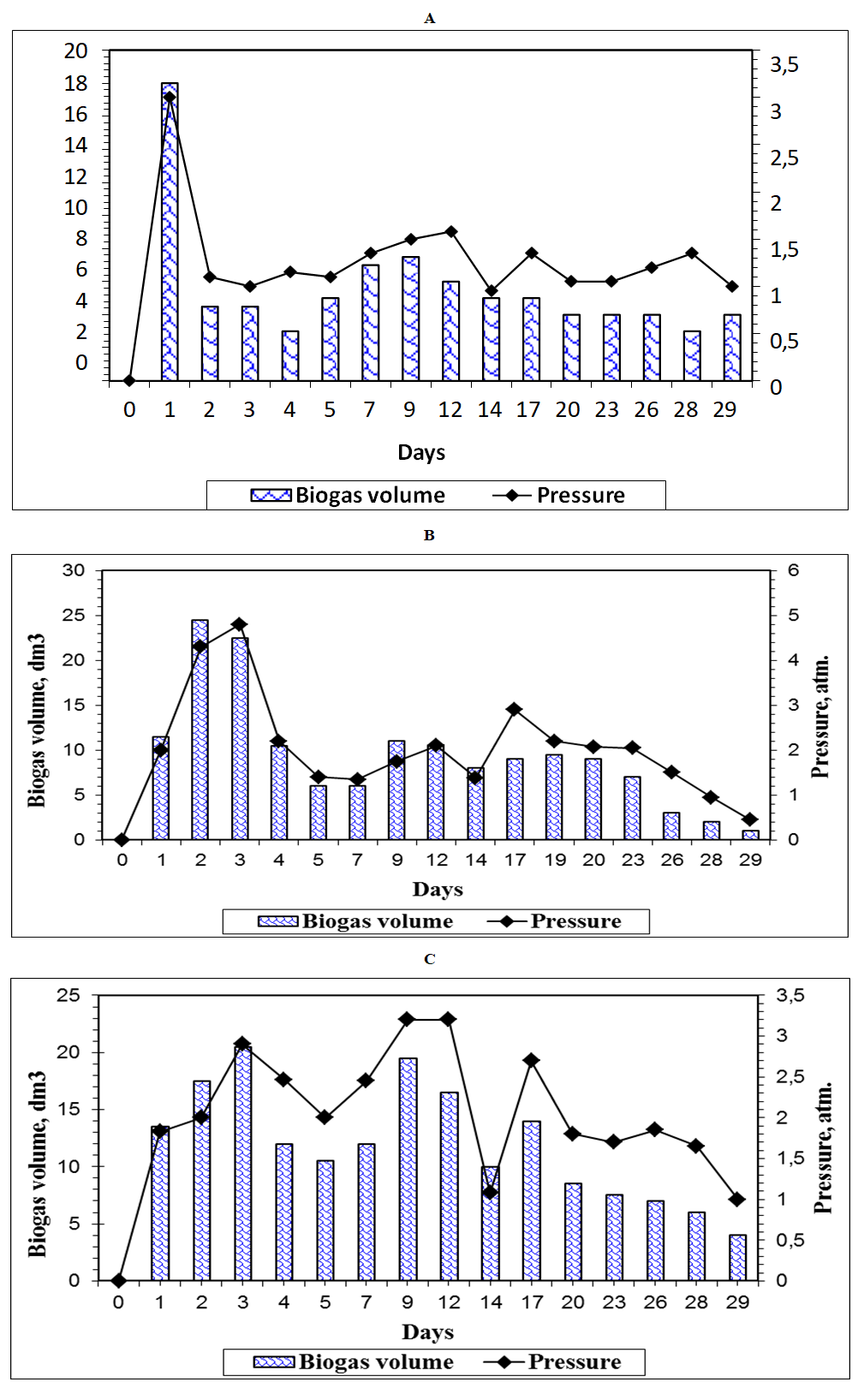 | Figure 1. Gas-formation dynamics of the microbial association in farm poultry dung (FPD) under thermophilic conditions (55 °C). (A) Control variant (Sample №1) containing natural microbial flora of FPD; (B) Experimental variant (Sample №2) supplemented with 10% BTMMA inoculum; (C) Experimental variant (Sample №3) supplemented with 20% BTMMA inoculum |
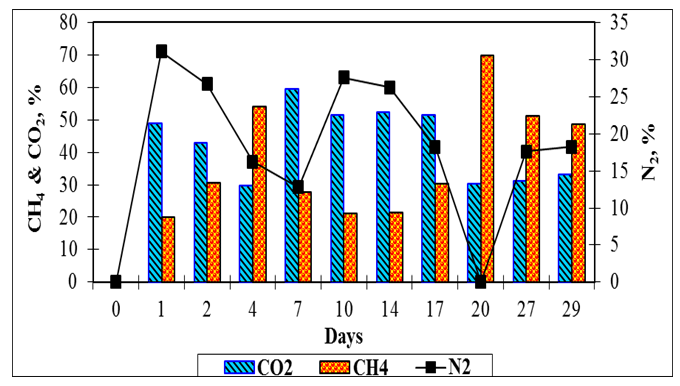
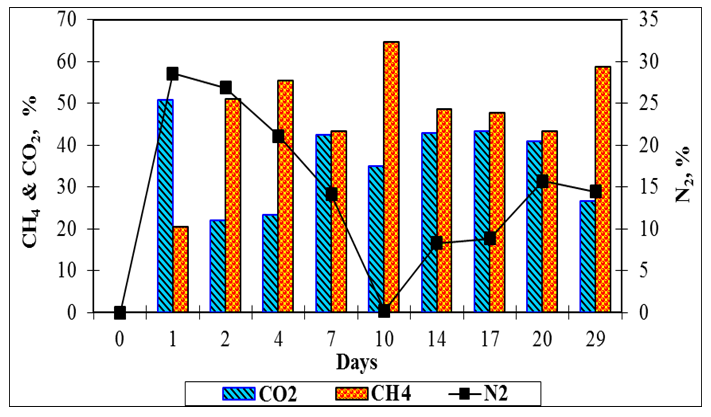
The observed response to inoculation agrees qualitatively with the findings of He et al. (2022), who demonstrated that methanogenic culture supplementation increased methane yield and shortened the methane production period during batch digestion of chicken manure. Their study also identified changes in methanogenic community composition following bioaugmentation, suggesting that introduced cultures can influence the microbial pathways supporting methane formation. In the present experiment, the earlier development of methane-rich biogas is consistent with improved initial methanogenic capacity. Nevertheless, the magnitude of improvement cannot be compared directly between the studies because He et al. expressed inoculum addition relative to volatile solids and evaluated methane yield, whereas the present results describe reactor-level biogas volumes and methane concentrations. PubMedThe different responses of the two inoculated treatments suggest that inoculum dosage influenced the temporal pattern of fermentation. Maximum methane concentrations occurred on day 20 in the 10% treatment and day 10 in the 20% treatment, compared with day 29 in the control. Thus, the higher inoculum level was associated with an earlier methane concentration maximum, although its maximum value was lower. He et al. (2022) likewise found that increasing bioaugmentation dosage did not lead to proportional improvements in bioaugmentation efficiency. Together, these findings indicate that the most suitable inoculum dose depends on the selected performance criterion. The present experiment does not establish an optimum dosage because cumulative methane yield, inoculum-associated gas production, and treatment costs were not determined. PubMedThe separation between peaks in total gas production and maximum methane concentration further indicates that gas quantity alone does not adequately describe fermentation performance. In the 10% treatment, the largest recorded gas production peak occurred on day 2, whereas maximum methane concentration occurred on day 20. This temporal difference is compatible with changing contributions of fermentation and methanogenesis during substrate conversion. However, gas composition profiles alone cannot establish the relative importance of individual methanogenic pathways. Similarly, the decline in CO₂ concentration accompanying methane enrichment does not independently demonstrate hydrogenotrophic methanogenesis, because changes in gas proportions may reflect several simultaneous biological and physicochemical processes. Measurements of hydrogen, acetate, other volatile fatty acids, and microbial community composition would be needed to test these interpretations.The results should also be distinguished from evidence that thermophilic digestion universally outperforms mesophilic operation. Bi et al. (2019) reported lower methane yields under thermophilic conditions, particularly at elevated organic loading, and associated this response with free ammonia accumulation, volatile fatty acid accumulation, and reduced methanogenic activity. Their findings contrast with any general assumption that elevated temperature necessarily improves poultry manure digestion. The present study compared inoculated and uninoculated treatments at the same temperature; it therefore supports a treatment-associated improvement under the tested thermophilic conditions rather than a direct advantage over mesophilic digestion. Differences between studies may reflect substrate composition, loading, inoculum adaptation, and reactor operation. air.unimi.itThe microbiological findings provide an additional perspective on manure treatment. Enterobacteriaceae and the other selected cultured indicator and pathogenic microorganisms were not detected on days 2 and 19 in either the control or the reported inoculated condition. Because non-detection occurred in both conditions, this outcome cannot be attributed specifically to BTMMA supplementation. Moreover, non-detection by cultivation does not establish complete pathogen elimination or comprehensive digestate safety. The reported changes in physiological microbial groups indicate shifts in the culturable community, but they do not demonstrate the dominance of particular methanogenic taxa. Likewise, antibiotic degradation, relief of disinfectant inhibition, and nitrogen fixation remain untested explanations because the corresponding compounds and functional activities were not measured.The strengths of this study include the direct comparison of two inoculum levels with an uninoculated control, the monitoring of both gas volume and composition, and the inclusion of microbiological observations. Its principal limitations are the absence of reported independent replication and uncertainty estimates, an unspecified basis for inoculum percentages, the lack of an inoculum-only blank, and the absence of substrate-normalized cumulative methane yields. The microbiological dataset also does not distinguish the two inoculum dosages. Consequently, the findings should be interpreted as descriptive laboratory evidence. Future research should incorporate replicated reactors, a defined inoculum-to-substrate ratio, blank-corrected methane measurements, and monitoring of ammonia, volatile fatty acids, pH, and solids degradation. Molecular community analysis, clearly defined microbial detection limits, and longer-term continuous operation would further clarify the mechanisms, reproducibility, and practical applicability of BTMMA supplementation.During the thermophilic fermentation of FPD, it was established that the introduction of 10% BTMMA noticeably altered the dynamics of biogas formation compared to the control. In this variant, two distinct peaks of intensive gas production were recorded, occurring on the 2nd and 9th days of fermentation, with biogas volumes of 24.5 and 11 dm³, respectively (Figure 1B). When the inoculum concentration was increased to 20%, the fermentation system exhibited three pronounced peaks, observed on the 3rd, 9th, and 17th days, yielding 20.5, 19.5, and 14 dm³ of biogas, respectively (Figure 1C). These results indicate that higher inoculum concentrations promote more complex and prolonged metabolic activity within the methanogenic community. A comparative assessment of fermentation duration across all three experimental variants (samples №1, №2, and №3) showed that the gasification phase in the inoculated systems lasted 23–26 days. In contrast, the control variant (sample №1) displayed a decline in active gas production after the 9th day, suggesting exhaustion of the native microbial potential or inhibition under thermophilic conditions. The cumulative biogas yield over the 29-day period further confirmed the strong stimulating effect of BTMMA. Total gas volume in the control did not exceed 84.5 dm³, whereas the addition of 10% and 20% inoculum increased biogas output by 1.7-fold and 2.1-fold, resulting in 151 dm³ and 179 dm³, respectively. Measurement of biogas pressure also showed marked differences: in the control system, pressure reached a maximum of 3 atm, whereas in the 10% BTMMA treatment it increased up to 4.8 atm, further supporting the intensified bioconversion activity in treated variants. The introduction of BTMMA, obtained through enrichment of cattle manure under thermophilic conditions, not only increased total gas output but also enhanced methane formation within the biogas mixture. Analysis of methane production kinetics demonstrated that methanogenesis commenced on the first day of fermentation in all variants, irrespective of inoculum presence (Figures 2, 3, and 4). However, within the first 24 hours, methane concentration in the treated variants (samples №2 and №3) was approximately 2.9 times higher than in the control (sample №1), suggesting a rapid establishment of active methanogenic pathways. In the natural microbial community of FPD (sample №1), the maximum methane concentration of 54.8% was recorded on the 29th day of fermentation (Figure 2). By contrast, in the variants supplemented with 10% and 20% BTMMA (samples №2 and №3), methane levels reached comparable values 54.1% and 55.5% by the 4th day of fermentation (Figures 3 and 4), demonstrating a substantially accelerated onset of intensive methanogenesis. Moreover, the highest methane outputs in the experimental treatments were achieved considerably earlier than in the control. In the 10% BTMMA variant, the maximum methane concentration of 69.7% was observed on the 20th day, while in the 20% inoculated sample the peak concentration of 64.7% occurred on the 10th day of fermentation. These findings clearly indicate that BTMMA inoculation enhances both the rate and the efficiency of methane formation, making the thermophilic digestion process more productive and energetically favorable.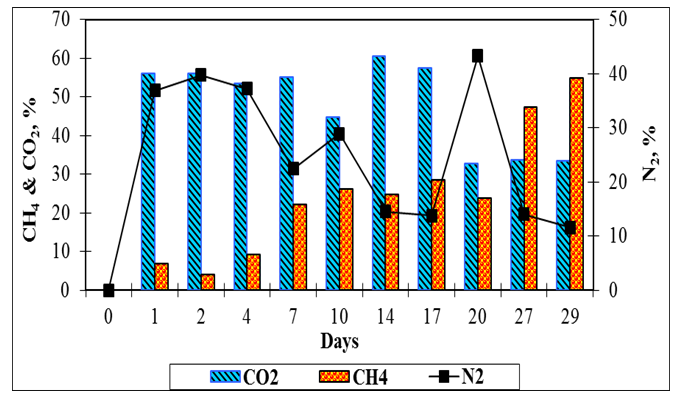 | Figure 2. Composition of biogas (CH₄, CO₂, and N₂) produced during thermophilic fermentation of farm poultry dung (FPD) in the control variant (sample №1) |
 | Figure 3. Contents of CH₄, CO₂, and N₂ in the biogas produced during thermophilic fermentation of farm poultry dung (FPD) supplemented with 10% BTMMA inoculum (sample №2) |
 | Figure 4. Contents of CH₄, CO₂, and N₂ in the biogas produced during thermophilic fermentation of farm poultry dung (FPD) supplemented with 20% BTMMA inoculum (sample №3) |
Analysis of methane-formation patterns revealed that in trial variant №2, enriched with a 10% BTMMA inoculum, two distinct peaks of intensive methanogenesis were observed—unlike the control sample. These peaks occurred on the 4th and 20th days of fermentation, reaching methane concentrations of 54.1% and 69.7%, respectively (Figure 3). In sample №3, supplemented with 20% inoculum, three pronounced methane-formation peaks were detected, appearing on the 4th, 10th, and 29th days of the process. Methane contents during these peaks amounted to 55.5%, 64.7%, and 58.7%, respectively (Figure 4). It was also determined that at the onset of fermentation, both in the control and inoculated variants, CO₂ and N₂ were present at relatively high concentrations. An important observation is that periods of intensive total biogas production did not coincide with the phases of maximum methane formation. This indicates that methane generation follows a metabolic sequence distinct from the formation of other gaseous intermediates. As reported in earlier studies [6,9,16], during the development of primary and acetogenic microflora, degradation of organic intermediates such as formate, acetate, lactate, butyrate, methanol, and ethanol results in the production of several gaseous compounds including CO₂, CO, H₂, and N₂. Many of these serve as essential precursors for methanogenesis. Since methane formation represents the terminal stage of anaerobic digestion, the rate and magnitude of methane production depend not only on the activity of methanogenic archaea themselves but also on the preceding microbial groups that supply the necessary substrates [2]. The elevated CO₂ levels observed during the initial stage of FPD fermentation, followed by subsequent increases in methane, confirm that CH₄ generation constitutes the final step in the breakdown of organic matter (Figures 2, 3, and 4). A clear correlation was observed between decreasing CO₂ concentrations and increasing methane levels during thermophilic fermentation. This suggests that CO₂ may serve as one of the key precursors for methane formation under these conditions. The progressive reduction of CO₂ concurrent with rising CH₄ production reflects the transition from acetogenic to methanogenic stages of the process. Our results further demonstrated that nitrogen transformations within the biogas system were linked to methanogenic activity. In the inoculated variants containing 10% and 20% BTMMA, the highest levels of nitrogen release in the gas phase coincided with the periods of maximum methane formation—on the 20th and 10th days of fermentation, respectively (Figures 3 and 4). It is well established that methanogens utilize ammonia nitrogen and certain amino acids as nitrogen sources, and nitrogen-fixing capabilities have been described for several methanogenic species [5]. Therefore, it is plausible that under thermophilic conditions, molecular nitrogen may become a more accessible nitrogen source due to the intensified activity of primary and acetogenic microbial groups.Earlier studies conducted under mesophilic conditions demonstrated that methane production in FPD proceeds with a considerably prolonged lag-phase, both with and without the addition of 20% inoculum of a balanced methanogenic microbial association (BMMA) [13]. This underscores the advantages of thermophilic digestion, which provides not only faster microbial activation but also more efficient methane generation.Table 1. Abundance of major physiological groups of microorganisms in initial and fermented farm poultry dung (FPD)
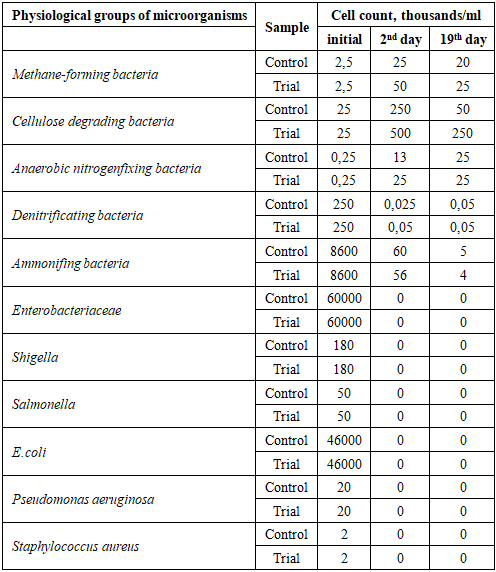 |
| |
|
Studies conducted under mesophilic conditions demonstrated that during the fermentation of FPD by the native microbial consortium, the maximum methane concentration did not exceed 31.5%. When 20% BMMA inoculum was added, methane production improved, with a peak of 42.5% recorded on the 15th day of fermentation. In contrast, thermophilic fermentation displayed markedly different behavior. With the addition of 20% BTMMA inoculum, intensive methane formation began almost immediately, and by the second day of the process, methane content already exceeded 56%. This rapid onset highlights the strong physiological adaptability and activity of thermophilic methanogenic consortia compared with mesophilic ones.It is well known that large commercial poultry farms routinely apply broad-spectrum antibiotics for disease prevention and growth regulation [8,11]. In addition, various chemical disinfectants are used to sanitize facilities, and residues of these compounds inevitably enter the waste stream, including poultry dung. Evidently, in mesophilic fermentation of FPD unlike the fermentation of housekeeping chicken manure (HChM) the observed delay in gas production by both uninoculated and BMMA-inoculated microbial communities is likely associated with the inhibitory effects of antibiotics and disinfectants. These substances negatively influence hydrolytic microorganisms that initiate the first stage of anaerobic degradation of suspended and solid organic matter. According to Vavilina et al. [15], hydrolysis often represents the rate-limiting stage of anaerobic digestion. Therefore, suppressed activity of hydrolytic and primary microflora leads to delayed formation of substrates required by methanogenic archaea, ultimately reducing methane yield. Previous studies have shown that in mesophilic fermentation of HChM, methane production begins only after a prolonged lag-phase, and even with the addition of BMMA, significant methane levels (55.2%) were not achieved until the 11th day of fermentation. Comparative analysis of FPD and HChM fermentation kinetics demonstrated that while the addition of 20% BMMA stimulated methane formation in HChM, the same inoculum had a considerably weaker effect on FPD. This discrepancy is most likely explained by the fact that industrial poultry waste contains higher concentrations of antibiotic and disinfectant residues compared with manure from small household farms. Chlorinated disinfectants, for example, are known to disrupt bacterial cell membranes, cause leakage of essential intracellular components, alter the structural integrity of spores, and impair enzyme systems. Antibiotic residues further inhibit the growth and metabolic activity of primary and acidogenic microorganisms that supply crucial intermediates for methanogenesis. During anaerobic digestion, primary microflora produce essential metabolites such as H₂, CO₂, CO, acetate, formate, butyrate, propionate, ethanol, and methanol [4,6,9,16]. Under mesophilic conditions (≈30°C), low methane accumulation in FPD both with and without BMMA inoculation—has been attributed to delayed development of these initial microbial groups [1]. Thermophilic fermentation at 55 °C, however, changes this dynamic. The metabolic activity within the fermentation system generates additional heat, which accelerates the degradation of antibiotic molecules. It is well established that many antibiotics lose biological activity when exposed to elevated temperatures. Therefore, under thermophilic conditions, the inhibitory impact of antibiotic residues on hydrolytic and acetogenic microflora becomes minimal. This facilitates a more rapid formation of substrates necessary for the growth and function of methane-producing archaea.Thus, our results show that the delays observed in methane production during mesophilic fermentation of FPD both with natural microflora and with the addition of BMMA are primarily caused by the inhibitory effects of antibiotics and disinfectants on hydrolytic and acetogenic microorganisms. Under thermophilic conditions, which accelerate antibiotic degradation, these inhibitory effects are greatly reduced, enabling faster and more efficient methane formation when using BTMMA.
ACKNOWLEDGEMENTS
The author gratefully acknowledges “Alchazorlik Azizbek yerlari” farm in Baliqchi District and “ORZU niholi baraka” farm in Oltinko‘l District, Andijan Region, Uzbekistan, for their assistance and cooperation during the research.
Author Contributions
S.I. Khusanov: Conceptualization, methodology, investigation, data curation, formal analysis, visualization, writing—original draft, and writing—review and editing. The author has read and approved the final version of the manuscript.
Conflicts of Interest
The author declares no financial or personal conflicts of interest that could have influenced the research reported in this manuscript.
References
| [1] | Bi S, Qiao W, Xiong L, Ricci M, Adani F, Dong R. Effects of organic loading rate on anaerobic digestion of chicken manure under mesophilic and thermophilic conditions. Renewable Energy. 2019; 139: 242–250. doi: 10.1016/j.renene.2019.02.083. |
| [2] | Bi S, Westerholm M, Qiao W, Mahdy A, Xiong L, Yin D, et al. Enhanced methanogenic performance and metabolic pathway of high solid anaerobic digestion of chicken manure by Fe²⁺ and Ni²⁺ supplementation. Waste Management. 2019; 94: 10–17. doi: 10.1016/j.wasman.2019.05.036. |
| [3] | He L, Li L, Li Y, Wang C, Sun Y. Bioaugmentation with methanogenic culture to improve methane production from chicken manure in batch anaerobic digestion. Chemosphere. 2022; 303: 135127. doi: 10.1016/j.chemosphere.2022.135127. |
| [4] | Jurgutis L, Slepetiene A, Volungevicius J, Amaleviciute-Volunge K. Biogas production from chicken manure at different organic loading rates in a mesophilic full scale anaerobic digestion plant. Biomass and Bioenergy. 2020; 141: 105693. doi: 10.1016/j.biombioe.2020.105693. |
| [5] | Li Y, Wang C, Xu X, Sun Y, Xing T. Bioaugmentation with a propionate-degrading methanogenic culture to improve methane production from chicken manure. Bioresource Technology. 2022; 346: 126607. doi: 10.1016/j.biortech.2021.126607. |
| [6] | Arriagada CB, Sanhueza PF, Guzmán-Fierro VG, Medina TI, Fernández KF, Roeckel MD. Efficient poultry manure management: Anaerobic digestion with short hydraulic retention time to achieve high methane production. Poultry Science. 2019; 98(12): 6636–6643. doi: 10.3382/ps/pez516. |
| [7] | Wang F, Pei M, Qiu L, Yao Y, Zhang C, Qiang H. Performance of anaerobic digestion of chicken manure under gradually elevated organic loading rates. International Journal of Environmental Research and Public Health. 2019; 16(12): 2239. doi: 10.3390/ijerph16122239. doi.org |
| [8] | Fuchs W, Wang X, Gabauer W, Ortner M, Li Z. Tackling ammonia inhibition for efficient biogas production from chicken manure: Status and technical trends in Europe and China. Renewable and Sustainable Energy Reviews. 2018; 97: 186–199. doi: 10.1016/j.rser.2018.08.038. |
| [9] | Shapovalov Y, Zhadan S, Bochmann G, Salyuk A, Nykyforov V. Dry anaerobic digestion of chicken manure: A review. Applied Sciences. 2020; 10(21): 7825. doi: 10.3390/app10217825. |
| [10] | Song Y, Qiao W, Zhang J, Dong R. Process performance and functional microbial community in the anaerobic digestion of chicken manure: A review. Energies. 2023; 16(12): 4675. doi: 10.3390/en16124675. doi.org |
| [11] | Tawfik A, Eraky M, Osman AI, Ai P, Zhou Z, Meng F, Rooney DW. Bioenergy production from chicken manure: A review. Environmental Chemistry Letters. 2023; 21: 2707–2727. doi: 10.1007/s10311-023-01618-x. |
| [12] | Manogaran MD, Shamsuddin R, Mohd Yusoff MH, Lay M, Siyal AA. A review on treatment processes of chicken manure. Cleaner and Circular Bioeconomy. 2022; 2: 100013. doi: 10.1016/j.clcb.2022.100013. |
| [13] | Jiang Y, McAdam E, Zhang Y, Heaven S, Banks C, Longhurst P. Ammonia inhibition and toxicity in anaerobic digestion: A critical review. Journal of Water Process Engineering. 2019; 32: 100899. doi: 10.1016/j.jwpe.2019.100899. |
| [14] | Plugge CM. Biogas. Microbial Biotechnology. 2017; 10(5): 1128–1130. doi: 10.1111/1751-7915.12854. |
| [15] | Holliger C, Alves M, Andrade D, Angelidaki I, Astals S, Baier U, et al. Towards a standardization of biomethane potential tests. Water Science and Technology. 2016; 74(11): 2515–2522. doi: 10.2166/wst.2016.336. |
| [16] | Holliger C, Astals S, de Laclos HF, Hafner SD, Koch K, Weinrich S. Towards a standardization of biomethane potential tests: A commentary. Water Science and Technology. 2021; 83(1): 247–250. doi: 10.2166/wst.2020.569. |


 Abstract
 Reference
 Full-Text PDF
 Full-text HTML