Kobil Djurakulov
Department of Biotechnology, Samarkand State University of Veterinary Medicine, Livestock and Biotechnologies, Samarkand, Uzbekistan
Correspondence to: Kobil Djurakulov, Department of Biotechnology, Samarkand State University of Veterinary Medicine, Livestock and Biotechnologies, Samarkand, Uzbekistan.
Copyright © 2026 The Author(s). Published by Scientific & Academic Publishing.
This work is licensed under the Creative Commons Attribution International License (CC BY).
http://creativecommons.org/licenses/by/4.0/

Abstract
This study evaluated the effects of four soil-moisture levels (70, 60, 50, and 40% of field capacity) on grain protein, starch, and wet-gluten contents in six wheat varieties: Istiqbolli, Leukurum-3, Javoxir, Makuz-3, Istiqlol-25, and Istiqlol. Protein and starch were expressed on a dry-matter basis, while wet gluten was reported as a percentage of the ground-grain test portion. As soil moisture decreased, protein content increased in all varieties, whereas starch and wet-gluten contents declined. Istiqlol-25 showed the largest increase in protein content, from 15.4 to 18.9%. Leukurum-3 showed the largest decrease in starch content, from 57.9 to 49.4%, while Javoxir had the smallest decrease in wet gluten, from 32.8 to 31.2%. These differences show that the grain-quality indicators of the studied varieties responded differently to decreasing soil moisture.
Keywords:
Wheat, Seeding rate and time, Growth dynamics, Yield
Cite this paper: Kobil Djurakulov, Analysis of Biochemical Indicators and Dynamics of Grain Quality in Wheat Varieties Under Different Moisture Conditions, International Journal of Genetic Engineering, Vol. 14 No. 10, 2026, pp. 306-309. doi: 10.5923/j.ijge.20261410.08.
1. Introduction
With the world population continuing to grow and global climate change accelerating, ensuring food security is one of humanity's highest-priority challenges. Wheat (Triticum spp.) is one of the planet's most important food crops, occupying a leading place in the daily diet of millions of people. The biological and nutritional value of wheat grain is determined by its content of proteins, carbohydrates (particularly starch), gluten, minerals, and vitamins, as well as their balanced ratios [2,4]. Therefore, along with increasing wheat yield, maintaining and improving its quality is a requirement of the times.In recent years, the threat of water shortages and drought has been increasing in Central Asia, particularly in Uzbekistan. Water stress has a significant impact on the physiological and biochemical processes of plants. Under conditions of water stress, wheat plants undergo profound changes in photosynthesis, nutrient absorption, translocation, and accumulation in the grain. This directly impacts the formation of important biochemical components of the grain, such as protein, starch, and gluten. Recent evidence confirms that drought affects not only wheat productivity but also grain composition. A meta-analysis of 48 datasets showed that drought increased grain protein concentration by approximately 9.4%, although its magnitude depended on drought type and environmental conditions [11]. Water deficit can also modify the accumulation and structural organization of wheat storage proteins, thereby influencing gluten properties and end-use quality [12].Recent studies have also shown that the response of wheat grain quality to drought is strongly genotype-dependent. Considerable variation has been reported among wheat lines in protein accumulation, gluten-related characteristics, and technological quality under water-deficit conditions [13]. Drought during grain filling may additionally alter starch deposition and the balance between carbohydrate and protein fractions in the developing grain [14]. These findings indicate that general drought-response patterns cannot be directly extrapolated to individual cultivars. In Uzbekistan, earlier studies have examined the yield response and agrotechnical characteristics of local wheat varieties, as well as water-exchange traits in local durum wheat [7–10]. However, comparative information on changes in protein, starch, and gluten contents across a controlled soil-moisture gradient remains limited. Therefore, evaluating cultivar-specific biochemical responses under decreasing water availability is important for identifying varieties that maintain desirable grain-quality characteristics under moisture stress.The main objective of this study was to determine changes in the biochemical composition of grain from local wheat varieties grown at different soil moisture levels (70, 60, 50, and 40% of field capacity, FC) and to evaluate cultivar-specific responses to decreasing water availability based on grain protein, starch, and gluten contents.
2. Materials and Methods
The research was conducted in the field and laboratory, following the field-research and biochemical-analysis protocols documented in [1]. Six wheat varieties widely planted and recognised as promising in the Republic were selected for the study: Istiqbolli, Leukurum-3, Javoxir, Makuz-3, Istiqlol-25, and Istiqlol. Leukurum-3 was included to compare its grain-quality response to changing soil-moisture conditions with the responses of the other selected varieties.The experiment was conducted under four soil-moisture regimes—70, 60, 50, and 40% of field capacity (FC)—to compare the biochemical responses of the six wheat varieties to decreasing water availability.Grain nitrogen was determined by the Kjeldahl method, and total protein content was calculated as nitrogen content multiplied by 5.7, as specified for wheat in GOST 10846-91 [5]. Starch content was determined by the polarimetric Aers method. The quantity and quality of wet gluten were assessed separately according to GOST 13586.1-68 [6]; wet-gluten content was not calculated from total protein. Gliadin and glutenin were not quantified separately. Protein and starch contents are reported as percentages of grain dry matter, whereas wet-gluten content is expressed as a percentage of the ground-grain test portion. The results were processed as M ± m [3].
3. Results and Discussion
The results showed that soil moisture level affected the biochemical composition of grain in all wheat varieties studied. As soil moisture decreased from 70 to 40% FC, protein content increased, whereas starch and gluten contents decreased. The magnitude of these changes varied among the varieties.To evaluate changes in grain biochemical composition, protein, starch, and gluten contents were compared at four soil moisture levels: 70, 60, 50, and 40% FC. The results are presented in Figure 1.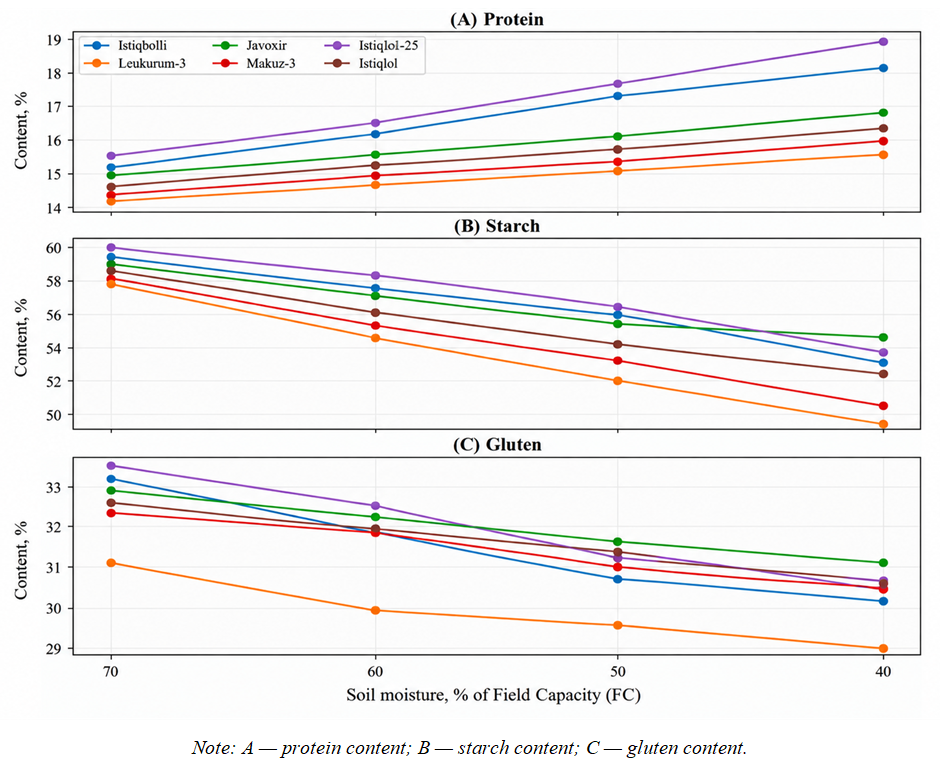 | Figure 1. Changes in protein, starch, and gluten contents in wheat grain at different soil moisture levels (% of field capacity, FC) |
As shown in Figure 1A, protein content increased consistently in all varieties as soil moisture decreased. At 70% FC, protein content ranged from 14.2 to 15.4%, whereas at 40% FC it increased to 15.4–18.9%.The most pronounced increase was observed in Istiqlol-25, in which protein content increased from 15.4% at 70% FC to 16.3% at 60% FC, 17.6% at 50% FC, and 18.9% at 40% FC, corresponding to an increase of 3.5 percentage points. In Istiqbolli, protein content increased from 15.0 to 18.1%. The corresponding increases were from 14.8 to 16.7% in Javoxir, from 14.3 to 15.8% in Makuz-3, and from 14.5 to 16.2% in Istiqlol. Leukurum-3 had the lowest protein content at 70% FC (14.2%) and showed the smallest increase, reaching 15.4% at 40% FC. It also had the lowest initial starch (57.9%) and wet-gluten (31.08%) values, providing a contrasting biochemical profile for comparison with the other varieties. Thus, the highest protein contents at 40% FC were recorded in Istiqlol-25 (18.9%) and Istiqbolli (18.1%).In contrast to protein, starch content showed the opposite trend (Figure 1B). At 70% FC, starch content ranged from 57.9 to 60.0%, whereas at 40% FC it decreased to 49.4–54.7%.In Istiqbolli, starch content decreased from 59.4% at 70% FC to 57.4% at 60% FC, 55.8% at 50% FC, and 53.4% at 40% FC. The largest decrease was observed in Leukurum-3, from 57.9 to 49.4%, corresponding to 8.5 percentage points. Starch content decreased from 59.0 to 54.7% in Javoxir, from 58.2 to 50.7% in Makuz-3, from 60.0 to 54.0% in Istiqlol-25, and from 58.6 to 52.8% in Istiqlol.Gluten content also varied with soil moisture level (Figure 1C). At 70% FC, gluten content ranged from 31.08 to 33.5%, whereas at 40% FC it decreased to 29.2–31.2%.In Istiqbolli, gluten content decreased from 33.1 to 30.4%; in Leukurum-3, from 31.08 to 29.2%; in Javoxir, from 32.8 to 31.2%; and in Makuz-3, from 32.3 to 30.6%. In Istiqlol-25, gluten content decreased from 33.5 to 30.7%, whereas in Istiqlol it decreased from 32.5 to 30.5%.Consequently, a decrease in water availability led to a decrease in gluten content in all studied varieties. However, the absolute magnitude of the change varied between varieties. The smallest decrease was observed in Javoxir —1.6 percentage points—while in Istiqbolli it was 2.7 percentage points.Analysis of the dynamics of three key biochemical parameters shows opposite changes in protein and starch content with decreasing soil moisture. An increase in protein content was accompanied by a decrease in starch content. A similar response has recently been reported under drought stress during grain filling, where reduced starch accumulation was accompanied by changes in protein accumulation and composition [14]. This response may reflect restricted carbohydrate deposition under water deficit, which alters the relative contribution of protein and starch to grain dry matter. At the same time, wet-gluten content decreased despite the increase in total protein content. These are distinct measurements: total protein was determined using the Kjeldahl method, whereas wet-gluten quantity was measured separately according to the GOST procedure [6]. Therefore, an increase in total protein does not necessarily correspond to an increase in wet-gluten content. Liu et al. [12] reported changes in wheat storage-protein synthesis and gluten structure under water-deficit conditions, while Lan et al. [13] showed that drought effects on protein concentration and gluten strength varied among wheat genotypes. In the present study, gliadin and glutenin fractions were not measured separately; therefore, the observed decrease in wet gluten cannot be attributed to a specific protein fraction. The varietal differences are consistent with reported genotype-dependent responses of wheat grain quality to drought [13]. Protein content increased most in Istiqlol-25 and Istiqbolli, starch content decreased most in Leukurum-3, and Javoxir showed the smallest decrease in gluten content between 70 and 40% FC.A comparison of the relative changes further illustrates the cultivar-specific nature of the response. Between 70 and 40% FC, protein content increased by approximately 22.7% in Istiqlol-25 and 20.7% in Istiqbolli, whereas the corresponding increases in Javoxir, Istiqlol, Makuz-3, and Leukurum-3 were about 12.8, 11.7, 10.5, and 8.5%, respectively. In contrast, starch content decreased most strongly in Leukurum-3 (approximately 14.7%) and Makuz-3 (12.9%), while the reduction in Javoxir was comparatively smaller (about 7.3%). Gluten content also declined, but the relative decrease was less pronounced than that observed for starch, ranging from approximately 4.9% in Javoxir to 8.4% in Istiqlol-25. Protein and starch percentages indicate their amounts per 100 g of dry grain, but grain mass and yield were not reported, so absolute amounts per grain or per unit area cannot be determined. Wet gluten is a hydrated fraction measured separately and cannot be added to protein and starch in a dry-matter balance. Thus, the percentage changes do not demonstrate that the decrease in starch mass was compensated by an increase in protein mass.The observed dynamics of biochemical components may be associated with changes in grain formation and filling under moisture stress. Reduced water availability can restrict photosynthetic activity and assimilate transport to developing grains, thereby limiting carbohydrate deposition. Since starch constitutes the major fraction of wheat grain dry matter, reduced starch accumulation may increase the relative proportion of nitrogen-containing compounds and contribute to the observed rise in total protein concentration. However, the simultaneous decline in wet gluten indicates that an increase in total protein does not necessarily correspond to an increase in gluten quantity. This may reflect changes in the relative proportions and accumulation of individual protein fractions under drought conditions, as also suggested in previous studies [12,13]. The magnitude of these responses is therefore likely to depend on both the intensity of water deficit and the genetic characteristics of individual cultivars.Thus, the results indicate that decreasing soil moisture from 70 to 40% FC was associated with increased grain protein content and decreased starch and gluten contents. The magnitude of these responses varied among the wheat varieties studied.
4. Conclusions
A decrease in soil moisture from 70 to 40% FC was accompanied by an increase in grain protein content and decreases in starch and gluten contents in all wheat varieties studied. At 40% FC, the highest protein contents were recorded in Istiqlol-25 (18.9%) and Istiqbolli (18.1%). The largest decrease in starch content was observed in Leukurum-3, reaching 49.4% at 40% FC. The magnitude of the biochemical response to decreasing soil moisture varied among varieties, indicating cultivar-specific differences in grain quality formation under water-deficit conditions.
ACKNOWLEDGEMENTS
The author expresses sincere gratitude to the administration of Samarkand State University of Veterinary Medicine, Livestock and Biotechnology for their support and for providing the necessary conditions for conducting the field and laboratory studies.
DISCLOSURE
The author declares that there is no conflict of interest regarding the publication of this paper. No specific funding was received for this research from public, commercial, or non-profit funding agencies.
References
| [1] | Ministry of Agriculture of the Republic of Uzbekistan, Field Research Data and Biochemical Analysis Protocols. Tashkent, Uzbekistan, 2025. |
| [2] | H. N. Atabaeva and T. H. Masudov, Osnovy rastenievodstva i biokhimii [Fundamentals of Crop Production and Biochemistry]. Tashkent, Uzbekistan: Mekhnat, 2018, 248 p. (in Russian). |
| [3] | B. A. Dospekhov, Metodika polevogo opyta (s osnovami statisticheskoi obrabotki rezultatov issledovanii) [Methods of Field Experimentation with the Fundamentals of Statistical Processing of Research Results]. Moscow, Russia: Alyans, 2011, 352 p. (in Russian). |
| [4] | E. D. Kazakov and G. P. Karpilenko, Biokhimiya zerna i khleboproduktov [Biochemistry of Grain and Bakery Products]. St. Petersburg, Russia: Giord, 2005, 512 p. (in Russian). |
| [5] | GOST 10846-91, Zerno i produkty ego pererabotki. Metod opredeleniya belka [Grain and Products of Its Processing. Method for Determination of Protein]. (in Russian). |
| [6] | GOST 13586.1-68, Zerno. Metody opredeleniya kolichestva i kachestva kleikoviny v pshenitse [Grain. Methods for Determining the Quantity and Quality of Gluten in Wheat]. (in Russian). |
| [7] | N. Khodjayeva, I. Urazbaev, T. Sayidkhonov, and Z. Ruzikulova, “Influence of some agro-technical measures on the yield of wheat of local variety ‘Istiklol 25’ native to Uzbekistan,” IOP Conf. Ser.: Earth Environ. Sci., vol. 1068, no. 1, p. 012011, Jul. 2022. |
| [8] | N. D. Khojaeva, I. U. Urazbaev, Z. U. Ruzikulova, and U. L. Gaziev, “Some agrotechnical properties of local durum wheat variety Istiklol,” Annals of the Romanian Society for Cell Biology, vol. 25, no. 4, 2021. |
| [9] | N. Khodjaeva, K. Dzhurakulov, A. Nurniyazov, and Sh. Shernazarov, “Vodoobmen nekotorykh mestnykh sortov tverdoi pshenitsy” [Water exchange of some local durum wheat varieties], in Proc. World Science: Problems and Innovations, 2016, pp. 131–134. (in Russian). |
| [10] | N. Khodjaeva, T. Saiidkhanov, S. Khamrakulov, and D. Faizieva, “Nekotorye fiziologicheskie pokazateli vodnogo obmena ozimoi tverdoi pshenitsy” [Some physiological indicators of water exchange in winter durum wheat], in Proc. Advanced Science, 2018, pp. 129–132. (in Russian). |
| [11] | C. Wan, P. Dang, L. Gao, J. Wang, J. Tao, X. Qin, B. Feng, and J. Gao, “How does the environment affect wheat yield and protein content response to drought? A meta-analysis,” Frontiers in Plant Science, vol. 13, Art. no. 896985, 2022, doi: 10.3389/fpls.2022.896985. |
| [12] | J. Liu, J. Zhang, G. Zhu, D. Zhu, and Y. Yan, “Effects of water deficit and high N fertilization on wheat storage protein synthesis, gluten secondary structure, and breadmaking quality,” The Crop Journal, vol. 10, no. 1, pp. 216–223, 2022, doi: 10.1016/j.cj.2021.04.006. |
| [13] | Y. Lan, R. Kuktaite, A. Chawade, and E. Johansson, “Diverse wheat lines to mitigate the effect of drought on end-use quality,” Frontiers in Food Science and Technology, vol. 3, Art. no. 1163412, 2023, doi: 10.3389/frfst.2023.1163412. |
| [14] | L. Li, Z. Mao, P. Wang, J. Cai, Q. Zhou, Y. Zhong, D. Jiang, and X. Wang, “Drought priming enhances wheat grain starch and protein quality under drought stress during grain filling,” Journal of Integrative Agriculture, vol. 24, no. 8, pp. 2888–2901, 2025, doi: 10.1016/j.jia.2024.05.008. |


 Abstract
 Reference
 Full-Text PDF
 Full-text HTML