
-
Paper Information
- Paper Submission
-
Journal Information
- About This Journal
- Editorial Board
- Current Issue
- Archive
- Author Guidelines
- Contact Us
International Journal of Genetic Engineering
p-ISSN: 2167-7239 e-ISSN: 2167-7220
2026; 14(10): 299-305
doi:10.5923/j.ijge.20261410.07
Received: Oct. 5; Accepted: Oct. 22, 2026; Published: Oct. 27, 2026

Particle-Size Distribution of Light Sierozem Soils in Guzar District, Kashkadarya Province, Uzbekistan
 Abstract
 Reference
 Full-Text PDF
 Full-text HTML
Yulduz Usmanova, Lazizaxon Gafurova, Olimaxon Ergasheva
National University of Uzbekistan, Tashkent, Uzbekistan
Correspondence to: Yulduz Usmanova, National University of Uzbekistan, Tashkent, Uzbekistan.
| Email: |  |
Copyright © 2026 The Author(s). Published by Scientific & Academic Publishing.
This work is licensed under the Creative Commons Attribution International License (CC BY).
http://creativecommons.org/licenses/by/4.0/

Soil particle-size distribution is an important soil property that influences soil physical characteristics, particularly in arid regions. This study characterized the particle-size distribution of light Sierozem soils in the territory of the Shurtan Gas Chemical Complex in Guzar District, Kashkadarya Province, Uzbekistan. Soil samples were collected from five soil profiles within a 1 ha Paulownia plantation, with profile depths ranging from 115 to 125 cm. Particle-size fractions were determined using the Kachinsky pipette method, as reported by the laboratory. The 0.05-0.01 mm fraction predominated across the sampled profiles and depths, with values ranging from 39.1 to 60.7%. The physical clay content, defined as the sum of particles smaller than 0.01 mm, ranged from 18.5% to 31.65%. The results revealed differences in the vertical distribution of particle-size fractions among profiles, particularly for the coarser fractions, whereas the predominant fraction showed comparatively consistent mean contents across profiles. The findings provide baseline information on the vertical distribution of particle-size fractions within the studied 1 ha Paulownia plantation and can support further investigations of soil physical properties and sustainable land management under arid conditions.
Keywords: Light sierozem soils, Particle-size distribution, Granulometric composition, Physical clay, Soil profile, Paulownia, Arid region
Cite this paper: Yulduz Usmanova, Lazizaxon Gafurova, Olimaxon Ergasheva, Particle-Size Distribution of Light Sierozem Soils in Guzar District, Kashkadarya Province, Uzbekistan, International Journal of Genetic Engineering, Vol. 14 No. 10, 2026, pp. 299-305. doi: 10.5923/j.ijge.20261410.07.
1. Introduction
- Land degradation and increasing desertification across regions, together with declines in soil fertility, have become pressing issues under current global climate change. Each year, an estimated 12 million hectares of land lose productivity due to desertification and drought, and more than 1 billion people in approximately 100 countries face threats to their livelihoods from land degradation and desertification (GEF, 2024). Drought is a major factor affecting global food and water security, influencing agricultural production and the availability of food and water supplies. Drylands particularly arid and desert regions are especially vulnerable to desertification, land degradation, and drought; they occupy 41% of the Earth’s land surface. The population living in drylands is projected to increase from 2.7 billion in 2010 to 4.0 billion by 2050, a 43% rise, further intensifying pressure on these ecosystems [12]. According to FAO reports (FAO, 2025), improper land use and climate change are intensifying soil degradation, salinization, and compaction particularly in arid regions [7]. Therefore, investigating the granulometric composition of light Sierozem soils is of crucial scientific and practical importance for maintaining soil fertility and enhancing sustainable land‑resource management. Furthermore, the FAO Global Soils Partnership (FAO, 2024) emphasizes the importance of soil monitoring systems, standardized soil analysis, and harmonized soil databases for effective land resource management and prevention of soil degradation [6]. Recent investigations (Aquino et al., 2024) of Central Asian loess deposits have demonstrated that parent materials strongly influence the physical and geochemical properties of soils, emphasizing the importance of studying granulometric composition in arid environments [1]. Recent reviews (Juliev et al., 2024) indicate that soil degradation, erosion, and desertification remain among the major environmental challenges threatening soil fertility and sustainable agriculture in Central Asia [17]. Furthermore, a regional analysis of long-term climatic data (Usmanova & Ergasheva, 2026b) for Guzar District reported increasing air temperatures and changes in precipitation patterns, highlighting the importance of understanding soil characteristics under arid climatic conditions [27]. In Uzbekistan and Central Asia regions, particularly in light Sierozem soils, the reserves of soil organic carbon and humus content are closely associated with the geomorphological characteristics of the area, erosion processes, and agricultural practices (Usmanova & Ergasheva, 2026a) [26]. Soil fertility refers to the inherent capacity of soil supply plants with essential nutrients, water, and air. Soils consist of particles of varying sizes, and the relative proportions of these mineral size fractions are referred to as the granulometric composition of the soil (El-Anwar et al., 2019; Makhkamova, 2020) [4,22]. Recent studies (Songulov et al., 2025) conducted in Kazakhstan demonstrated that irrigation modifies not only the mineralogical composition but also the fine-dispersed fractions of Sierozem soils, thereby affecting their physical properties and long-term agricultural productivity [24]. Soil degradation caused by erosion alters soil structure, decreases humus content, and negatively influences the stability of soil aggregates. These changes are closely related to soil granulometric characteristics, which determine soil resistance to degradation processes (Gafurova & Ergasheva, 2020; Gafurova et al., 2024) emphasized that regular soil monitoring and analysis of soil properties are essential for maintaining soil fertility and sustainable land use [9,10]. All soil properties participate in soil fertility, ranging from the granulometric composition and physical properties of soils to their biological characteristics. Organic matter and the biological activity associated with it have a significant influence on the physical and chemical properties of soils (Gafurova & Ergasheva, 2020; Gafurova N., et al., 2024; Gafurova et al., 2025) [8,10,11]. Soil granulometric composition, refers to the distribution of soil particles according to their size. The proportion of sand, silt, and clay fractions in the soil determines its water permeability, water-holding capacity, and physical properties. Soils with a finer (heavy) granulometric composition retain more water but have lower permeability, whereas coarser (light) soils allow water to pass through more rapidly (Duchaufour, 1982) [3]. Recent studies (Jabbarov et al., 2025) in arid regions of Central Asia also revealed considerable spatial variability in particle-size distribution and soil physical properties under changing climatic conditions [15]. In recent years, considerable attention has been paid to the study of the granulometric composition of soils in arid and irrigated regions. Modern studies in Soil Science indicate that soil texture is one of the major factors influencing soil fertility, water retention, aeration, and physical stability. The relative proportions of sand, silt, and clay fractions influence important soil physical properties, including water retention, permeability, drainage, and aeration. Soils with a higher proportion of fine particles generally have greater water-holding capacity, whereas coarse-textured soils tend to allow more rapid water movement and drainage. Therefore, characterization of particle-size distribution is important for assessing the physical condition of soils and understanding their potential for agricultural use under arid conditions. A related study in the Shurtan Gas Complex area of Guzar District examined the morphological and agrochemical characteristics of light Sierozem soils (Usmanova et al., 2026). Building on the regional research, the present study specifically investigates the distribution of particle-size fractions across five soil profiles within a 1 ha Paulownia plantation [28].The aim of this study was to determine and characterize the granulometric composition of light Sierozem soils in Guzar District, Kashkadarya Province, Uzbekistan, and to assess the distribution of particle-size fractions as a basic indicator of their physical properties.
2. Material and Methods
- Study area and soil sampling. The study area is located within the territory of the Shurtan Gas Chemical Complex in the Guzar district, Kashkadarya region, Uzbekistan, and is characterized by light Sierozem soils under Paulownia plantations in arid climatic conditions. Soil samples were collected from the study area using a diagonal sampling approach. For soil sampling within the experimental field, five georeferenced sampling points were established: Point 1 (38.448630° N, 65.792159° E; 443 m a.s.l.), Point 2 (38.447898° N, 65.792076° E; 442 m a.s.l.), Point 3 (38.447839° N, 65.792567° E; 444 m a.s.l.), Point 4 (38.448647° N, 65.792707° E; 438 m a.s.l.), and Point 5 (38.448222° N, 65.792377° E; 440 m a.s.l.). Five soil profiles were selected within the study area. Soil samples were collected from the identified genetic horizons, covering depths of 0-125 cm in Profile 1., 0-122 cm in Profile 2., 0-115 cm in Profile 3., 0-120 cm in profile 4., and 0-116 cm in Profile 5 (Figure 2). The total investigated area was 1 ha.
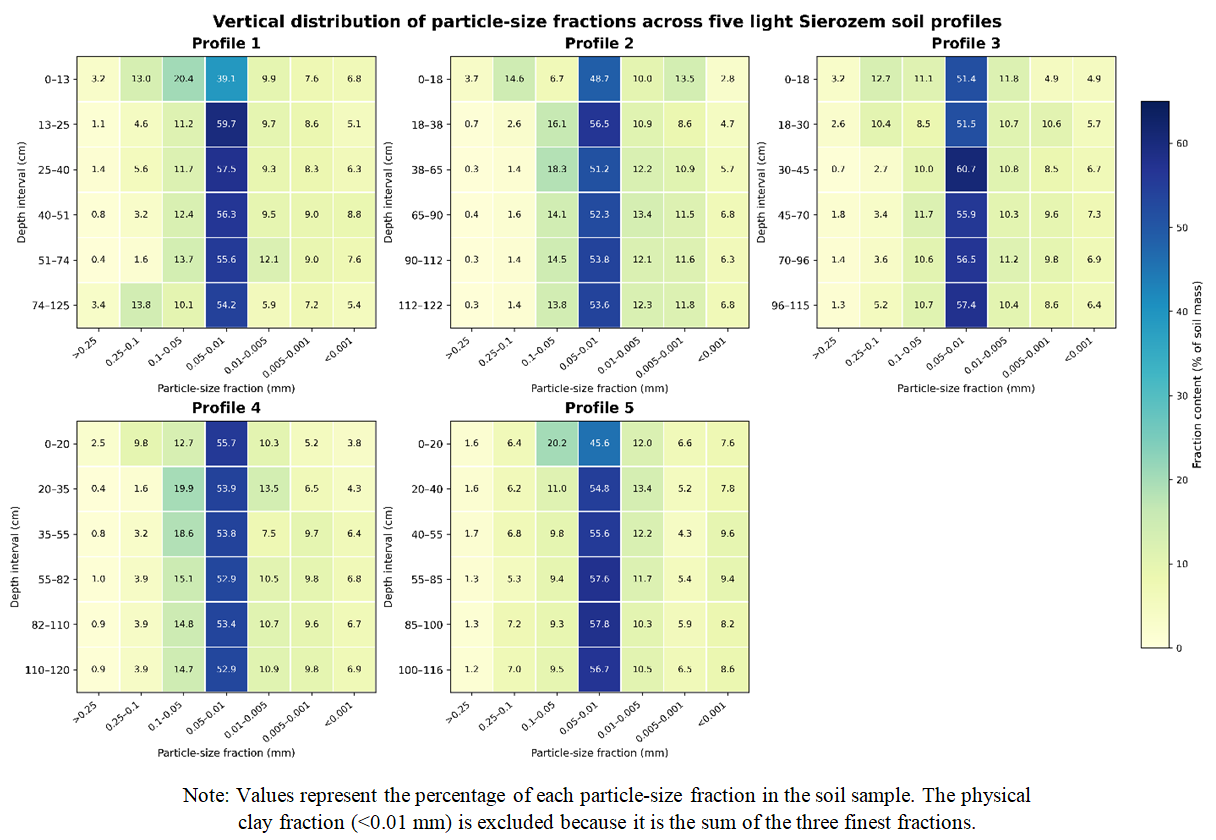 | Figure 1. Vertical distribution of particle-size fractions across five light Sierozem soil profiles |
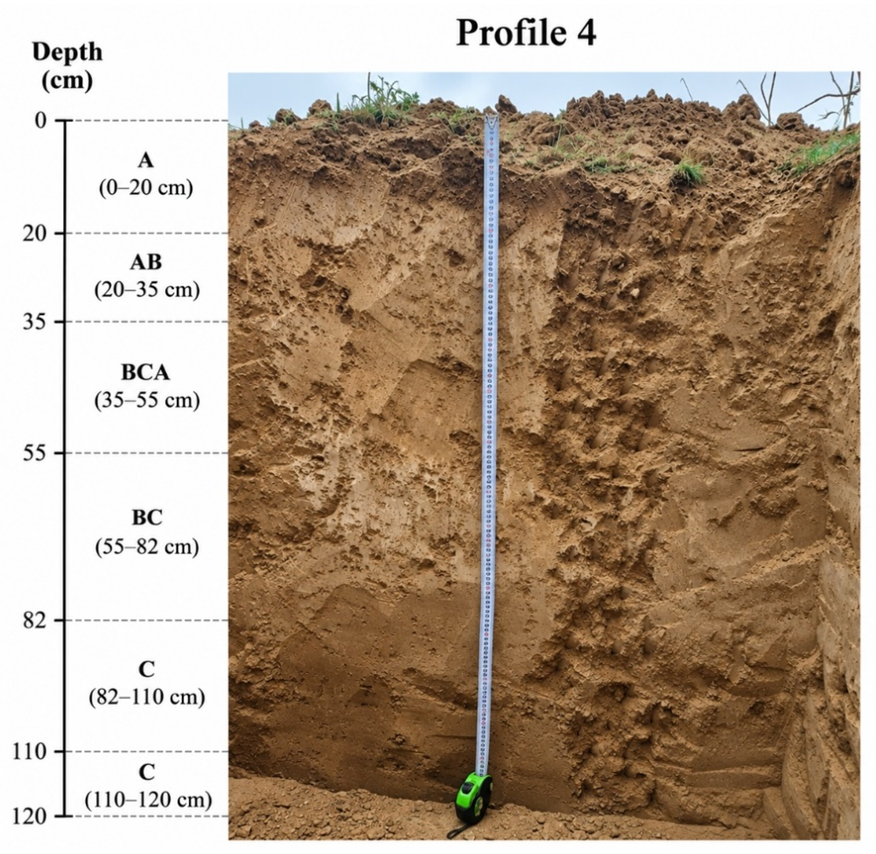 | Figure 2. Field photograph of soil profile 4 showing the six sampling intervals at depths of 0-20, 20-35, 35-55, 55-82, 82-110, and 110-120 cm. Study area in Guzar District, Kashkadarya Province, Uzbekistan (2025) (Source: Photo by Usmanova Y.A., 2025) |
3. Results
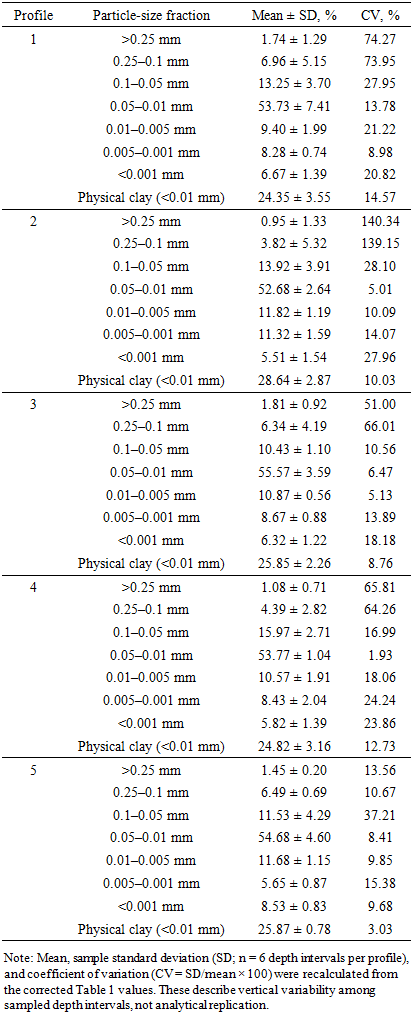
- In the study area, Paulownia seedlings were planted in autumn 2024 (Ergasheva, & Usmanova, 2025), and soil samples were collected to characterize the particle-size distribution of light Sierozem soils under the studied arid conditions [5]. The analysis covered five soil profiles with sampling depths expending to 125 cm. Particle-size distribution across soil profiles. The distribution of particle-size fractions varied among profiles and depth intervals, indicating vertical variability in the granulometric composition of the investigated soils. The 0.05-0.01 mm fraction was predominant particle-size fraction in all profiles. Its content ranged from 39.1 to 60.7%. The minimum value was recorded in Profile 1 at 0-13 cm, whereas the maximum occurred in Profile 3 at 30-45 cm. This fraction remained predominant throughout the sampled depths, although its proportion varied both between profiles and within individual profiles. The results demonstrate that particles within the 0.05-0.01 mm size range represent the principal component of the reported particle-size distribution in the studied light Sierozem soils. The vertical distribution of this fraction differed among profiles. In Profile 1, its content increased from 39.1% at 0-13 cm to 59.7% at 13-25 cm, followed by a gradual decrease to 54.2% at 74-125 cm. In Profile 2, the fraction varied within a narrower range of 48.7-56.5%, with the highest value observed at 18-38 cm. Profile 3 showed values of 51.4-60.7%, including the maximum value recorded in the study. In Profile 4, the fraction was comparatively stable, ranging from 52.9% to 55.7%. In Profile 5, it increased from 45.6% in the upper 0-20 cm layer to 57.8% at 85-100 cm, before decreasing slightly to 56.7% at 100-116 cm. These differences illustrate that the vertical pattern of particle-size distribution was not uniform across the five profiles (Figure 1). The coarser fractions also showed variability with depth. The content of particles larger than 0.25 mm ranged from 0.32% to 3.66% across the dataset. The 0.25-0.1 mm fraction ranged from 1.36% to 14.64%. The relatively high values of these fractions in some surface layers, particularly in Profile 1 and 2, contrasted with their lower values in several deeper layers. However, the magnitude and direction of these changes differed among profiles, indicating that the observed vertical variation cannot be described by a single trend applicable to all sampling locations.Distribution of the physical clay fraction. The reported physical clay content, defined as the sum of particles smaller than 0.01 mm, ranged from 18.5% to 31.65% across the five profiles. The minimum was recorded in Profile 1 at 74-125 cm, whereas the maximum occurred in Profile 2 at 65-90 cm. In Profile 2, physical clay content was 28.8% at 38-65 cm, increased to 31.65% at 65-90 cm, and subsequently varied between 30.0% and 30.9% in the two deeper intervals. This pattern indicates that the highest reported physical clay values in this profile occurred in the lower part of the sampled sequence rather than in the surface layer.These findings are in agreement with Liu et al. (2022), who reported that soil texture is one of the main factors controlling water retention and land management in arid regions of the Syr-Darya River Basin. However, unlike their study, which found no significant relationship between soil texture and salinity, the present study focused primarily on the vertical distribution of granulometric fractions within soil profiles [21]. In Profile 1, physical clay content ranged from 18.5% to 28.7%. It increased from 23.4% at 13-25 cm to 28.7% at 51-74 cm, followed by a decrease to 18.5% at 74-125 cm. Profile 3 showed values between 21.6% and 27.9%, while Profile 4 ranged from 19.3% to 27.6%. In Profile 5, physical clay content was comparatively consistent, ranging from 24.4% to 26.5%. These profile-specific differences highlight the importance of considering both the sampling depth and the individual soil profile when describing particle-size variability. The results are consistent with the findings of Huseynova (2022), who reported that meadow-Sierozem soils are predominantly medium loamy, confirming the dominant role of granulometric composition in determining soil physical properties [13].The physical clay values reported here follow the particle-size classification used in the original laboratory analysis. They should not be directly equated in the USDA soil texture classification because the size thresholds differ. Accordingly, the results are interpreted within the context of the reported particle-size fraction rather than as USDA textural classes. Implication and limitations. Soil particle-size distribution is an important characteristic related to water retention, drainage, permeability, and aeration. Nevertheless, these properties were not directly measured in the present study, and their actual status cannot be established from particle-size data alone. Similarly, the observed differences among profiles and depths intervals may be associated with variations in soil-forming materials and depositional conditions, although these factors were not independently investigated. Therefore, the observed patterns should be interpreted as evidence of vertical and profile-level variability rather than as proof of a particular causal process. Overall, the results show that the 0.05-0.01 mm fraction predominated throughout the investigated profiles, while the physical clay content and coarser particle-size fractions varied among sampling depths. The corrected dataset provides baseline information on the vertical distribution of particle-size fractions in light Sierozem soils within the investigated 1 ha Paulownia plantation in Guzar District, Kashkadarya Province, Uzbekistan. The particle-size distribution varied among the five soil profiles and across the soil sampled depth intervals (Table 1). The highest coefficients of variation were recorded for the >0.25 mm fraction in Profile 2 (CV = 140.34%) and the 0.25 – 0.1 mm fraction in the same sample profile (CV = 139.15%) according to the current statistical table. Their high CV values reflect substantial relative variation among the six sampled depth intervals, with relatively high surface-layer values and much lower values in deeper layers. Because the mean contents of these fractions were low, the standard deviations were large relative to their means. These CV values therefore indicate pronounced vertical variability within the sampled profile rather than analytical variability among replicate measurements. The 0.05 – 0.01 mm fractions had the highest mean content in all five profiles, ranging from 54.68 ± 4.60 in Profile 5 to 55.57 ± 3.59 in Profile 3. Its CV values ranged from 1.93% in Profile 4 to 13.78% in Profile 1, indicating comparatively low vertical variability, particularly in Profiles 2 and 4. This suggest that the predominant particle-size fraction was relatively consistent across the sampled depth intervals compared with the coarser fractions. The mean physical clay content (<0.01 mm) ranged from 24.35% in Profile 1 to 28.64% in Profile 2. The corresponding CV values ranged from 3.03% in Profile 5 to 14.57% in Profile 1, indicating differences in the vertical variability of fine particles. Profile 5 showed the lowest relative variability in physical clay content, whereas Profile 1 showed the highest.
|
4. Discussion
- The soils of the foothill plains are generally characterized by medium and light loamy granulometric composition, while alluvial cone deposits may contain medium and heavy loamy soils (Atlas of the Soil covers of the Republic of Uzbekistan, 2010) [2]. In the present study, the investigated light Sierozem soils were predominantly light loamy, with relatively small variations in particle-size fractions among genetic horizons. The descriptive statistics further confirmed vertical variability within the profiles, particularly for the coarse fractions (Table 1). The observed differences in granulometric composition among soil horizons may reflect both differences in parent material and the possible influence of long-term irrigation. However, the present study did not experimentally separate the effects of irrigation from those of parent material. Therefore, irrigation should be considered a possible contributing factor rather than a direct causal explanation. This interpretation is consistent with previous studies of irrigated Sierozem soil in Central Asia. Songulov et al. (2025) reported changes in fine-dispersed fractions and silt accumulation in irrigated light Sierozem soils of Kazakhstan [24]. Ruziev et al. (2023) similarly observed increases in dust and silt fractions and reported physical clay contents of 21.6 – 26.3% in irrigated Sierozem soils of the Zarafshan Valley [23]. Kenjaev (2023) also found that irrigated Sierozem and meadow-alluvial soils in the Zarafshan Valley were predominantly light and medium loamy [19]. Together, these studies provide a regional context for interpreting the vertical variation observed in the present soil profiles.The predominance of coarse silt and light loamy fractions may have important implications for soil water and air regimes. According to Duchaufour (1982), lighter-textured soils generally allow more rapid water movement, whereas soils with heavier granulometric composition have greater water-holding capacity but lower permeability [3]. The observed particle-size distribution may influence water movement and soil aeration. However, these properties were not directly measured in the present study and require further investigation. The predominance of light-loamy texture observed in the present study has important agronomic implications for Paulownia cultivation in arid regions. Soil texture plays a fundamental role in regulating soil aeration, water infiltration, and the leaching regime, which are closely related to root development and plant establishment. According to Jakubowski (2022), Paulownia species perform best in deep, fertile, well-drained, and well-aerated soils, while prolonged waterlogging or poor soil aeration may restrict root respiration and reduce plant performance [16]. Similarly, Zhao & Lundgren (2025) emphasized that adequate soil aeration and drainage are important environmental factors supporting the rapid growth and productivity of Paulownia plantations [29]. In the present study, coarse silt fractions predominated and the content of physical clay ranged from 18.5% to 31.65%, with the soil being predominantly classified as light loamy according to the Kachinsky classification. These characteristics may contribute to relatively favorable aeration, water movement, and leaching conditions in the studied soil under the arid climate. Therefore, the granulometric characteristics identified in this study provide useful baseline information for assessing the suitability of these soil texture conditions for Paulownia cultivation. However, further studies are needed to directly evaluate the effect of soil texture on Paulownia growth and productivity.
5. Conclusions
- The study characterized the particle-size distribution of light Sierozem soils in five profiles within a Paulownia plantation in the territory of the Shurtan Gas Chemical Complex, Guzar District, Kashkadarya Province, Uzbekistan. The 0.05 – 0.01 mm fraction predominated throughout the sampled profiles, with its content ranging from 39.1% to 60.7%. The physical clay content (<0.01 mm) ranged from 18.5% to 31.65%, demonstrating differences in the proportion of fine particles among profiles and depth intervals. Descriptive statistics revealed contrasting patterns of vertical variability among particle-size fractions. The highest coefficients of variation were observed for the >0.25 mm and 0.25 – 0.1 mm fractions in Profile 2, whereas the predominant 0.05 – 0.01 mm fraction showed comparatively low variability, particularly in Profile 2 and 4. Overall, the results indicate that particle-size distribution varied according to both soil depth and profile. These findings provide baseline data for characterizing the vertical distribution of particle-size fractions within the studied plantation. Further research should include a larger number of soil profiles and direct measurements of soil hydraulic and aeration properties to clarify the relationship between particle-size distribution, soil physical functioning, and land management under arid conditions.Conflict of Interest: the authors declare that they have no conflict of interest.AI use disclosure: during the preparation of this manuscript, the authors used ChatGPT (OpenAI) to assist with language editing, improvement of text clarity and structure, and formatting of tables. All scientific data, statistical calculations, references, and final content were reviewed and verified by the authors, who take full responsibility for the accuracy and integrity of the manuscript.