
-
Paper Information
- Previous Paper
- Paper Submission
-
Journal Information
- About This Journal
- Editorial Board
- Current Issue
- Archive
- Author Guidelines
- Contact Us
International Journal of Genetic Engineering
p-ISSN: 2167-7239 e-ISSN: 2167-7220
2026; 14(10): 281-286
doi:10.5923/j.ijge.20261410.04
Received: Sep. 28; Accepted: Oct. 15, 2026; Published: Oct. 20, 2026

Regional Analysis of the Relationship Between Fast Food Consumption and Anthropometric Indicators in Primary School-Age Children
 Abstract
 Reference
 Full-Text PDF
 Full-text HTML
Abdullaev Gofurjon Rakhimjanovich1, Ulukhujaeva Nozima Narzullokhonovna2
1Professor of the Department of Anatomy and Physiology, Doctor of Biological Sciences, Namangan State University, Namangan, Uzbekistan
2Independent Researcher, Namangan State University, Namangan, Uzbekistan
Correspondence to: Abdullaev Gofurjon Rakhimjanovich, Professor of the Department of Anatomy and Physiology, Doctor of Biological Sciences, Namangan State University, Namangan, Uzbekistan.
| Email: |  |
Copyright © 2026 The Author(s). Published by Scientific & Academic Publishing.
This work is licensed under the Creative Commons Attribution International License (CC BY).
http://creativecommons.org/licenses/by/4.0/

Purpose: The purpose of this study is to identify differences in anthropometric indicators (height and body weight) among 8–10-year-old children living in different regions (Namangan city, Mingbuloq and Yangiqo'rg'on districts) who regularly consume fast food products, and to assess their regional characteristics. Methods: More than 265 pupils aged 8, 9, and 10 were examined using anthropometric methods (height measured with a stadiometer, weight with medical scales); the data were processed using variation statistics (mean M±m, standard deviation CD, coefficient of variation V) and Student's t-test (P=0.01). Results: No statistically significant differences in height were found between regions (Tf
Keywords: Fast food, Primary school age, Anthropometric indicators, Height, Body weight, Healthy nutrition, Regional analysis, Physical development, Student's t-test, Children's health
Cite this paper: Abdullaev Gofurjon Rakhimjanovich, Ulukhujaeva Nozima Narzullokhonovna, Regional Analysis of the Relationship Between Fast Food Consumption and Anthropometric Indicators in Primary School-Age Children, International Journal of Genetic Engineering, Vol. 14 No. 10, 2026, pp. 281-286. doi: 10.5923/j.ijge.20261410.04.
Article Outline
1. Introduction
- In recent years, interest in fast-food products among children has been steadily increasing worldwide, including in Uzbekistan. According to the World Health Organization, the prevalence of overweight among children and adolescents aged 5–19 years increased from 8% in 1990 to 20% in 2022, while the prevalence of obesity rose from 2% to 8% (approximately 160 million children) over the same period [1]. According to monitoring conducted in the European Region during 2022–2024, 25% of children aged 7–9 years were overweight, while 11% were classified as obese [2]. A large-scale international analysis published by the NCD Risk Factor Collaboration in 2024 also confirmed a persistent upward trend in the prevalence of overweight and obesity among children and adolescents worldwide [3].The association between fast-food consumption and body weight has been investigated in numerous international studies. A well-known 15-year follow-up of the CARDIA cohort study involving American adults aged 18-30 years demonstrated that a higher frequency of fast-food consumption was associated with increased body weight and reduced insulin sensitivity [4]. Subsequent analyses found that frequent consumption of fast food and restaurant meals was associated with a three-year increase in body mass index [5]. In an international study involving children and adolescents from 17 countries, 6-7-year-old children who frequently consumed fast food were found to have a higher body mass index [8]. A study conducted among adolescents aged 13-15 years in the United Kingdom showed that fast-food consumption was associated with a higher body mass index, a higher percentage of body fat, and an increased risk of obesity [9]. Furthermore, a higher density of fast-food outlets around children's homes and schools was found to be associated with increased body weight indicators among children [10]. A large systematic review and meta-analysis published in 2023 by Danish researcher Dorthe Dalstrup Jakobsen and her colleagues at Aarhus University, Denmark, encompassing 60 studies, statistically confirmed that high fast-food consumption was associated with an average 17% increase in the risk of overweight/obesity among children and adolescents (OR = 1.17) [11].At the same time, some researchers emphasize that this association is somewhat more complex. A systematic review conducted by Rosenheck noted that establishing a clear cause-and-effect relationship between fast-food consumption and weight gain is difficult because factors such as low levels of physical activity and other dietary habits may exert simultaneous effects [7]. Another study involving children in the United States found that obesity was more strongly associated not with fast-food consumption itself, but with children's overall dietary patterns, including foods consumed outside fast-food settings [6]. Large-scale studies conducted in China have also demonstrated that increasing fast-food consumption is associated with obesity and elevated blood pressure among children [12,13]. In several Asian countries, fast-food consumption has been accompanied by a rapid increase in the prevalence of obesity among urban populations [14]. A cohort study conducted in Iran showed that fast-food consumption was associated with an increased risk of metabolic syndrome [15]. A large systematic review and meta-analysis commissioned by the World Health Organization also reported that high consumption of unhealthy foods and beverages during childhood was associated with increased body mass index, body fat percentage, and the likelihood of overweight/obesity, although the certainty of evidence for some outcomes was assessed as low [20].Children’s living environment- whether urban or rural/district-has also been shown to influence their dietary habits and weight status in a number of comparative studies. A comparative study conducted among urban and rural schoolchildren in Argentina identified differences associated with social and environmental conditions [16], while a study in the United States demonstrated that children living in rural areas had a substantially higher risk of overweight and obesity than their urban counterparts [17]. This issue is also becoming increasingly relevant in Uzbekistan. According to the results of a study conducted under the supervision of Professor Abdulvohid Muxtorov between April and September 2025, which covered 15,000 households across 14 regions of the country, one in every four of the 2,404 adolescents aged 10–19 years was found to be overweight. The author associated this situation with an imbalance in school diets and the high consumption of unhealthy food products [18]. However, the extent to which such regional differences affect the anthropometric indicators of primary school-aged children has not yet been sufficiently investigated under the conditions of our region.The aim of this study was to comparatively investigate the height and body weight indicators of 8-10-year-old children who live in different areas of Namangan Region (urban and district centers) and regularly consume fast-food products, to statistically substantiate regional differences, and to compare the obtained findings with trends reported in the international literature. The following objectives were established: 1) to measure the anthropometric indicators of children from different areas; 2) to statistically analyze the obtained data; 3) to identify the possible causes of differences between the areas and compare them with the findings of international studies; and 4) to develop practical recommendations.
2. Literature Review and Methods
- The relationship between the dietary characteristics and physical development of children and adolescents has been investigated by a number of local and international researchers. According to experts, primary school age represents an important stage in a child’s physical and physiological development, and dietary habits established during this period are highly likely to persist later in life. Numerous international studies have reported that the regular consumption of fast-food products that are high in calories, fat, and sugar but low in fiber and vitamins may contribute to metabolic disturbances and the early development of overweight and obesity [4,8,9,10,11]. At the same time, local studies also indicate the need to improve the quality of nutrition among children and adolescents in Uzbekistan and to strengthen anthropometric monitoring [18].The study was conducted among 8-, 9-, and 10-year-old schoolchildren who regularly consumed fast-food products in three areas of Namangan Region: Namangan city, Mingbuloq District, and Yangiqo‘rg‘on District. The following numbers of schoolchildren were included according to age group: 10-year-olds-Namangan city (n=32), Mingbuloq District (n=45), Yangiqo‘rg‘on District (n=35); 9-year-olds-Namangan city (n=36), Mingbuloq District (n=22), Yangiqo‘rg‘on District (n=45); and 8-year-olds-Namangan city (n=46), Mingbuloq District (n=26), Yangiqo‘rg‘on District (n=24).Anthropometric measurements were performed using generally accepted methods: height was measured using a stadiometer, while body weight was measured using a medical scale. The obtained data were processed using methods of variation statistics. For each group, the minimum (Min) and maximum (Max) values, arithmetic mean and its standard error (M±m), standard deviation (SD), and coefficient of variation (V) were calculated. Student’s t-test was applied to determine the statistical significance of differences between the areas [19], with the significance level set at P=0.01 (Tf–the calculated value; Tst-the tabulated [critical] value; Tf
3. Results and Discussion
- The study results were analyzed separately according to age group. Table 1 presents the anthropometric indicators of 10-year-old children across the three areas, Table 2 presents those of 9-year-old children, and Table 3 presents the corresponding indicators of 8-year-old children.
 | Table 1. Anthropometric Indicators of 10-Year-Old Children Living in Different Areas Who Prefer Fast Food |
 | Table 2. Anthropometric Indicators of 9-Year-Old Children Living in Different Areas Who Prefer Fast Food |
 | Table 3. Anthropometric Indicators of 8-Year-Old Children Living in Different Areas Who Prefer Fast Food |
 Tst). However, children from Namangan City had statistically significantly higher body weight than children from Mingbuloq and Yangiqo‘rg‘on districts (Tf>Tst), while no significant difference in body weight was observed between Mingbuloq and Yangiqo‘rg‘on districts (Tf
 Tst).In the group of 9-year-old children, no statistically significant differences were found in either height or body weight for any of the three pairwise regional comparisons (Namangan–Mingbuloq, Namangan-Yangiqo‘rg‘on, and Mingbuloq-Yangiqo‘rg‘on) (Tf
 Tst in all cases). This may indicate that the influence of regional factors has not yet become clearly evident in this age group.In the group of 8-year-old children, no statistically significant differences in height were identified for any of the pairwise regional comparisons (Tf
 Tst). However, a statistically significant difference in body weight was recorded between Namangan City and Mingbuloq District (Tf>Tst), whereas no significant differences were observed for the Namangan–Yangiqo‘rg‘on and Mingbuloq–Yangiqo‘rg‘on comparisons (Tf
 Tst).The diagrams below provide a visual comparison of the results obtained for all three age groups.
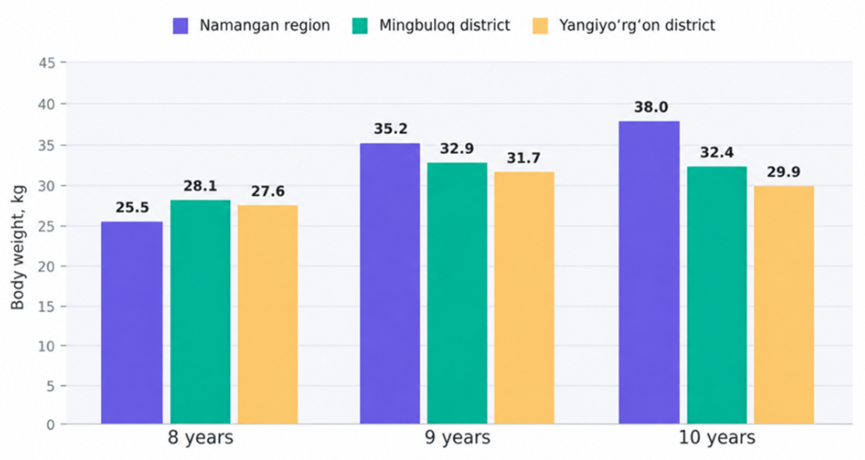 | Figure 1. Average body mass indicators by age groups of children in different regions (kg) |
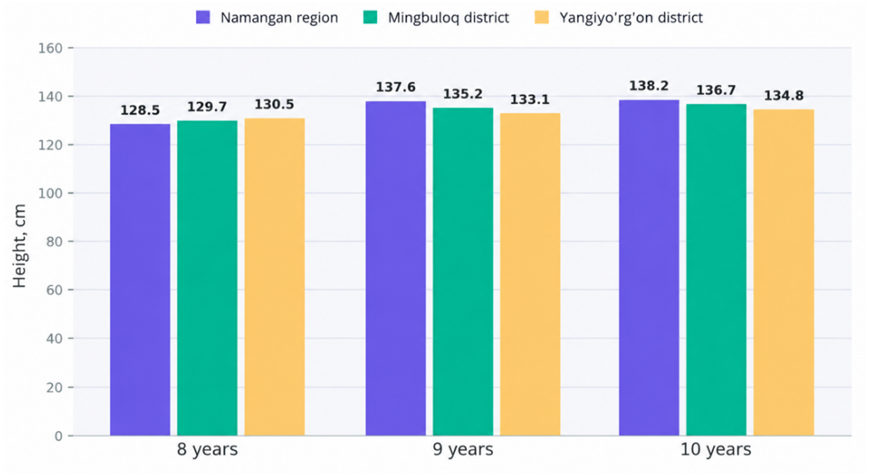 | Figure 2. Average height indicators by age groups of children in different regions (cm) |
4. Conclusions
- According to the findings of the present study, almost no statistically significant regional differences were observed in the height of primary school-aged children who regularly consumed fast-food products. However, statistically significantly higher body weight values were identified among children living in urban settings compared with those living in districts, particularly in the groups of 10- and 8-year-old children. When considered alongside international studies, including the CARDIA cohort study [4], the 2023 meta-analysis [11], and studies conducted in China and Iran [12,13,15], these findings confirm that the regular consumption of fast-food products, particularly in urban environments where access to such products is greater, has a real and substantial effect on children’s body weight. At the same time, this effect does not operate independently; rather, it interacts with physical activity and overall dietary patterns [6,7]. Therefore, practical recommendations should be based on a comprehensive approach.Based on the findings obtained, the following recommendations were developed: 1) to strengthen preventive measures promoting healthy nutrition in schools and families in urban areas; 2) to conduct scientifically grounded awareness-raising activities for parents on the proper organization of children’s nutrition; 3) to introduce a system for the regular anthropometric monitoring of children’s health; and 4) to implement additional measures aimed at increasing children’s physical activity alongside dietary recommendations. Further research in this area should be conducted among broader age groups and using larger sample sizes.