
-
Paper Information
- Paper Submission
-
Journal Information
- About This Journal
- Editorial Board
- Current Issue
- Archive
- Author Guidelines
- Contact Us
International Journal of Genetic Engineering
p-ISSN: 2167-7239 e-ISSN: 2167-7220
2026; 14(10): 266-269
doi:10.5923/j.ijge.20261410.02
Received: Sep. 20; Accepted: Oct. 6, 2026; Published: Oct. 10, 2026

Effect of Pre-Sowing Treatments and Temperature on Seed Germination of Tetradium daniellii
 Abstract
 Reference
 Full-Text PDF
 Full-text HTML
M. M. Mamadjanova
Independent Researcher, Andijan State University, Andijan, Uzbekistan
Correspondence to: M. M. Mamadjanova, Independent Researcher, Andijan State University, Andijan, Uzbekistan.
| Email: |  |
Copyright © 2026 The Author(s). Published by Scientific & Academic Publishing.
This work is licensed under the Creative Commons Attribution International License (CC BY).
http://creativecommons.org/licenses/by/4.0/

The study investigated the germination behaviour of Tetradium daniellii seeds in relation to pre-sowing treatments and temperature conditions. Particular attention was given to the hard seed coat and the internal structure of the seeds, which were examined using anatomical sections. To assess the response of the seeds to different pre-sowing treatments, three experimental variants were compared: untreated seeds, seeds subjected to four successive freezing–thawing cycles at −18°C and 24°C, and seeds soaked in warm water at 40°C for 24 hours. Germination rate, germination energy, and seed viability were used to evaluate the effectiveness of the treatments. The untreated seeds showed 25% germination, whereas freezing–thawing increased germination to 42%. The most pronounced response was observed after warm-water treatment, when germination reached 58%, with germination energy and viability of 47% and 65%, respectively. The influence of temperature was subsequently examined under controlled laboratory conditions at +15°C, +20°C, +25°C, and +30°C. The seeds pre-treated with warm water showed the highest germination percentage at +25°C, reaching 62.6%. At +30°C, germination began earlier and germination energy reached 55%, although the final germination percentage was slightly lower (58.4%). These findings indicate that the germination of T. daniellii is strongly influenced by both pre-sowing treatment and temperature. Warm-water treatment followed by germination at approximately +25°C provided favourable conditions for obtaining a higher proportion of viable seedlings and may be useful for the generative propagation of the species.
Keywords: Tetradium daniellii, Seed germination, Seed dormancy, Pre-sowing treatment, Freezing–thawing, Warm-water treatment, Temperature, Germination energy, Seed viability
Cite this paper: M. M. Mamadjanova, Effect of Pre-Sowing Treatments and Temperature on Seed Germination of Tetradium daniellii, International Journal of Genetic Engineering, Vol. 14 No. 10, 2026, pp. 266-269. doi: 10.5923/j.ijge.20261410.02.
1. Introduction
- Tetradium daniellii (Benn.) T.G. Hartley, also known as the bee-bee tree or Korean evodia, produces seeds with an epigeal germination pattern. Therefore, seeds should generally be sown at a relatively shallow depth. However, insufficient sowing depth may reduce the rate of water uptake during imbibition. In addition, the hard seed coat of T. daniellii creates a barrier to germination and makes the application of pre-sowing treatments necessary.Previous studies have reported considerable variation in the germination capacity of T. daniellii seeds. Marković et al. [1] recorded a germination rate of only 2.7% under untreated conditions. According to their results, four successive cycles of freezing at −18°C followed by thawing at room temperature (24°C) increased germination to 27%. In contrast, exposure of the seeds to hot water at 90°C for 90 seconds resulted in no germination, indicating that the effectiveness of thermal treatment depends strongly on the temperature and duration of exposure.The influence of pre-sowing treatments on the propagation of Evodia danielii (Benn.) Hemsl. was also investigated by Poșta Daniela Sabina [1]. The study demonstrated that preliminary treatment of seeds could improve both germination and subsequent seedling development. In particular, one-month stratification in sand increased germination by 19.97% compared with the control, while soaking the seeds in water at 25°C for 24 hours resulted in a 34.83% increase.Differences were also observed in seedling growth following these treatments. The mean seedling height was 3.57 cm in the control treatment, compared with 5.14 cm after sand stratification and 6.23 cm after soaking in warm water. These findings demonstrate that appropriate pre-sowing treatment can influence not only seed germination but also the early growth of seedlings. Therefore, identifying suitable methods for overcoming seed dormancy and improving germination is an important step in the successful generative propagation of T. daniellii.
2. Materials and Methods
- Seeds of Tetradium daniellii were collected during the last ten days of October 2022 from a 35–40-year-old tree growing in the Tashkent Botanical Garden. Following collection, the basic quality characteristics of the seeds were examined. The seeds were observed to occur in pairs within the same carpel, with one seed positioned above the other. The upper seed was larger, measuring approximately 2.4–4.0 mm, and was regarded as fertile, whereas the lower basal seed was smaller, with a length of 1.5–3.5 mm.To examine the internal organization of the seeds, anatomical sections were prepared and analysed. The observations showed that the fertile seeds contained an embryo, while the basal seeds consisted predominantly of endosperm and did not contain an embryo. This structural difference was considered in the interpretation of the relatively low germination capacity observed in untreated seed material.An experiment was subsequently conducted to determine the response of the seeds to different pre-sowing treatments. The treatment procedures were selected on the basis of methods previously described by M. Marković et al. [1] and D.S. Poșta [2]. Three experimental variants were established: (1) untreated seeds (control); (2) seeds subjected to four consecutive freezing–thawing cycles, consisting of freezing at −18°C and subsequent thawing at room temperature (24°C); and (3) seeds soaked in warm water at 40°C for 24 hours. The effects of these treatments were assessed using seed germination and related germination characteristics.
3. Results
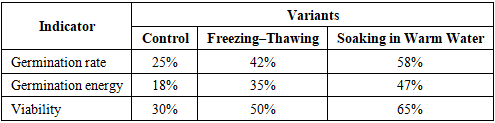
- During the experiments, the germination percentage, germination energy, and seedling viability indicators were determined for each variant (see Table 1).
|
4. Discussion
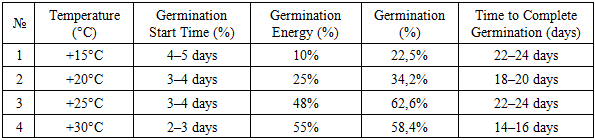
- In the first variant, selected as the control group, seeds were prepared for sowing in their natural state, without any treatment. Under these conditions, the germination rate was 25%, the germination energy was 18%, and the viability was 30%. These results suggest that the majority of seeds remained in a state of physiological dormancy, which may cause difficulties in timely germination even under natural conditions.In the second treatment variant, the seeds were frozen at –18°C and then thawed at 24°C, repeating this cycle four times. This process, aimed at breaking dormancy mechanisms through alternating cold and warm exposure, can be referred to as "alternative stratification." As a result, the germination rate increased to 42%, germination energy to 35%, and viability to 50%. These indicators confirm that cold treatment activated the seeds’ physiological processes.The third variant, and the one evaluated as the most effective, involved soaking the seeds in warm water at 40°C for 24 hours. This treatment softened the seed coat, promoted water uptake, and triggered internal metabolic activity. The results achieved in this variant were as follows: germination rate – 58%, germination energy – 47%, and viability – 65%, indicating the high effectiveness of this method.Based on the experimental results, it can be concluded that Tetradium daniellii seeds exhibit a clear state of physiological dormancy, and appropriate pre-sowing treatments are essential to overcome it. Among all the tested methods, soaking in warm water gave the best results, while the freezing-thawing stratification also proved to be moderately effective. Therefore, both stratification and thermal treatments are recommended in practice to improve seed germination.Temperature is one of the main factors influencing the germination process of plant seeds. It affects the biochemical processes inside the seed, thereby determining its germination capacity, growth rate, and developmental potential. For each plant species, there exists a specific temperature range where germination is most effective. This range is typically characterized by minimum, optimal, and maximum temperatures.• Minimum temperature is the lowest temperature at which seeds can germinate. Below this threshold, germination either does not occur or proceeds extremely slowly.• Optimal temperature is the most favorable range where germination is fast and seedlings are vigorous.• Maximum temperature is the highest limit at which seeds can germinate. Temperatures above this level may not only inhibit germination but can also damage the seed.For most plant species, the optimal temperature range lies between 20°C and 30°C, although this can vary depending on the species' natural origin and genetic traits.Various research studies have confirmed the effect of temperature on seed germination. Temperature also regulates the onset of internal biochemical activities within the seed. Enzymes involved in germination function actively within specific temperature limits. Very low or excessively high temperatures reduce enzyme activity, negatively affecting the germination process.In addition, temperature influences imbibition, the water absorption process, and the activation of associated internal signaling pathways. If the temperature exceeds optimal levels, metabolic processes can become disrupted, potentially damaging the internal structure of the seed.Under natural conditions, many plant species are adapted to diurnal temperature fluctuations (day-night cycles). In such thermoperiodic environments e.g., 25–30°C during the day and 15–20°C at night seeds tend to germinate more quickly and efficiently. Reproducing these natural temperature cycles artificially in laboratory conditions can significantly enhance germination.In 2024, the complete chloroplast genome sequence of T. daniellii from Uzbekistan was reported for the first time from Central Asia. From a practical standpoint, knowing the optimal temperature for a plant species is crucial in seed production, seedling cultivation, and direct field sowing. Therefore, careful control of temperature and creation of optimal conditions are key guarantees for improving germination success [3,4].Providing seeds with a temperature regime specific to their species can significantly increase germination rates and accelerate development. This plays a critical role in achieving higher productivity and yield in crop cultivation.To determine the effect of temperature on the germination of Tetradium daniellii seeds, laboratory observations were conducted using a thermostat set to four different temperature conditions: +15°C, +20°C, +25°C, and +30°C. The experiments were carried out during February–March 2022. Seeds used in the experiments had been pre-soaked in water at 40°C for 24 hours.Maintaining a precise and stable water temperature during the soaking process was of particular importance in the experimental setup. Therefore, a Zhune-brand laboratory electric hot plate capable of accurate temperature control was used.Based on the laboratory findings, the optimal temperature for the germination of Tetradium daniellii seeds was observed to be +25°C, at which the germination rate reached 62.6% (see Table 2).
|
5. Conclusions
- Based on the results of the laboratory experiments, it was determined that temperature has a significant effect on the germination and germination dynamics of Tetradium daniellii seeds. The level of temperature not only influenced the overall germination rate, but also directly affected the onset of germination and germination energy. At +15°C, seeds germinated slowly and weakly, with germination starting after 4–5 days. Germination energy was 10%, and the total germination rate was 22.5%. Complete germination required 22–24 days. At +20°C, germination occurred slightly faster, beginning within 3–4 days. Germination energy reached 25%, and total germination was 34.2%. Full germination was achieved in 18–20 days. At +25°C, germination started in 3–4 days, with a moderate pace. The highest germination rate 62.6% was recorded at this temperature. Germination energy was 48%. Although the germination duration (22–24 days) was not the shortest, this temperature was assessed as the most optimal for seed germination. At +30°C, seeds germinated the fastest, beginning within 2–3 days, and germination energy reached the highest value at 55%. The total germination rate was 58.4%, and complete germination was observed within 14–16 days. Although germination occurred more rapidly with rising temperature, the total germination rate was slightly lower than at +25°C.Thus, +25°C is considered the optimal temperature for Tetradium daniellii seeds, as it ensures the highest germination percentage (62.6%). However, if rapid and vigorous germination is the primary goal, then +30°C may be effective due to its high germination energy and short germination period. In this case, though, it is necessary to increase the seed sowing rate per hectare and to pay close attention to seedling care, particularly to prevent desiccation of the young sprouts due to the high temperature.In contrast, +15°C resulted in slow and inefficient germination, and therefore is considered unfavorable.From the above findings, it can be concluded that the most suitable time for sowing Tetradium daniellii seeds in open field conditions is during the second ten-day period of April, when air and soil temperatures typically reach around +25°C.