
-
Paper Information
- Paper Submission
-
Journal Information
- About This Journal
- Editorial Board
- Current Issue
- Archive
- Author Guidelines
- Contact Us
International Journal of Genetic Engineering
p-ISSN: 2167-7239 e-ISSN: 2167-7220
2026; 14(10): 261-265
doi:10.5923/j.ijge.20261410.01
Received: Sep. 17; Accepted: Oct. 5, 2026; Published: Oct. 9, 2026

Germination of Mung Bean (Vigna radiata L.) Cultivars Under Drought Stress Conditions
 Abstract
 Reference
 Full-Text PDF
 Full-text HTML
Odinayeva N. N.
Bukhara State University, Bukhara City, 11 M. Iqbal Street, Uzbekistan
Correspondence to: Odinayeva N. N., Bukhara State University, Bukhara City, 11 M. Iqbal Street, Uzbekistan.
Copyright © 2026 The Author(s). Published by Scientific & Academic Publishing.
This work is licensed under the Creative Commons Attribution International License (CC BY).
http://creativecommons.org/licenses/by/4.0/

In this study, varietal responses of mung bean (Vigna radiata L.) to salicylic acid (SA) were analyzed in terms of seed germination under drought stress simulated using PEG-6000. Four mung bean cultivars, Durdona, Barqaror, Istiqbol-32, and Ishonch, were selected for the study. Drought stress was induced using PEG-6000 at concentrations of 10, 15, and 20%. Under each stress condition, the seeds were subjected to pre-sowing treatment with SA, and their germination was compared with that of untreated seeds. In the Durdona cultivar, SA treatment increased seed germination from 59 to 73%, 47 to 62%, and 10 to 27% under PEG-10%, PEG-15%, and PEG-20% conditions, respectively. In the Barqaror cultivar, the corresponding germination rates increased from 55 to 67%, 46 to 60%, and 8 to 21%, respectively. The Istiqbol-32 cultivar exhibited relatively high inherent drought tolerance; SA treatment increased seed germination from 71 to 86% under PEG-10%, from 52 to 68% under PEG-15%, and from 16 to 34% under PEG-20% conditions. In the Ishonch cultivar, the corresponding values increased from 53 to 65%, 39 to 51%, and 0 to 9%, respectively. The complete inhibition of germination in untreated Ishonch seeds under PEG-20% indicated the high sensitivity of this cultivar to severe water deficit. Comparative analysis among the cultivars showed that Istiqbol-32 was the most drought-tolerant, Durdona was relatively tolerant, Barqaror exhibited an intermediate level of tolerance, and Ishonch was the most drought-sensitive cultivar. The results of this study may provide a scientific basis for selecting drought-tolerant mung bean cultivars and improving SA-based pre-sowing seed treatment strategies for mung bean cultivation in drought-prone regions.
Keywords: Vigna radiata L., Salicylic acid, PEG-6000, Drought stress, Seed germination
Cite this paper: Odinayeva N. N., Germination of Mung Bean (Vigna radiata L.) Cultivars Under Drought Stress Conditions, International Journal of Genetic Engineering, Vol. 14 No. 10, 2026, pp. 261-265. doi: 10.5923/j.ijge.20261410.01.
1. Introduction
- Mung bean (Vigna radiata L.) is one of the important leguminous crops from both food and agricultural perspectives, and its productivity is strongly dependent on environmental factors, particularly water availability. Drought is an abiotic stress that limits seed germination, seedling establishment, and subsequent plant development. Seeds are particularly sensitive to water deficit during germination, and insufficient water uptake by seeds reduces the activation of metabolic processes. In recent studies, pre-sowing treatment of seeds with biologically active compounds has been considered a promising biotechnological approach for improving plant adaptation to subsequent stress conditions [1,2].Polyethylene glycol, particularly PEG-6000, is widely used under laboratory conditions to simulate water deficit in a controlled manner. By reducing the water potential of the medium, PEG induces osmotic stress in seeds and seedlings that mimics drought conditions. De and Kar investigated mung bean seeds and seedlings under water stress induced by PEG-6000 and demonstrated that increasing stress intensity reduced seed germination as well as root and shoot growth [3]. Subsequent studies have also shown that increasing PEG-6000 levels significantly decreases germination, root and shoot length, and fresh and dry biomass in mung bean genotypes [4]. Importantly, these responses are not uniform across all genotypes, and considerable differences have been observed among cultivars.Genotypic differences in drought tolerance of mung bean are of particular importance for breeding programs. Wang et al., who investigated 18 mung bean cultivars under PEG-induced osmotic stress, reported that exposure to 20% PEG reduced seed germination to varying degrees and demonstrated that the cultivars could be classified into different groups according to their drought tolerance [5].Salicylic acid (SA) plays an important role in mitigating the adverse effects of drought. SA acts as an endogenous phenolic signaling molecule in plants and is involved in regulating seed germination, photosynthesis, vegetative and reproductive development, and responses to environmental stresses [6]. Pre-sowing seed treatment with SA is considered one of the approaches for enhancing physiological preparedness against stress. Seed priming may activate pre-germinative metabolic processes, promote membrane repair, stimulate antioxidant defense systems, and improve subsequent adaptation to stress conditions [1,7]. Srivastava et al. associated this phenomenon with plant “stress memory” and identified salicylic acid and PEG among the compounds extensively investigated in seed-priming studies [2].The effects of SA under drought conditions are also associated with the antioxidant defense system. Recent reviews have reported that SA regulates processes related to antioxidant defense, membrane stability, photosynthetic activity, and water relations under drought conditions [8]. For example, priming wheat seeds with SA has been shown to enhance drought tolerance and promote better seedling establishment. However, the effectiveness of SA is concentration-dependent, and in some cases, high concentrations may inhibit rather than stimulate seed germination [9].Direct evidence from mung bean is particularly important. Kumar et al. specifically investigated the effects of salicylic acid on three Vigna radiata genotypes exposed to PEG-induced drought stress [10]. The protective effect of SA in mung bean has also been demonstrated under other types of water-related stress. For example, a study involving two mung bean genotypes under waterlogging stress showed that pretreatment with SA contributed to the recovery of growth parameters, enhancement of antioxidant defense, and reduction of oxidative stress [11]. These findings support the role of SA as a physiological regulator capable of modulating stress-response mechanisms in mung bean.Thus, the available literature indicates three important patterns: first, increasing osmotic stress induced by PEG-6000 reduces mung bean seed germination; second, the extent of this reduction is genotype-dependent; and third, pre-sowing treatment with SA can mitigate the adverse effects of stress to a certain extent. From this perspective, a comparative evaluation of the responses of the local Durdona, Barqaror, Istiqbol-32, and Ishonch cultivars to SA under the same PEG gradient is scientifically important for identifying drought-tolerant cultivars and improving practical pre-sowing seed treatment technologies.
2. Materials and Methods
- The seeds of four mung bean (Vigna radiata L.) cultivars, Durdona, Barqaror, Istiqbol-32, and Ishonch, were used as the experimental material. The main objective of the experiment was to evaluate the effect of pre-sowing treatment with salicylic acid (SA) on seed germination of different mung bean cultivars under varying levels of artificially induced drought stress.To simulate drought stress under laboratory conditions, PEG-6000 (polyethylene glycol-6000), a high-molecular-weight osmotic agent, was used. The experiments were conducted using PEG-6000 at concentrations of 10, 15, and 20%. These three concentrations represented different levels of drought-induced osmotic stress. At each PEG concentration, two main treatments were compared: seeds without SA treatment and seeds subjected to pre-sowing treatment with SA.The response of the mung bean cultivars to drought stress was evaluated based on the reduction in seed germination with increasing PEG-6000 concentration. The protective effect of SA was assessed by comparing seed germination between SA-treated and untreated seeds at the same PEG-6000 concentration.
3. Results and Discussion
- To determine the effect of SA on the germination response of the “Durdona” mung bean cultivar under drought stress, experiments were conducted using PEG-6000 at concentrations of 10, 15, and 20%. Seed germination rates determined in untreated and SA-treated samples are presented in Figure 1.
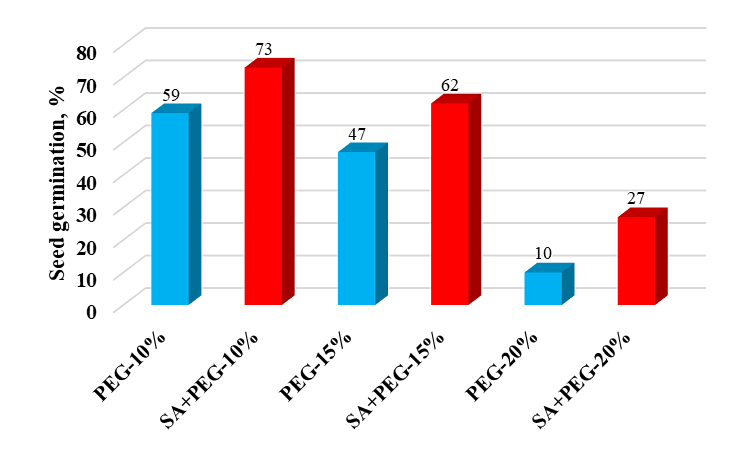 | Figure 1. Effect of salicylic acid on the germination of the “Durdona” mung bean cultivar under drought stress |
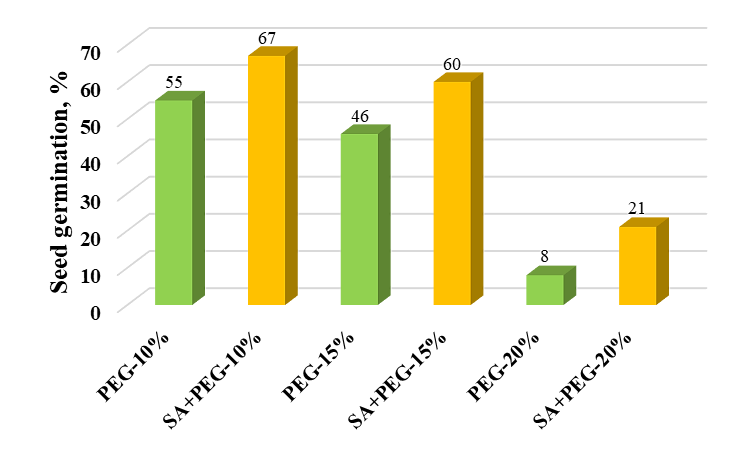 | Figure 2. Effect of salicylic acid on the germination of the “Barqaror” mung bean cultivar under drought stress |
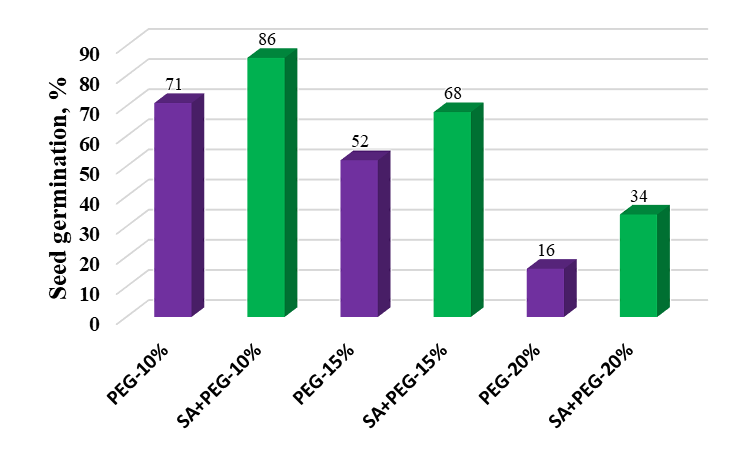 | Figure 3. Effect of salicylic acid on the germination of the “Istiqbol-32” mung bean cultivar under drought stress |
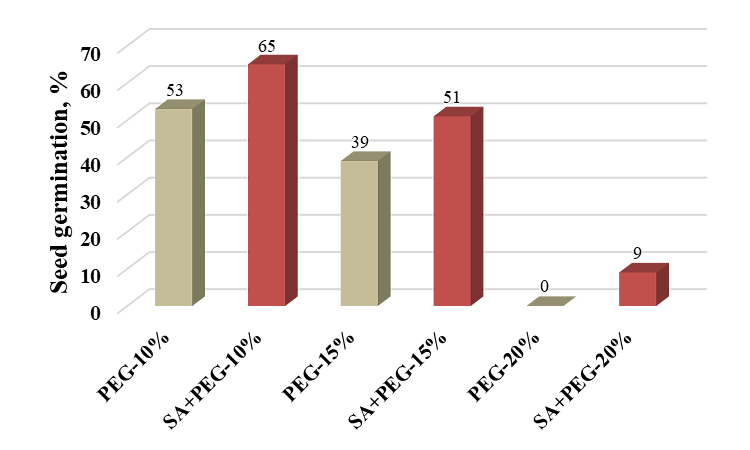 | Figure 4. Effect of salicylic acid on the germination of the “Ishonch” mung bean cultivar under drought stress |
4. Conclusions
- Under untreated conditions, at 20% PEG, the germination rates of the Durdona, Barqaror, Istiqbol-32, and Ishonch cultivars were 10, 8, 16, and 0%, respectively. These results demonstrated that genotypic differences among the cultivars became more pronounced as drought stress intensified.Pre-sowing treatment with SA increased mung bean seed germination at all PEG levels. In particular, under 20% PEG, germination increased from 10 to 27% in Durdona, 8 to 21% in Barqaror, 16 to 34% in Istiqbol-32, and 0 to 9% in Ishonch.Comparative analysis among the cultivars identified Istiqbol-32 as the most drought-tolerant cultivar, showing germination rates of 86, 68, and 34% under 10, 15, and 20% PEG, respectively, following SA treatment. The Durdona cultivar also exhibited a pronounced protective response to SA treatment.