Boymurodov Husniddin Tashboltayevich1, Khorazov Sayfulla Janzak oglu2
1Professor, Samarkand State University of Veterinary Medicine, Biotechnology and Biotechnology, Samarkand, Uzbekistan
2Researcher, Samarkand State University of Veterinary Medicine, Animal Husbandry and Biotechnology, Samarkand, Uzbekistan
Correspondence to: Boymurodov Husniddin Tashboltayevich, Professor, Samarkand State University of Veterinary Medicine, Biotechnology and Biotechnology, Samarkand, Uzbekistan.
| Email: |  |
Copyright © 2026 The Author(s). Published by Scientific & Academic Publishing.
This work is licensed under the Creative Commons Attribution International License (CC BY).
http://creativecommons.org/licenses/by/4.0/

Abstract
A total of 9 species belonging to 2 families and 4 genera and 2 subspecies are distributed in the Syrdarya river. We found out that a total of 8 species are distributed in the upper part of Sirdayo and Fergana Valley, 3 species from the Unionidae family and 2 subspecies, and 3 species from the Corbiculidae family. It was studied that 11 species are distributed in the middle part of Syrdarya, including 4 species from the Unionidae family and 2 subspecies, and 5 species from the Corbiculidae family. As a result of the molecular-genetic analysis of bivalve molluscs of the families Unionidae, Corbiculidae in the Syrdarya River from the Genbank database (Genebank, NCBI) Corbicula fluminalis (O.F. Muller, 1774) species (accession number PP256501), Corbiculina ferghanensis (Kursalova et Starobogatov, 1971) species (accession number PP239092) and Sinanodonta gibba (Benson, 1895) was taken as the type (accession number PQ059482).
Keywords:
Family Corbiculidae, Corbiculina tibetensis, Corbiculina ferghanensis, Corbicula purpurea, Sinanodanta gibba, Sinanodanta puerorum
Cite this paper: Boymurodov Husniddin Tashboltayevich, Khorazov Sayfulla Janzak oglu, Distribution and Molecular Genetic Analysis of Biotopes of Bivalves of the Families Unionidae and Corbiculidae in the Syrdarya River, International Journal of Genetic Engineering, Vol. 14 No. 9, 2026, pp. 254-260. doi: 10.5923/j.ijge.20261409.05.
1. Introduction
Today, the increase in droughts on a global scale is causing changes in the hydrological regime of large river basins and the transformation of biodiversity. Changes in the land use system of mankind, along with the reduction of wetland ecosystems, are ensuring the crisis of hydrofauna representatives. Accordingly, it is of scientific and practical importance to assess the current state of hydrofauna representatives of river basins with unstable hydrological regimes and identify the target factors causing their crisis.Studies on the study of hydrobionts in water types were conducted by some authors [2,3].
2. Material and Methods
When collecting materials from the area, the methods were used [4]. Samples brought from the Syrdarya aquatic ecosystems were identified in laboratory conditions to the species level using the identifiers. In compiling the taxonomic system, “System of bivalve mollusks of the Zarafshan River Basin”, “Fauna of mollusks of aquatic ecosystems of Central Asia and adjacent areas” were formed according to the systematics [1,4,6,5].Species were isolated from some samples of bivalve mollusks Corbicula fluminalis, Corbiculina ferghanensis and Sinanodonta gibba collected from the aquatic ecosystems of the Syrdarya coast for molecular genetic studies. GeneJET GENOMIC DNA reagents were widely used to extract DNA from the obtained samples [7].
3. Results and Discussion
The Syrdarya River is one of the longest rivers in Central Asia, second only to the Amu Darya River in terms of water content. Until now, the river has been called by various names, and in the works of ancient Greek historians it was mentioned as Yaksart, Danu, Saykhun, and Khasart. It takes its name from the confluence of the Naryn and Karadarya rivers in the area of the Balikchi village of the Fergana Valley. The river flows into the Aral Sea. The length of the Syrdarya is more than 2,272 km, and the basin area is approximately 462,000 km2. [8,9].To date, species of the Unionidae and Corbiculidae families have not been specifically studied in the riverine aquatic ecosystems. As a result of the studies, it was determined that 9 species and 2 subspecies belonging to 2 families and 4 genera are distributed in the aquatic ecosystems of the Syrdarya coast (Table 1). The studies were conducted in two areas on the river bank in a stationary state: the upper part of the Syrdarya in the Fergana Valley and the middle part of the Syrdarya in the Syrdarya region. We found that a total of 8 species are distributed in the upper part of the Syrdarya in the Fergana Valley, including 3 species and 2 subspecies from the Unionidae family, and 3 species from the Corbiculidae family. The species were studied in an environment with a depth of 1.2-1.9 m, an average water temperature of 12-18 °C, water clarity of 0.15-0.21 cm, and a current velocity of 0.56-0.64 m/sec. In the muddy and swampy biotopes of the waters of the Karadarya and Naryn rivers after their confluence, an average of 0.8, 0.9, and 0.7 specimens of Sinanodanta gibba, Sinanodonta puerorum, and Sinanodanta orbicularis, respectively, were found per 1 m2 of area.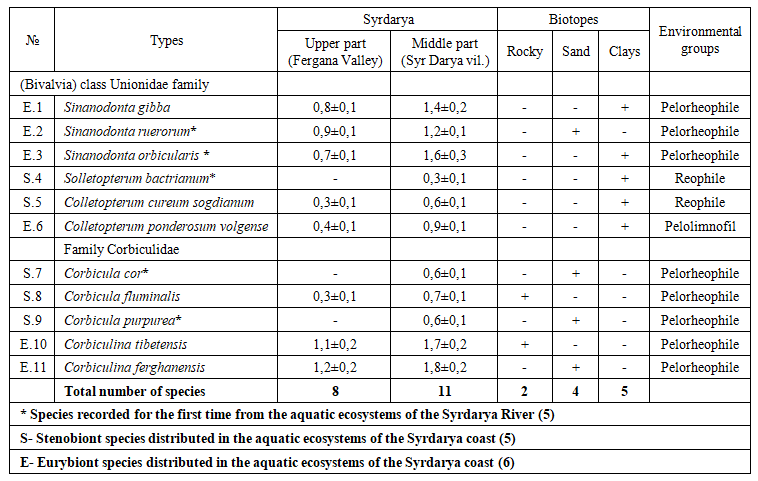 | Table 1. Distribution of biotopes and ecological groups of bivalves of the families Unionidae and Corbiculidae in the Syrdarya River (n= 10, m2/individual) |
It was determined that the species Colletopterium bactrianum from the genus Colletopterum was not distributed because this species is a rare stenobiont species that is sensitive to water hydrochemical changes. We determined that Colletopterium cyreum sogdianum was distributed at 0.3, and Colletopterium ponderosum volgense at 0.4. Among these species, Colletopterium cyreum sogdianum is a stenobiont species with a very low distribution density.In the Fergana Valley section of the river, it was found that Corbicula fluminalis from the Corbiculidae family Corbicula genus was distributed in sandy and rocky biotopes. However, Corbicula cor, Corbicula purpurea species were not found in the waters of this area, which may be due to the fluctuations in the water level and the hydrochemical composition of the waters. Corbicula tibetensis 1.1, Corbicula ferghanensis 1.2 from the Corbiculina genus, which are more densely distributed than other species, were found in this section of the river. It was analyzed that the bivalves distributed in the Syrdarya River were also distributed in the biotopes of the Great Fergana, North Fergana, South Fergana and Great Andijan canals along the river bank with water and fish. Sinanodonta puerorum, Sinanodanta orbicularis, Colletopterium bactrianum were shown for the first time in the aquatic ecosystems of the upper part of the river [4,5,8].The distribution of the rare stenabiont species Colletopterium bactrianum, Colletopterium cyreum sogdianum, and Corbicula fluminalis in the waters of the region, as well as the distribution of the eurybiont species Sinanodanta gibba, Sinanodonta puerorum, Sinanodanta orbicularis, Colletopterium ponderosum volgense, Corbiculina tibetensis, and Corbiculina ferghanensis, was analyzed.In the middle part of the Syrdarya River, 11 species are distributed in the Syrdarya region, of which 4 species and 2 subspecies from the Unionidae family, and 5 species from the Corbiculidae family were studied. A higher number and density of species were observed in the middle part of the river than in the upper part. The distribution and density of species in the middle part of the river were specifically analyzed, the depth is 1.5-2.8 m, the average water temperature is 14-20 °C, the water clarity is 0.20-0.28 cm, and the height above sea level is 340-489 m. In the parts at higher altitudes, the distribution of the Unionidae family Sinanodanta genus Sinanodanta gibba 1.4, Sinanodonta puerorum 1.2, Sinanodanta orbicularis 1.6, and the Colletopterum genus Colletopterium bactrianum 0.3, Colletopterium cyreum sogdianum 0.6, and Colletopterium ponderosum volgense 0.9 was studied on average per grain [5,8,9].The Syrdarya River differs from other rivers in its high turbidity. In the section of the Syrdarya near the city of Bekabad, an average of 2.17 kg of turbidity was observed per 1 m3 of water. The high content of turbidity in the river is of great importance in the formation of biotopes favorable for the spread of large bivalve mollusks of the genera Sinanodanta and Colletopterum. These genera live semi-buried in the mud. In the relatively fast-flowing sandy and rocky areas of the river, Corbicula cor 0.6, Corbicula fluminalis 0.7, Corbicula purpurea 0.6 from the Corbicula family are distributed, which are stenobiont species with low density. We can include species of the Corbiculina genus, which have a higher density and are widely adapted to the Syr Darya aquatic ecosystems than other species. The density of these species is Corbiculina tibetensis 1.7, Corbiculina ferghanensis 1.8, and they are species that have adapted to changes in important factors such as the hydrochemical composition of water and flow velocity. It was studied that the species Colletopterium bactrianum, Colletopterium cyreum sogdianum from the genus Colletopterum of the Unionidae family, Corbicula cor, Corbicula fluminalis, Corbicula purpurea from the genus Corbicula of the Corbiculidae family, which are distributed in the waters of this area of the river, are stenabionts, and the species Sinanodanta gibba, Sinanodonta puerorum, Sinanodanta orbicularis, Colletopterium ponderosum volgense from the genus Sinanodanta of the Unionidae family, Corbiculina tibetensis, Corbiculina ferghanensis from the genus Corbiculina of the Corbiculidae family are eurybionts.When analyzing the ecological groups of species in the upper part of the Syr Darya River, the Fergana Valley, and the middle part of the Syr Darya River, the Syrdarya region, it was determined for the first time that 8 species of pelorheophiles accounted for 72.7% (Sinanodanta orbicularis, Corbicula cor, Sinanodanta gibba, Sinanodonta puerorum, Corbicula fluminalis, Corbicula purpurea, Corbiculina tibetensis, Corbiculina ferghanensis), 2 species of rheophiles accounted for 18% (Colletopterium cyreum sogdianum, Colletopterium bactrianum), and one species of pelolimnophiles accounted for 9.2% (Colletopterium ponderosum volgense). When analyzing the distribution in biotopes, it was found that 2 species were distributed in rocky soils (18.5%, Corbicula fluminalis, Corbiculina tibetensis), 4 species were distributed in sandy soils (36.5%, Sinanodonta puerorum, Corbicula cor, Corbicula purpurea, Corbiculina ferghanensis), and 5 species were distributed in clay soils (45%, Sinanodanta gibba, Sinanodanta orbicularis, Colletopterium bactrianum, Colletopterium cyreum sogdianum, Colletopterium ponderosum volgense).We conducted molecular genetic analyses of the bivalve mollusks Corbicula fluminalis, Corbicula ferghanensis, and Sinanodonta gibba, which are distributed in relatively polluted waters on the coast of the Syrdarya River due to human factors.Molecular taxonomic analysis of Corbicula fluminalis for molecular genetic analysis of the mollusk Corbicula fluminalis, belonging to the genus Corbicula Megerle von Mühlfeld, 1811, sample materials were collected from the Syrdarya River and Syrdarya region. The collected samples were fixed in 96% ethanol solution. Based on the morphological and morphometric characteristics of C. fluminalis, this species was subjected to molecular genetic analysis. The GeneJET GENOMIC DNA reagent kit was used to extract genomic DNA from the heel of C. fluminalis. Polymerase chain reaction (PCR) was performed using genomic DNA isolated from the Corbicula fluminalis species. In this reaction, primers LCO-1460: ggycaacaaatcataagatattgg and HCO-219 taaacttcagggtgaccaaaaaatca, which read the mitochondrial DNA SOI region, which is widely used in the identification of bivalve mollusks, were used. The results obtained from the PCR were run on gel electrophoresis. The products obtained from the PCR were purified and sent for sequencing. The initial results obtained from the sequencing were studied with bioinformatics programs (Figure 1). [1].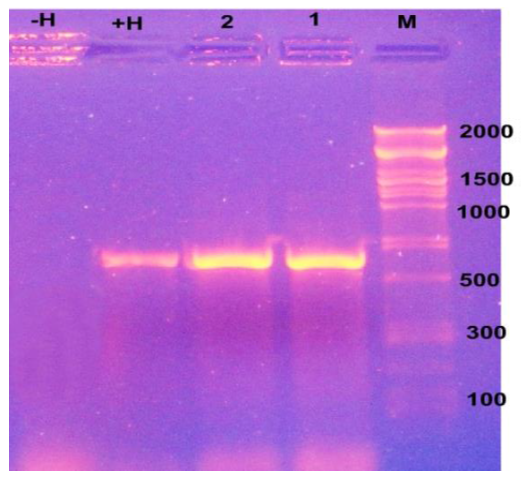 | Figure 1. PCR result of C. fluminalis. (Note: M-marker.1. C. fluminalis, +N-control, -N-control.) |
Molecular genetic studies The nucleotide sequence of 610 base pairs belonging to the COI region of the mRNA of the species Corbicula fluminalis, belonging to the genus Corbicula, was isolated and compared with the nucleotide sequence of the species C. fluminalis (accession number: MH822472) from the National Center for Bioinformatics Information (NCBI) (https://www.ncbi.nlm.nih.gov) (Figure 2). 15 nucleotide differences were observed between the nucleotides of the species Corbicula fluminalis and C. ferghanensis. Next, the differences between the species Corbicula fluminalis and the nucleotides of the species Corbicula fluminalis (accession number: MH822472) obtained from the National Center for Bioinformatics Information (NCBI) (https://www.ncbi.nlm.nih.gov) were studied.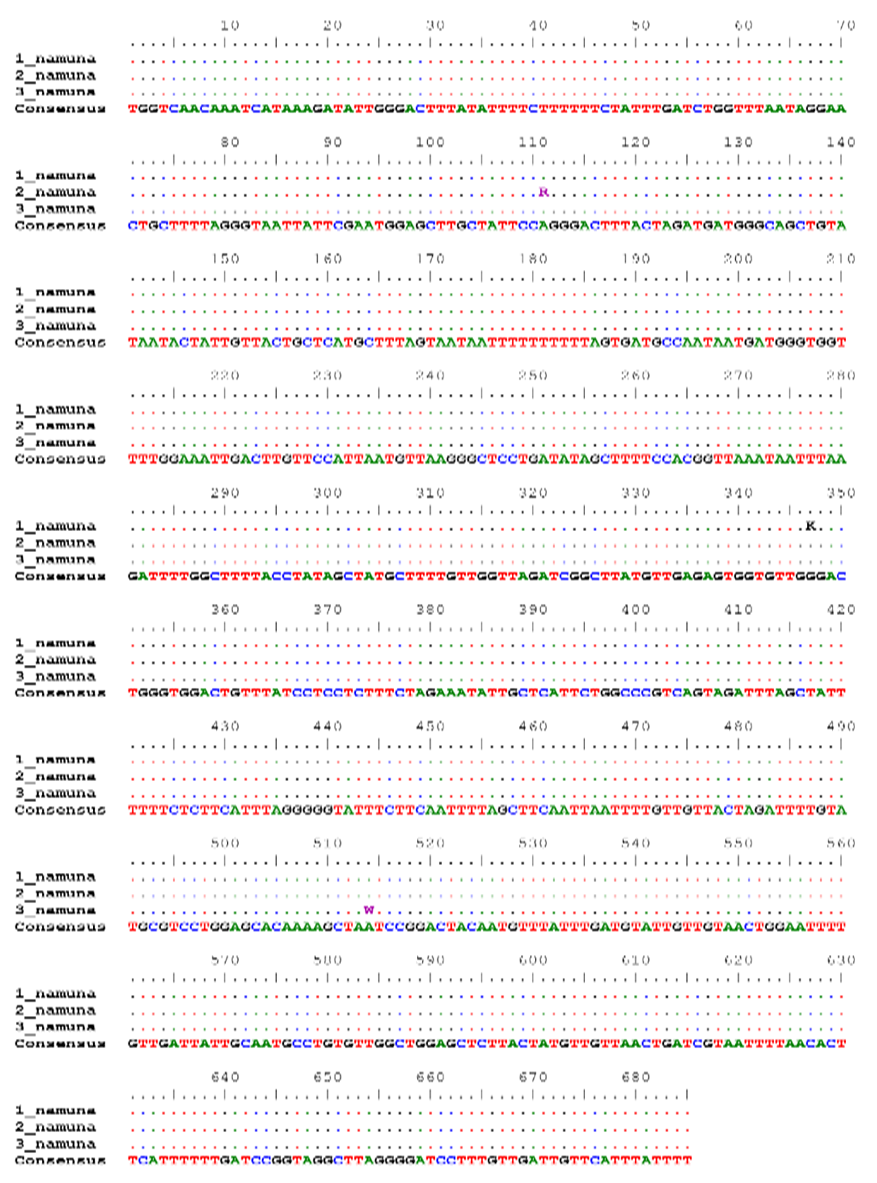 | Figure 2. Comparison of the nucleotide sequences of the mRNA COI region of species belonging to the genus Corbicula based on sequence material. (Note: Nucleotide sequence of the species C. fluminalis) |
Molecular genetic analysis of Corbiculina ferghanensis. During the research period, mollusks collected from the middle reaches of the Syrdarya River and the Dostlik canals were fixed in 70% ethanol solution to conduct molecular genetic analysis of the species Corbicula Megerle von Mühlfeld, 1811, which belongs to the genus Corbicula. The species C. ferghanensis was isolated for molecular genetic studies based on morphological and morphometric characteristics [1,8]. The GeneJET GENOMIC DNA reagent kit was used to isolate genomic DNA from the tail of the species. The genomic DNA isolated from the species C. ferghanensis was subjected to polymerase chain reaction (PCR). The PCR product was run on gel electrophoresis (Figure 3).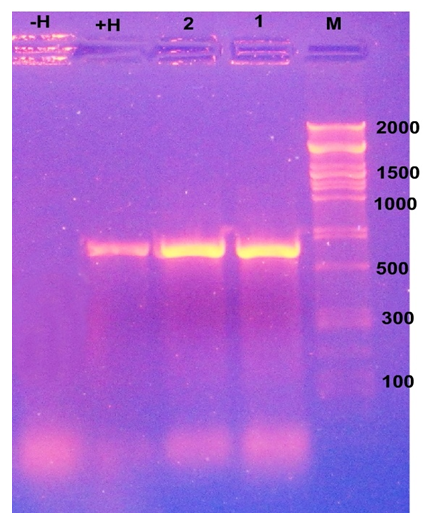 | Figure 3. PCR result of C. ferghanensis species. (Note: M-marker. C. ferghanensis, +N-control, -N-control. Note: M-marker. C. ferghanensis, +N-control, -N-control.) |
PCR products were purified and sequenced. The data obtained from the sequence were analyzed using bioinformatics programs (Fig. 4).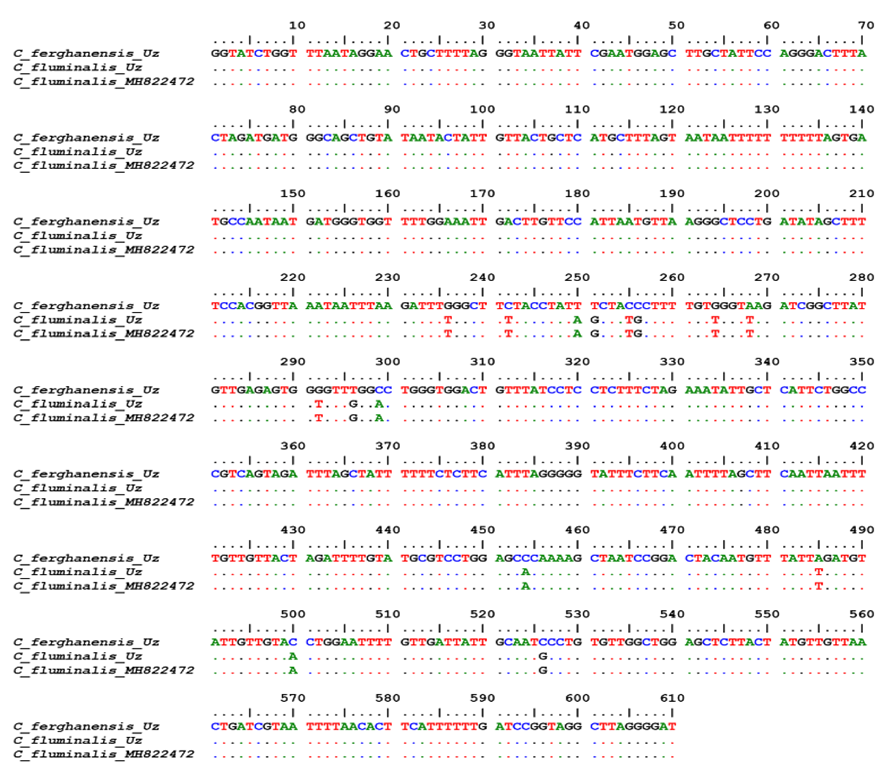 | Figure 4. Comparison of nucleotide sequences of the mRNA COI region of species belonging to the genus Corbicula based on sequence material. (Note: Nucleotide sequence of C. ferghanensis. Sonsensus – corrected nucleotide sequence (the sequence is in the 5’ to 3’ direction, with identical nucleotide bases marked with dots). According to the results of molecular genetic studies, a 610-base pair nucleotide sequence belonging to the COI region of the mRNA of C. fluminalis and C. ferghanensis, belonging to the Corbicula genus, was isolated and assigned an accession number in the Genebank database of the National Center for Bioinformatics Information (NCBI) (https://www.ncbi.nlm.nih.gov) (PP239092).) |
Molecular genetic analysis of Sinanodonta gibba (Benson, 1895).The morphological structure of species belonging to the Unionidae family has been studied in detail. Changes in the aquatic environment are observed in the morphology of the shells of bivalve mollusc species, indicating the need for molecular genetic analysis of these species. Based on the sequence chromatography obtained in molecular genetic studies of the species Sinanodonta gibba belonging to the Unionidae family, nucleotides with a length of 547 base pairs belonging to the 18S domain of the rDNA of Sinanodonta gibba were isolated using the species Gibbosula polysticta (accession number: MK687414) from the International Center for Bioinformatics Information (https://blast.ncbi.nlm.nih.gov) [5,7].According to bioinformatic analysis, there were 8 nucleotide differences between the nucleotides of G. polysticta obtained from the S. gibba genebank database (Figure 5).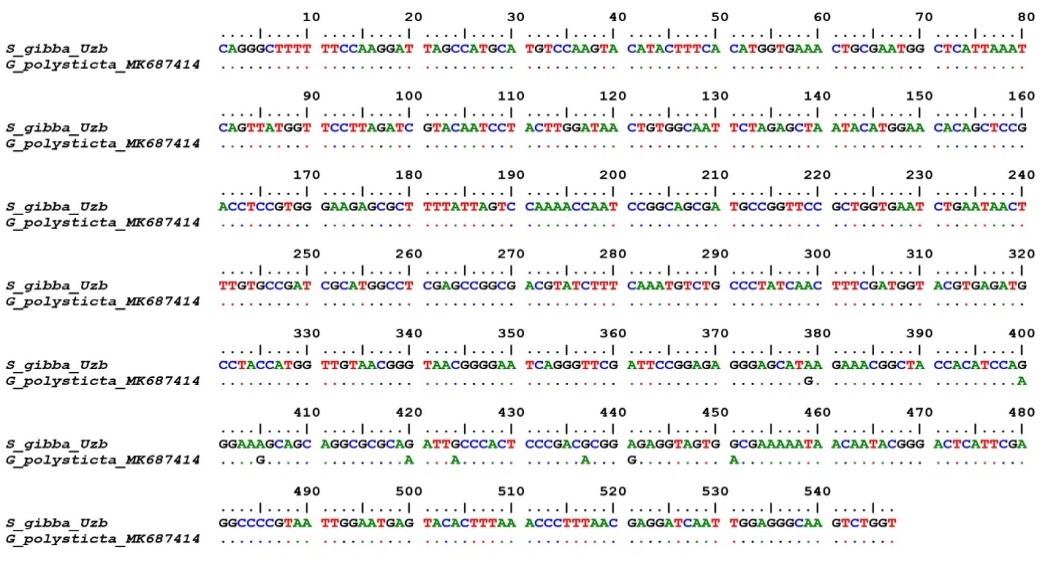 | Figure 5. Comparison of nucleotide sequences of the species Synanodonta gibba with that of the species Gibbosula polysticta (accession number: MK687414) from the GenBank database |
The nucleotides of the species Synanodonta gibba were found to be A-adenine at nucleotides 379, 405, and 441, and the nucleotides of the species Gibbosula polysticta were found to be G-guanine at nucleotides 400, 420, 424, 437, and 451. The nucleotide sequence of the 18S domain of the rDNA of the species Synanodonta gibba of the family Unionidae was studied bioinformatically. It was found that there were 8 nucleotide differences between the nucleotides of these species, and these differences amounted to 1.46% [1].The genebank database (Genebank, NCBI) was used to identify the species Corbicula fluminalis (accession number PP256501), Corbiculina ferghanensis (Kursalova et Starobogatov, 1971) (accession number PP239092), and Sinanodonta gibba (Benson, 1895) (accession number PQ059482) (Table 2).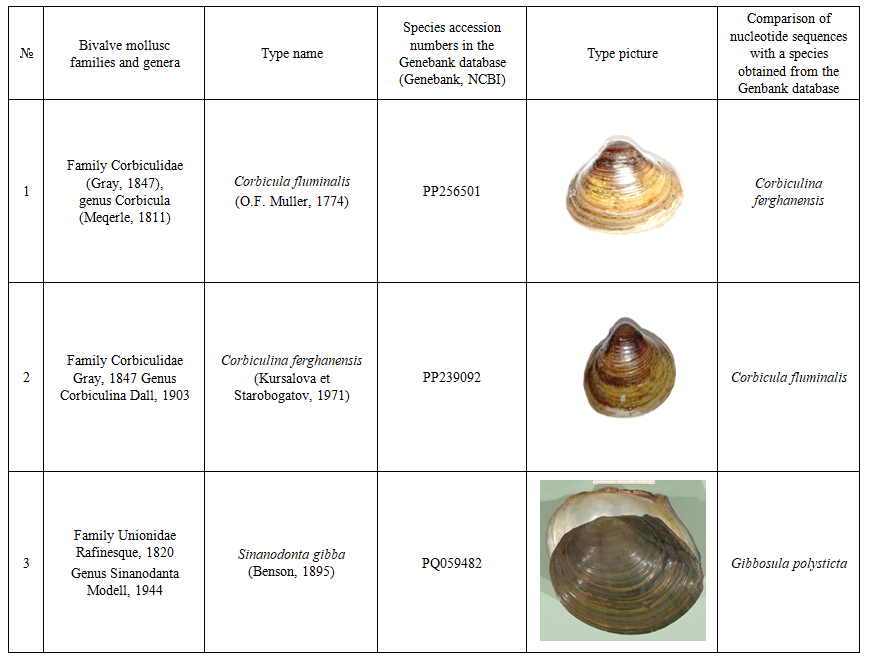 | Table 2. Molecular genetic analysis of some bivalve mollusks distributed along the Syr Darya River (http://ncbi.nlm.nih.gov) |
4. Conclusions
A total of 9 species and 2 subspecies belonging to 2 families and 4 genera are distributed in the Syrdarya River. We found that a total of 8 species are distributed in the upper part of the Syrdarya, the Fergana Valley, including 3 species and 2 subspecies from the Unionidae family, and 3 species from the Corbiculidae family. In the middle part of the Syrdarya, in the Syrdarya region, 11 species are distributed, including 4 species and 2 subspecies from the Unionidae family, and 5 species from the Corbiculidae family. When analyzing the ecological groups, it was found that pelorheophiles account for 72.7%, rheophiles for 18%, and pelorimnophiles for 9.2%, 18.5% in rocky biotopes, 36.5% in sandy biotopes, and 45% in muddy biotopes. The genebank database (Genebank, NCBI) was used to obtain the species Corbicula fluminalis, Corbiculina ferghanensis (accession number PP239092), and Sinanodonta gibba (accession number PQ059482).
References
| [1] | Adavoudi R., Pilot M. Consequences of hybridization in mammals: A systematic review // Genes. 2021. V. 13. №1. P. 50. https://doi.org/10.3390/genes13010050. |
| [2] | Bruestle E. L., Karboski C., Hussey A., Fisk A. T., Mehler K., Pennuto C., Gorsky D. Novel trophic interaction between lake sturgeon (Acipenser fulvescens) and non-native species in an altered food web // Canadian Journal of Fisheries and Aquatic Sciences. 2019. V. 76. №1. P. 6-14. https://doi.org/10.1139/cjfas-2017-0282. |
| [3] | Dobler A. H., Hoos P., Geist J. Distribution and potential impacts of non-native Chinese pond mussels Sinanodonta woodiana (Lea, 1834) in Bavaria, Germany // Biological Invasions. 2022. V. 24. №6. P. 1689-1706. https://doi.org/10.1007/s10530-022-02737-2. |
| [4] | Izzatullaev Z. I., Boymurodov H. T. The Results of the Pearl’s Growing of Bivalve Freshwater Mollusks (Bivaivia: Unionidae, Anadontinae) of Uzbekistan // Byulleten'Moskovskogo Obshchestva Ispytatelei Prirody Otdel Biologicheskii. 2016. V. 121. №5. P. 16-19. |
| [5] | Boymurodov H. Distribution and Ecological Groups of Bivalve Mollusks of the Families Unionidae and Corbiculidae in the Aquatic Ecosystems of the Kyzylkum Nature Reserve // Reliability: Theory & Applications. 2022. V. 17. №SI 4 (70). P. 562-566. |
| [6] | Boymurodov H., Jabborov K., Jabbarova T., Aliyev B., Mirzamurodov O., Egamqulov A. Changes in the habitats of the Unionidae, Euglesidae, Pisididae and Corbiculidae species with the construction of reservoirs in the Kashkadarya basin due to climate change // Reliability: Theory & Applications. 2022. V. 17. №SI 4 (70). P. 343-347. |
| [7] | Boymurodov K., Khasanov N. Influence of abiotic factors on biodiversity of the populations of bivalve mollusks of the Lower Zarafshan reservoirs // E3S Web of Conferences. EDP Sciences, 2021. V. 265. P. 01012. https://doi.org/10.1051/e3sconf/202126501012. |
| [8] | Boymurodov K., Zhabborova T., Tuinazarova I., Otakulov B., Egamkulov A. Aquatic ecosystems of the lower reaches of the Zarafshan River. Diversity and ecological groups of mollusks // E3S Web of Conferences. EDP Sciences, 2021. V Boymurodov. 262. P. 04009. https://doi.org/10.1051/e3sconf/202126204009. |
| [9] | Boymurodov K., Suyarov S. Bivalve mollusk fauna and ecological groups of Unionidae and Corbiculidae families in natural and artificial reservoirs of Uzbekistan // E3S Web of Conferences. EDP Sciences, 2021. V. 265. P. 01014. https://doi.org/10.1051/e3sconf/202126501014. |


 Abstract
 Reference
 Full-Text PDF
 Full-text HTML