
-
Paper Information
- Paper Submission
-
Journal Information
- About This Journal
- Editorial Board
- Current Issue
- Archive
- Author Guidelines
- Contact Us
International Journal of Genetic Engineering
p-ISSN: 2167-7239 e-ISSN: 2167-7220
2026; 14(9): 246-253
doi:10.5923/j.ijge.20261409.04
Received: Jul. 31, 2026; Accepted: Aug. 26, 2026; Published: Sep. 18, 2026

Antihypertensive Activity of Fruit Juice, Peel, and Seed Extracts of Local Pomegranate (Punica granatum L.) Cultivars
 Abstract
 Reference
 Full-Text PDF
 Full-text HTML
Farogat Sheraliyevna Ergasheva1, Shunqor Sadullayevich Xushmatov2, Habibjon Khojiboboyevich Kushiev3, Inoyatov Islom4, Almamatov Bakhrom4
1Doctoral Student (DSc), Gulistan State University, Uzbekistan
2Chief Specialist, Ministry of Higher Education, Science and Innovation of the Republic of Uzbekistan
3Director, Research Institute of Agrobiotechnology and Biochemistry, Gulistan State University, Uzbekistan, Lecturer at Gulistan State University
4Gulistan State University, Uzbekistan
Correspondence to: Farogat Sheraliyevna Ergasheva, Doctoral Student (DSc), Gulistan State University, Uzbekistan.
| Email: |  |
Copyright © 2026 The Author(s). Published by Scientific & Academic Publishing.
This work is licensed under the Creative Commons Attribution International License (CC BY).
http://creativecommons.org/licenses/by/4.0/

The present study evaluated the antihypertensive activity of fruit juice, peel, and seed extracts obtained from selected local pomegranate (Punica granatum L.) cultivars. The extracts exhibited significant dose-dependent antihypertensive activity within the dose range of 100–500 mg kg⁻¹. Overall, the antihypertensive efficacy of the cultivars increased in the following order: «Oq Dona (Tuyatish)» < «Oq Shirin» < «Achchiq Dona» <«Qora Qayim» < «Qizil Anor». Administration of the extracts significantly reduced both systolic arterial blood pressure (SBP) and diastolic arterial blood pressure (DBP) under physiological conditions as well as in rats with adrenaline-induced experimental hypertension 60 min after administration of adrenaline hydrochloride (0.25 mg kg⁻¹). Among the tested cultivars, «Qizil Anor» exhibited the strongest antihypertensive activity. The obtained experimental findings suggest that local pomegranate extracts represent a promising natural source of bioactive compounds for the development of antihypertensive nutraceuticals and phytopharmaceutical preparations.
Keywords: Punica granatum L., Pomegranate, Antihypertensive activity, Systolic blood pressure, Diastolic blood pressure, Experimental hypertension, Adrenaline-induced hypertension, Plant extracts, Phytotherapy
Cite this paper: Farogat Sheraliyevna Ergasheva, Shunqor Sadullayevich Xushmatov, Habibjon Khojiboboyevich Kushiev, Inoyatov Islom, Almamatov Bakhrom, Antihypertensive Activity of Fruit Juice, Peel, and Seed Extracts of Local Pomegranate (Punica granatum L.) Cultivars, International Journal of Genetic Engineering, Vol. 14 No. 9, 2026, pp. 246-253. doi: 10.5923/j.ijge.20261409.04.
1. Introduction
- Hypertension is currently one of the most prevalent cardiovascular disorders worldwide, affecting approximately 26.4–45% of the global population, and its prevalence is projected to increase to 29–60% by 2025. According to the World Health Organization, hypertension is responsible for approximately 9.4 million deaths annually worldwide [1,2,3]. The pathogenesis of arterial hypertension is a complex, multifactorial process regulated by intricate neurohumoral mechanisms within the human body [4,5,6,7].Hypertension is generally classified into two major forms: primary (essential) hypertension, which accounts for approximately 90–95% of all cases, and secondary hypertension, which develops as a consequence of other underlying diseases and represents about 5–10% of cases. Both forms are characterized by disturbances in the function of the brain, cardiovascular system, and kidneys, substantially increasing the risk of stroke and ischemic heart [8,9,10,11]. Numerous factors contribute to the development of hypertension, including excessive body weight (obesity), excessive dietary sodium chloride (NaCl) intake, insulin resistance, dysregulation of the renin–angiotensin–aldosterone system (RAAS), hyperactivation of the sympathetic nervous system, endothelial dysfunction associated with impaired endothelin and nitric oxide (NO) biosynthesis, disruption of Ca²⁺ transport homeostasis in vascular smooth muscle cells, elevated angiotensin concentrations, developmental abnormalities during fetal life, and various neurohumoral disorders [12,13,14].Approximately 60–70% of hypertension cases are associated with overweight or obesity. In obese individuals, enhanced sympathetic innervation, activation of the renin–angiotensin–aldosterone system, and stimulation of peripheral α- and β-adrenergic receptors contribute significantly to elevated arterial blood pressure [15,16,17,18]. Activation of α-adrenergic receptors in vascular smooth muscle cells by the sympathoadrenal system, catecholamines, and angiotensin II plays a pivotal role in the development of vasoconstriction-mediated [19,20]. Furthermore, norepinephrine has been reported to participate in vascular smooth muscle contraction through β3-adrenergic receptor-mediated activation of the adenylate cyclase (AC)–cAMP–protein kinase A (PKA) signaling cascade [21,22]. Several studies have demonstrated alterations in erythrocyte membrane ion permeability and impaired functional activity of ion transport systems under hypertensive conditions [23]. In addition, increasing evidence confirms that inflammatory processes at the cellular level are actively involved in the pathogenesis of arterial hypertension [24,25]. Atrial natriuretic peptide (ANP), synthesized by cardiomyocytes, has also been shown to play an important role in the regulation of blood pressure during hypertension [26].Moreover, activation of endothelial nitric oxide synthase (eNOS) in vascular endothelial cells stimulates nitric oxide (NO) production, which is essential for maintaining vascular relaxation through vasodilation. Contemporary clinical management of arterial hypertension relies on both monotherapy and combination therapy using various pharmacological agents, including calcium channel blockers, angiotensin-converting enzyme (ACE) inhibitors, angiotensin II receptor (AT₁) blockers, diuretics, α- and β-adrenergic blockers, among others [26]. Even a modest reduction of 5 mmHg in systolic or diastolic blood pressure has considerable clinical significance, decreasing the incidence of cardiovascular diseases by 15–20%, reducing stroke risk by 20–40%, and lowering overall mortality by approximately 7% (Whelton et al., 2002; Stockton et al., 2017). Consequently, the development of novel antihypertensive agents has increasingly focused on modulating ion transport systems, particularly calcium channels located in vascular smooth muscle cells [27,28]. In recent years, medicinal plant extracts rich in biologically active compounds have attracted considerable attention as promising alternatives for antihypertensive therapy because of their high therapeutic potential and relatively low toxicity and adverse effects.Therefore, the present study aimed to evaluate the antihypertensive activity of juice, peel, and seed extracts obtained from five local pomegranate (Punica granatum L.) cultivars— «Qizil Anor», «Qora Qayim», «Oq Shirin», «Oq Dona (Tuyatish)», and «Achchiq Dona» —using in vivo experimental animal models.
2. Materials and Methods
- Plant MaterialsFive local pomegranate (Punica granatum L.) cultivars, namely «Qizil Anor», «Qora Qayim», «Oq Shirin», «Oq Dona (Tuyatish)», and «Achchiq Dona», cultivated in a private orchard located in Halqabod neighborhood, Mirzaobod District, Syrdarya Region, Uzbekistan (40°32′39″N, 68°41′58.9″E), were selected as the experimental materials.Preparation of Pomegranate ExtractsFruit juice, peel, and seed extracts of the local pomegranate cultivars were prepared according to previously published standard protocols with slight modifications [29,30].Briefly, pomegranate peels and seeds were dried in an Orienterm ShS-40-01 drying oven (EltemiksLAB, Russian Federation) at 60 ± 0.5°C for 24 h until the residual moisture content reached approximately 5–10%. The dried materials were mechanically ground using a Polaris PCG 1317 laboratory grinder (CityConsalt Ltd., China). Ten grams of each powdered sample were transferred into extraction flasks and extracted with 70% ethanol at a 1:5 (w/v) ratio by incubation at 75 ± 0.5°C for 48 h.Subsequently, the extracts were subjected to ultrasonic-assisted extraction using a GT SONIC-D3 ultrasonic water bath (Ultrasonic Cleaner, China; 50 Hz) in two consecutive cycles of 25 min each at 40 ± 0.5°C. The ethanol solvent (approximately 50%) was then removed under reduced pressure using a RE100-Pro rotary evaporator (DLab, China) equipped with a vertical condenser at 0.1 MPa, 60 ± 0.5°C, for 10 min with a rotational speed of 20–280 rpm.The concentrated extracts were filtered through Whatman No. 1 filter paper (DV Expert, Russian Federation), transferred into glass flasks, and stored at 4 ± 0.5°C for 24 h. Finally, the samples were freeze-dried by sublimation using a laboratory lyophilizer (Russian Federation) for 10 h to obtain dry powdered extracts.Fresh pomegranate juice was prepared mechanically using an MJ-M176P Juicer (Panasonic, Japan). The obtained juice was subsequently processed by lyophilization to produce a powdered juice extract following previously described procedures [31,32,33].Experimental AnimalsExperiments were carried out using healthy adult outbred white laboratory rats of both sexes (♂/♀), weighing 275–320 g, obtained from the animal facility of the Institute of Bioorganic Chemistry, Academy of Sciences of the Republic of Uzbekistan. Animals were maintained under standard laboratory conditions at 20 ± 5°C, 75 ± 10% relative humidity, and a 12 h light/12 h dark photoperiod, with free access to standard laboratory chow and drinking water [34,35].Blood Pressure MeasurementSystolic arterial blood pressure was measured non-invasively in the tail artery using the SISTOLA blood pressure monitoring system (Neurobotics, Russian Federation). Rats were placed in a restraining chamber maintained at 34 ± 0.5°C to ensure stable peripheral circulation. Blood pressure measurements were performed using an infrared sensor-based tail cuff system by inflating the cuff to 215 mmHg, followed by gradual deflation. The recorded data were analyzed using AcqKnowledge 4.2 for MP150 software [36,37].Experimental DesignExperimental hypertension was induced by a single administration of adrenaline hydrochloride (0.25 mg kg⁻¹) according to previously described methods [38].Adrenaline-induced hypertension remained stable for approximately 140 min following injection. Fifteen minutes after adrenaline administration, pomegranate extracts were administered intraperitoneally at doses ranging from 100 to 500 μg kg⁻¹. Changes in arterial blood pressure were monitored throughout the experimental period [39].Statistical AnalysisStatistical analyses were performed using OriginPro v.8.5 SR1 (OriginLab Corporation, Northampton, MA, USA). Experimental results are presented as mean ± standard error of the mean (M ± m) obtained from n independent experiments, where M represents the arithmetic mean and m represents the standard error of the mean (SEM).Statistical significance between experimental and control groups was evaluated using Student's t-test, and differences were considered statistically significant at P < 0.05 and P < 0.01.
3. Results and Discussion
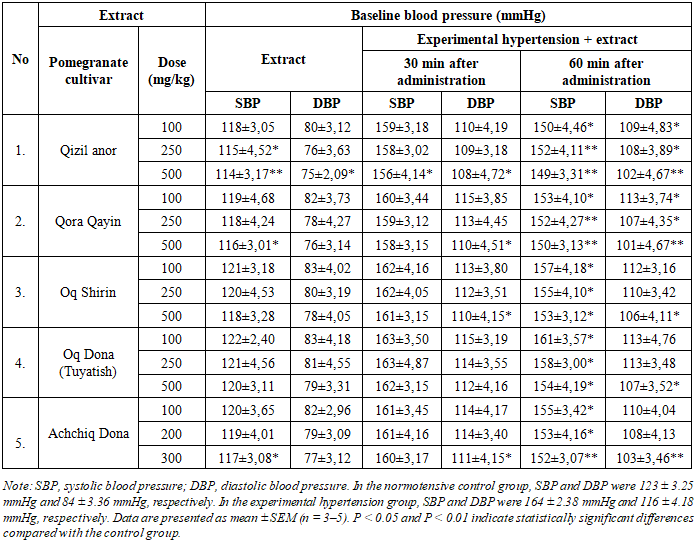
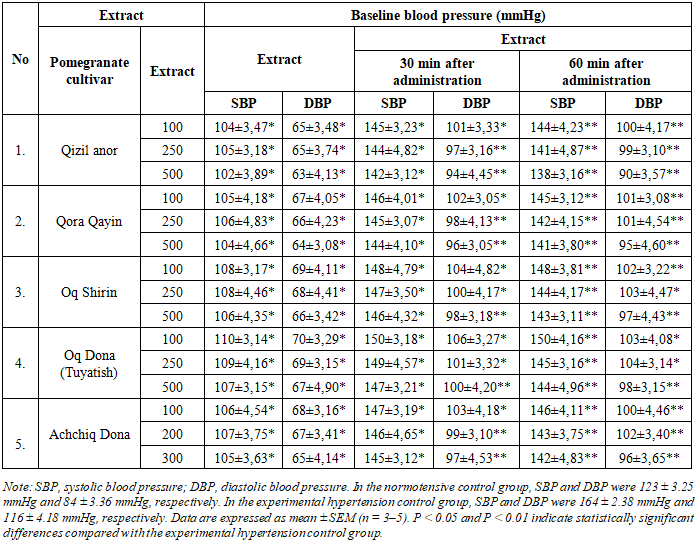
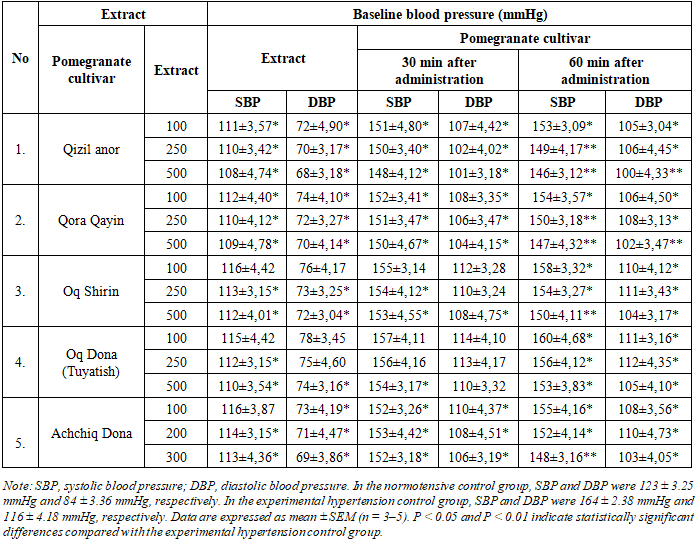
- Under physiological conditions (control group), the mean systolic arterial blood pressure (SBP) of the experimental rats was 123 ± 3.25 mmHg, whereas the mean diastolic arterial blood pressure (DBP) was 84 ± 3.36 mmHg. Following induction of experimental hypertension by intraperitoneal administration of adrenaline hydrochloride (0.25 mg kg⁻¹), blood pressure was measured after 30 min, at which time SBP and DBP increased significantly to 164 ± 2.38 mmHg and 116 ± 4.18 mmHg, respectively. These values are consistent with previously reported findings for adrenaline-induced hypertension models [40]. As described above, the pathogenesis of arterial hypertension involves activation of the sympathoadrenal system through α- and β-adrenergic receptors, which represent important pharmacological targets for antihypertensive therapy. Additional mechanisms include activation of the renin–angiotensin–aldosterone system (RAAS), disturbances in renal Na⁺, Ca²⁺, and K⁺ transport, enhanced sodium reabsorption, endothelial dysfunction resulting in reduced synthesis of bradykinin, nitric oxide (NO), and prostacyclin, together with increased production of angiotensin II and endothelin, all of which contribute to elevated vascular resistance and blood pressure [25,1]. Experimental hypertension induced by stress factors or pharmacological agents such as adrenaline is considered a reliable, reproducible, and widely accepted model for evaluating the antihypertensive activity of biologically active compounds because it closely mimics the sympathetic overactivation observed in human hypertension [11,12,33].Mechanistically, adrenaline activates α-adrenergic receptors located on vascular smooth muscle cell membranes, leading to stimulation of phospholipase C through G-protein signaling. This subsequently increases the production of inositol 1,4,5-trisphosphate (IP₃) and diacylglycerol (DAG). IP₃ activates IP₃ receptors located on the sarcoplasmic reticulum, resulting in intracellular Ca²⁺ release and elevation of cytosolic calcium concentration. Simultaneously, stimulation of β-adrenergic receptors increases intracellular cyclic AMP (cAMP), thereby contributing to vascular smooth muscle contraction and the development of hypertension [21,12,13]. The present study demonstrated that fruit juice extracts obtained from local pomegranate (Punica granatum L.) cultivars exhibited dose-dependent antihypertensive activity at doses ranging from 100 to 500 mg kg⁻¹. Overall antihypertensive efficacy increased in the following order:«Oq Dona (Tuyatish) » < «Oq Shirin» < «Achchiq Dona» < «Qora Qayim» < «Qizil Anor».Among the tested cultivars, the «Qizil Anor» fruit juice extract showed the strongest antihypertensive activity. At the highest tested dose (500 mg kg⁻¹) under physiological conditions, the extract significantly reduced SBP and DBP by 7.32% and 10.71%, respectively, corresponding to blood pressure values of 114 ± 3.17 mmHg (SBP) and 75 ± 2.09 mmHg (DBP) compared with the control group (Table 1).Furthermore, administration of the «Qizil Anor» fruit juice extract (500 mg kg⁻¹) to rats with adrenaline-induced experimental hypertension produced a pronounced antihypertensive effect. Sixty minutes after adrenaline injection (0.25 mg kg⁻¹), SBP and DBP were reduced by 9.15% and 12.07%, respectively, compared with the hypertensive control group, reaching values of 149 ± 3.31 mmHg (SBP) and 102 ± 4.67 mmHg (DBP) (Table 1).
|
|
|
4. Conclusions
- Overall, the available evidence indicates that the antihypertensive activity of plant-derived extracts is mediated through multiple complementary mechanisms. These include blockade of voltage-dependent Ca²⁺ channels, activation of Ca²⁺-activated K⁺ (KCa) channels, inhibition of α- and β-adrenergic receptors, stimulation of endothelial nitric oxide synthase (eNOS) and NO production, activation of endogenous antioxidant defense systems, and suppression of ACE activity and endothelin synthesis [35].The present study demonstrated that juice, peel, and seed extracts obtained from five local pomegranate (Punica granatum L.) cultivars («Qizil Anor», «Qora Qayim», «Oq Shirin», «Oq Dona (Tuyatish) » and «Achchiq Dona» ) possess significant in vivo antihypertensive activity.The antihypertensive effects of the extracts were dose-dependent over the range of 100–500 mg kg⁻¹, with the overall efficacy increasing in the following order:«Oq Dona (Tuyatish) » < «Oq Shirin» < «Achchiq Dona» < «Qora Qayim» < «Qizil Anor».The extracts significantly reduced both systolic and diastolic blood pressure under physiological conditions as well as in rats with adrenaline-induced experimental hypertension measured 60 min after administration of adrenaline hydrochloride (0.25 mg kg⁻¹).These findings provide experimental evidence supporting the therapeutic potential of local pomegranate cultivars as a valuable natural source of antihypertensive bioactive compounds. The results may serve as a scientific basis for the future development of functional foods, nutraceuticals, dietary supplements, and novel antihypertensive phytopharmaceuticals derived from pomegranate extracts.