
-
Paper Information
- Next Paper
- Previous Paper
- Paper Submission
-
Journal Information
- About This Journal
- Editorial Board
- Current Issue
- Archive
- Author Guidelines
- Contact Us
International Journal of Genetic Engineering
p-ISSN: 2167-7239 e-ISSN: 2167-7220
2026; 14(9): 232-236
doi:10.5923/j.ijge.20261409.02
Received: Aug. 10, 2026; Accepted: Sep. 5, 2026; Published: Sep. 9, 2026

Comparative Analysis of the Flowering Biology of Vigna umbellata (Thunb.) Ohwi & Ohashi Under Tashkent and Navoi Conditions
 Abstract
 Reference
 Full-Text PDF
 Full-text HTML
Makhfuza Nazaralieva
PhD Student, Denov Institute of Entrepreneurship and Pedagogy, Surkhandarya, Uzbekistan
Correspondence to: Makhfuza Nazaralieva, PhD Student, Denov Institute of Entrepreneurship and Pedagogy, Surkhandarya, Uzbekistan.
| Email: |  |
Copyright © 2026 The Author(s). Published by Scientific & Academic Publishing.
This work is licensed under the Creative Commons Attribution International License (CC BY).
http://creativecommons.org/licenses/by/4.0/

Vigna umbellata is a protein-rich leguminous crop that can grow even in low-fertility soils and is cultivated for food, fodder, green manure, and green hedges. However, its bioecological characteristics under the conditions of Uzbekistan have not been sufficiently studied. The research was carried out in experimental plots in Tashkent city and in Karmana district of Navoi region. The flowering dynamics of the plant were studied using the methods of A.N. Ponomaryov and Z.G. Bespalova. The results scientifically substantiated the dependence of the daily and seasonal flowering dynamics of V. umbellata on abiotic factors and compared these dynamics between the two regions. Based on the obtained results, the species can be cultivated as a promising leguminous crop in the foothill and desert zones of Uzbekistan.
Keywords: Vigna umbellata, Flowering phenology, Seasonal flowering dynamics, Daily flowering dynamics, Bioecological adaptation, Introduction, Relative air humidity, Air temperature
Cite this paper: Makhfuza Nazaralieva, Comparative Analysis of the Flowering Biology of Vigna umbellata (Thunb.) Ohwi & Ohashi Under Tashkent and Navoi Conditions, International Journal of Genetic Engineering, Vol. 14 No. 9, 2026, pp. 232-236. doi: 10.5923/j.ijge.20261409.02.
Article Outline
1. Introduction
- Climate change is causing noticeable shifts in the phenological phases of plants, particularly during the reproductive stage. Changes in air temperature, relative air humidity, and precipitation directly affect the onset, duration, and intensity of flowering and are among the main factors determining the bioecological adaptation of plants. Therefore, a comparative study of flowering biology under different ecological conditions is of considerable scientific importance for evaluating the introduction potential of plants across regions and for identifying their adaptation mechanisms under climate change.Vigna umbellata (Thunb.) Ohwi & Ohashi is one of the promising leguminous crops with high value as both food and fodder. This species is distinguished by its drought tolerance, its ability to grow on soils with low fertility, and its high nutritional value. In recent years, interest in this species has increased as an alternative crop for arid regions under climate change. In particular, its laboratory and field germination, phenology, and physiological parameters have been studied under the climatic conditions of Uzbekistan [1,2]. However, the reproductive biology of V. umbellata, especially the variability of its flowering phenology under different agroclimatic conditions, has not yet been sufficiently investigated.Previous studies have shown that sowing date and plant density significantly influence the vegetative growth and reproductive development of Vigna umbellata [3]. However, these studies have mainly focused on agronomic indicators rather than flowering dynamics in arid continental environments. Studies conducted under Indian conditions described the morphobiological characteristics of V. umbellata and reported that, during the flowering period, each raceme usually forms 5-20 flowers and that the peduncle may reach up to 20 cm in length. Although these data characterize the reproductive biology of the species, the daily and seasonal rhythm of flower opening and its relationship with ecological factors have not been described in detail [4]. Later molecular-genetic studies identified genetic mechanisms related to flowering time, maturation, and seed traits, and mapped genes and markers controlling flowering. While these studies are important for explaining the genetic basis of flowering, the manifestation of genetic potential under different ecological conditions, especially the dynamics of flowering in introduced areas, remains insufficiently clarified [5]. In addition, resistance to abiotic and biotic stresses has been widely studied in wild and cultivated species of the genus Vigna. Researchers emphasize that V. umbellata has a certain degree of adaptability to drought, salinity, and high temperature and is a valuable genetic resource for breeding [6,7]. Nevertheless, most existing studies have focused on stress tolerance, genetic diversity, and seed germination, while the relationship between flowering phenology, daily flowering rhythm, and ecological factors has been scarcely investigated. Therefore, studying the flowering dynamics of V. umbellata under introduced arid continental climatic conditions is important for assessing the ecological adaptation of the species, determining its reproductive biology, and scientifically justifying its introduction as a promising leguminous crop under the conditions of Uzbekistan.Existing studies describe the flowering biology of Vigna umbellata mainly in individual regions or under specific agroclimatic conditions. However, studies that comparatively analyze the flowering biology of the plant under different ecological conditions, particularly in different agroclimatic regions of Uzbekistan, have not been encountered. As a result, the level of ecological adaptability and introduction potential of the species has not been fully evaluated.The main aim of the study is to conduct a comparative analysis of the seasonal and daily flowering biology of V. umbellata introduced under the conditions of Tashkent and Navoi regions, to assess the influence of key climatic factors on flowering dynamics, and to identify the features of the species’ bioecological adaptation to different agroclimatic conditions.The scientific novelty of this study lies in the fact that the seasonal and daily flowering biology of Vigna umbellata (Thunb.) Ohwi & Ohashi introduced in Tashkent and Navoi regions, which differ in their agroclimatic conditions, was comparatively evaluated for the first time in Uzbekistan. Differences in the onset, duration, and daily rhythm of flowering were analyzed in relation to selected climatic factors, and the adaptation features and introduction prospects of the species under different introduction conditions were scientifically assessed on the basis of the obtained results.
2. Materials and Methods
2.1. Study Areas
- Tashkent city and Karmana district of Navoi region were selected as the study areas. These areas are located in different natural-geographical zones of Uzbekistan and differ from each other in climate, relief, and ecological conditions. Tashkent city is located in the north-eastern part of the republic, in the Chirchik-Akhangaran valley, at the foothills of the Western Tien Shan Mountains, at an average altitude of 440-480 m above sea level. The experimental site in Tashkent was located in the experimental field of the Botanical Garden of the National University of Uzbekistan named after Mirzo Ulugbek; the area is situated at approximately 444 m above sea level, belongs to the foothill zone, and has a temperate continental climate. Karmana district is located in the central part of Navoi region, in the lower reaches of the Zarafshan valley, at approximately 330-360 m above sea level. The area belongs to desert and semi-desert landscapes and is characterized by a sharply continental and dry climate.The selection of these areas made it possible to comparatively assess the factors affecting the growth, development, flowering, and productivity of the study object under different ecological and climatic conditions. Since the Tashkent area represents the foothill zone and Karmana district represents the desert zone, the obtained results are important for drawing scientific conclusions across different agroclimatic conditions.
2.2. Plant Material
- The experiment was conducted in 2024-2025. In each field plot, 40 plants were individually marked in four replications, with 10 plants in each replication. The results were calculated per 10 plants.
2.3. Experimental Design
- Seeds were sown in the third ten-day period of April and in the first ten-day period of May using a planting pattern of 30 x 10 cm. To assess the natural adaptability of the species under local environmental conditions, no mineral or organic fertilizers were applied during the experiment. Weeds were not removed during the growing season. Irrigation was carried out once a month by furrows, depending on the available water supply of the experimental field.
2.4. Flowering Observations
- Flowering dynamics were studied using the methods of Ponomaryov [8] (1960) and Bespalova [9] (1965). During seasonal observations, the onset, peak period, and completion of flowering were recorded throughout the growing season. To determine the daily flowering rhythm, the number of newly opened flowers was recorded every hour during the flowering period. To evaluate the relationship with flowering activity, data on air temperature and relative air humidity were obtained from the nearest meteorological station. Observations were carried out daily from 07:00 to 18:00, and only newly opened flowers were recorded at each observation time.
2.5. Meteorological Observations
- Daily meteorological data, including average, minimum, and maximum air temperature, relative air humidity, and precipitation, were obtained from Uzhydromet. These data were used to analyze the effect of climatic factors on seasonal and daily flowering dynamics.
2.6. Statistical Analysis
- The obtained data were processed in Microsoft Excel 2021 (Microsoft Corp., USA), and descriptive statistical indicators, including the arithmetic mean, were calculated. Graphs were prepared using Microsoft Excel 2021.
3. Results and Discussion
3.1. Comparative Description of the Climatic Conditions of Tashkent and Navoi Region
- In Tashkent city and Karmana district of Navoi region, which were selected as the study areas, climatic indicators differed considerably during 2024-2025 (Figures 1-2). In both areas, the average air temperature increased steadily from the spring months and reached its highest level in June-July. Air temperature began to decrease from the autumn months. However, clear differences were recorded between the observation years and the study areas in terms of precipitation and relative air humidity.During the growing season, which includes May-September, the average air temperature in 2024 was 25.8 °C in Tashkent and 26.1 °C in Navoi, while in 2025 it changed to 27.4 °C in Tashkent and 27.6 °C in Navoi (Figure 1). In 2025, a further increase in temperature was observed in both areas during the summer months, reaching 31.2 °C in Tashkent and 31.9 °C in Navoi in July (Figure 2). From the second half of the growing season, the temperature gradually decreased in both areas.Marked differences were observed in precipitation. In particular, in Tashkent conditions, the average amount of precipitation during May-September in 2024 and 2025 was 12.0 mm and 0.14 mm, respectively; in the source text, precipitation for May-June in 2024 and 2025 is reported as 17.9 mm and 3.5 mm, respectively. The average relative air humidity during May-September was recorded, according to the study areas and observation years, as 39% and 32.6% in Tashkent and 32.14% and 28.48% in Navoi (Figures 1-2).In general, Tashkent city was characterized by relatively more humid agroclimatic conditions and better precipitation supply during the growing season, whereas Navoi region was characterized by higher air temperature, lower precipitation, and lower relative humidity. These agroclimatic differences served as the basis for the comparative assessment of the observed differences in the seasonal and daily flowering biology of Vigna umbellata in the following sections.
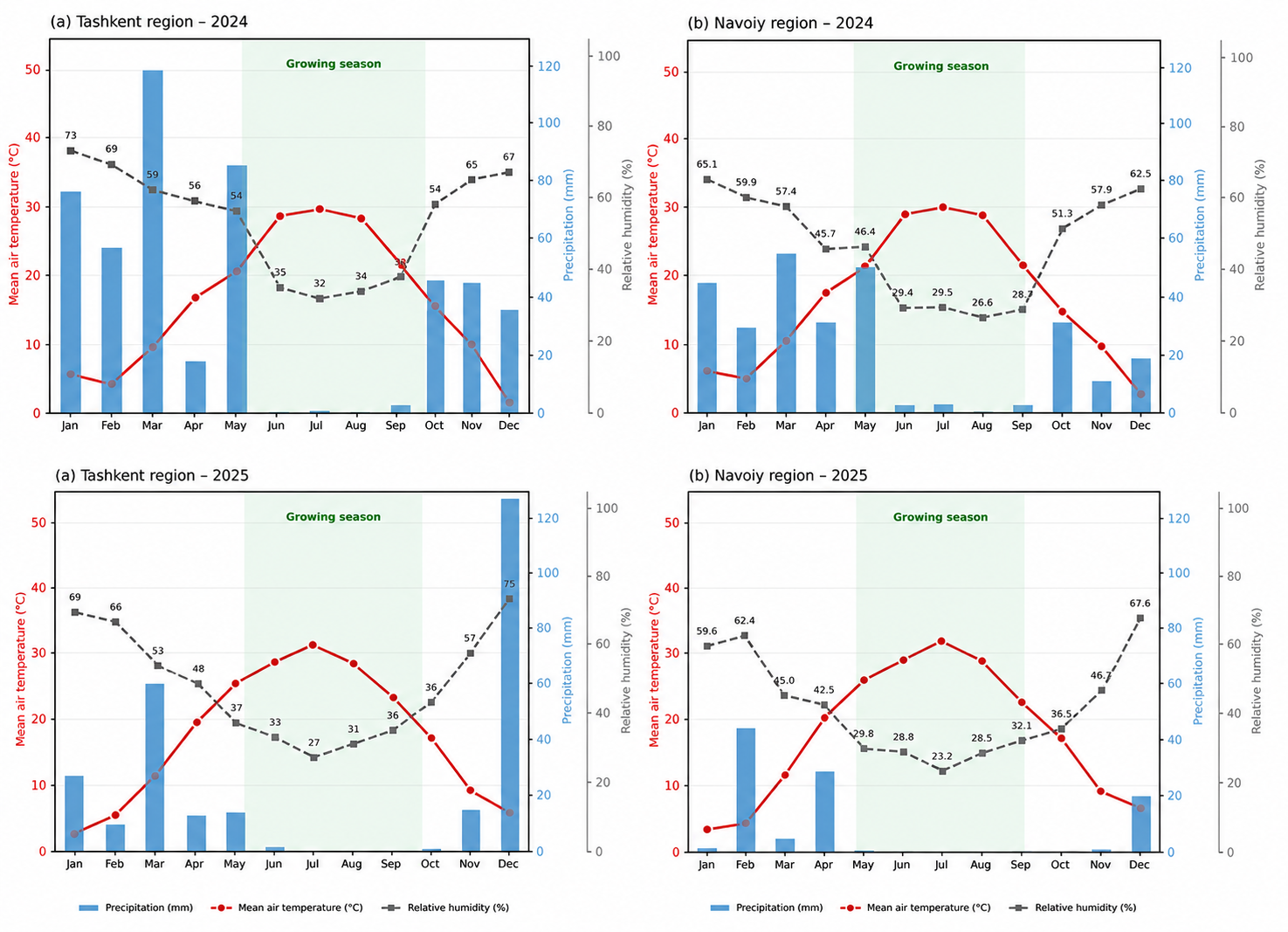 | Figure 1. Climadiagrams of Tashkent (a) and Navoi (b) conditions during 2024-2025 |
3.2. Comparative Analysis of Seasonal Flowering Biology
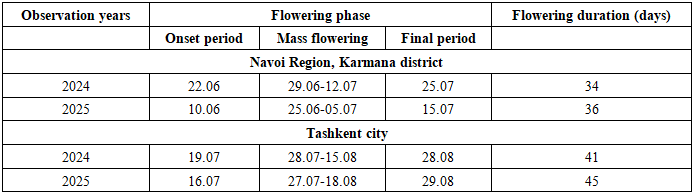
- Phenological observations of Vigna umbellata introduced in Tashkent and Navoi regions during 2024-2025 showed that the flowering biology of the plant is sensitive to agroclimatic conditions. In particular, the onset, duration, and intensity of flowering differed markedly by study area and year.Under the conditions of Karmana district of Navoi region, flowering began much earlier than under Tashkent conditions. In 2024, flowering began on 22 June, ended on 25 July, and the total flowering duration was 34 days. In 2025, flowering began on 10 June and continued until 15 July, with a duration of 36 days. By contrast, under Tashkent conditions, flowering in 2024 began on 19 July, ended on 28 August, and lasted 41 days. In 2025, flowering continued from 16 July to 29 August, with a duration of 45 days. Consequently, flowering under Tashkent conditions lasted 7-9 days longer than in Navoi (Table 1). In both areas, the onset of flowering began with 1-2 flowers opening per day, while the number of newly opened flowers increased sharply during the mass flowering stage. At the final stage of flowering, the number of new flowers gradually decreased, and by the end of the growing season the flowering process was completed. The observations showed that, under introduction conditions, the flowering biology of V. umbellata changes in accordance with the agroclimatic characteristics of the regions.
|
3.3. Comparative Analysis of Daily Flowering Dynamics
- Daily observations showed that the flowers of Vigna umbellata do not open uniformly throughout the day, but rather exhibit high activity during a specific time interval. In both study areas, the opening of new flowers began in the morning hours, reached its highest intensity in the first half of the day, and then gradually decreased in the afternoon. In both years, flower opening was observed between 07:00 and 10:00. This indicates that the species has a morning daily flowering rhythm. In 2025, flowering intensity was higher in both areas than in 2024, which suggests that V. umbellata is adapting to the existing climatic conditions.The flowering period lasted approximately 35-40 days under Navoi conditions and 40-45 days under Tashkent conditions, while each flower remained open for only one day. This indicates that the flower opening of V. umbellata is of the diurnal type. Most members of the Fabaceae family typically show a similar flowering pattern. In this case, the flowers begin to open in the early morning, remain open for several hours, and complete their functional role on the same day. Such a flowering type indicates that the total flowering duration results from the continuous daily opening of new flowers.
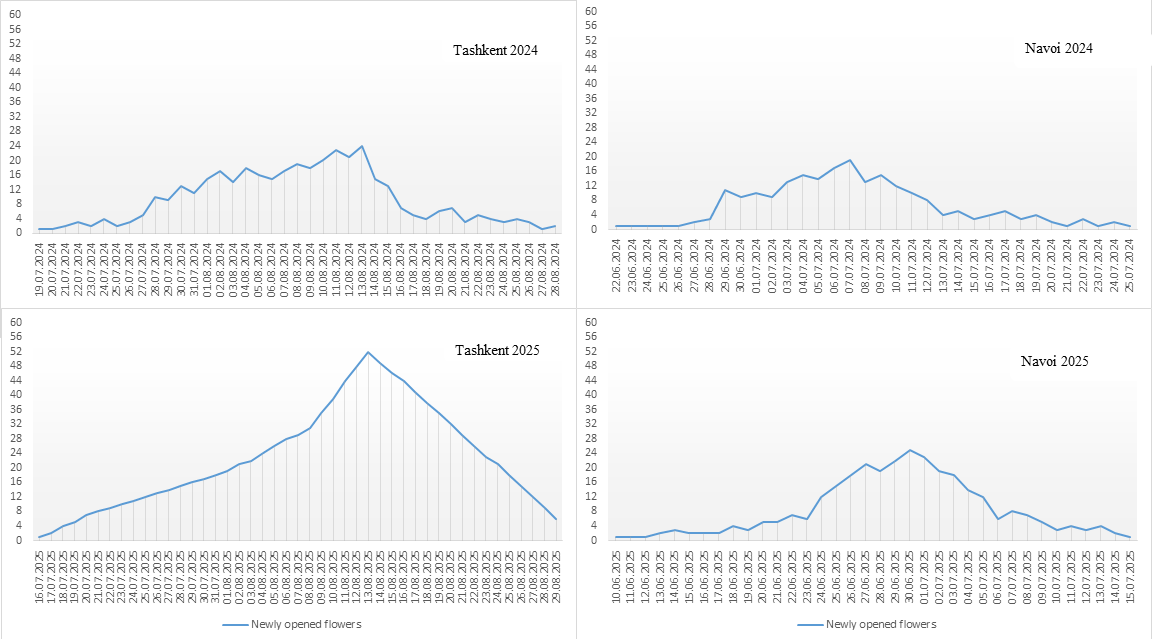 | Figure 2. Number of flowers opened daily under Tashkent and Navoi conditions (2024-2025) |
4. Conclusions
- In conclusion, observations of the flowering process of V. umbellata under two different environmental conditions showed that flower opening occurred in the morning, at around 07:00-08:00, when the air temperature was +29.1-31.1 °C and relative air humidity was 15-35%. Mass flowering occurred at around 09:00, when the air temperature began to rise and relative air humidity was still moderate. The duration of flowering under Navoi climatic conditions was shorter than under the conditions of Tashkent city. This was associated with differences in air temperature, annual precipitation, and relative air humidity.