
-
Paper Information
- Next Paper
- Paper Submission
-
Journal Information
- About This Journal
- Editorial Board
- Current Issue
- Archive
- Author Guidelines
- Contact Us
International Journal of Genetic Engineering
p-ISSN: 2167-7239 e-ISSN: 2167-7220
2026; 14(9): 225-231
doi:10.5923/j.ijge.20261409.01
Received: Aug. 12, 2026; Accepted: Sep. 3, 2026; Published: Sep. 9, 2026

Granulometric Composition, Agro-Production Assessment, and Pedogenetic Evolutionary Processes of Soils in the Shahrisabz Urban Area
 Abstract
 Reference
 Full-Text PDF
 Full-text HTML
Parpiyev Gofurjon Toxirovich1, Dilmurodov Asliddin Nizomiddin ugli2
1Doctor of Biological Sciences, Professor, National Center for Knowledge and Innovation in Agriculture, Uzbekistan
2PhD Doctoral Student, Tashkent State Agrarian University, Uzbekistan
Correspondence to: Parpiyev Gofurjon Toxirovich, Doctor of Biological Sciences, Professor, National Center for Knowledge and Innovation in Agriculture, Uzbekistan.
| Email: |  |
Copyright © 2026 The Author(s). Published by Scientific & Academic Publishing.
This work is licensed under the Creative Commons Attribution International License (CC BY).
http://creativecommons.org/licenses/by/4.0/

The article provides a scientific assessment of the granulometric composition, mechanical composition groups, physical clay content, and agro-production properties of the soils in the territory of Shahrisabz city, Kashkadarya Region, Republic of Uzbekistan. The study examined irrigated typical sierozems, meadow-sierozem, meadow, and meadow-saz soils distributed within the study area. The results showed that the physical clay content ranged from 19.1 to 66.0%, indicating that the soils belonged to light, medium, and heavy loamy mechanical composition groups. Medium loamy soils exhibited the most favorable agro-production properties, whereas heavy loamy soils had high potential fertility but required regulation of the water-air regime and appropriate ameliorative measures. The study established that the evolutionary development of soils in Shahrisabz is influenced by natural pedogenesis, irrigation-induced agropedogenesis, hydromorphic processes, urban pedogenesis, and biopedogenesis in green urban areas. The development of soddy layers was identified as an important factor contributing to soil biological activity, structural stability, and ecological sustainability. The findings provide a scientific basis for rational urban soil management, agroecological monitoring, and the prevention of soil degradation.
Keywords: Granulometric composition, Physical clay, Medium loamy soil, Agro-production assessment, Soddy layer, Pedogenesis, Agropedogenesis, Urban pedogenesis, Biopedogenesis
Cite this paper: Parpiyev Gofurjon Toxirovich, Dilmurodov Asliddin Nizomiddin ugli, Granulometric Composition, Agro-Production Assessment, and Pedogenetic Evolutionary Processes of Soils in the Shahrisabz Urban Area, International Journal of Genetic Engineering, Vol. 14 No. 9, 2026, pp. 225-231. doi: 10.5923/j.ijge.20261409.01.
Article Outline
1. Introduction
- Soil is one of the fundamental components of the biosphere, and its physical, chemical, and biological properties determine the stability of terrestrial ecosystems, food security, and the ecological condition of territories. One of the founders of soil science, V.V.Dokuchaev, defined soil as a “natural-historical body” and scientifically established that its formation is the result of the interaction of parent material, climate, relief, living organisms, and time [1]. This concept constitutes the theoretical basis for modern studies of soil evolution, anthropogenic transformation, and urban soils.Today, sustainable soil resource management, prevention of soil degradation, and assessment of soil health are among the priority areas of global scientific research. According to studies conducted by FAO and the Global Soil Partnership [5,6], soil health is assessed using a system of physical, chemical, and biological indicators, among which granulometric composition, bulk density, water-physical properties, organic carbon content, and biological activity are considered key indicators. According to FAO data, a large proportion of the world's soils are exposed to degradation processes caused by erosion, salinization, compaction, depletion of organic matter, and urbanization [4].In recent years, particular attention has been paid to the study of urban soils. Urbanization processes may cause disruption of soil profiles, compaction, soil sealing, reduction of biological activity, and changes in natural soil functions. In classical studies of urban soils, P.J. Craul [2,12] demonstrated that soils in urban environments may undergo substantial anthropogenic transformation and may contain mixed horizons, compacted layers, and technogenic materials. This approach contributed to the development of the concept of urban pedogenesis.Lehmann and Stahr [3] emphasized the need to consider not only the productive functions of urban soils but also their ecosystem services. According to the authors, urban soils play an important ecological role in regulating water, storing carbon, supporting biodiversity, and regulating the urban microclimate. Therefore, assessment of the physical condition of urban soils, including their granulometric composition and structural properties, is an important component of ecological monitoring.Recent studies have proposed the use of integrated indicators to assess the condition of urban soils. Séré et al. [7] developed a specific indicator system based on physical, chemical, and biological parameters to assess urban soil functions. The study examined 109 urban soils under different land-use conditions and found that soils in parks and green areas had higher ecological functionality, whereas compacted and sealed soils demonstrated lower functional capacity.Soil granulometric composition is one of its principal diagnostic characteristics. The ratio of sand, silt, and clay fractions determines water-physical properties, water-holding capacity, aeration, structural stability, and the ability to retain nutrients. The Kachinsky method is widely used for determining and assessing soil mechanical composition, while the content of physical clay serves as an important criterion for distinguishing soils according to their agro-production groups [10]. Studies of soil physical properties have identified granulometric composition as one of the principal factors in assessing soil fertility and ameliorative condition [11].In Uzbekistan, the formation of irrigated soils is associated not only with natural pedogenetic processes but also with long-term irrigation, agricultural activity, and anthropogenic impacts. In irrigated sierozems, meadow-sierozems, and hydromorphic soils, changes in mechanical composition, development of illuvial processes, salinization, and compaction determine the principal directions of soil evolution.The soils of the Shahrisabz urban area represent a complex soil-ecological system formed under the influence of both natural and anthropogenic factors. Irrigated typical sierozems, meadow-sierozems, meadow, and meadow-saz soils distributed throughout the area differ in granulometric composition, development of soddy layers (approximately 0-10 cm), and agro-production properties. In these soils, evolutionary processes can be observed in the sequence of natural pedogenesis → agropedogenesis → urban pedogenesis → biopedogenesis.Therefore, studying the granulometric composition of soils in the Shahrisabz urban area, determining their physical clay content, and assessing their agro-production properties are of considerable scientific and practical importance for rational soil resource management, development of urban green areas, and prevention of soil degradation.
2. Materials and Methods
- The study was conducted on irrigated typical sierozems, meadow-sierozems, meadow, and meadow-saz soils distributed throughout the Shahrisabz urban area. Soil profiles were selected and morphologically described using standard field soil-science methods.The granulometric composition of soil samples was determined using the Kachinsky method. The contents of sand, silt, and clay fractions were calculated. The content of physical clay (<0.01 mm) was used to determine mechanical composition groups and assess agro-production properties [8,9].The study included a comprehensive analysis of soil profile morphology, degree of development of soddy layers, changes in mechanical composition along the soil profile, and soil evolutionary processes.
3. Results and Discussion
- The study of the granulometric composition, morphogenetic characteristics of soddy layers, and agro-production potential of soils in the Shahrisabz urban area is of considerable scientific and practical importance for assessing the current condition of the soil cover. Soil mechanical composition is one of the principal diagnostic indicators reflecting the conditions of soil genesis. The ratio of sand, silt, and clay particles determines water-physical properties, structural stability, water-retention capacity, nutrient accumulation potential, and the environment available for plant root development.At the same time, soddy-accumulative layers approximately 0-10 cm thick formed in the upper part of the soil profile represent important genetic horizons determining soil fertility and ecological stability. Their formation is closely associated with vegetation density, continuous accumulation of organic residues, microbial activity, and soil moisture conditions. The accumulation of organic matter in soddy layers improves soil structure, increases aggregate stability, and optimizes the soil water-air regime. Particularly in long-term irrigated soils, the degree of preservation of soddy layers is an important indicator of agroecological condition.The results obtained in the Shahrisabz urban area demonstrated that the granulometric composition of the soil cover is heterogeneous. The formation of soil mechanical composition is influenced by geomorphological conditions, parent material composition, irrigation history, duration of land use, and anthropogenic impacts. During the study, the contents of sand fractions (>0.25; 0.25-0.1; 0.1-0.05 mm), silt fractions (0.05-0.01; 0.01-0.005; 0.005-0.001 mm), and clay fractions (<0.001 mm) were determined in soil profiles, and the physical clay content (<0.01 mm) was subsequently assessed.The results showed that the physical clay content in the soils of the Shahrisabz urban area ranged from 19.1 to 66.0%, and the soils were classified into light, medium, and heavy loamy mechanical composition groups (Table 1). The wide range of these values indicates differences in the distribution of mechanical particles within the soil profile and reflects the specific evolutionary processes occurring in different soil types.In addition to granulometric composition, the structural condition of the approximately 0-10 cm soddy layers plays an important role in determining agro-production properties. Soils with a moderate physical clay content generally develop well-formed soddy layers that provide favorable conditions for organic matter accumulation. The balance between sand and clay fractions in such soils contributes to an optimal water-air regime and creates favorable conditions for root development.In heavy loamy soils with a high physical clay content, soddy layers are characterized by high cation-exchange capacity and high water-holding capacity. However, such soils may experience compaction, reduced water permeability, and restricted aeration. Therefore, the richness of soddy layers in organic matter is particularly important for maintaining structural stability in these soils.The evolutionary development of soils in the Shahrisabz urban area reflects the combined influence of natural pedogenesis, sod formation, agropedogenesis associated with irrigated agriculture, and urban pedogenesis. The soil cover initially developed under natural conditions and subsequently underwent transformation as a result of irrigation, cultivation, and urban infrastructure development. Throughout these processes, the degree of preservation of soddy layers has been an important factor determining the continuity of soil ecological functions.Irrigated Typical SierozemIrrigated typical sierozems represent one of the genetically important soil groups in the Shahrisabz urban area. Their present condition has developed under the combined influence of natural soil-forming processes and long-term irrigated agriculture (Table 1). Their granulometric composition, particularly physical clay content and the degree of development of upper soddy-accumulative layers, represents one of the principal factors determining their agro-production properties.The formation of soddy layers in irrigated typical sierozems is mainly associated with high biological activity, regular accumulation of plant residues, and intensive organic matter cycling. The accumulation of humic substances in these layers improves soil structure, increases aggregate stability, and enhances the binding of mechanical particles. As a result, physical properties such as water retention, water permeability, and aeration become more stable.In the soil profile at Amir Temur Square (profile No. 56), the physical clay content was 40.6% in the upper 0-12 cm soddy layer, 42.2% at 12-19 cm, and 38.2% at 19-30 cm. These values indicate a relatively uniform mechanical composition throughout the profile and allow the soil to be classified as medium loamy (Table 1).The soddy layer formed in the upper part of these soils has a favorable aggregate condition resulting from the combined effects of mechanical composition and biological processes. The medium loamy texture provides a balanced water-air regime and favorable conditions for plant root development. Consequently, these soils have high agro-production potential for urban green areas, park complexes, and intensively cultivated agricultural lands.Soils located in the A.Temur massif of the “Fayzobod” mahalla (profile No. 59) showed a gradual increase in mechanical heaviness with depth. The physical clay content was 43.8% in the upper 0-28 cm layer, increasing to 54.0% at 60-95 cm and 56.4% at 145-190 cm. This pattern indicates the accumulation of fine-dispersed particles in the lower part of the soil profile and suggests intensified illuvial processes.In these soils, the soddy layer has developed through the accumulation of organic matter in the upper horizons and plays an important role in maintaining biological activity and structural stability. However, increasing mechanical heaviness may slow water movement and promote compaction in the lower horizons. Therefore, the use of organic fertilizers, maintenance of soil structure, and regulation of the water regime are important management measures.Soils in the “Kamolot” mahalla (profile No. 58) also showed a relatively heavy mechanical composition. The physical clay content ranged from 45.4 to 62.8%, and the soils were mainly classified as heavy loams. The increase in physical clay content with depth indicates migration and redistribution of fine-dispersed particles, potentially associated with long-term irrigation.The presence of soddy layers in these soils contributes to ecological stability. Organic matter-enriched upper horizons reduce soil compaction, improve water infiltration, and create favorable conditions for microbial activity. Thus, maintaining soddy layers in heavy-textured soils is important for stabilizing soil fertility.Overall, the granulometric composition and development of soddy layers in irrigated typical sierozems represent key factors determining their agro-production potential. In medium loamy soils, the combination of these factors produces high fertility and favorable water-physical conditions, whereas heavy loamy soils possess high potential fertility but require appropriate ameliorative management.Irrigated Meadow-Sierozem SoilsIrrigated meadow-sierozem soils in the Shahrisabz urban area differ from irrigated typical sierozems in their genesis, moisture regime, and granulometric composition (Table 1). Their formation is associated with the influence of hydromorphic processes, relatively shallow groundwater, periodic wetting, and agropedogenic processes resulting from long-term irrigation.The formation of soddy-accumulative layers in these soils is associated with the development of meadow vegetation, regular accumulation of root residues, and intensive organic matter cycling. The accumulation of humic substances in soddy layers increases biological activity, promotes structural development, and enhances the formation of stable aggregates. In meadow-sierozem soils, these processes are closely linked to moisture conditions and play an important role in the development of soil fertility (Table 1).In soils located along Buyuk Ipak Yuli Street (profile No. 95), the physical clay content decreased from 27.0 to 19.1%. These values indicate a predominance of light mechanical composition and allow the soils to be classified as light loams.The relatively high proportion of sand fractions in the upper soddy layers contributes to favorable water permeability and aeration. However, due to their light texture, these soils have a relatively low capacity to retain moisture and soluble nutrients. Therefore, enrichment with organic matter, preservation of sod cover, and moisture-conserving agricultural practices are important for maintaining soil fertility.In soils of the “Oymovut” mahalla (profile No. 82), an increase in mechanical heaviness with depth was observed. The physical clay content increased from 33.1 to 50.9%, with medium loamy texture in the upper horizons and heavy loamy texture in the lower horizons.This pattern indicates downward movement of fine-dispersed particles and the development of illuvial processes within the profile. Such processes may intensify under irrigation and lead to compaction and reduced water permeability in certain horizons. At the same time, the presence of an upper soddy layer contributes to improved soil structure, increased biological activity, and preservation of organic matter reserves.From an evolutionary perspective, irrigated meadow-sierozem soils developed initially under natural meadow-forming conditions and subsequently underwent transformation under irrigated agriculture and anthropogenic influence. Natural pedogenesis and agropedogenesis have therefore jointly contributed to their present granulometric and morphological characteristics.Thus, the agro-production assessment of irrigated meadow-sierozem soils is determined not only by mechanical composition but also by the degree of development of soddy layers. In light loamy soils, soddy layers are particularly important for moisture regulation and structural development, whereas in medium and heavy loamy soils they contribute to reducing compaction and maintaining ecological soil functions.Irrigated Meadow SoilsIrrigated meadow soils represent one of the widespread soil groups in the Shahrisabz urban area. Their formation is associated with high moisture availability, meadow vegetation, and long-term irrigation. These soils vary considerably in granulometric composition, ranging from light to heavy loams (Table 1).
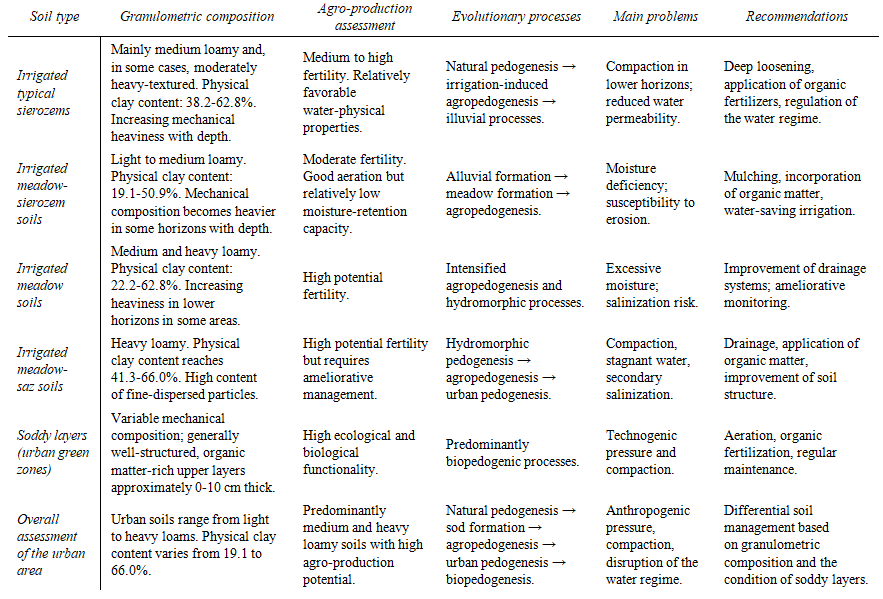 | Table 1. Granulometric Composition, Agro-Production Assessment, and Evolutionary Processes of Soils in the Shahrisabz Urban Area |
4. Conclusions, Proposals, and Recommendations
- 1. The study of the granulometric composition and formation characteristics of soddy layers in the soils of the Shahrisabz urban area demonstrated that the soil cover represents a complex evolutionary system formed under the combined influence of natural pedogenesis and long-term anthropogenic impacts. The physical clay content (<0.01 mm) ranged from 19.1 to 66.0%, and the soils were classified into light, medium, and heavy loamy mechanical composition groups. This differentiation results in significant variations in water-physical properties, structural stability, moisture-retention capacity, and agro-production potential.2. Soddy-accumulative layers formed in the soils of the Shahrisabz urban area were identified as important genetic indicators of soil fertility and ecological stability. Their development is associated with vegetation, accumulation of organic residues, microbial activity, and moisture conditions. These layers play a significant role in the formation of soil structure, humus reserves, and biological activity. In particular, well-developed soddy layers in medium loamy soils optimize the soil water-air regime and contribute to high agroecological potential.3. The agro-production assessment of irrigated typical sierozems, meadow-sierozems, meadow, and meadow-saz soils is directly related to their granulometric composition and the distribution of mechanical particles throughout the soil profile. Medium loamy soils with a physical clay content of 30–45% demonstrated the most favorable agro-production properties, with optimal water-air conditions, favorable tillage characteristics, and nutrient-retention capacity. Heavy loamy soils with physical clay contents exceeding 45% possess high potential fertility but are characterized by compaction, reduced water permeability, and restricted aeration.4. The increasing mechanical heaviness observed within soil profiles and the accumulation of fine-dispersed particles in lower horizons indicate long-term irrigation and the development of illuvial processes. In particular, the increase in physical clay content in deeper horizons in the “Fayzobod,” “Kamolot,” “Oymovut,” and other areas indicates migration and redistribution of materials within the soil profile. These processes demonstrate the increasing influence of agropedogenic and urban-pedogenic factors on the present condition of the soils.5. The evolutionary development of soils in the Shahrisabz urban area involves the sequential and interconnected influence of natural pedogenesis, sod formation, agropedogenesis, urban pedogenesis, and biopedogenesis. Although naturally formed soils have subsequently undergone transformation under irrigation, economic activities, and urban environmental pressures, preserved soddy layers in green areas remain important for restoring ecological soil functions and maintaining soil stability. Therefore, the degree of soddy-layer development should be considered an important diagnostic criterion alongside granulometric composition.6. For effective soil management in the Shahrisabz urban area, differential agronomic and ameliorative measures should be implemented based on granulometric composition and the condition of soddy layers approximately 0–10 cm thick. In light loamy soils, measures aimed at increasing organic matter reserves and conserving moisture should be prioritized; in medium loamy soils, existing fertility potential should be maintained; and in heavy loamy soils, management should focus on preventing compaction, improving soil structure, and regulating the water-air regime.7. In urban green areas, parks, and recreational zones, preservation of soddy layers and enhancement of their biological activity are recommended as important measures for maintaining ecological soil stability. Prevention of mechanical disturbance of the soil surface, application of organic fertilizers, maintenance of vegetation cover, and regular monitoring of soil humus status can reduce the negative effects of urban pedogenic pressures.