
-
Paper Information
- Paper Submission
-
Journal Information
- About This Journal
- Editorial Board
- Current Issue
- Archive
- Author Guidelines
- Contact Us
International Journal of Genetic Engineering
p-ISSN: 2167-7239 e-ISSN: 2167-7220
2026; 14(8): 218-223
doi:10.5923/j.ijge.20261408.05
Received: Aug. 10, 2026; Accepted: Aug. 28, 2026; Published: Aug. 31, 2026

First Report of Hemiclepsis marginata Parasitism on Alburnoides holciki in Uzbekistan
 Abstract
 Reference
 Full-Text PDF
 Full-text HTML
Salokhiddin Usmonov, Khayrulla Solijonov
Department of Ecology and Sustainable Development, Andijan State University, 129 University Street, Andijan City, Uzbekistan
Correspondence to: Salokhiddin Usmonov, Department of Ecology and Sustainable Development, Andijan State University, 129 University Street, Andijan City, Uzbekistan.
| Email: |  |
Copyright © 2026 The Author(s). Published by Scientific & Academic Publishing.
This work is licensed under the Creative Commons Attribution International License (CC BY).
http://creativecommons.org/licenses/by/4.0/

Parasitic freshwater leeches may affect fish health by producing feeding lesions, weakening the host and creating favourable conditions for secondary infections; however, host records from Central Asian inland waters remain limited. We report a new host-parasite association of the freshwater leech Hemiclepsis marginata with the riffle minnow Alburnoides holciki in the Surkhandarya basin, Uzbekistan. In late May 2025, leeches and fish were collected from shallow freshwater biotopes at 38°19'03.3N, 67°54'27.2E. Twenty-four leech specimens were examined using external morphology, body measurements and standard taxonomic characters. Leeches were attached to the soft external tissues of A. holciki, mainly the gills, fins and skin. The locality was characterized by 30-70 cm water depth, 15-20 °C water temperature, pH 6.9 and dissolved oxygen of 8.11 mg/L. The bottom substrate was sandy and slightly marshy and contained insect larvae, mollusks and other benthic invertebrates. A review of available host records for the genus Hemiclepsis revealed no previous record of H. marginata parasitizing A. holciki. This finding expands the known host range of H. marginata and represents the first documented association between this leech and A. holciki. The occurrence of the species at a locality showing visible signs of anthropogenic disturbance provides additional information on its habitat use in Uzbekistan. Further studies should assess prevalence, seasonal dynamics, pathological effects and the potential role of H. marginata in pathogen transmission within native fish communities.
Keywords: Glossiphoniidae, Host-parasite interaction, Cyprinid fish, Central Asia, Inland waters, Host record
Cite this paper: Salokhiddin Usmonov, Khayrulla Solijonov, First Report of Hemiclepsis marginata Parasitism on Alburnoides holciki in Uzbekistan, International Journal of Genetic Engineering, Vol. 14 No. 8, 2026, pp. 218-223. doi: 10.5923/j.ijge.20261408.05.
Article Outline
1. Introduction
- Leeches (Annelida: Clitellata: Hirudinida) are an ecologically diverse group of annelids inhabiting freshwater, marine and terrestrial ecosystems. More than 900 species have been described worldwide, although recent taxonomic, molecular and genomic studies indicate that hirudinean diversity remains incompletely documented, particularly in poorly investigated regions [11,13,19,20]. Freshwater leeches occupy a range of trophic niches, including predation, temporary ectoparasitism and associations with other aquatic organisms. The family Glossiphoniidae Vaillant, 1890 is an exclusively freshwater lineage that includes numerous species with specialized host associations [21].Parasitic and blood-feeding leeches are associated with various vertebrate hosts, particularly fishes, amphibians and reptiles. Fish-associated leeches usually act as temporary ectoparasites and may attach to the skin, fins, oral cavity and gills [4,23]. Their feeding activity can cause localized tissue damage, haemorrhage and blood loss, while severe infestations may lead to epithelial damage, inflammatory responses and reduced host condition [1,24]. Gill attachment may be particularly important because injury to highly vascularized branchial tissues can potentially affect respiratory function. Feeding lesions may also facilitate secondary infections, and some fish-associated leeches have been implicated as mechanical or biological vectors of aquatic pathogens [2,4,6]. Thus, fish-leech interactions are relevant to parasite biodiversity, fish health and freshwater disease ecology.The genus Hemiclepsis Vejdovsky, 1884 comprises dorsoventrally flattened glossiphoniid leeches occurring mainly in freshwater habitats. Members of the genus are associated with freshwater fishes and other vertebrates, while several species also use freshwater mussels as shelters or secondary hosts [3,18]. Recent studies show that host associations within Hemiclepsis are more diverse than previously recognized. Hemiclepsis yangtzenensis Xu et al., 2021, for example, was described from Asian swamp eel (Monopterus albus) stocks in China [18], while hirudiniasis caused by Hemiclepsis marginata asiatica has been documented in aquarium-reared red-bellied pacu, Piaractus brachypomus [22]. These findings emphasize the importance of new host records for understanding host specificity and ecological plasticity in freshwater leeches.Hemiclepsis marginata (O. F. Müller, 1774) is one of the most widely distributed members of the genus and has been reported from Palearctic and Oriental freshwater systems. Its morphology, taxonomy, geographic distribution and host associations have been discussed in both classical and recent studies [10,17]. In Uzbekistan, the species was historically reported from the Zarafshan River basin and other inland waters [14]. More recent morphological and molecular studies confirmed H. marginata in the Fergana Valley and provided additional information on its taxonomy and biology in Central Asia [17]. Associations with the Aral basin snowtrout Schizothorax eurystomus and the marsh frog Pelophylax ridibundus have also been documented in Uzbekistan [17]. Nevertheless, information on the host spectrum, attachment sites and ecological characteristics of H. marginata in Central Asian inland waters remains limited.Reliable documentation of new host–parasite associations is particularly important in regions where freshwater parasite communities are insufficiently studied. Recent studies of fish-associated leeches have shown that well-documented host records can provide useful information on parasite distribution, host use and regional parasite diversity [23]. Studies of other fish-parasitic leeches also indicate that geographic and host ranges may be broader than suggested by historical records [25]. Therefore, additional verified host records are needed to better understand the host range of H. marginata.The riffle minnow Alburnoides holciki Coad & Bogutskaya, 2012 (Leuciscidae) is a Central Asian freshwater fish originally described from the Hari River basin [5]. Subsequent morphological and molecular studies expanded its known distribution in Central Asia [9], and DNA barcoding confirmed its occurrence in the inland waters of Uzbekistan [15]. Some populations previously identified as A. eichwaldii were shown to represent A. holciki, demonstrating that its distribution extends farther north than previously recognized [15]. Despite increasing knowledge of its distribution and molecular identity, information on the parasites and ectoparasitic associations of A. holciki remains very limited.The Surkhandarya basin in southern Uzbekistan forms part of the upper Amu Darya drainage and supports diverse native freshwater communities. However, host-parasite relationships involving freshwater leeches and native fishes of this region remain poorly documented. Establishing such records is important for improving regional biodiversity inventories and providing baseline information for future studies of parasite distribution and fish health.Therefore, the aim of the present study was to document a previously unreported host–parasite association between Hemiclepsis marginata and Alburnoides holciki in the Surkhandarya basin, Uzbekistan. We provide morphological evidence for leech identification, document its attachment to the external tissues of A. holciki, characterize the environmental conditions of the collection locality, and evaluate the record in the context of previously published host associations within the genus Hemiclepsis. This study expands current knowledge of the host range of H. marginata and contributes new information to the parasitological and biodiversity inventory of Central Asian freshwater ecosystems.
2. Materials and Methods
- Leech specimens were collected in late May 2025 from freshwater biotopes of the Surkhandarya basin, Uzbekistan (38°19'03.3"N, 67°54'27.2"E). A total of 24 leech individuals of different body sizes were obtained using hydrobiological collecting instruments. Fish specimens were collected from the same biotopes where the leeches were recorded. The sampling locality and specimen photographs were documented by Salokhiddin Usmonov and Khayrulla Solijonov (Figure 1).
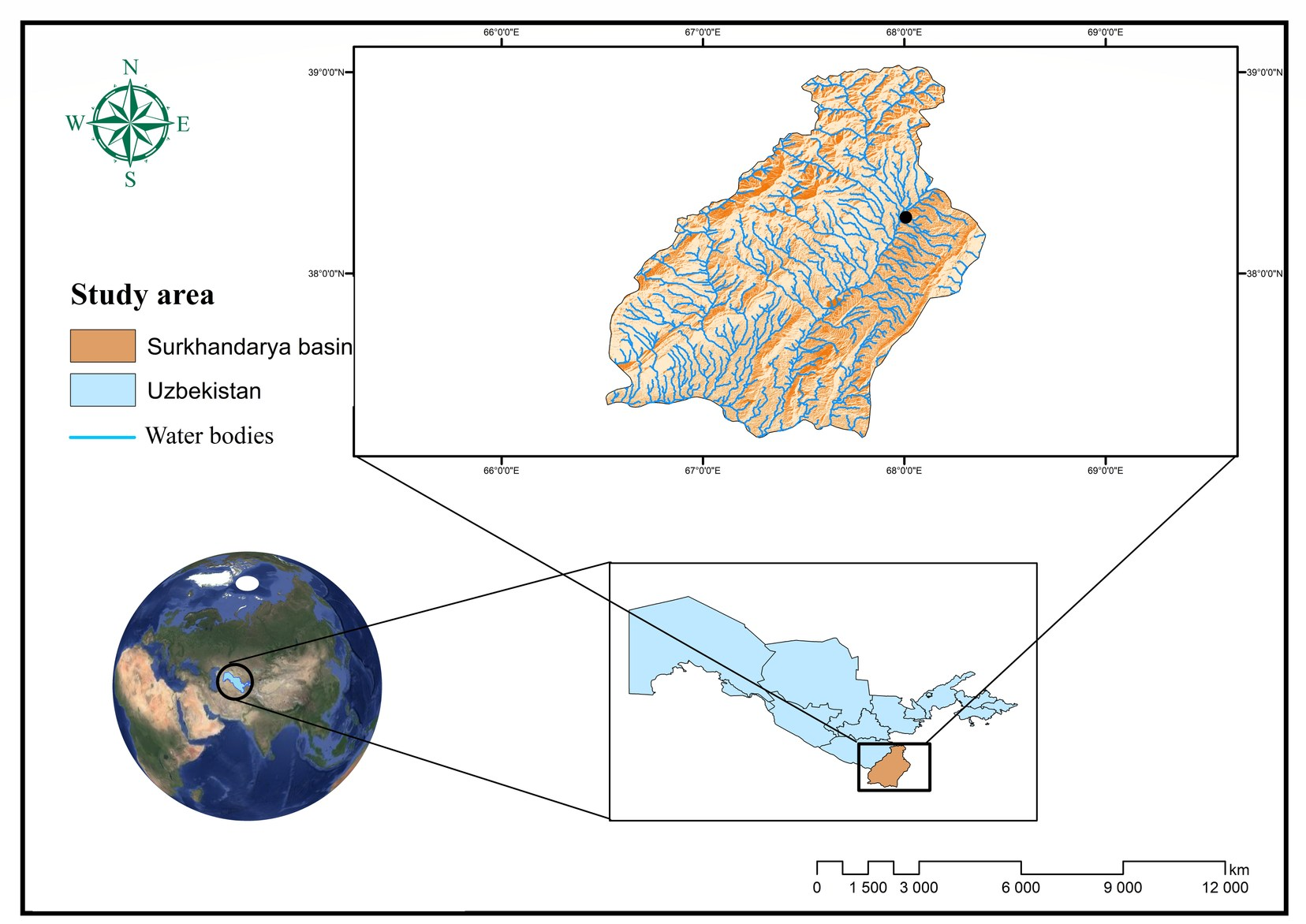 | Figure 1. Sampling Locality of Hemiclepsis marginata in the Surkhandarya Basin, Uzbekistan |
3. Results
3.1. Taxonomic Position
- Phylum: Annelida Lamarck, 1809Class: Clitellata Michaelsen, 1919Subclass: Hirudinea Lamarck, 1818Order: Hirudinida Siddall et al., 2001Suborder: Glossiphoniiformes Tessler & de Carle, 2018Family: Glossiphoniidae Vaillant, 1890Genus: Hemiclepsis Vejdovsky, 1884Species: Hemiclepsis marginata (O. F. Müller, 1774)
3.2. Material Examined
- Uzbekistan, Surkhandarya basin, 38°19'03.3"N, 67°54'27.2"E, late May 2025, 24 specimens, collected from shallow freshwater biotopes and from the external surface of Alburnoides holciki. The material was collected and photographed by Salokhiddin Usmonov and Khayrulla Solijonov.
3.3. Morphological Identification
- The examined specimens corresponded to Hemiclepsis marginata. Adult individuals were medium-sized, dorsoventrally flattened and somewhat transparent. Body length in adults was 16-18 mm, body width was approximately 2.5-8.0 mm, and fully extended individuals reached 27-30 mm. The body was claviform. The margins and anterior extremity were almost colorless or hyaline, whereas the ground coloration was pale yellow.The dorsal surface was variegated with orange, reddish-brown, lemon-yellow and green pigments. Lemon-yellow spots formed longitudinal rows on the dorsal surface. Low papillae were visible in positions corresponding to the outer paramedian and intermediate sense organs. The ventral surface lacked distinct spots and papillae. The posterior sucker bore a paramarginal row of lemon-yellow spots with reddish-brown radial streaks. The body consisted of 72 annuli; the first pair of eyes was situated on annulus 3 and the second, larger pair on annulus 4. The male gonopore was located between annuli 29 and 30, and the female gonopore was two annuli posterior to it, between annuli 31 and 32.
3.4. Host Association and Habitat
- Leeches were observed attached to the soft external tissues of A. holciki, particularly the gills, fins and skin (Figure 2). This record represents the first documented host-parasite association between H. marginata and A. holciki from the Surkhandarya basin.
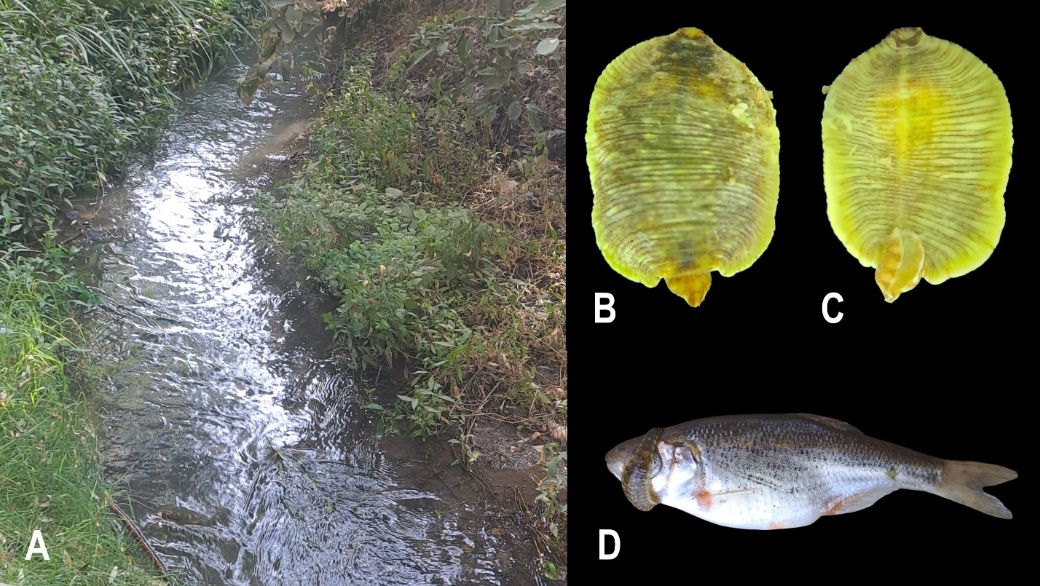 | Figure 2. Hemiclepsis marginata and Its Habitat: (A) Natural Habitat; (B) Dorsal View; (C) Ventral View; (D) Host-Parasite Association Between A. holciki and H. marginata. Photographs by Salokhiddin Usmonov |
4. Discussion
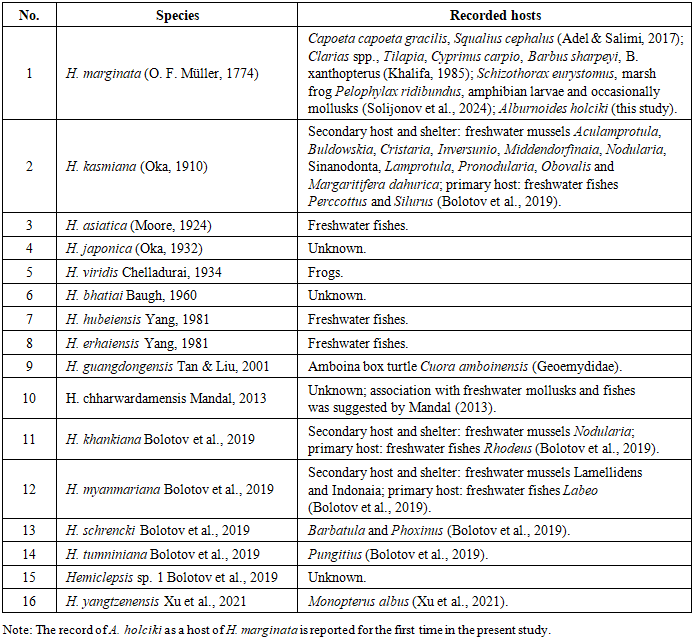
- The present study documents Alburnoides holciki as a previously unreported host of Hemiclepsis marginata and expands the known host range of this freshwater leech. Species of Hemiclepsis are associated with a broad spectrum of aquatic vertebrates, particularly freshwater fishes, while some species also use freshwater mussels as shelters or secondary hosts (Table 1) [3,18]. However, no previous record of H. marginata parasitizing A. holciki was found in the available literature.
|
5. Conclusions
- This study documents the first host-parasite association between Hemiclepsis marginata and Alburnoides holciki from the Surkhandarya basin, Uzbekistan. The record expands the known host range of H. marginata and contributes to parasitological and biogeographic knowledge of Central Asian freshwater ecosystems. The occurrence of the leech at a locality showing visible signs of anthropogenic disturbance provides additional ecological information on the species in Uzbekistan.
CONFLICT OF INTEREST
- The authors declare that there is no conflict of interest.
ACKNOWLEDGEMENTS
- This research was carried out within the framework of projects ALM-202303153-01 and AK-25-30 of the Innovative Development Agency.