
-
Paper Information
- Previous Paper
- Paper Submission
-
Journal Information
- About This Journal
- Editorial Board
- Current Issue
- Archive
- Author Guidelines
- Contact Us
International Journal of Genetic Engineering
p-ISSN: 2167-7239 e-ISSN: 2167-7220
2026; 14(8): 213-217
doi:10.5923/j.ijge.20261408.04
Received: Jul. 12, 2026; Accepted: Aug. 8, 2026; Published: Aug. 22, 2026

Comparative Palynomorphological Characteristics of Pollen Grains of Inula L. (Asteraceae) Species in the Flora of Uzbekistan
 Abstract
 Reference
 Full-Text PDF
 Full-text HTML
Ermatova Gulzoda Zakirdjanovna, Naralieva Nasiba Mamanovna, Ibroximova Gulboxor Abdufattaevna
Andijan State University, Andijan, Uzbekistan
Correspondence to: Ermatova Gulzoda Zakirdjanovna, Andijan State University, Andijan, Uzbekistan.
| Email: |  |
Copyright © 2026 The Author(s). Published by Scientific & Academic Publishing.
This work is licensed under the Creative Commons Attribution International License (CC BY).
http://creativecommons.org/licenses/by/4.0/

This study comparatively investigated the pollen morphology of Inula helenium L., I. grandis Schrenk ex Fisch. & C.A.Mey., and I. rhizocephala Schrenk ex Fisch. & C.A.Mey. occurring in the flora of Uzbekistan using light microscopy (LM). Pollen grain shape, symmetry, aperture type, exine structure, and morphometric characteristics were analyzed. The results showed that pollen grains of all three species were predominantly subspheroidal, radially symmetrical, tricolporate, and characterized by an echinate exine. The main interspecific differences were observed in pollen grain size and the morphological characteristics of the exine spines. The mean pollen grain diameter was 27.11 µm in I. helenium, 23.57 µm in I. grandis, and 21.95 µm in I. rhizocephala. Comparative analysis revealed that I. helenium was distinguished by relatively larger pollen grains and well-developed exine spines, whereas I. grandis and I. rhizocephala showed greater similarity in their morphometric characteristics. These findings indicate that pollen grain size and exine sculpture provide additional palynomorphological criteria for distinguishing species within the genus Inula.
Keywords: Inula, Asteraceae, Pollen morphology, Palynomorphology, Light microscopy, Exine, Echinate, Tricolporate, Morphometry
Cite this paper: Ermatova Gulzoda Zakirdjanovna, Naralieva Nasiba Mamanovna, Ibroximova Gulboxor Abdufattaevna, Comparative Palynomorphological Characteristics of Pollen Grains of Inula L. (Asteraceae) Species in the Flora of Uzbekistan, International Journal of Genetic Engineering, Vol. 14 No. 8, 2026, pp. 213-217. doi: 10.5923/j.ijge.20261408.04.
1. Introduction
- Palynomorphological characters are of considerable diagnostic importance in the systematics of the genus Inula. Pollen grains of the family Asteraceae are generally characterized by a tricolporate aperture system, echinate exine ornamentation, and a distinctive exine structure. However, pollen size and shape, the ratio of polar to equatorial axes, aperture morphology, exine thickness, as well as spine height, basal diameter, and density vary considerably among species and genera. Therefore, this combination of palynomorphological characters provides important diagnostic criteria for the systematics and taxonomy of Asteraceae, including the genus Inula, and may also contribute to the assessment of phylogenetic relationships.During the first half of the twentieth century, palynology emerged as an important field in plant systematics. Wodehouse investigated the morphological characteristics of pollen grains, particularly exine ornamentation and spine structure, and demonstrated the diagnostic value of these characters in distinguishing representatives of Asteraceae [1]. Subsequently, Erdtman standardized the methodology and terminology used in palynological studies and established unified criteria for describing pollen aperture types, symmetry, polarity, and general morphology [2]. His work provided an important methodological framework for the consistent application of the tricolporate aperture system and other palynomorphological characters typical of Asteraceae in taxonomic studies.On this basis, during the 1970s and 1980s, pollen morphology in representatives of the family Asteraceae was investigated in greater detail, with electron microscopy and morphometric analyses becoming increasingly important for the taxonomic evaluation of palynological characters. Stix conducted a comparative analysis of pollen morphology in European representatives of Asteraceae and summarized the principal palynomorphological types characteristic of the family [4]. Subsequently, Skvarla et al. used scanning electron microscopy to examine the exine surface and ultrastructure of pollen spines, thereby introducing micromorphological characters that are difficult to distinguish under light microscopy into taxonomic studies [3].By the 1980s, morphometric approaches had become increasingly incorporated into palynomorphological research. The handbook prepared by Moore, Webb, and Collinson provided descriptions of the general pollen morphology and morphometric characteristics of Inula helenium and I. britannica, indicating that although the basic structural pattern of pollen is generally retained within Inula, certain differences occur in pollen dimensions and micromorphological characters [5]. However, because such parameters may vary depending on environmental conditions, the developmental stage of the sample, and the method of specimen preparation, their interpretation as taxonomic criteria requires an adequate number of samples for statistical analysis and consideration in combination with other morphological characters.The application of morphometric approaches was further enhanced by the increasing use of scanning electron microscopy (SEM) in palynological studies. In this context, Blackmore et al. demonstrated the taxonomic and phylogenetic significance of exine ornamentation and the shape, basal structure, and microstructural characteristics of pollen spines in Asteraceae [6]. Subsequently, Punt et al. standardized the terminology and criteria used for describing pollen characters and summarized aperture types, exine structure, and morphometric parameters relevant to the characterization of pollen [7]. These approaches were later applied by Dósa to the study of Inula species occurring in the Hungarian flora. Taxonomically informative differences in exine thickness, spine morphology, and spine density were reported among I. spiraeifolia, I. hirta, I. britannica, I. salicina, and I. helenium [8].After the palynomorphological studies conducted on the European flora, the pollen morphology of Inula and related genera began to be comparatively investigated in other geographical regions. Karlıoğlu Kılıç et al. conducted a comprehensive analysis of the pollen morphology of eight endemic Inula taxa distributed in Turkey using light microscopy (LM) and scanning electron microscopy (SEM). Their results demonstrated that pollen dimensions, the ratio of the polar to equatorial axes, exine ornamentation, and the morphometric characteristics of the spines have considerable diagnostic value for distinguishing species [9]. More recently, Qu et al. comparatively examined the pollen morphology of 19 species belonging to eight genera of the tribe Inuleae and identified intergeneric differences in pollen size, aperture type, and exine ornamentation [10]. In particular, their study revealed distinct palynomorphological differences between the genera Blumea and Carpesium and provided new palynological descriptions for representatives of Inula, Laggera, Pentanema, and Pterocaulon. These findings further support the value of pollen morphology as complementary evidence for assessing taxonomic boundaries and relationships among genera within the tribe Inuleae [11].Although studies conducted worldwide have provided an important scientific basis for understanding the taxonomic boundaries, phylogenetic relationships, and palynomorphological characteristics of the genus Inula, its regional diversity has also been investigated within individual floristic regions. In particular, studies conducted in the countries of the former Soviet Union and Central Asia have focused on the floristic composition, systematics, geographical distribution, and ecological and morphological characteristics of the genus. These studies represent an important source of information for assessing the distribution and diversity of Inula species in Central Asia [12].Nevertheless, comparative studies on pollen morphology and morphometric characteristics of I. helenium, I. grandis, and I. rhizocephala occurring in the flora of Uzbekistan remain limited. Therefore, a comparative investigation of the palynomorphological characteristics of these species is important for identifying species-specific pollen characters and complementing their taxonomic descriptions.
2. Materials and Methods
- Pollen morphology of Inula helenium L., Inula grandis Schrenk ex Fisch. & C.A.Mey., and Inula rhizocephala Schrenk ex Fisch. & C.A.Mey. was investigated using standard palynological methods. Pollen samples were obtained from fresh flowers collected during the flowering period. Pollen grains were separated from the anthers, mounted on microscope slides, and examined using permanent preparations made in glycerin–gelatin medium.Microscopic observations were carried out at different magnifications using a BS203 trinocular biological microscope (Chongqing MIC Technology Co., Ltd., China). Images were captured and morphometric measurements were performed using a KERN ODC 241 digital camera system (KERN Optics, Germany).For the morphological characterization of pollen grains, pollen shape, aperture type, exine structure, and characteristics of exine sculpture were evaluated. The main morphometric parameters included the polar axis (P), equatorial diameter (E), P/E ratio, exine thickness, and the length of exine elements. All measurements were performed using specialized imaging software and expressed in micrometers (µm).Pollen shape and other diagnostic characters were evaluated according to the palynological terminology and classification criteria proposed by Erdtman (1952) and Punt et al. (2007). Based on the obtained data, the studied species were comparatively analyzed with respect to exine sculpture, density and development of exine elements, and other diagnostic palynomorphological characters.
3. Discussion
- According to the results of the present study, pollen grains of I. helenium were subspheroidal in shape, radially symmetrical, tricolporate, and characterized by an echinate exine. Pollen grain diameter ranged from 25.30 to 31.04 µm, with a mean value of 27.11 µm (Fig. 1). Microscopic observations showed that I. helenium had relatively large pollen grains, with well-developed spines on the exine surface and clearly defined outer contours. These morphological characteristics indicate a high degree of stability in the palynomorphological features of I. helenium pollen grains.
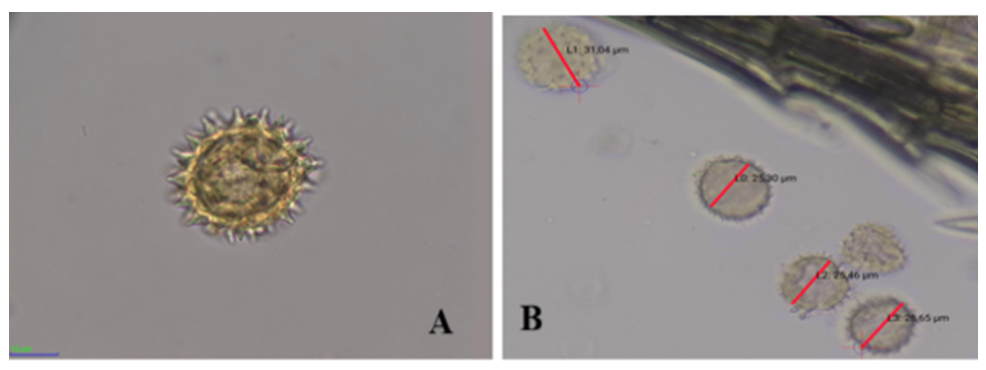 | Figure 1. Light microscopic images and morphometric measurements of pollen grains of Inula helenium L.: A – general view of a single pollen grain; B – morphometric measurement of pollen grain diameter |
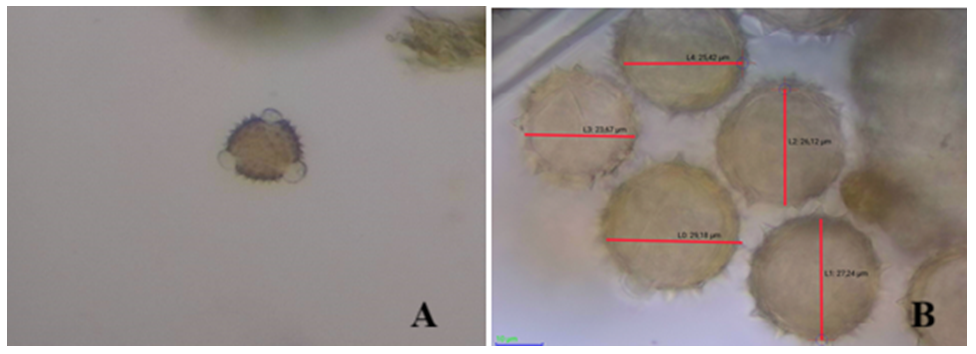 | Figure 2. Light microscopic images and morphometric measurements of pollen grains of Inula grandis: A – general view of a single pollen grain; B – morphometric measurement of pollen grain diameter |
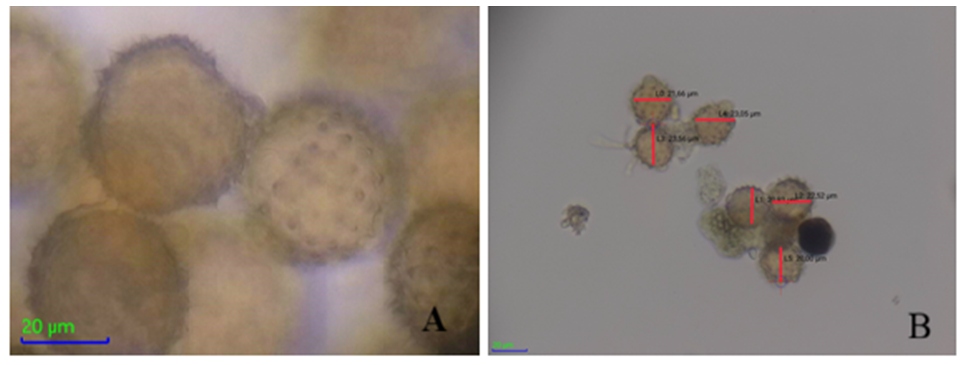 | Figure 3. Light microscopic images and morphometric measurements of pollen grains of Inula rhizocephala: A – general view of a single pollen grain; B – morphometric measurement of pollen grain diameter |
|
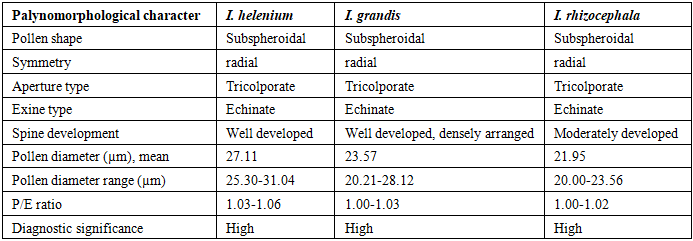
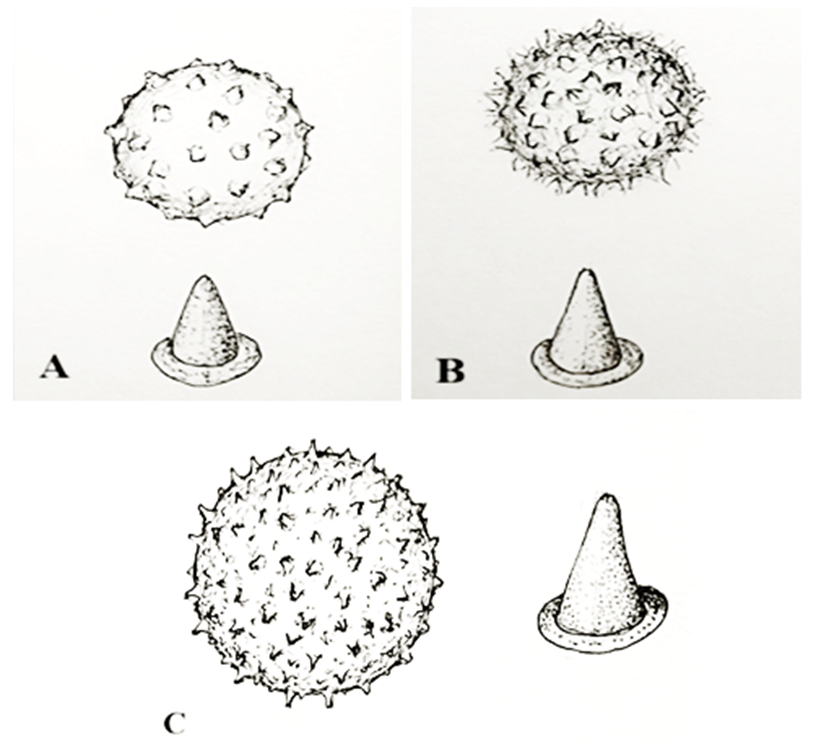 | Figure 4. Pollen morphology and patterns of morphological variation in Inula species: A – I. helenium; B – I. grandis; C – I. rhizocephala |
4. Conclusions
- The results of the present study demonstrated that variation in pollen morphology among the studied Inula species was primarily associated with differences in pollen grain diameter, exine development, and the length and distribution of exine spines. These characters provide useful palynomorphological criteria for distinguishing the studied species and contribute to a more precise assessment of their taxonomic characteristics.Despite the overall similarity in pollen morphology, distinct interspecific differences were observed among the studied Inula species. The major differences were associated with pollen grain diameter and morphological characteristics of the exine sculpture, particularly the degree of spine development. These palynomorphological differences represent additional diagnostic characters for distinguishing I. helenium, I. grandis, and I. rhizocephala and may contribute to a more detailed taxonomic characterization of species within the genus Inula.