
-
Paper Information
- Next Paper
- Previous Paper
- Paper Submission
-
Journal Information
- About This Journal
- Editorial Board
- Current Issue
- Archive
- Author Guidelines
- Contact Us
International Journal of Genetic Engineering
p-ISSN: 2167-7239 e-ISSN: 2167-7220
2026; 14(8): 210-212
doi:10.5923/j.ijge.20261408.03
Received: Jul. 17, 2026; Accepted: Aug. 15, 2026; Published: Aug. 22, 2026

Adaptation Potential of Students' Organisms During Training at a Medical University
 Abstract
 Reference
 Full-Text PDF
 Full-text HTML
Tadjibaeva Dilafruz Raxmonberdievna
Department of Histology and Biology, Fergana Medical Institute of Public Health, Uzbekistan
Correspondence to: Tadjibaeva Dilafruz Raxmonberdievna, Department of Histology and Biology, Fergana Medical Institute of Public Health, Uzbekistan.
| Email: |  |
Copyright © 2026 The Author(s). Published by Scientific & Academic Publishing.
This work is licensed under the Creative Commons Attribution International License (CC BY).
http://creativecommons.org/licenses/by/4.0/

A study involving 32 second-year students majoring in General Medicine and Dentistry at the Fergana Medical Institute of Public Health was conducted to assess the adaptive capabilities of the cardiovascular system during higher education. The article examines the informative value of heart rate variability indices, analyzed using mathematical methods, in the comprehensive assessment of students’ physiological adaptive reserves. A comparative analysis of the components of the student adaptation process is presented, and the need to study adaptation problems throughout the educational process is substantiated.
Keywords: Adaptation potential, Heart rate variability, Mathematical analysis, Heart rate, Blood pressure, Systolic blood pressure, Diastolic blood pressure, Subject’s age, Body weight
Cite this paper: Tadjibaeva Dilafruz Raxmonberdievna, Adaptation Potential of Students' Organisms During Training at a Medical University, International Journal of Genetic Engineering, Vol. 14 No. 8, 2026, pp. 210-212. doi: 10.5923/j.ijge.20261408.03.
1. Introduction
- The conditions of higher education increase the demands placed on students’ adaptive mechanisms. Disruption of the adaptation process to educational conditions may result in neuropsychological and psychosomatic disorders that develop during the period of study. During the educational process, students’ health status determines their adaptive reserve. Normal functioning of the student’s body ensures a stable level of activity and interaction among functional systems, organs, tissues, and regulatory mechanisms. In assessing the adaptive capabilities of students’ organisms, determining the functional state of the cardiovascular system is of particular importance. Autonomic regulatory mechanisms play a key role in ensuring adaptive responses of the body and maintaining homeostasis when environmental conditions change. [1]
2. Materials and Methods
- The study used data obtained from an examination of 32 male students aged 18–27 years in their second year of study at the Fergana Medical Institute of Public Health. The students were divided into two groups. The main group consisted of 16 students majoring in General Medicine and 16 students majoring in Dentistry.The diagnostic methods presented in research methodology for assessing a student’s adaptation potential are relatively labor-intensive and time-consuming, which limits their application in large-scale studies of students. Therefore, it is advisable to determine adaptive capabilities using the Baevsky R. M. index, taking into account information concerning the health group of the individual student. [2]
3. Results and Discussion
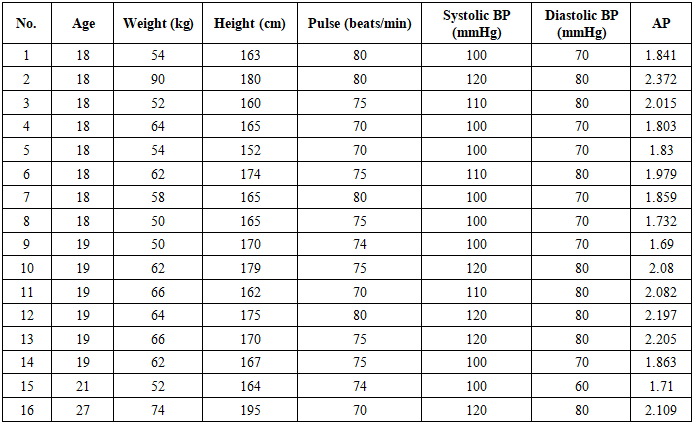
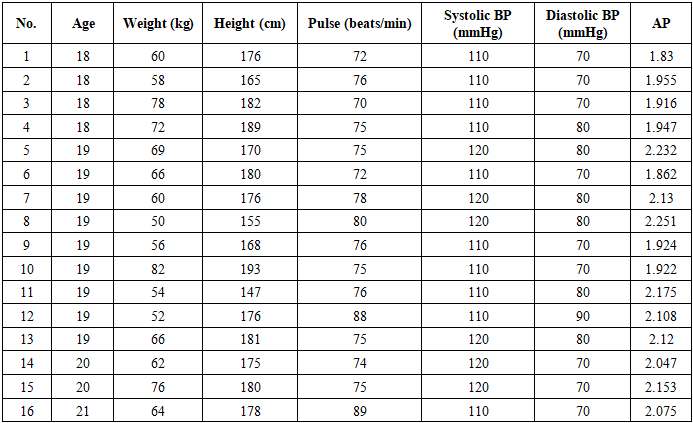
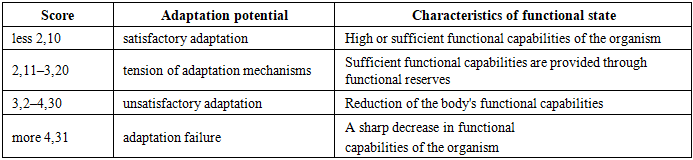
- Calculation of adaptation potential (AP) using the modified formula of R. M. Baevsky. The adaptation potential (AP) was calculated using the modified formula of R. M. Baevsky [3]. The health coefficient is used as a criterion for assessing the adaptive capabilities of the organism. The following values are entered into the formula: heart rate, systolic blood pressure, diastolic blood pressure, age, body weight, and height of the subject. The R. M. Baevsky formula for determining the adaptation potential of the subject’s organism is:AP = (0.011 × HR) + (0.014 × SBP) + (0.0008 × DBP) + (0.014 × A) + (0.009 × BW) + (0.004 × S) – (0.009 × H) – 0.273,where HR is heart rate (beats/min); SBP is systolic blood pressure (mmHg); DBP is diastolic blood pressure (mmHg); A is the subject’s age (years); BW is body weight (kg); S is sex (coefficient: 2 for females and 1 for males); H is height (cm). The score obtained corresponds to a specific degree of adaptation: less than 2.10 – satisfactory adaptation; 2.11–3.20 – tension of adaptation mechanisms; 3.20–4.30 – unsatisfactory adaptation; above 4.31 – breakdown of adaptation mechanisms. [4]The study was conducted according to the principle of maximum non-interference with natural physiological processes and compliance with bioethical principles. Accordingly, all research procedures were performed with voluntary informed consent, and painful or invasive procedures were completely excluded.Heart rate can be determined by palpation (by feeling the pulse in the radial artery). Two or three fingers are placed on the artery while the thumb supports the wrist from the dorsal side. The pulse is counted using a stopwatch for ten seconds two or three times; the obtained value is then multiplied by 6 to determine the heart rate per minute.Blood pressure was determined using the Korotkoff method with a phonendoscope or electronic blood pressure monitors.Systolic (maximum) and diastolic (minimum) blood pressure correspond to the phases of the cardiac cycle (systole myocardial contraction and diastole myocardial relaxation). The difference between systolic and diastolic pressure constitutes pulse pressure (PP). [5]Hemodynamic indicators and mean AP value
|
|
|

|
4. Conclusions
- The results obtained from the examination of 32 students and the data presented in the tables show that, under conditions of functional rest, the hemodynamic indicators of all subjects corresponded to age-related physiological norms. Based on the actual values of adaptation potential in the studied sample, a normative table was developed. Among the subjects with different levels of AP under conditions of relative rest, satisfactory adaptation (AP < 2.10) was identified in 23 students. According to the results, these students had high or sufficient functional capabilities of the organism. Tension of adaptation mechanisms (AP 2.11–3.20) was identified in 9 students. In these students, sufficient functional capabilities were maintained through functional reserves.