
-
Paper Information
- Paper Submission
-
Journal Information
- About This Journal
- Editorial Board
- Current Issue
- Archive
- Author Guidelines
- Contact Us
International Journal of Genetic Engineering
p-ISSN: 2167-7239 e-ISSN: 2167-7220
2026; 14(8): 201-204
doi:10.5923/j.ijge.20261408.01
Received: Jun. 28, 2026; Accepted: Jul. 20, 2026; Published: Aug. 3, 2026

Molecular Characterization and Phylogenetic Relationships of Blaps Species from the Central Kyzylkum Based on Mitochondrial COI Sequences (Coleoptera: Tenebrionidae)
 Abstract
 Reference
 Full-Text PDF
 Full-text HTML
Mahliyo Kamolova
PhD Researcher, Navoi State University, Navoi, Uzbekistan
Correspondence to: Mahliyo Kamolova, PhD Researcher, Navoi State University, Navoi, Uzbekistan.
Copyright © 2026 The Author(s). Published by Scientific & Academic Publishing.
This work is licensed under the Creative Commons Attribution International License (CC BY).
http://creativecommons.org/licenses/by/4.0/

The genus Blaps Fabricius, 1775 comprises more than 200 species of darkling beetles adapted to desert and semi-desert environments. However, molecular data for several Blaps species occurring in the Central Kyzylkum Desert remain limited. In this study, three Blaps species collected from the Central Kyzylkum Desert - Blaps deplanata, Blaps holconata, and Blaps titanus - were molecularly characterized based on a 589-bp fragment of the mitochondrial cytochrome c oxidase subunit I (COI) gene, and their phylogenetic relationships were evaluated. Genomic DNA was extracted from adult beetle specimens, and the target COI fragment was amplified by polymerase chain reaction (PCR) and sequenced. Pairwise comparisons revealed 12 nucleotide differences between B. deplanata and B. holconata, 13 between B. deplanata and B. titanus, and 17 between B. holconata and B. titanus. The greatest genetic divergence was observed in comparisons with Blaps lethifera: 109 nucleotide differences (18.5%) between B. deplanata and B. lethifera, and 107 differences (18.1%) between B. titanus and B. lethifera. Phylogenetic analysis indicated that the three Blaps species from the Central Kyzylkum clustered together with B. lethifera within two major clades. The newly generated COI sequences were deposited in GenBank under accession numbers PX712921 (B. holconata), PX712922 (B. titanus), and PX712923 (B. deplanata). These findings enrich the available molecular data for Blaps species occurring in the Central Kyzylkum and confirm the usefulness of the COI marker for molecular species identification and preliminary phylogenetic inference. Because this study was based on a single mitochondrial marker and a limited number of specimens, future studies incorporating larger sample sizes and additional molecular markers will provide a more comprehensive understanding of the evolutionary relationships among Blaps species.
Keywords: Blaps, Tenebrionidae, Central Kyzylkum Desert, Uzbekistan, COI, DNA barcoding, Molecular phylogeny, GenBank
Cite this paper: Mahliyo Kamolova, Molecular Characterization and Phylogenetic Relationships of Blaps Species from the Central Kyzylkum Based on Mitochondrial COI Sequences (Coleoptera: Tenebrionidae), International Journal of Genetic Engineering, Vol. 14 No. 8, 2026, pp. 201-204. doi: 10.5923/j.ijge.20261408.01.
Article Outline
1. Introduction
- Darkling beetles (Coleoptera: Tenebrionidae) represent one of the most diverse groups of insects in terms of ecology and morphology. They are particularly abundant in desert and semi-desert ecosystems, where they exhibit remarkable adaptations to arid environments. Consequently, Tenebrionidae constitute an important model group for studies of desert biodiversity, ecology, adaptation, and biogeography.The genus Blaps Fabricius, 1775 is among the most species-rich genera within the family Tenebrionidae, currently comprising more than 200 described species according to the latest taxonomic revision [10]. Members of this genus are distributed mainly throughout the Palearctic region and exhibit particularly high diversity in arid habitats. Species identification has traditionally relied on external morphological characters and genital structures. However, morphological similarity among closely related species and variation in diagnostic characters may complicate reliable identification. Therefore, integrating morphological and molecular evidence has become increasingly important in the systematics of Blaps [5,8,10].The mitochondrial cytochrome c oxidase subunit I (COI) gene is one of the most widely used molecular markers in animal DNA barcoding. Some regions of this gene are highly conserved, allowing efficient primer binding, whereas other regions evolve rapidly and enable discrimination among closely related species [1]. Although COI-based analyses cannot fully replace morphological studies because a single molecular marker cannot completely reconstruct evolutionary history, the COI marker remains an effective tool for species identification and preliminary phylogenetic assessment.Previous studies have demonstrated the importance of integrating molecular and morphological data when investigating phylogenetic relationships within the genus Blaps [5,8,10]. Nevertheless, molecular information for several Tenebrionidae species occurring in Uzbekistan and Central Asia remains scarce. Therefore, newly generated COI sequences from the Central Kyzylkum will contribute to expanding existing molecular databases and clarifying the phylogenetic relationships of Blaps species in the region. The objective of this study was to obtain partial COI sequences of B. deplanata, B. holconata, and B. titanus collected from the Central Kyzylkum Desert, compare them with COI sequences of selected Blaps species available in GenBank, evaluate nucleotide divergence, and infer their phylogenetic relationships.
2. Materials and Methods
- Study Area and Specimen CollectionAdult specimens of Blaps deplanata, B. holconata, and B. titanus were collected during field surveys conducted in the Central Kyzylkum Desert, Uzbekistan. Specimens were initially identified based on external morphological characteristics and preserved in 70% ethanol until molecular analysis.DNA ExtractionGenomic DNA was extracted from the legs and antennae of adult beetles using the GeneJET Genomic DNA Purification Kit according to the manufacturer's instructions. Extracted DNA was stored at - 20°C until polymerase chain reaction (PCR) amplification.PCR Amplification of the Mitochondrial COI GeneA fragment of the mitochondrial COI gene was amplified by polymerase chain reaction (PCR). Amplification was performed using Sileks reagents in a Touchgene Gradient thermal cycler (United Kingdom). The reaction mixture was prepared according to the manufacturer’s recommendations.Thermal cycling conditions included an initial denaturation at 95°C for 3 min, followed by 45 cycles of denaturation at 93°C for 20 s, annealing at 52°C for 30 s, and extension at 72°C for 2 min, with a final extension at 72°C for 10 min. The PCR products were separated by electrophoresis on a 2% agarose gel prepared in 1× TAE buffer and visualized under ultraviolet light.Purification and SequencingAmplified COI fragments were purified from agarose gels using Sileks M reagents according to the manufacturer's protocol. Purified PCR products were sequenced using ABI PRISM® BigDye™ Terminator v3.1 chemistry on an ABI PRISM 3100-Avant automated DNA sequencer (Applied Biosystems). Raw nucleotide sequences were inspected using Chromas v1.45 and prepared for subsequent bioinformatic analyses.Sequence Processing and Phylogenetic AnalysisThe obtained nucleotide sequences were examined and edited using Chromas v1.45. Additional COI sequences of Blaps species were retrieved from the GenBank database. Multiple sequence alignment was performed using MAFFT v7 [3]. Maximum-likelihood phylogenetic analysis was conducted using IQ-TREE v1.6.12 with 1,000 ultrafast bootstrap replicates [2,6]. The phylogenetic tree was visualized using iTOL v6.6 [4]. Pairwise genetic divergence percentages were calculated by dividing the observed number of nucleotide differences by the alignment length of 589 bp.
3. Results and Discussion
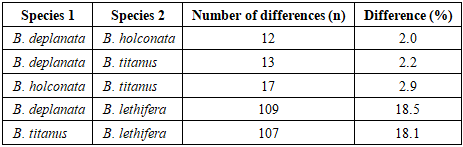
- Characteristics of COI SequencesPCR amplification and sequencing successfully generated a 589-bp fragment of the mitochondrial COI gene for each studied species. These sequences were used for comparative and phylogenetic analyses. The COI sequence of B. lethifera (GenBank accession KM447337) was included for pairwise comparisons.Pairwise Nucleotide DifferencesAnalysis of the COI fragment revealed nucleotide differences among the studied species. B. deplanata differed from B. holconata by 12 nucleotide positions and from B. titanus by 13 positions. A total of 17 nucleotide differences were observed between B. holconata and B. titanus. Comparisons with B. lethifera revealed considerably greater divergence: 109 nucleotide differences between B. deplanata and B. lethifera, and 107 differences between B. titanus and B. lethifera (Table 1).
|
4. Conclusions
- A 589-bp fragment of the mitochondrial COI gene was successfully obtained from specimens of Blaps deplanata, B. holconata, and B. titanus collected in the Central Kyzylkum Desert. Pairwise comparisons revealed nucleotide differences among the studied species, while maximum-likelihood analysis placed them together with B. lethifera in a strongly supported clade. The newly deposited GenBank sequences (PX712921, PX712922, and PX712923) enrich the available molecular resources for Blaps species from the Central Kyzylkum. The results demonstrate that the COI marker is effective for molecular identification and preliminary phylogenetic analysis of Blaps species. Future studies based on larger sample sizes and additional molecular markers will provide a more comprehensive understanding of the phylogenetic relationships within the genus.
Data Availability
- The COI sequences generated in this study are available in the GenBank database under accession numbers PX712921 (Blaps holconata), PX712922 (Blaps titanus), and PX712923 (Blaps deplanata). For comparative analyses, the COI sequence of Blaps lethifera (GenBank accession KM447337) was retrieved from the GenBank database.