
-
Paper Information
- Next Paper
- Paper Submission
-
Journal Information
- About This Journal
- Editorial Board
- Current Issue
- Archive
- Author Guidelines
- Contact Us
International Journal of Genetic Engineering
p-ISSN: 2167-7239 e-ISSN: 2167-7220
2026; 14(7): 191-194
doi:10.5923/j.ijge.20261407.03
Received: Jun. 20, 2026; Accepted: Jul. 22, 2026; Published: Aug. 3, 2026

Comparative Analysis of Leaf Cell Sap Concentration in Soybean Cultivars Grown Under Different Irrigation Methods
 Abstract
 Reference
 Full-Text PDF
 Full-text HTML
Nomozov Ramozon Karim ugli1, Hamroyeva Marg‘uba Komilovna2
1Phd Student, Denau Institute of Entrepreneurship and Pedagogy, Uzbekistan
2Associate Professor, Denau Institute of Entrepreneurship and Pedagogy, Uzbekistan
Correspondence to: Nomozov Ramozon Karim ugli, Phd Student, Denau Institute of Entrepreneurship and Pedagogy, Uzbekistan.
| Email: |  |
Copyright © 2026 The Author(s). Published by Scientific & Academic Publishing.
This work is licensed under the Creative Commons Attribution International License (CC BY).
http://creativecommons.org/licenses/by/4.0/

This study investigated changes in leaf cell sap concentration (CSC) in soybean cultivars grown under drip and furrow irrigation. The effects of different irrigation methods on the water status of soybean plants were evaluated based on leaf cell sap concentration. Field experiments were conducted, and leaf CSC was measured using a digital refractometer during the major growth stages. The results showed that leaf CSC remained relatively stable in soybean cultivars grown under drip irrigation, whereas an increase in CSC was observed under furrow irrigation. Differences in leaf CSC among cultivars were associated with their biological characteristics. The findings indicate that leaf cell sap concentration is a reliable physiological indicator for the rapid assessment of soybean water status and the evaluation of irrigation method efficiency.
Keywords: Soybean, Leaf cell sap concentration, Drip irrigation, Furrow irrigation, Water deficit, Water use efficiency, Drought tolerance, Refractometer, Nafis, Madad, Orzu, Sevinch
Cite this paper: Nomozov Ramozon Karim ugli, Hamroyeva Marg‘uba Komilovna, Comparative Analysis of Leaf Cell Sap Concentration in Soybean Cultivars Grown Under Different Irrigation Methods, International Journal of Genetic Engineering, Vol. 14 No. 7, 2026, pp. 191-194. doi: 10.5923/j.ijge.20261407.03.
1. Introduction
- Climate change, limited water resources, and the increasing frequency of droughts have made efficient water use an essential requirement for sustainable crop production. Efficient water resource management and the adoption of water-saving technologies are key factors for ensuring sustainable agricultural development.Drip irrigation is a modern irrigation technology that enables the efficient delivery of water and mineral fertilizers directly to the plant root zone, thereby improving water and resource use efficiency while reducing production costs. This system is based on the precise and controlled application of water through emitters, which helps suppress weed growth and enhances the efficiency of agronomic practices [1].Currently, sprinkler, drip, and subsurface irrigation are the principal irrigation methods used for soybean cultivation. Over the past two decades, increasing water scarcity and the development of reliable subsurface irrigation systems have led to growing interest in both drip and subsurface irrigation technologies [2].Based on a three-year field study conducted in a low-rainfall region of Japan, Chomsang et al. (2021) reported that drip irrigation significantly increased seed yield, aboveground dry biomass, and the number of branches, nodes, and productive pods in soybean. Furthermore, drip irrigation improved leaf water status, maintained photosynthetic activity and dry matter accumulation, and effectively reduced yield losses, particularly during years with limited precipitation [3].Leaf cell sap concentration (CSC) is an important physiological indicator for assessing plant water status, as it enables rapid and reliable assessment of water stress. The ability to determine CSC rapidly using a digital refractometer further enhances the practical value of this method.Field experiments conducted in sugar beet, tomato, and potato under drip irrigation revealed a significant negative correlation between leaf cell sap concentration and soil moisture. The researchers reported that leaf CSC increased as soil moisture decreased. Based on these findings, leaf CSC was recommended as an effective physiological indicator for the rapid assessment of plant water status and for determining irrigation scheduling [4,5].According to Jones, various approaches have been proposed for determining irrigation timing during the growing season. Based on their principles and characteristics, these approaches can be classified into three groups: 1 methods based on soil moisture measurements; 2 methods based on soil water balance calculations; 3 methods based on plant physiological responses. Currently, the first two groups are the most widely used in agricultural practice [6,7]. However, irrigation scheduling based on plant physiological responses requires further research and is considered one of the most promising approaches for optimizing irrigation management.Studies on mulberry (Morus alba L.) leaves demonstrated a strong relationship between the cell sap concentration measured in the leaf petiole and that measured in the leaf blade. Therefore, measuring leaf CSC using petiole samples has been recognized as a practical and reliable method. The researchers also recommended this parameter as an important diagnostic indicator for evaluating plant physiological status, water status, and leaf quality [8].In a study of Actinidia deliciosa (kiwifruit) conducted under the humid subtropical conditions of Russia, Besedina et al. (2020) found a strong relationship between leaf petiole cell sap concentration (CSC) and soil moisture in the 0–60 cm soil layer. They also reported that during the fruit development period (August–September), high temperatures combined with reduced precipitation intensified leaf water deficit, leading to increased CSC [9].Turner and Begg (1986) investigated the response of soybean (Glycine max L. Merr.) leaf cell sap to water deficit and showed that changes in cell sap characteristics were closely associated with plant water status. The authors also suggested that osmotic adjustment may occur under mild water stress, indicating the potential of leaf cell sap characteristics as physiological indicators of drought response [10].Moftah and Michel (1987) showed that osmotic adjustment in soybean leaves was associated with changes in leaf solute potential and the accumulation of compatible solutes under salt stress, highlighting the importance of cell sap properties in maintaining plant water relations [11].The growth, development, and productivity of soybean are strongly influenced by soil moisture and irrigation method. Water deficit adversely affects plant growth and development, disrupts normal physiological processes, and ultimately reduces crop productivity. Therefore, the adoption of drip irrigation for soybean cultivation is of particular importance in the Surkhandarya region of southern Uzbekistan, where prolonged water deficit frequently occurs during the summer months.
2. Materials and Methods
- Field experiments were conducted during 2024–2026 at the Research Institute of Fine Fiber Cotton, Termez District, Surkhandarya Region, Uzbekistan, to investigate leaf cell sap concentration (CSC) in soybean cultivars grown under drip and furrow irrigation.The soybean (Glycine max) cultivars Nafis, Madad, Orzu, and Sevinch were grown under drip and furrow irrigation methods (Fig. 1).
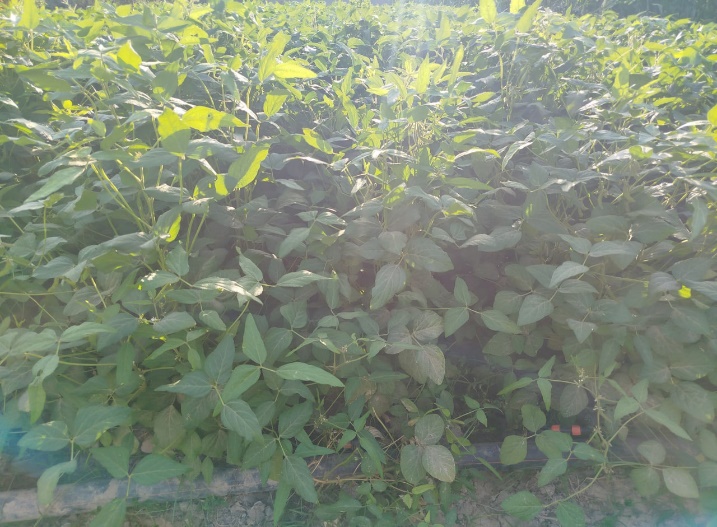 | Figure 1. Soybean cultivars grown under drip irrigation |
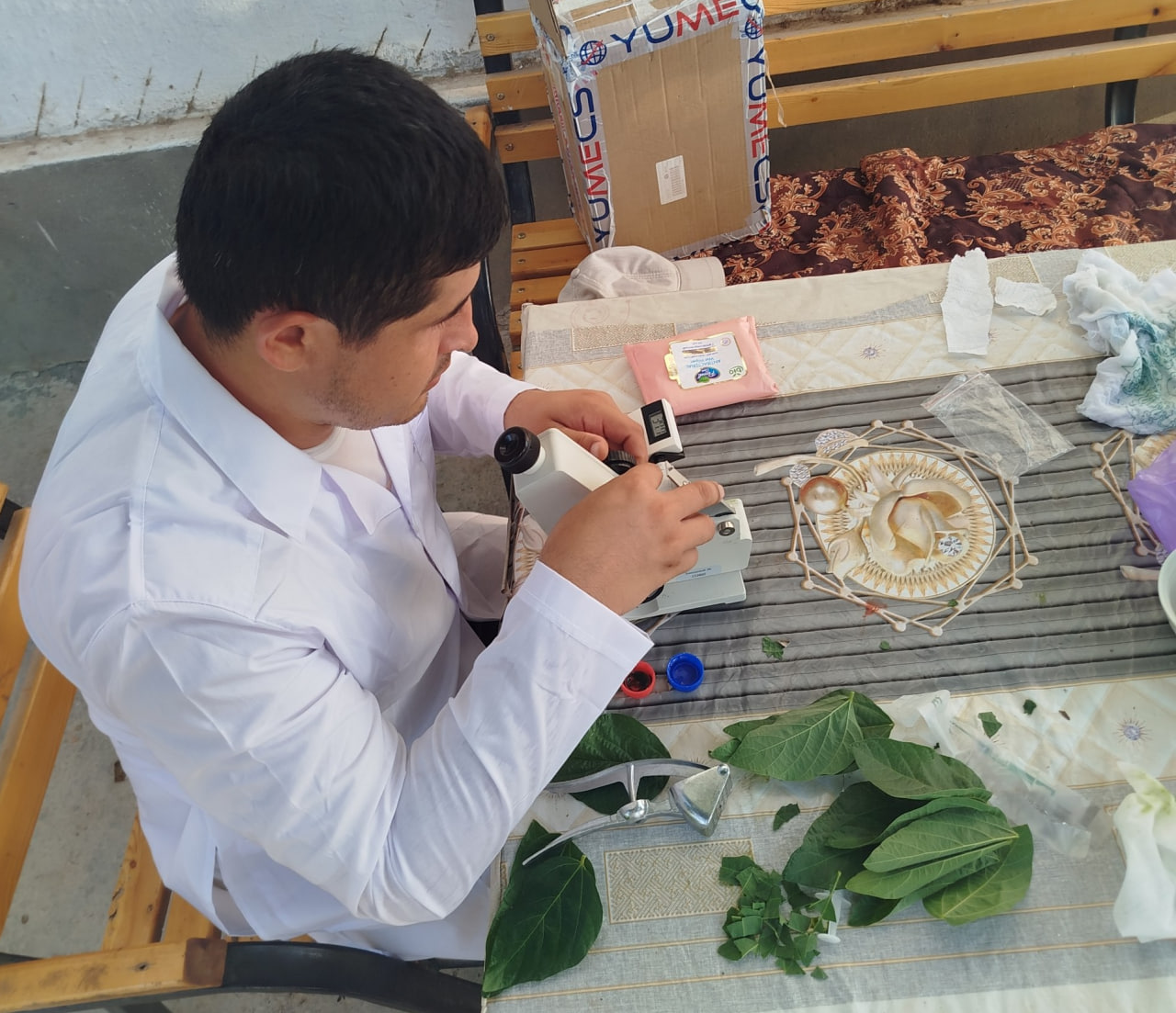 | Figure 2. Determination of leaf cell sap concentration using an IRF-454 refractometer (Russia) |
3. Results
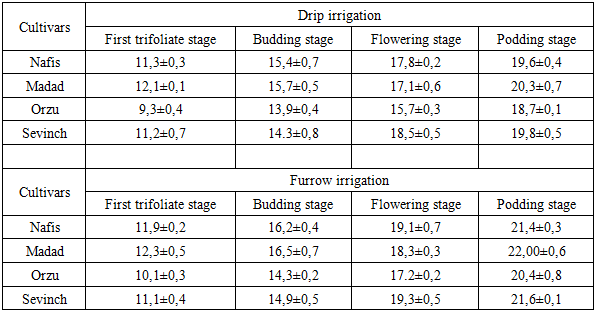
- Marked changes in leaf cell sap concentration (CSC) were observed throughout the growing season in soybean cultivars grown under different irrigation methods (Table 1). The results showed that leaf CSC gradually increased during plant development in all studied cultivars. The lowest CSC values were recorded at the unifoliate stage, whereas the highest values were observed during the pod formation stage. Furthermore, leaf CSC was consistently higher under furrow irrigation than under drip irrigation at all developmental stages.
|
4. Discussion
- The lower leaf cell sap concentration (CSC) observed under drip irrigation indicates that the plants maintained a more favorable water status. In contrast, the reduction in soil moisture between irrigation events under furrow irrigation likely intensified osmotic adjustment processes, resulting in increased leaf CSC. These findings further confirm that leaf CSC is a sensitive physiological indicator for assessing plant water status.The present findings are consistent with those reported by Shatkovskyi et al. (2019), who demonstrated that leaf CSC increased as soil moisture decreased in sugar beet, potato, and tomato. Similarly, Besedina et al. (2021) identified leaf CSC as a reliable physiological indicator for evaluating soil moisture conditions and optimizing irrigation scheduling in kiwifruit (Actinidia deliciosa). Furthermore, Chomsang et al. (2021) reported that drip irrigation improved the water status of soybean plants. Likewise, the lower leaf CSC observed under drip irrigation in the present study indicates that soybean plants maintained a more favorable water status under this irrigation method.
5. Conclusions
- The present study showed that different irrigation methods significantly influenced the water status of soybean varieties. Drip irrigation contributed to maintaining a more favorable plant water status, as reflected by the lower leaf cell sap concentration (CSC). The results highlight the advantages of drip irrigation for maintaining the physiological status of soybean plants. Therefore, leaf cell sap concentration (CSC) can be considered a useful physiological indicator for evaluating plant water status and supporting irrigation scheduling in soybean cultivation. The results demonstrate that leaf cell sap concentration (CSC) has considerable potential as a rapid and practical physiological indicator for monitoring soybean water status under different irrigation methods.