
-
Paper Information
- Paper Submission
-
Journal Information
- About This Journal
- Editorial Board
- Current Issue
- Archive
- Author Guidelines
- Contact Us
International Journal of Genetic Engineering
p-ISSN: 2167-7239 e-ISSN: 2167-7220
2026; 14(7): 181-185
doi:10.5923/j.ijge.20261407.01
Received: May 24, 2026; Accepted: Jun. 20, 2026; Published: Jul. 9, 2026

Effect of Storage Conditions on the Germination Energy and Electrolyte Release of Beans (Phaseolus vulgaris L.) Seeds
 Abstract
 Reference
 Full-Text PDF
 Full-text HTML
Abdusalomova Zarifa Rashidovna, Sanakulov Akmal Lapasovich
Department of Plant Physiology and Microbiology, Sharof Rashidov Samarkand State University, Samarkand, Uzbekistan
Correspondence to: Abdusalomova Zarifa Rashidovna, Department of Plant Physiology and Microbiology, Sharof Rashidov Samarkand State University, Samarkand, Uzbekistan.
| Email: |  |
Copyright © 2026 The Author(s). Published by Scientific & Academic Publishing.
This work is licensed under the Creative Commons Attribution International License (CC BY).
http://creativecommons.org/licenses/by/4.0/

This study aims to study the significant changes in the germination energy dynamics of bean seeds under cold storage conditions depending on seed moisture, temperature, and storage time, and to study the release of electrolytes from seeds, and to deeply analyze the physiological quality indicators of bean seeds in relation to storage conditions, which will serve to create a scientific basis for the storage and effective use of high-quality seed material.
Keywords: Germination energy, Beans, Phaseolus vulgaris L., Electrolyte release, Electrical conductivity, EC index, Storage life, Temperature, Seed moisture
Cite this paper: Abdusalomova Zarifa Rashidovna, Sanakulov Akmal Lapasovich, Effect of Storage Conditions on the Germination Energy and Electrolyte Release of Beans (Phaseolus vulgaris L.) Seeds, International Journal of Genetic Engineering, Vol. 14 No. 7, 2026, pp. 181-185. doi: 10.5923/j.ijge.20261407.01.
Article Outline
1. Introduction
- Recent studies have shown that seed storage conditions directly affect their physiological state, determining membrane stability and germination energy, as assessed by electrolyte release. Therefore, choosing optimal temperature and humidity regimes and controlling electrolyte release indicators for high-quality storage of bean seeds is of great scientific and practical importance. In agriculture, legumes, especially beans (Phaseolus vulgaris L.), play an important role in ensuring food security. The quality of bean seeds, especially germination energy and laboratory germination, directly affects productivity. During seed storage, environmental factors — temperature, humidity, and air conditions — significantly affect their physiological state, causing biochemical changes. In these processes, as a result of the disruption of the stability of cell membranes, electrolyte release from seeds increases.
2. Literature Review
- Recent studies have comprehensively studied the factors affecting seed quality and have shown that electrolyte release is a rapid and reliable method for assessing the physiological state of seeds. It was found that as the storage period increases, membrane permeability increases, which in turn leads to a decrease in seed germination energy.The electrolyte release index is considered a reliable indicator for assessing seed quality, allowing to determine the degree of seed aging and degradation. In this regard, it is of scientific and practical importance to study the effect of different storage conditions on the germination energy and electrolyte release of bean seeds. Especially in the context of climate change, improving the technologies for high-quality seed storage is one of the urgent issues.Therefore, this study aims to deeply analyze the physiological quality indicators of bean seeds in relation to storage conditions, which will serve to create a scientific basis for the storage and effective use of high-quality seed material.In recent years, intensive research has been conducted on the quality of seeds and changes in their physiological state during storage. Marek Roach and Fabrice Bailly (2020) found that the process of seed aging is associated with the accumulation of reactive oxygen species (ROS) and the degradation of cell membranes. It is scientifically proven that these processes lead to increased electrolyte release and reduced germination energy. [1]Hua Li et al. (2021) observed a significant increase in the electrolyte release index in legume seeds stored at different temperatures and humidity conditions. The authors emphasize that membrane stability is rapidly impaired under high humidity conditions, which negatively affects seed germination. [2]Patrícia M. Marcos-Filho (2022) in her work on improving seed vigor assessment methods lists the electrolyte release test as one of the fastest and most reliable indicators. These studies have shown that there is a strong inverse correlation between electrolyte release and germination energy. [3]The updated guidelines of the International Seed Testing Association (2023) recommend the electrical conductivity test as a standard method for assessing seed quality. This method is noted to be particularly sensitive for beans and other legume seeds. [4]Zhenyu Wang et al. (2023) found that electrolyte release increased with increasing seed storage time, which was associated with a decrease in mitochondrial activity. This, in turn, led to a decrease in germination energy. [5]A study by Ricardo D. Vieira (2024) showed that changes in storage conditions (humidity and temperature) in bean seeds produced a clear functional relationship between electrolyte release and laboratory germination. The author argues that by ensuring optimal storage conditions, seed quality can be maintained for a long time. [6]An analysis of the cited sources shows that seed storage conditions directly affect their physiological quality. In particular, electrolyte release is an important diagnostic criterion for assessing seed aging and a decrease in germination energy. Therefore, ensuring optimal temperature and humidity conditions during bean seed storage and assessing their quality through electrolyte release is one of the current scientific directions.
3. Materials and Methods
- The study utilized seeds of common bean (Phaseolus vulgaris L.) of the [Insert Variety Name, e.g., 'local cultivar'] obtained from the [Insert Source, e.g., 2025 harvest]. The initial seed moisture content was determined using the oven-dry method at 103 ± 2°C for 17 hours (ISTA, 2023). Seeds were then conditioned to achieve four different moisture content levels (Factor A): 8%, 10%, 12%, and 14%. This was accomplished by either drying seeds in a desiccator with silica gel or humidifying them in a controlled environment chamber at 20°C and the required relative humidity. The samples were periodically weighed until the target moisture levels were reached, then sealed in airtight containers and stored at 5°C for 48 hours to allow for moisture equilibration within the seed lot.All data were analyzed using a three-way analysis of variance (ANOVA) to determine the individual and interactive effects of seed moisture (A), temperature (B), and storage time (C) on germination energy and electrolyte release. The significance of differences between treatment means was assessed using Fisher's Least Significant Difference (LSD) test at a probability level of p < 0.05. Furthermore, a Pearson correlation analysis was performed to establish the relationships between the variables, and a multiple linear regression model was constructed to predict the electrolyte release (EC) based on the study factors. All statistical analyses were performed using statistical software (e.g., SPSS version 26.0 or R).
4. Results and Discussion
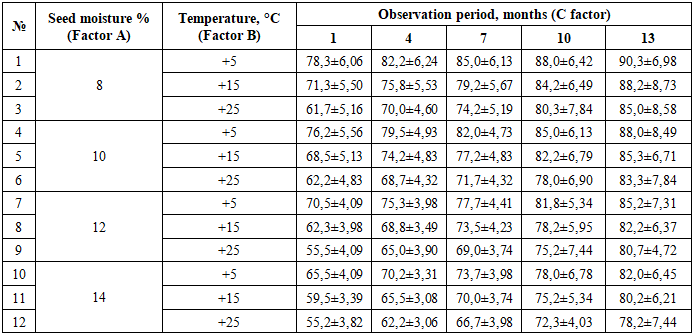
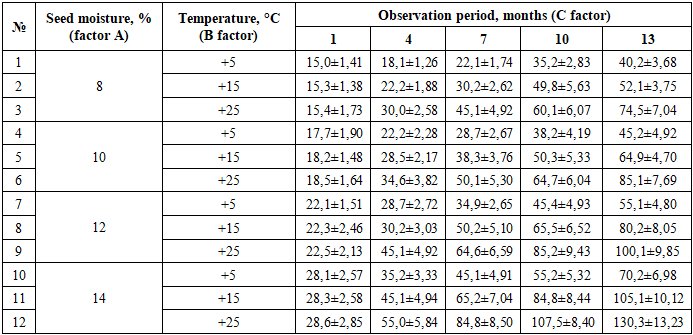
- The obtained data showed that the dynamics of germination energy of bean seeds under different storage conditions significantly changed depending on seed moisture, temperature and storage time. The obtained results confirm the existence of an interrelationship between these factors and their complex effect on the physiological quality indicators of seeds.First of all, the highest germination energy was observed at a seed moisture content of 8%. In particular, under storage conditions at a temperature of +5°C, germination energy was 78.3% in the 1st month, and then it steadily increased over 13 months, reaching 90.3%. It was found that with increasing temperature (+15 and +25°C), these indicators decreased, that is, at +25°C, they increased from 61.7% in 1 month to 85.0% in 13 months, but still remained at a low level.
|
|
|
5. Conclusions
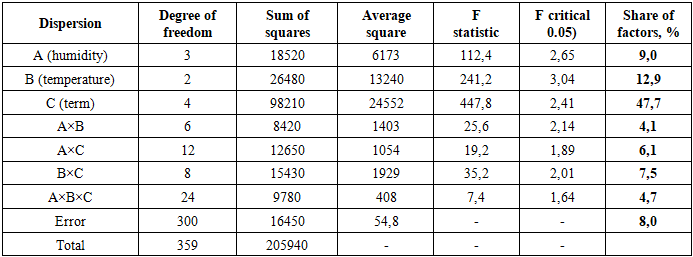
- In conclusion, the storage conditions of beans (Phaseolus vulgaris L.) seeds significantly affect their physiological state, germination energy, and cell membrane stability. The results of the study showed that storing seeds at optimal temperature and humidity conditions maintains their germination and germination energy at a high level. Under unfavorable storage conditions, the biological activity of seeds decreases and the release of electrolytes from the seeds increases as a result of damage to cell membranes.The level of electrolyte release was found to be an important indicator of seed viability and quality. It was observed that with the extension of storage time and the influence of high humidity and temperature, the aging of seeds accelerated and the germination energy decreased. On the contrary, in seeds stored in dry and cool conditions, the electrolyte release was low, and the germination indicators were maintained high.According to the results, the factors of storage time, temperature, and seed moisture significantly affected the release of electrolytes from beans seeds. The results of the analysis of variance showed that the largest contribution was made by storage time (F=447.8), which was found to be the main factor associated with the physiological aging of seeds.It has been scientifically proven that the most optimal conditions for storing bean seeds are a combination of low humidity (8–10%) and low temperature (+5°C), which provides high germination energy.According to the results of the analysis of variance, the largest contribution was made by the storage period (F=447.8), which was the main factor associated with the physiological aging of seeds.Of the influencing factors, the largest contribution was made by the storage period, which accounted for 47.7% of the total variability. This indicates that the physiological aging processes in seeds are mainly time-dependent.Another aspect is that the coefficient of determination in this model is R²=0.91, which is 91% of the change in electrolyte output, and according to the analysis of standardized coefficients, it was found that the greatest effect is related to storage time, followed by temperature and seed moisture. Thus, it is important to adhere to optimal storage regimes for high-quality storage of bean seeds, which will help maintain the quality of seeds, achieve high yields, and increase seed production efficiency.