
-
Paper Information
- Next Paper
- Paper Submission
-
Journal Information
- About This Journal
- Editorial Board
- Current Issue
- Archive
- Author Guidelines
- Contact Us
International Journal of Genetic Engineering
p-ISSN: 2167-7239 e-ISSN: 2167-7220
2026; 14(6): 166-170
doi:10.5923/j.ijge.20261406.02
Received: May 20, 2026; Accepted: Jun. 16, 2026; Published: Jun. 25, 2026

Geochemical Characteristics of Irrigated Serozem-Meadow Soils of the Mirzachul Oasis
 Abstract
 Reference
 Full-Text PDF
 Full-text HTML
Oblokulov Muzaffar Rahmonkul Ugli1, Parpiyev Gofurjon Tokhirovich2, Masharipov Norbek Kenjabayevich3
1Lecturer at Department of Agro-soil Science and Land Reclamation, Gulistan State University, Uzbekistan
2Doctor of Biological Sciences, Senior Researcher, Central Asian University for Environmental Protection and Climate Change Studies (Green University), National Committee of the Republic of Uzbekistan on Ecology and Climate Change
3Senior Lecturer, Doctor of Philosophy (PhD) in Biological Sciences, Gulistan State University, Republic of Uzbekistan
Copyright © 2026 The Author(s). Published by Scientific & Academic Publishing.
This work is licensed under the Creative Commons Attribution International License (CC BY).
http://creativecommons.org/licenses/by/4.0/

This article investigates the geochemical characteristics of irrigated serozem-meadow soils distributed in the Bayaut and Mirzaabad districts of the Mirzachul oasis. The quantitative contents of cyclic elements, rare earth elements (REEs), and radioactive elements (Th and U), as well as their Clarke concentration coefficients (Cc), were analyzed. The research results revealed the predominance of the Ca-Fe-Al geochemical system in the soils of the U.Yusupov massif of Bayaut district, whereas increased migratory activity of Sr, Mg, and As was identified in the T. Ahmedov massif of Mirzaabad district. Rare earth elements were generally distributed at the level of the natural geochemical background; however, ytterbium (Yb) exhibited elevated Clarke concentration coefficient values. The concentrations of thorium and uranium remained within the natural geochemical background range, and no signs of anthropogenic radioactive contamination were detected.
Keywords: Mirzachul Oasis, Irrigated serozem-meadow soils, Geochemical characteristics, Clarke concentration coefficient, Rare earth elements, Thorium, Uranium, Geochemical background, Element migration, Biogeochemistry
Cite this paper: Oblokulov Muzaffar Rahmonkul Ugli, Parpiyev Gofurjon Tokhirovich, Masharipov Norbek Kenjabayevich, Geochemical Characteristics of Irrigated Serozem-Meadow Soils of the Mirzachul Oasis, International Journal of Genetic Engineering, Vol. 14 No. 6, 2026, pp. 166-170. doi: 10.5923/j.ijge.20261406.02.
1. Introduction
- Soil is regarded as a “biocosmic natural body”; therefore, its investigation is most appropriately conducted within the framework of integrative scientific disciplines such as geochemistry, biogeochemistry, and soil biogeochemistry. In this context, the concepts proposed by V.I. Vernadsky [2] concerning the existence and behavior of chemical elements are of particular importance. According to his theory, the history of chemical elements within the biosphere constitutes the subject matter of geochemistry, while the principle that “all elements are present everywhere” serves as one of its fundamental postulates.Fundamental and comprehensive studies in soil chemistry, geochemistry, and soil biogeochemistry have been carried out by A.I. Perelman, M.A. Glazovskaya, N.S. Kasimov, V.V. Dobrovolsky, V.A. Kovda, A. Oren, and other researchers, who employed various methodological approaches and obtained significant scientific and practical results [1,4,5,7].The first investigations of chemical element migration within the “soil–plant” system were conducted by A.P. Vinogradov [3], who laid the foundations of the theory of biogeochemical provinces. Issues related to the migration and evolution of rare and dispersed elements were examined by A.A. Saukov [9], while the first methodological guidelines on trace elements were developed by Ya.V. Peive [8]. Furthermore, the geochemical theory of salt migration and accumulation in soils was established by V.A. Kovda [7]. V.V. Kovalsky [6] developed a methodology for compiling biogeochemical cartograms of trace elements and laid the foundation for the scientific discipline known as “geochemical ecology.”
2. Materials and Methods
- The study focused on sierozem-meadow soils (gray meadow soils) developed under semi-hydromorphic conditions and widely distributed across the Bayaut and Mirzaabad districts of the Syrdarya region within the Mirzachul Oasis.Soil investigations were conducted using the morphogenetic and comparative-geographical approaches developed by V.V. Dokuchaev, as well as pedogeochemical methodologies proposed by A.I. Perelman, G.V. Dobrovolsky, M.A. Glazovskaya, and Alina Kabata-Pendias. Chemical analyses were performed in accordance with the guidelines set forth in the manual “Guidelines for Chemical and Agrophysical Soil Analyses in Land Monitoring”, developed by the Research Institute of Soil Science and Agrochemistry, and the “Methodological Recommendations for Soil Mapping on Irrigated Lands, Accounting for Saline Soils, and Determination of Leaching Requirements.”The concentrations of chemical elements in soil and plant samples were determined by mass spectrometry at JSC Uzbekgeologorazvedka. The analytical evaluation of elemental abundances was carried out using the Clarke values established by A.P. Vinogradov.
3. Results and Discussion
- An analysis of the Clarke concentration coefficients (Cc) was carried out for irrigated sierozem-meadow soils in the Bayaut and Mirzaabad districts of the Syrdarya region.Geochemical Characteristics of Cyclic Elements Based on the Clarke Concentration Coefficient (Cc). The vertical distribution of cyclic elements (Fe, Ca, Na, K, Mo, Mn, Ba, Sr, Zn, Ni, Co, Mg, Al, B, P, Cu, Pb, As, W, Hf, Sb, Cr, Ti, Tl, Cd, Bi, Ag, and Sn) was investigated in irrigated sierozem-meadow soils of the U. Yusupov massif in the Bayaut district and the T. Ahmedov massif in the Mirzaabad district.The iron (Fe) content in the soils of the Bayaut district ranged from 25,860 to 30,180 mg kg⁻¹, whereas in the Mirzaabad district it varied between 24,840 and 33,010 mg kg⁻¹. These values indicate the lithogenic origin and relative stability of this element within the soil profile. The aluminum (Al) content ranged from 53,440 to 62,030 mg/kg and from 52,270 to 67,150 mg/kg in the Bayaut and Mirzaabad districts, respectively, reflecting a high natural background level and a strong association with the clay fraction of the soils (Table).Calcium (Ca) concentrations varied from 66,640 to 81,770 mg kg⁻¹ in the Bayaut district and from 70,570 to 86,150 mg/kg in the Mirzaabad district, indicating well-developed carbonate accumulation processes. Magnesium (Mg) content ranged from 13,600 to 19,180 mg/kg and from 13,620 to 23,780 mg/kg in the respective districts, with greater variability observed in the Mirzaabad soils (Table).Sodium (Na) concentrations ranged from 9,718 to 10,780 mg/kg in the Bayaut district and from 9,850 to 11,130 mg/kg in the Mirzaabad district, suggesting the occurrence of salinization processes in both areas, with a more pronounced manifestation in the Mirzaabad district. Potassium (K) exhibited a relatively uniform distribution throughout the soil profile, with concentrations ranging from 16,130 to 17,360 mg/kg in the Bayaut district and from 15,160 to 18,610 mg/kg in the Mirzaabad district (Table).Strontium (Sr) concentrations in the soils of the Bayaut district ranged from 255 to 449 mg/kg, whereas in the Mirzaabad district they varied from 280 to 856 mg/kg. Particularly noteworthy is the accumulation of Sr up to 856 mg kg⁻¹ in the deeper horizons of the Mirzaabad soils, confirming the intensive migration of this element under saline and carbonate-rich conditions. Barium (Ba) concentrations ranged from 562 to 1,064 mg/kg and from 563 to 789 mg/kg in the Bayaut and Mirzaabad districts, respectively (Table).Manganese (Mn) concentrations varied between 491 and 581 mg/kg in the Bayaut district and between 462 and 596 mg/kg in the Mirzaabad district. As a sensitive indicator of redox conditions, Mn reflects the influence of hydromorphic processes. Zinc (Zn) contents ranged from 53,8 to 63,3 mg/kg and from 53,1 to 66,9 mg/kg, respectively, indicating a relatively stable distribution and a close association with biological activity (Table).Copper (Cu) concentrations ranged from 25,2 to 42,2 mg/kg in the Bayaut district and from 25,1 to 43,9 mg/kg in the Mirzaabad district. Lead (Pb) concentrations varied from 15,9 to 18,6 mg/kg and from 15,5 to 17,6 mg kg⁻¹, respectively, suggesting a low level of anthropogenic influence. Arsenic (As) contents ranged from 26,0 to 37,8 mg/kg in the Bayaut district and from 30,1 to 55,4 mg/kg in the Mirzaabad district, where a more pronounced geochemical anomaly was observed.Boron (B) concentrations ranged from 16,0 to 28,8 mg/kg and from 15,1 to 40,5 mg/kg in the respective districts, reflecting biological cycling associated with agro-irrigation processes. Phosphorus (P) contents varied from 551 to 692 mg/kg in the Bayaut district and from 502 to 947 mg/kg in the Mirzaabad district, with a tendency toward accumulation in the upper soil horizons (Table).Comparative analysis revealed that the soils of the U. Yusupov massif in the Bayaut district are characterized by a relatively stable carbonate-lithogenic system with lower elemental variability. In contrast, the soils of the T. Ahmedov massif in the Mirzaabad district represent a geochemical system with greater migration activity and more pronounced salinization processes.The high variability of Sr, As, and Mg concentrations in the Mirzaabad district indicates the intensity of hydromorphic processes and salt migration. In the Bayaut district, the Ca-Fe-Al geochemical association predominates, reflecting the development of a stable accumulative geochemical environment.Geochemical Characteristics of Rare Earth Elements Based on the Clarke Concentration Coefficient (Cc). The contents and Clarke concentration coefficients (Cc) of rare earth elements (REEs), including Ce, Nd, La, Tb, Ho, Tm, Lu, Sm, Eu, Yb, Pr, Gd, Dy, and Er, were investigated in the sierozem-meadow soils of the U. Yusupov massif in the Bayaut district and the T. Ahmedov massif in the Mirzaabad district (Table).The obtained results demonstrated that rare earth elements are distributed relatively uniformly throughout the soil profile. Their Clarke concentration coefficients (Cc) were generally close to background levels (Cc ≈ 1) or only slightly exceeded them, indicating the absence of significant geochemical enrichment and reflecting the predominantly lithogenic control on their distribution.For the group of light rare earth elements (ΣLREE = La + Ce + Pr + Nd + Sm), a tendency toward more pronounced accumulation was observed. The Clarke concentration coefficients (Cc) averaged 1,0–1,4. Cerium (Ce) is particularly notable, with its accumulation attributed to adsorption by clay minerals, fixation in a carbonate-rich environment, and its limited migratory mobility. Neodymium (Nd) and praseodymium (Pr) occur at levels close to background values and are characterized by low geochemical mobility (Table).The middle rare earth element group (ΣMREE = Eu + Gd + Tb + Dy) is distributed relatively uniformly throughout the soil profile, with maximum Cc values remaining at approximately 1. Europium (Eu) exhibits a weak positive anomaly in certain horizons, which is associated with its sensitivity to redox conditions. Dysprosium (Dy) and gadolinium (Gd) show stable geochemical behavior without significant migration (Table).The heavy rare earth element group (ΣHREE = Ho + Er + Tm + Yb + Lu) is characterized by relatively low concentrations and stable distribution patterns. The Clarke concentration coefficients (Cc) are as follows: Lu = 0,27-0,40; Ho = 0,29-0,40; Er = 0,55-0,68; Tm = 0,57-0,75. The majority of these elements are associated with the solid mineral phase, indicating their low susceptibility to leaching under irrigation conditions.
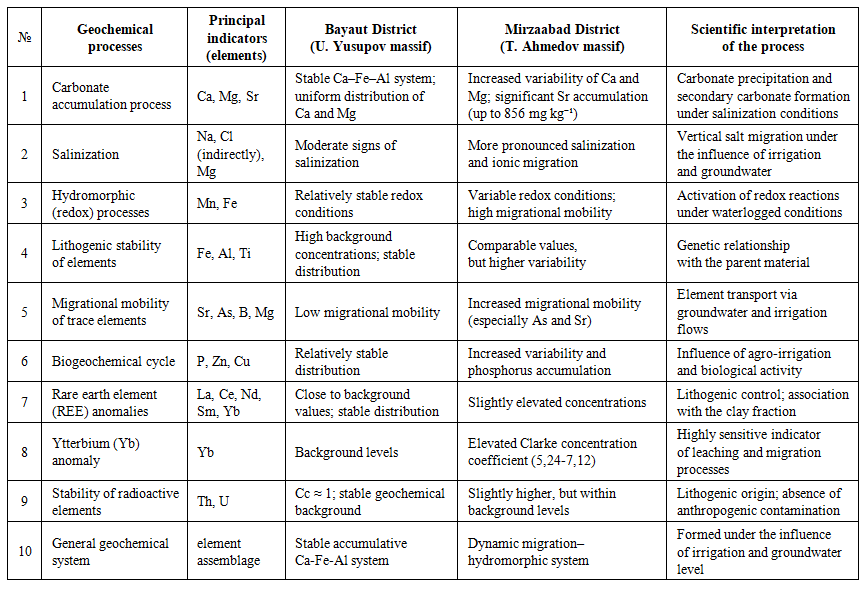 | Table 1. Geochemical processes and elemental migration in irrigated sierozem-meadow soils of the Mirzachul Oasis |
4. Conclusions
- 1. The results of the study demonstrated that the geochemical composition of irrigated sierozem-meadow soils in the Bayaut and Mirzaabad districts of the Syrdarya region is characterized by spatial and genetic differences. In the soils of the U. Yusupov massif in the Bayaut district, the Ca-Fe-Al geochemical system predominates, while the vertical distribution of elements exhibits relative stability and an accumulative character. In the T.Ahmedov massif of the Mirzaabad district, the high variability of Sr, Mg, and As contents indicates the active development of hydromorphic processes and salt migration. 2. Geochemical analysis of rare earth elements showed that most of them are relatively uniformly distributed throughout the soil profile and remain at natural background levels. Despite some accumulation of light rare earth elements (La, Ce, Pr, Nd, Sm), the overall REE composition is primarily controlled by natural lithogenic factors, and no signs of anthropogenic contamination were detected. 3. Among the heavy rare earth elements, a significant excess of the Clarke concentration coefficient was observed for ytterbium (Yb) compared to other elements in the group, allowing it to be considered a sensitive geochemical indicator of irrigation and leaching processes. 4. The contents of thorium (Th) and uranium (U), as well as their Clarke concentration coefficients, remain predominantly at natural geochemical background levels (Cc ≈ 1). This indicates a stable radiogeochemical environment in the studied area and the lithogenic origin of radioactive elements. 5. In future studies, it is recommended to improve the geochemical monitoring system of irrigated sierozem-meadow soils, particularly in the Mirzaabad massif, with special attention to the dynamics of Sr, As, Mg, Yb, and radioactive elements in relation to groundwater levels, salinization processes, and irrigation regimes. This will help preserve soil fertility, assess geochemical equilibrium, and maintain the environmental safety of agro-landscapes.