
-
Paper Information
- Paper Submission
-
Journal Information
- About This Journal
- Editorial Board
- Current Issue
- Archive
- Author Guidelines
- Contact Us
International Journal of Genetic Engineering
p-ISSN: 2167-7239 e-ISSN: 2167-7220
2026; 14(6): 161-165
doi:10.5923/j.ijge.20261406.01
Received: May 15, 2026; Accepted: Jun. 6, 2026; Published: Jun. 13, 2026

Effect of Moroccan Locust (Dociostaurus maroccanus) Flour on Body Weight Recovery and Feed Efficiency in an Experimental Protein Deficiency Model
 Abstract
 Reference
 Full-Text PDF
 Full-text HTML
Ibragimova Shahruza Shuhrat qizi, Zaripov Bakridin Zaripovich
National University of Uzbekistan, Tashkent, Uzbekistan
Correspondence to: Ibragimova Shahruza Shuhrat qizi, National University of Uzbekistan, Tashkent, Uzbekistan.
| Email: |  |
Copyright © 2026 The Author(s). Published by Scientific & Academic Publishing.
This work is licensed under the Creative Commons Attribution International License (CC BY).
http://creativecommons.org/licenses/by/4.0/

It is known that protein deficiency is accompanied by a slowdown in growth and recovery processes in the body, a decrease in body weight, and a reduction in feed utilization efficiency. In this work, the effect of Moroccan locust (Dociostaurus maroccanus) flour on body weight recovery and feed efficiency was evaluated in an experimental protein deficiency model. The protein deficiency model was induced by feeding a low-protein diet for 21 days, followed by nutritional correction based on locust flour for the next 30 days. This was manifested through the dynamics of body weight recovery, the amount of feed consumed, and feed efficiency indicators. These data indicate that Moroccan locust flour can be considered a promising nutritional component supporting body weight recovery under protein deficiency conditions.
Keywords: Rats, Protein deficiency, Moroccan locust, Dociostaurus maroccanus, Body weight, Feed efficiency
Cite this paper: Ibragimova Shahruza Shuhrat qizi, Zaripov Bakridin Zaripovich, Effect of Moroccan Locust (Dociostaurus maroccanus) Flour on Body Weight Recovery and Feed Efficiency in an Experimental Protein Deficiency Model, International Journal of Genetic Engineering, Vol. 14 No. 6, 2026, pp. 161-165. doi: 10.5923/j.ijge.20261406.01.
Article Outline
1. Introduction
- Protein deficiency is an alimentary-metabolic condition that occurs as a result of an insufficient amount of protein in the diet to meet the body’s requirements, and it is characterized by a slowdown in growth and recovery processes, a decrease in body weight, and impaired protein metabolism in tissues. Proteins participate in the synthesis of enzymes, hormones, transport proteins, and structural components as the main plastic material in the body. When protein deficiency occurs in the diet, protein synthesis slows down, the breakdown of endogenous proteins increases, and physiological recovery processes in the body are disrupted [1,2].The amount of protein in feed and its biological value are among the important factors determining body weight recovery and the efficiency of feed utilization. Under experimental conditions, the assessment of changes in body weight, the amount of feed consumed, and feed efficiency indicators is of great importance in determining the physiological effectiveness of protein-rich feed components. In particular, evaluating the effect of nutritional correction agents on body weight restoration in a protein deficiency model induced by a low-protein diet has important scientific and practical significance [3,4].In recent years, insect flour, including locust flour, has attracted scientific interest as a protein-rich alternative feed source. The presence of protein, amino acids, fatty acids, and minerals in locusts and grasshoppers makes it possible to evaluate them as components with high nutritional value. Nevertheless, the effect of Moroccan locust (Dociostaurus maroccanus) flour on body weight recovery and feed efficiency in an experimental protein deficiency model has not been sufficiently studied [5–6].In this regard, the purpose of this work is to study the effect of Moroccan locust (Dociostaurus maroccanus) flour on body weight recovery and feed efficiency in laboratory rats in an experimental protein deficiency model.
2. Materials and Methods
- For this experiment, outbred white male rats weighing 150–180 g were kept under standard vivarium conditions with unlimited access to water and feed. The experiments were conducted in accordance with the bioethical requirements for working with laboratory animals and the ARRIVE 2.0 guidelines [10]. According to the experimental design, the rats were divided into control, protein deficiency model, and nutritional correction groups treated with Moroccan locust (Dociostaurus maroccanus) flour.The rats in the control group were maintained on a standard AIN-93G-type diet. The composition of the standard diet per 1 kg of feed was as follows: casein — 200 g, corn starch — 397.486 g, maltodextrin — 132 g, sucrose — 100 g, soybean oil — 70 g, cellulose — 50 g, mineral mixture — 35 g, vitamin mixture — 10 g, L-cystine — 3 g, choline bitartrate — 2.5 g, and tert-butylhydroquinone — 0.014 g. In this diet, the amount of casein was 200 g/kg, that is, 20% of the diet mass [11].The protein deficiency model was induced by feeding a low-protein diet containing 3% casein for 21 days. The AIN-93G composition was used as the basis, but the amount of casein was reduced from 200 g/kg to 30 g/kg. The reduced 170 g of casein was replaced with corn starch. Accordingly, the composition of the protein deficiency-inducing diet per 1 kg of feed was as follows: casein — 30 g, corn starch — 567.486 g, maltodextrin — 132 g, sucrose — 100 g, soybean oil — 70 g, cellulose — 50 g, mineral mixture — 35 g, vitamin mixture — 10 g, L-cystine — 3 g, choline bitartrate — 2.5 g, and tert-butylhydroquinone — 0.014 g. Feeding a 3% protein diet for three weeks is considered a well-founded experimental approach for forming a protein deficiency state in rats [12].To confirm the formation of the protein deficiency model, blood samples were collected from the rats at the end of the 21-day low-protein diet period. The levels of total protein and albumin in blood serum were determined using an RT-1904C biochemical analyzer (China) based on standard diagnostic reagents.The decrease in total protein and albumin levels in the protein deficiency group compared with the control group was evaluated as a biochemical criterion confirming the formation of alimentary protein deficiency against the background of a low-protein diet.After confirmation of the protein deficiency model, the nutritional correction stage was carried out for the next 30 days. The rats in the model group remained on the low-protein diet, whereas the rats in the correction group were given a diet supplemented with 20% Moroccan locust (Dociostaurus maroccanus) flour. In this case, locust flour accounted for 20% of the diet mass, that is, 200 g/kg of feed. In the correction diet, 3% casein was maintained, while locust flour was introduced by replacing part of the corn starch. The correction diet per 1 kg of feed was as follows: casein — 30 g, Moroccan locust flour — 200 g, corn starch — 367.486 g, maltodextrin — 132 g, sucrose — 100 g, soybean oil — 70 g, cellulose — 50 g, mineral mixture — 35 g, vitamin mixture — 10 g, L-cystine — 3 g, choline bitartrate — 2.5 g, and tert-butylhydroquinone — 0.014 g. Before being included in the experiment, locust flour was dried, mechanically ground, and brought to a powder form that could be uniformly mixed into the diet. Since edible insects and grasshoppers are considered protein-rich alternative feed sources, their use as a nutritional correction component under protein deficiency conditions is scientifically justified [7,8].The amount of locust flour consumed relative to body weight was calculated based on the actual feed intake of each animal. The calculation was carried out according to the following formula:Locust flour amount, g/kg/day = daily feed intake, g × 0.20 / body weight, kgFor example, if a rat with a body weight of 150–180 g consumes 12–15 g of diet per day, it receives approximately 2.4–3.0 g of locust flour through a diet supplemented with 20% locust flour. This corresponds to an average amount of approximately 13.3–20.0 g/kg/day relative to body weight [9].During the experiment, the body weight of the rats was determined at three stages: at the beginning of the experiment, at the end of the 21-day protein deficiency period, and at the end of the 30-day nutritional correction stage. The amount of feed consumed in each group was recorded. Body weight recovery was evaluated based on the difference between body weight after the protein deficiency period and body weight at the end of the correction stage. The feed efficiency coefficient was calculated as the ratio of body weight gain to the amount of feed consumed:Feed efficiency = body weight gain, g / feed consumed, gThe results were statistically processed using OriginPro 2026 software. The arithmetic mean (M), standard error (±m), and level of statistical significance were determined. Differences between groups were assessed using one-way analysis of variance (ANOVA). Differences were considered statistically significant at P<0.05.
3. Results
- In the experimental protein deficiency model, body weight recovery was studied based on changes in body weight in the control, protein deficiency, and nutritional correction groups treated with Moroccan locust (Dociostaurus maroccanus) flour, while feed utilization efficiency was analyzed according to the ratio between the amount of feed consumed and body weight gain. The formation of the protein deficiency state was evaluated based on changes in the levels of total protein and albumin in blood serum.
3.1. Changes in Body Weight Across Groups
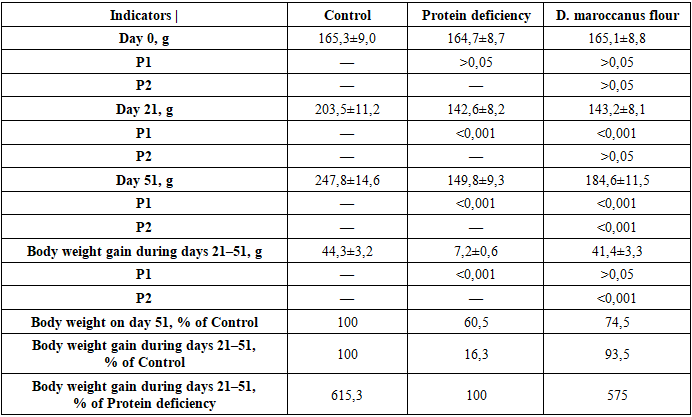
- Data on changes in body weight across groups are presented in Table 1.
|
3.2. Changes in Total Protein and Albumin Levels in Blood Serum Across Groups
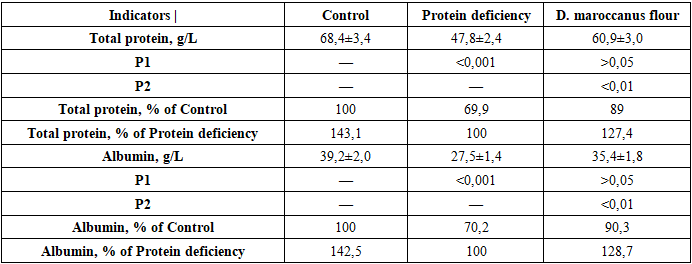
- The results obtained for total protein and albumin levels in blood serum are presented in Table 2.
|
3.3. Feed Intake and Feed Efficiency
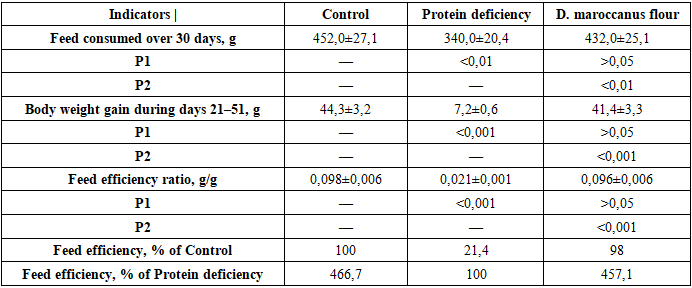
- The results on feed intake and feed efficiency are presented in Table 3.
|
4. Discussion
- It is known that protein deficiency is an alimentary-metabolic condition that occurs when the diet does not contain a sufficient amount of high-quality protein, and it is characterized by a slowdown in growth processes, a decrease in body weight, and impaired protein metabolism in the body. Proteins are the main plastic substrates required for the formation of body tissues and for the synthesis of enzymes, transport proteins, and serum proteins. Therefore, under low-protein diet conditions, body weight gain slows down, albumin and total protein levels decrease, and feed utilization efficiency declines [13–14].The obtained results showed that a diet containing 3% casein formed a protein deficiency model in rats. This was confirmed by a sharp slowdown in body weight gain, the persistence of lower body weight compared with the control on day 51, as well as a decrease in total protein and albumin levels in blood serum. Thus, the changes observed in the experiment were associated with the fact that the body’s plastic needs were not fully met due to protein deficiency in the diet [15].In the group subjected to 30-day nutritional correction with Moroccan locust (Dociostaurus maroccanus) flour, body weight recovery was considerably higher than in the protein deficiency group. At the same time, the final body weight did not fully reach the control level. This indicates that locust flour reduced the consequences of protein deficiency, but the 30-day correction period was not sufficient to fully restore body weight to the normal level.The results on feed efficiency also confirm the positive effect of locust flour. While the efficiency of converting consumed feed into body weight sharply decreased in the protein deficiency group, this indicator approached the control level in the group given D. maroccanus flour. This shows that the protein and amino acids in locust flour were used in the body as plastic material necessary for body weight recovery. Edible insects, including grasshoppers, are considered alternative nutritional sources with high protein content and an important amino acid composition [16,17].The increase in total protein and albumin levels in blood serum in the correction group compared with the protein deficiency group indicates that locust flour had a positive effect on the recovery of protein metabolism. However, the fact that these indicators did not fully equal the control level shows that its effect had a partially restorative character.Thus, under experimental protein deficiency conditions, Moroccan locust (Dociostaurus maroccanus) flour activated body weight recovery, improved feed utilization efficiency, and contributed to the restoration of total protein and albumin levels in blood serum. The obtained results indicate that this flour can be evaluated as an alternative protein source in protein deficiency conditions.
5. Conclusions
- Thus, the low-protein diet containing 3% casein formed an experimental protein deficiency model in rats, accompanied by a slowdown in body weight gain, a decrease in feed efficiency, and a reduction in total protein and albumin levels in blood serum. Thirty-day nutritional correction with Moroccan locust (Dociostaurus maroccanus) flour activated body weight recovery and significantly improved feed utilization efficiency compared with the protein deficiency group. The increase in total protein and albumin levels in the correction group confirmed that locust flour had a positive effect on the restoration of protein metabolism. However, the final body weight and serum protein indicators did not fully reach the control level. Therefore, Moroccan locust flour can be evaluated as a promising alternative protein source that improves body weight recovery and feed efficiency under protein deficiency conditions.