
-
Paper Information
- Paper Submission
-
Journal Information
- About This Journal
- Editorial Board
- Current Issue
- Archive
- Author Guidelines
- Contact Us
International Journal of Genetic Engineering
p-ISSN: 2167-7239 e-ISSN: 2167-7220
2026; 14(5): 155-160
doi:10.5923/j.ijge.20261405.04
Received: Apr. 15, 2026; Accepted: May 12, 2026; Published: Jun. 2, 2026

Selection of Strains and Evaluation of Environmental Parameters in Yogurt Production Using Indigenous Bacteria
 Abstract
 Reference
 Full-Text PDF
 Full-text HTML
Saidova Dilfuza Erkin qizi, Bekmurodova Gullola Amirovna, Amirsaidova Dildora Amindjanovna, Miralimova Shakhlo Mirjamalovna
Institute of Microbiology of the Academy of Sciences of the Republic of Uzbekistan
Correspondence to: Saidova Dilfuza Erkin qizi, Institute of Microbiology of the Academy of Sciences of the Republic of Uzbekistan.
| Email: |  |
Copyright © 2026 The Author(s). Published by Scientific & Academic Publishing.
This work is licensed under the Creative Commons Attribution International License (CC BY).
http://creativecommons.org/licenses/by/4.0/

The aim of this study was to develop a yogurt starter culture based on indigenous lactic acid bacteria (LAB) isolated in Uzbekistan and to optimize its technological parameters. The study utilized the strains Streptococcus thermophilus AWL, Lactobacillus delbrueckii subsp. bulgaricus AWL-D, and Lactobacillus acidophilus AWL. Fermentation experiments were conducted at temperatures of 37°C and 42°C using different starter concentrations and with the addition of a stabilizer (sodium tripolyphosphate, STPP). A comprehensive analysis included fermentation kinetics, titratable acidity (°T), pH dynamics, viable cell counts (CFU/ml), organoleptic evaluation, and comparative analysis with commercial yogurts. The optimized starter culture (B2) reduced the fermentation time to 5 hours and 40 minutes at 42°C, achieved an acidity of 110°T, maintained pH within the range of 4.4–4.6, and ensured a viable cell concentration of 6×10⁹ CFU/ml. The developed culture demonstrated superior microbiological and technological performance compared to commercial products. The results indicate the feasibility of industrial-scale production of indigenous starter cultures and highlight their strategic importance for the development of the dairy industry in Uzbekistan.
Keywords: Lactic acid bacteria, Yogurt fermentation, Starter optimization, Thermophilic bacteria, Probiotic potential, CFU, Dairy biotechnology
Cite this paper: Saidova Dilfuza Erkin qizi, Bekmurodova Gullola Amirovna, Amirsaidova Dildora Amindjanovna, Miralimova Shakhlo Mirjamalovna, Selection of Strains and Evaluation of Environmental Parameters in Yogurt Production Using Indigenous Bacteria, International Journal of Genetic Engineering, Vol. 14 No. 5, 2026, pp. 155-160. doi: 10.5923/j.ijge.20261405.04.
Article Outline
1. Introduction
- Microbiome profiling studies of naturally fermented dairy products in Central Asia have revealed a high diversity of indigenous lactic acid bacteria (LAB) communities and their unique adaptive characteristics, such as carbohydrate metabolism and acid tolerance [1]. Recent studies have also demonstrated that starter composition and fermentation conditions significantly influence metabolite production and the formation of health-promoting bioactive compounds. For instance, under co-fermentation conditions, the composition of starter cultures has been shown to significantly affect fermentation kinetics, acidity dynamics, and the synthesis of bioactive peptides [2]. In addition, probiotic LAB possess antibacterial, immunomodulatory, and antioxidant properties that may improve both product quality and consumer health [3,4].The Government of Uzbekistan has set the development of the dairy industry as a strategic priority, aiming to increase milk processing capacity by 32% by 2026 [5]. Therefore, optimizing starter cultures based on local isolates would not only provide economic benefits but also ensure the production of health-promoting functional dairy products. According to laboratory data, yogurt products fermented with imported starter cultures usually contain 10⁵–10⁷ CFU/ml (colony-forming units per milliliter) of viable bacteria, whereas the functional probiotic threshold is ≥10⁶ CFU/ml [6,7].In recent years, yogurt has been recognized as one of the fastest-growing categories in the global dairy market. According to the International Dairy Federation [8], the global yogurt market expanded with an average annual growth rate of 5.2% between 2018 and 2023. At the same time, in Central Asia, including Uzbekistan, industrial yogurt production largely relies on imported starter cultures, which increases production costs and limits technological independence [1].Yogurt is a fermented dairy product produced through the activity of thermophilic lactic acid bacteria, primarily Streptococcus thermophilus and Lactobacillus delbrueckii subsp. bulgaricus. The metabolic cooperation between these microorganisms ensures rapid acidification, synthesis of flavor compounds such as acetaldehyde and diacetyl, and the formation of a gel structure, which determines the key physicochemical and sensory properties of yogurt [9,10,11]. S. thermophilus grows rapidly during the initial stage of fermentation, reducing dissolved oxygen in milk and producing formate and CO₂, which stimulates the growth of L. delbrueckii subsp. bulgaricus. In turn, L. bulgaricus exhibits strong proteolytic activity, generating peptides and amino acids that provide essential nutrients for the growth of S. thermophilus [11,12]. Yogurt containing Lactobacillus acidophilus not only improves sensory and rheological properties but also enhances the probiotic and functional value of the product [13,2]. For this reason, it is widely used in the industrial production of functional and health-promoting yogurts.During yogurt fermentation, the main biochemical processes include the following: hydrolysis of lactose into glucose and galactose by β-galactosidase; formation of pyruvate and lactic acid through glycolysis; destabilization of κ-casein micelles and gel formation due to decreasing pH; and inhibition of pathogenic and spoilage microorganisms as a result of acidification [14]. Strains capable of producing exopolysaccharides (EPS) improve yogurt texture, reduce syneresis, and enhance rheological stability [15]. EPS interact with the protein network and increase water-binding capacity. The optimal temperature range for thermophilic strains is 42–45°C, where enzymatic activity and glycolytic flux reach maximum levels [10]. However, titratable acidity above 120°T may lead to excessive contraction of the protein network, resulting in a dense texture and overly sour taste.Starter concentration directly affects fermentation kinetics. Increasing the inoculum level shortens the lag phase, increases the maximum growth rate (µmax), and leads to a higher final CFU/ml count [16,17]. For probiotic effectiveness, the product should contain at least 10⁶–10⁷ CFU/ml viable cells at the time of consumption [6,7]. Stabilizers such as STPP (sodium tripolyphosphate) interact with milk proteins through ion-exchange reactions, altering calcium balance and strengthening the casein network. This increases water-holding capacity, reduces syneresis, and improves product stability during storage [18]. In addition, stabilizer addition enhances protein–polysaccharide interactions and improves the rheological parameters of the gel.Under the conditions of Uzbekistan, isolation and technological optimization of indigenous strains can reduce dependence on imported starter cultures and enable the development of highly efficient starters adapted to the characteristics of local raw milk. Therefore, the aim of this study was to develop a yogurt starter culture based on indigenous isolates and to evaluate its fermentation activity, microbiological stability, and potential for industrial application.
2. Materials and Methods
2.1. Microorganisms
- The bacterial strains used in this study were Streptococcus thermophilus AWL, isolated from yogurt, and Lactobacillus delbrueckii subsp. bulgaricus AWL-D, isolated from strained fermented milk (suzma). These strains were selected due to their thermophilic characteristics and their technological suitability for yogurt fermentation.
2.2. Fermentation Conditions
- Pasteurized cow’s milk with a standardized fat content of 3.2% was used as the fermentation substrate. The milk was incubated at two different temperatures, 37°C and 42°C, which were selected as the experimental fermentation conditions.Several experimental variants were designed to evaluate the effect of starter composition and stabilizer addition on the fermentation process. The control sample consisted of milk without any additives or starter cultures. In the A1 variant, milk was inoculated with indigenous starter strains using a standard inoculum concentration. In the A2 variant, the starter culture was combined with STPP (sodium tripolyphosphate) as a stabilizer. In the B1 variant, the indigenous starter culture was applied at a higher cell concentration (double inoculum). Finally, the B2 variant consisted of the indigenous starter culture supplemented with STPP and a double cell concentration. These experimental conditions were used to determine the optimal combination for yogurt fermentation.
2.3. Analytical Methods
- Titratable Acidity DeterminationFermentation time was determined by recording the incubation period after inoculation of milk with the starter culture. The endpoint of fermentation was defined as the onset of milk coagulation, indicated by the formation of a firm coagulum. Fermentation times were compared across different temperature conditions and starter culture variants, which served as control parameters for evaluating the fermentation process.Titratable acidity (°T) was determined using the standard titration method. A defined amount of milk or yogurt sample was taken and titrated with 0.1 N NaOH solution using phenolphthalein as an indicator. The volume of NaOH consumed during titration was used to calculate the titratable acidity expressed in degrees Thorner (°T).°T = (VNaOH × NNaOH × 9) / VsampleIn this context:VNaOH – volume of NaOH consumed during titration (ml)NNaOH – normality of the NaOH solutionVsample – volume of the milk sample (ml)pH measurement. The pH value was measured using a digital pH meter.CFU/ml (Standard Plate Count Method).The viable cell count was determined using the plate count method. Milk samples were serially diluted in a sterile diluent. The diluted samples were then inoculated onto semi-solid MRS culture medium and incubated at 37–42°C for 24–48 hours. After incubation, the number of formed colonies was counted.The viable cell concentration was calculated using the following formula:CFU/mL = (number of colonies × dilution factor) / plated volume (mL)Organoleptic Properties.The following attributes were evaluated by a sensory assessment panel: coagulum uniformity and gel structure, taste (sourness, sweetness), aroma, and syneresis (liquid separation). Each parameter was scored using a 5-point or 9-point scale, and the average values were calculated.
2.4. Statistical and Visual Analysis
- ANOVA was used to determine differences among variants in terms of fermentation time, acidity, pH, CFU, and organoleptic scores. Statistical analysis was conducted based on triplicate experiments (mean ± SD).
3. Results and Their Analysis
- During the implementation of the study, the following structure was developed and analyzed based on the established indicators (Table 1).
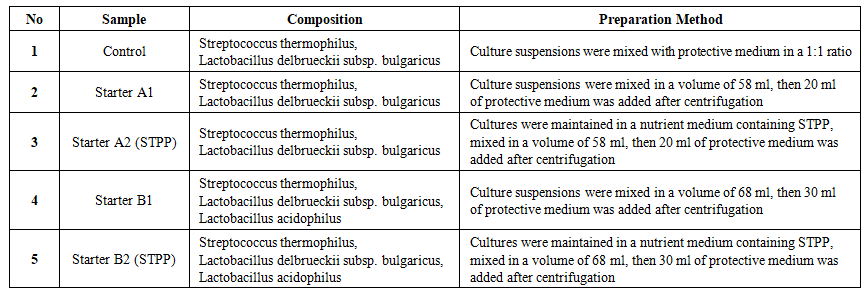 | Table 1. Samples Selected for the Study |
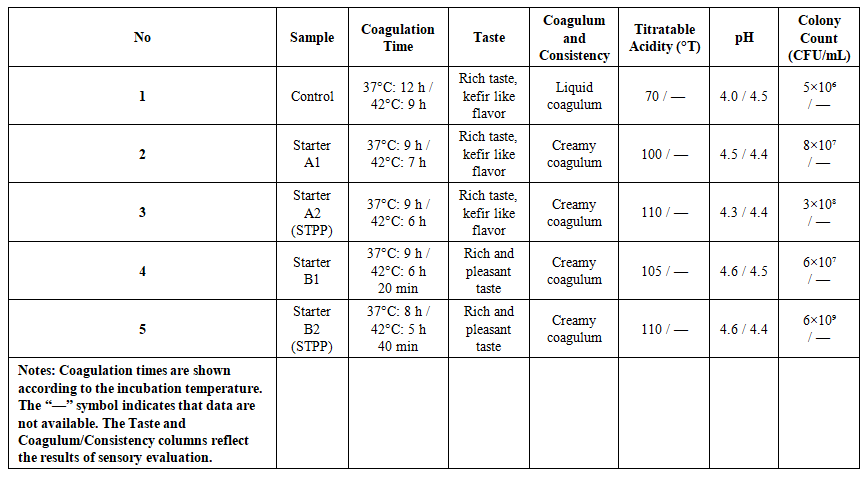 | Table 2. Fermentation Efficiency and Quality Indicators |
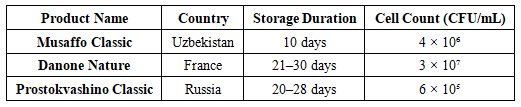 | Table 3. Microbiological Indicators and Storage Duration of Commercial Yogurts |
4. Discussion
- Incubation temperature and inoculum concentration are key factors influencing both the efficiency of the fermentation process and the quality of the final product. The results of this study demonstrated that the B2 starter, applied at 42°C with a double inoculum concentration, represented the most optimal conditions, significantly reducing fermentation time and improving quality parameters. This setting maximizes the activity of thermophilic lactic acid bacteria and provides the potential for effective industrial application.Moreover, the symbiotic relationship between S. thermophilus and L. bulgaricus strains constitutes one of the main mechanisms driving the fermentation process. Their cooperation accelerates lactose breakdown and elevates the acidity of the product, thereby enhancing the taste, texture, and microbiological quality of yogurt.The addition of sodium tripolyphosphate (STPP) during fermentation further contributed to the strengthening of the protein network, stabilizing the gel structure and significantly reducing syneresis. This, in turn, improved the organoleptic and rheological properties of the final product.The effect of double inoculum concentration on probiotic efficacy was also evident in the study. This parameter led to a significant increase in CFU counts, which plays a critical role in enhancing the functional and health-promoting properties of the product. A high concentration of viable probiotic microorganisms increases the likelihood of exerting beneficial effects during consumption and improves the overall health profile of the yogurt.The widespread implementation of local starter strains in dairy production offers several positive economic and industrial benefits. Primarily, the use of local starters reduces dependence on imports, thereby substantially lowering the costs associated with purchasing commercial starter cultures. This, in turn, decreases production costs and enhances the overall competitiveness of the dairy industry.Additionally, the application of local starters strengthens the technological independence of the dairy sector, as strains adapted to regional conditions help stabilize production processes. This fosters sustainable growth and promotes the development of innovative capacities within the dairy processing industry.Furthermore, the advancement of local biotechnological potential creates opportunities for new scientific research, technological development, and product innovation, contributing to the long-term sustainable growth of the national economy.Increasing the production of fermented dairy products using local starters, particularly functional yogurts and probiotic products, aligns with global trends in healthy nutrition. This not only meets domestic market demand but also expands export potential.In conclusion, the industrial application of local starters enhances economic efficiency and plays a critical role in ensuring the ecological and social sustainability of the dairy sector. Therefore, continued research in this area and broader implementation in production processes should be considered a priority within state policy and industrial strategy frameworks.
5. Conclusions
- The results of the study demonstrated that the B2 starter (42°C, double inoculum) reduced fermentation time by 45%, achieved a final titratable acidity of 110°T, and maintained high viability with 6×10⁹ CFU/mL of probiotic cells. The product exhibited excellent sensory quality, indicating that starters based on local strains have promising potential for industrial-scale application. These findings are of significant importance for the development of the national dairy industry and for reducing dependence on imported starter cultures.