
-
Paper Information
- Next Paper
- Paper Submission
-
Journal Information
- About This Journal
- Editorial Board
- Current Issue
- Archive
- Author Guidelines
- Contact Us
International Journal of Genetic Engineering
p-ISSN: 2167-7239 e-ISSN: 2167-7220
2026; 14(4): 129-132
doi:10.5923/j.ijge.20261404.05
Received: Mar. 24, 2026; Accepted: Apr. 20, 2026; Published: Apr. 29, 2026

Growth Dynamics and Analysis of Selected Biochemical Parameters in Rabbits (Oryctolagus cuniculus)
 Abstract
 Reference
 Full-Text PDF
 Full-text HTML
Tokhirova M. R.1, Akhmedova D. K.2, Tulqinova S. Z.3, Yuldoshshaykhova N. F.3
1PhD Student, National University of Uzbekistan, Tashkent, Uzbekistan
2Senior Lecturer, National University of Uzbekistan, Tashkent, Uzbekistan
3Student, National University of Uzbekistan, Tashkent, Uzbekistan
Correspondence to: Tokhirova M. R., PhD Student, National University of Uzbekistan, Tashkent, Uzbekistan.
| Email: |  |
Copyright © 2026 The Author(s). Published by Scientific & Academic Publishing.
This work is licensed under the Creative Commons Attribution International License (CC BY).
http://creativecommons.org/licenses/by/4.0/

This study evaluates growth performance and selected biochemical parameters in rabbits (Oryctolagus cuniculus) at different developmental stages. Thirty clinically healthy rabbits were monitored from 30 to 90 days of age. Growth indicators (body weight, average daily gain, feed conversion ratio) and serum biochemical parameters (total protein, glucose, cholesterol, urea, calcium, phosphorus) were analyzed. Statistical evaluation was performed using one-way ANOVA. The results revealed significant age-related differences (p < 0.05) in body weight, total protein, and glucose levels. The most intensive growth phase occurred between 30–60 days of age. Biochemical changes reflected metabolic adaptations during development. The findings provide a scientific basis for improving feeding strategies and optimizing rabbit production systems.
Keywords: Rabbit, Growth rate, Serum biochemistry, Metabolism, Productivity, Statistical analysis
Cite this paper: Tokhirova M. R., Akhmedova D. K., Tulqinova S. Z., Yuldoshshaykhova N. F., Growth Dynamics and Analysis of Selected Biochemical Parameters in Rabbits (Oryctolagus cuniculus), International Journal of Genetic Engineering, Vol. 14 No. 4, 2026, pp. 129-132. doi: 10.5923/j.ijge.20261404.05.
1. Introduction
- The domestic rabbit (Oryctolagus cuniculus) is an important livestock species characterized by rapid growth, high feed efficiency, and reproductive capacity. Understanding growth dynamics alongside biochemical blood parameters is essential for improving productivity and maintaining animal health. Growth is regulated by genetic, nutritional, and environmental factors and is closely associated with metabolic intensity. Serum biochemical indicators serve as reliable markers of physiological and metabolic status. The objective of this study was to evaluate growth performance and selected biochemical parameters in rabbits at different age stages and determine statistically significant differences. Rabbit meat is classified as a dietary product. It retains its taste and quality characteristics even after canning or smoking. For this reason, the demand for rabbit meat remains high in many countries worldwide. In terms of tenderness, rabbit meat is comparable to poultry meat, while its caloric value is similar to that of chicken. The digestibility of rabbit meat is higher than that of beef, pork, and mutton, primarily due to its high content of easily digestible, complete proteins. Approximately 90% of rabbit meat is digestible, whereas only about 62% of the same proportion of beef is digested.The cholesterol content in rabbit meat is reported to be 2.7 times lower than that in veal. According to data provided by various authors, the cholesterol concentration in 100 g of fat and meat from different animal species is as follows: beef fat – 1.25 g; pork fat – 0.33 g; rabbit fat – 1.40 g; veal – 0.11 g; rabbit meat – 0.04 g. The taste and nutritional value of meat depend not only on its protein and mineral content, but also on the composition of amino acids and vitamins. The concentration of amino acids in muscle tissue varies according to the animal species, age, rearing conditions, feeding regime and level of nutrition, as well as its physiological status. When rabbits are slaughtered on a large scale, their by-products are also utilized efficiently. The stomach is collected and processed to obtain gastric juice, which is used for therapeutic purposes in the treatment of gastrointestinal disorders. Rabbit bones are processed into bone meal, which serves as a mineral- and vitamin-rich feed supplement for various livestock species. In addition, high-grade glue is produced from the ears and paws. Rabbit blood is also considered a valuable by-product; it is incorporated into the feed ration of animals raised for fattening as a protein-rich nutritional supplement.
2. Materials and Methods
- Study object and animal materialDuring our research, three different rabbit breeds (Oryctolagus cuniculus) were crossbred with the aim of increasing meat productivity. As a result of the crossbreeding program, hybrid offspring were obtained and evaluated. The crossbred rabbits differed from their parental forms in terms of viability, productivity, body weight, and early maturity [2,4,7]. Crossbreeding is widely used in breeding programs to significantly improve the productive and qualitative traits of one breed under the influence of another. It is also applied to enhance the overall performance of non-pedigreed or low-productivity rabbits. Through systematic selection and hybridization, desirable genetic traits such as rapid growth rate, improved feed efficiency, and higher carcass yield can be consolidated. At the same time, pure breeding remains the primary activity in all pedigree breeding farms. Pure breeding plays a crucial role in preserving breed standards, maintaining genetic stability, and improving valuable traits within cultural (improved) rabbit breeds [1]. One of the main objectives of purebred selection is to enhance productive characteristics while safeguarding beneficial hereditary qualities.In our study, crossbreeding experiments were conducted using high meat-producing rabbit breeds, namely the White Giant, Californian, and Burgundy breeds (Oryctolagus cuniculus) [8]. These breeds were selected due to their superior growth rate, carcass yield, and feed efficiency. To evaluate the genetic potential for improving meat productivity, different combinations of F₁ and F₂ generations were analyzed. The F₁ generation was obtained through primary crossbreeding between the selected breeds, while the F₂ generation was produced by intercrossing F₁ hybrids [5,6]. Comparative assessment of these generations allowed us to determine the inheritance patterns of productive traits and the expression of heterosis effects. Biochemical analyses were performed to assess metabolic intensity and physiological adaptations associated with increased meat productivity [8,9]. Parameters such as total protein, glucose, cholesterol, and urea levels were examined to establish correlations between growth performance and metabolic indicators. The evaluation of F₁ and F₂ combinations provided insight into the effectiveness of crossbreeding strategies for enhancing meat production traits and identifying the most promising hybrid genotypes for further selection work.
3. Results
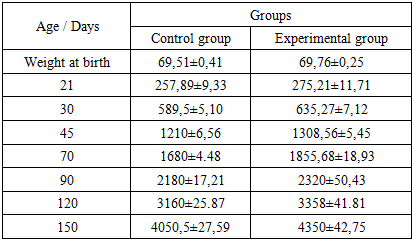
- At birth, the total number of kits in the control group was 20 head, whereas the experimental group consisted of 35 head. By 60 days of age, 16 kits remained in the control group and 30 kits in the experimental group. No significant differences were observed in the live body weight of kits at birth between the control and experimental groups. However, by 30 days of age, rabbits in the experimental group exceeded their counterparts in the control group by 14.17% in body weight, with an average difference of 80.11 g. Survival rates of the experimental rabbits by 60 days of age varied depending on breed origin. The survival rate was 73% in White Giant rabbits, 80% in Burgundy rabbits, and 77.1% in Californian rabbits. Comparative analysis showed that kits belonging to the White Giant and Californian breeds demonstrated higher survival rates compared to the Burgundy breed. These results indicate that crossbreeding positively influenced early growth intensity and viability, particularly during the first 60 days of development, which is considered a critical period for rabbit production efficiency. At birth, the control group consisted of 20 kits, while the experimental group included 35 kits. By 60 days of age, 16 kits remained in the control group and 30 kits in the experimental group.

|

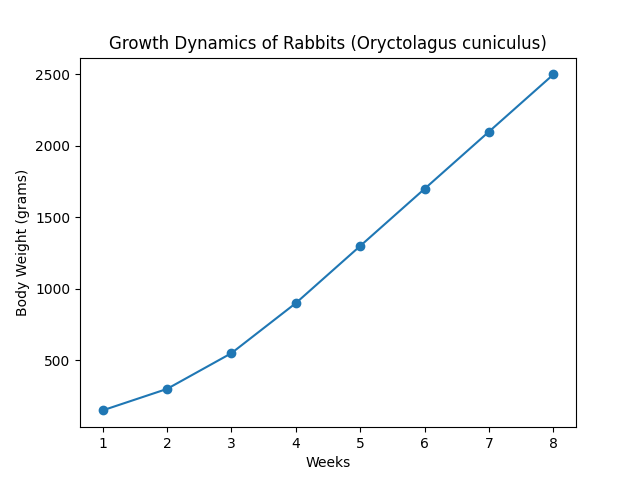 | Figure 1. Growth dynamics of rabbits (Oryctolagus cuniculus) over an 8-week period, showing a steady increase in body weight |
|
|
|
4. Conclusions
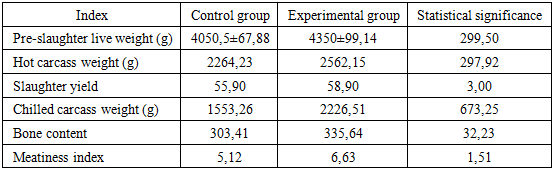
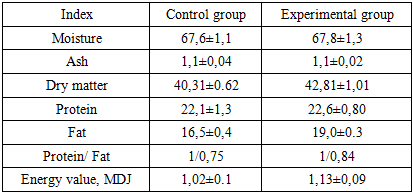
- Based on the research findings, it can be concluded that Hycole and Californian rabbit breeds exhibit high genetic potential for meat productivity when maintained on a full-value feeding ration. By 150 days of age, the experimental group demonstrated superior growth dynamics, achieving a pre-slaughter live weight of 4,350 g, which was 299.50 g higher than the control group. Furthermore, the meat quality analysis revealed excellent nutritional properties; the chilled carcass weight in the experimental group reached 2,226.51 g with a bone yield of 13.10%. A key finding was the favorable chemical composition of the meat, where the protein content exceeded the fat content by 10.84%. This confirms that these imported breeds, under optimized nutritional conditions, produce high-quality, lean dietary meat with significant commercial value.
ACKNOWLEDGEMENTS
- The authors would like to express their sincere gratitude to the administration of the National University of Uzbekistan for providing the necessary laboratory facilities and experimental base for this study. Special thanks are also extended to the technical staff of the experimental rabbit farm for their dedicated assistance in the daily care and monitoring of the Hycole and Californian rabbit breeds throughout the 150-day research period.