
-
Paper Information
- Paper Submission
-
Journal Information
- About This Journal
- Editorial Board
- Current Issue
- Archive
- Author Guidelines
- Contact Us
International Journal of Genetic Engineering
p-ISSN: 2167-7239 e-ISSN: 2167-7220
2026; 14(4): 110-112
doi:10.5923/j.ijge.20261404.02
Received: Mar. 3, 2026; Accepted: Mar. 27, 2026; Published: Apr. 2, 2026

The Quantity of Chlorophyll of Wheat Varieties During the Flowering Period
 Abstract
 Reference
 Full-Text PDF
 Full-text HTML
Yuldasheva Shakhnoza Xasanboyevna1, Khamraev Nurbek Ulugbekovich2
1PhD Student, Khorezm Mamun Academy, Khiva, Uzbekistan
2Senior Researcher (PhD), Department of Natural Sciences, Khorezm Mamun Academy, Khiva, Uzbekistan
Correspondence to: Yuldasheva Shakhnoza Xasanboyevna, PhD Student, Khorezm Mamun Academy, Khiva, Uzbekistan.
| Email: |  |
Copyright © 2026 The Author(s). Published by Scientific & Academic Publishing.
This work is licensed under the Creative Commons Attribution International License (CC BY).
http://creativecommons.org/licenses/by/4.0/

This article analyzes the quantity of chlorophyll of wheat varieties during the flowering period. 95% ethanol was used as the solvent to determine chlorophyll in leaves. According to the results of the study, the Drujba, Ravnaq, and Jiva varieties showed high values for chlorophyll a, chlorophyll b, total chlorophyll, and carotenoid content, while the MV-NEMERE, Vassa, Krasnodarskaya-99, and Kroshka varieties showed the lowest values. It is recommended to use these varieties as material for creating high-yielding varieties tolerance to various abiotic factors.
Keywords: Wheat varieties, Flowering period, Quantity of chlorophyll and carotenoids
Cite this paper: Yuldasheva Shakhnoza Xasanboyevna, Khamraev Nurbek Ulugbekovich, The Quantity of Chlorophyll of Wheat Varieties During the Flowering Period, International Journal of Genetic Engineering, Vol. 14 No. 4, 2026, pp. 110-112. doi: 10.5923/j.ijge.20261404.02.
1. Introduction
- Chlorophyll is one of the important pigment content which is used as an index of plantproduction capacity [5]. Chlorophyll pigments consist of two main types, ‘a’ and ‘b’. Their contents relate closely to primary production because they absorb sunlight and convert sunlight, water, and carbon dioxide into carbohydrates and oxygen [3]. Chlorophyll ‘a’ is the principal pigment involved in the photosynthesis whereas chlorophyll ‘b’ is the accessory pigment, collecting the energy in order to pass into chlorophyll ‘a’. Indication of high levels of chlorophyll content is a result of effective photosynthetic and metabolic activity.The amount of chlorophyll present in leaves depends to a large extent on the status of plant nutrition. Deficiencies of various mineral elements are known to disturb the development of chloroplast pigments in general and chlorophyll in particular in addition to reducing growth and yield. The readily availability of nutrient from fertilizers attributed to vigorous foliage growth, increased meristematic and more intense physiological activities in the plants which favoured the synthesis of more photo-assimilates [6] resulted maximum chlorophyll content of wheat. Thus, the value of leaf chlorophyll content can help to understand nutritional status of the plant, and scientifically guide the fertilizer management to ensure a good crop quality and yield. Whereas the relationship between the chlorophyll content of leaves and the actual photosynthetic canopy area is well documented, comparatively little information is available about the vertical distribution of important plant parameters including chlorophyll, a key crop biophysical characteristic [1], and nitrogen, crucial resource for plant development [2,7].
2. Materials and Methods
- Twenty one varieties of winter soft wheat were obtained from Khorezm Scientific Research Institute of Cereals and Legumes. Varieties were grown using the same agrotechnics in the soil-climatic conditions of Khorezm region. The Krasnodarskaya-99 variety was taken as a control variety. Laboratory experiments were carried out in the laboratory "Analysis of Cereal Crops and Products" of the Khorezm Mamun Academy.Accurately weighing 0.5 g of fresh plant leaf sample, we proceeded homogenizing in a tissue homogenizer with 10 ml of 95% ethanol. The homogenized sample mixture underwent centrifugation at 10,000 rpm for 15 min at +4 °C. Separating the supernatant continued with its 0.5 ml mixed with 4.5 ml of the 95% ethanol. The solution mixture sustained analysis for chlorophyll a, chlorophyll b, and carotenoid content through a spectrophotometer (Analytik jena Specord 50). Healthy and uninfected leaves collection ensued at the flowering stage. Fresh leaf samples thorough washing first used tap water, followed by distilled water in the laboratory, and then kept drying at room temperature (22°C). Their analysis proceeded to determine various chlorophyll types (Ch-a 663 nm, Ch-b 645 nm, and carotenoids 470 nm) by following the methodology of Nayek [4].
3. Results and Discussion
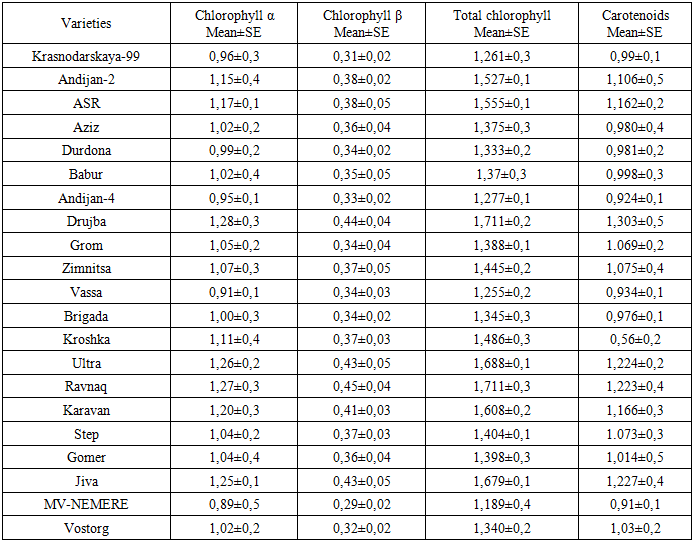
- The amount of chlorophyll "a" pigment in the leaves of varieties grown under natural conditions changed from 0.89±0.5 mg/g to 1.28±0.3 mg/g, and the amount of chlorophyll "b" from 0.29±0.02 mg/g to 0.45±0.04 mg/g. It was found that the lowest chlorophyll a content was observed in the MV-NEMERE and Vassa varieties (0.89±0.5 mg/g and 0.91±0.1 mg/g, respectively), while the highest values were observed in the Drujba and Ravnaq varieties (1.28±0.3 mg/g and 1.27±0.3 mg/g, respectively). The best indicator in terms of chlorophyll "b" content was found in the varieties Ravnaq and Drujba (0.45±0.04 mg/g and 0.44±0.04 mg/g, respectively), and the lowest indicator was in the varieties MV-NEMERE and Krasnodarskaya-99 (0.29±0.02 mg/g and 0.31±0.02 mg/g, respectively) (Table 1).
|
4. Conclusions
- According to the results of the general analysis of the samples, the content of chlorophyll a from physiological characteristics ranged from 0.89±0.5 mg/g to 1.28±0.3 mg/g, the content of chlorophyll b from 0.29±0.02 mg/g to 0.45±0.04 mg/g, the total chlorophyll content from 1.189±0.4 mg/g to 1.711±0.3 mg/g, and the content of carotenoids from 0.56±0.2 mg/g to 1.303±0.5 mg/g.According to the results of the study, the Drujba, Ravnaq, and Jiva varieties showed high values for chlorophyll a, chlorophyll b, total chlorophyll, and carotenoid content, while the MV-NEMERE, Vassa, Krasnodarskaya-99, and Kroshka varieties showed the lowest values.