
-
Paper Information
- Paper Submission
-
Journal Information
- About This Journal
- Editorial Board
- Current Issue
- Archive
- Author Guidelines
- Contact Us
International Journal of Genetic Engineering
p-ISSN: 2167-7239 e-ISSN: 2167-7220
2026; 14(3): 100-103
doi:10.5923/j.ijge.20261403.04
Received: Feb. 21, 2026; Accepted: Mar. 17, 2026; Published: Mar. 31, 2026

Analysis of Herbarium Data of the Genus Glycyrrhiza L. Preserved in the the National Herbarium of Uzbekistan
 Abstract
 Reference
 Full-Text PDF
 Full-text HTML
Khurramov Otabekhon G’ayratkhon ugli
Assistant., Department of Biology, Samarkand State Pedagogical Institute, Samarkand, Uzbekistan
Correspondence to: Khurramov Otabekhon G’ayratkhon ugli, Assistant., Department of Biology, Samarkand State Pedagogical Institute, Samarkand, Uzbekistan.
| Email: |  |
Copyright © 2026 The Author(s). Published by Scientific & Academic Publishing.
This work is licensed under the Creative Commons Attribution International License (CC BY).
http://creativecommons.org/licenses/by/4.0/

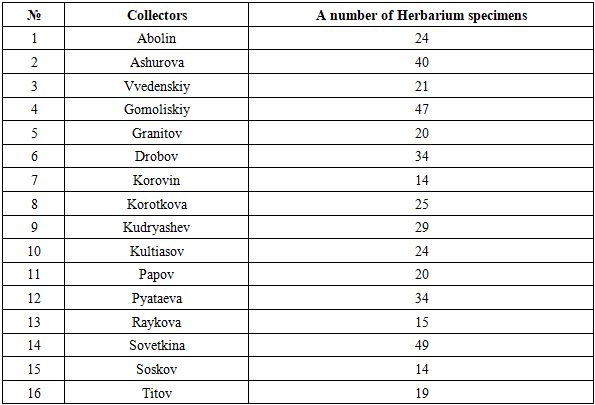
The study aimed to analyze the distribution of the genus Glycyrrhiza in Central Asian countries through herbarium specimens. A total of 974 samples from the National Herbarium of Uzbekistan were examined. Glycyrrhiza glabra was identified as the most widespread species across Uzbekistan, Kazakhstan, Turkmenistan, Tajikistan, and Kyrgyzstan. The results reveal geographic variation in species distribution and research activity levels. In this study, an analysis was conducted on 974 herbarium specimens of the Glycyrrhiza genus collected from various regions of Central Asia between 1900 and 2020 and preserved in the Central Herbarium of Uzbekistan. The specimens stored in the Central Herbarium of Uzbekistan served as the primary material of this research. For the taxonomic identification of Glycyrrhiza specimens, the reference “Key to the Plants of Central Asia” was used, while the data analysis was performed using MS Excel 2019 software. The analysis of the herbarium specimens of this genus provides important information for determining the distribution ranges of Glycyrrhiza species across Central Asia, identifying changes in their geographical distribution, and locating potential plant reserves. According to the research results, most of the 974 Glycyrrhiza specimens stored in the Central Herbarium of Uzbekistan were collected from the territories of Uzbekistan and Kazakhstan. When analyzed by collection periods, the largest number of specimens were gathered between 1920 and 1940, and the main collectors were identified as Sovetkina, Gomolitskiy, and Ashurova.
Keywords: National Herbarium of Uzbekistan, Glycyrrhiza, Herbarium
Cite this paper: Khurramov Otabekhon G’ayratkhon ugli, Analysis of Herbarium Data of the Genus Glycyrrhiza L. Preserved in the the National Herbarium of Uzbekistan, International Journal of Genetic Engineering, Vol. 14 No. 3, 2026, pp. 100-103. doi: 10.5923/j.ijge.20261403.04.
1. Introduction
- Among the numerous medicinal plants found in the flora of our country, one of the most ancient and significant genera is Glycyrrhiza. This genus ranks first among flowering plants in terms of the number of medicines derived from it [4]. The root of Glycyrrhiza has become increasingly competitive among products on the global market. This plant is widely used in many fields of production, including heavy and light industries, cosmetics, medicine, and food manufacturing [1]. The leaves and stems of the plant are also used as fodder for livestock, while its flowers, rich in nectar, make it valuable for beekeeping. In Uzbekistan, the cultivation of this plant brings significant economic, social, and ecological benefits [5].The root of Glycyrrhiza has been used since ancient times in both Eastern and Western medicine for the treatment of various diseases. The root is consumed mainly in dried and fresh forms. At present, Glycyrrhiza is widely utilized in the form of dried licorice sticks, licorice powder, licorice extract, licorice syrup, and licorice paste [3]. The extract of Glycyrrhiza glabra without fibers is used as a flavoring and aromatic additive in cooked foods, alcoholic and non-alcoholic beverages, chewing gum, and spices [5]. The fiberless stems of Glycyrrhiza glabra have also proven to be a good supplementary feed for livestock. Its leaves contain about twice as much protein as alfalfa, making it a valuable component of dry fodder mixtures. In addition, the plant is effectively used in apiculture as a nectar source for bees [2]. Based on the obtained data, Glycyrrhiza species can be regarded as ecologically and economically important plants with diverse functional properties. Herbarium specimens serve as an important source for determining the distribution areas and ranges of plant species, searching for their reserves, and clarifying their morphological characteristics. To date, there are no scientific references concerning the analysis of Glycyrrhiza genus specimens preserved in the Central Herbarium of Uzbekistan, which ranks first among the Central Asian herbaria. In this study, an analysis of 974 specimens of Glycyrrhiza collected from various regions of Central Asia between 1920 and 2020 and preserved in the Central Herbarium of Uzbekistan is presented. The distribution of the collected specimens by country, collector, and species has been determined and analyzed.
2. Material and Methods
- The primary source of information was specimens of the genus Glycyrrhiza L. preserved in the unique scientific collection of the National Herbarium of Uzbekistan—the Herbarium of the Institute of Botany. An electronic database of herbarium records for the genus was developed using MS Excel 2019 based on these materials. The database includes details on genus and species names, herbarium labels, specimen registration numbers, and collector information. For species identification, the “Key to the Plants of Central Asia” and other relevant literature on the flora of Central Asia were used as primary references [3].
3. Results and Discussion
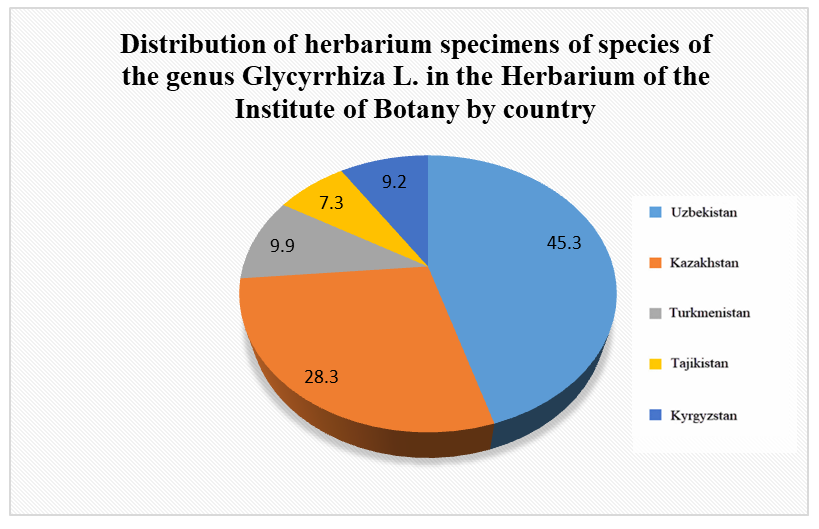
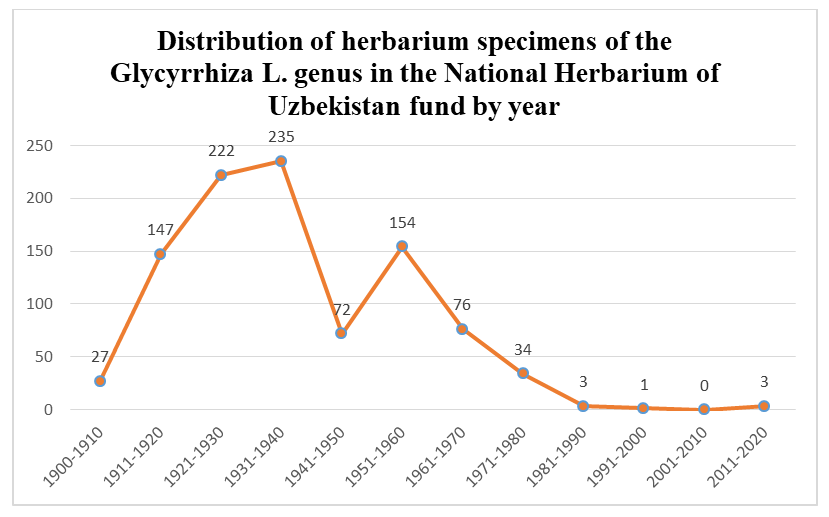
- A total of 974 herbarium specimens representing five species of the genus Glycyrrhiza L., collected from the Central Asian region and preserved in the herbarium collection of the Institute of Botany, Academy of Sciences of Uzbekistan, were analyzed. The National Herbarium of Uzbekistan holds specimens not only from Uzbekistan but also from neighboring countries, including Glycyrrhiza species absent from the Uzbek flora. The country-of-origin analysis revealed that 45% (410 specimens) originated from Uzbekistan, 29% (255 specimens) from Kazakhstan, and the remaining 26% (236 specimens) from Turkmenistan, Tajikistan, and Kyrgyzstan (Figure 1). Herbarium specimens of the genus Glycyrrhiza preserved in the National Herbarium of Uzbekistan collection of the Institute of Botany, Academy of Sciences of Uzbekistan, were analyzed based on their collection years. Results indicated an uneven distribution of specimens across different periods. The earliest decade, 1900–1910, included only 27 specimens, while a sharp increase to 147 specimens occurred during 1911–1920. Collection activity steadily grew through subsequent decades, reaching 222 specimens in 1921–1930 and peaking at 235 specimens in 1931–1940 (Figure 2).
 | Figure 1 |
 | Figure 2 |
|
|
4. Conclusions
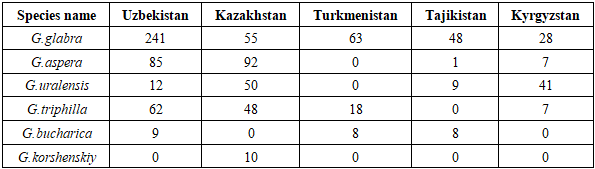
- An analysis of herbarium specimens of the genus Glycyrrhiza L. housed in the National Herbarium of Uzbekistan, Institute of Botany, Academy of Sciences of Uzbekistan, revealed that the majority of specimens were collected in Uzbekistan and Kazakhstan, which represent the genus's primary distribution area. Herbarium collection activity was most intense between the 1920s and 1940s, but then significantly decreased and virtually ceased in recent decades.At the species level, G. glabra was identified as the most widespread species, recorded throughout Central Asia, while other species were restricted to narrower regional ranges. Collecting activity was uneven, with some researchers playing a leading role in the collection's development. Overall, the National Herbarium of Uzbekistan serves as an important scientific resource for understanding the floristic diversity, distribution, and history of the study of the genus Glycyrrhiza in Central Asia.