Nargiza Eshmurodova, Mubarak Abdullayeva
National University of Uzbekistan, Tashkent, Uzbekistan
Correspondence to: Nargiza Eshmurodova, National University of Uzbekistan, Tashkent, Uzbekistan.
| Email: |  |
Copyright © 2026 The Author(s). Published by Scientific & Academic Publishing.
This work is licensed under the Creative Commons Attribution International License (CC BY).
http://creativecommons.org/licenses/by/4.0/

Abstract
The study analyzes climatic, hydrological, and algological conditions in the Southern Aral Sea region, focusing on the Sudochye and Zhiltyrbas water bodies. The research is based on climatic and hydrological data for 2020-2024 and algological observations conducted during 2019-2025. The results reveal pronounced seasonal and interannual variability of environmental factors affecting aquatic ecosystems. The region is characterized by a sharply continental climate, with maximum daytime air temperatures reaching +41 – +43°C in summer and minimum nighttime temperatures dropping to −29°C in winter. Seasonal dynamics of the ultraviolet radiation index show low values in winter (3-5), gradual increases in spring, and peak levels of up to 10 during summer. Hydrological analysis indicates an increase in annual water inflow through the Southern Karakalpakstan Main Collector from 504 million m³ in 2022 to 606 million m³ in 2024, with maximum discharge during the irrigation season. Phytoplankton studies reveal the dominance of Bacillariophyta species, including Thalassiosira, Chaetoceros, Nitzschia, Amphora, and Achnanthes, as well as the presence of euryhaline Chlorophyta such as Dunaliella salina, adapted to salinity fluctuations. The findings highlight the key role of climatic variability, water inflow, and hydrochemical conditions in shaping algal community structure and primary productivity, contributing to the understanding of ecosystem transformation and supporting ecological monitoring and sustainable water management in arid regions.
Keywords:
Aral Sea region, Hydrological regime, Climate variability, Sudochye Lake, Zhiltyrbas water body
Cite this paper: Nargiza Eshmurodova, Mubarak Abdullayeva, Climatic and Hydrological Controls on Seasonal Phytoplankton Dynamics in Sudochye and Zhiltyrbas Lakes, Southern Aral Sea, International Journal of Genetic Engineering, Vol. 14 No. 3, 2026, pp. 91-99. doi: 10.5923/j.ijge.20261403.03.
1. Introduction
The Aral Sea region represents one of the most widely recognized examples of large-scale environmental transformation in the world, resulting from a combination of natural and anthropogenic factors [7,9,10,15]. Since the second half of the twentieth century, intensive use of the water resources of the Amu Darya and Syr Darya rivers for irrigated agriculture has led to a dramatic reduction in the area and volume of the Aral Sea. As a consequence, significant changes have occurred in the regional climate, hydrological regime, and ecological state of natural systems in the Aral Sea basin. The decline in sea level, the expansion of the exposed seabed, and the intensification of aridization processes have had a substantial impact on the functioning of aquatic ecosystems and the biological diversity of the region.The Southern Aral Sea region is characterized by a sharply continental climate with a high seasonal amplitude of air temperatures, considerable solar radiation intensity, and pronounced variability in hydrological processes. In recent decades, a trend toward increasing air temperatures, enhanced evaporation, and fluctuations in water inflow has been observed, leading to changes in the hydrological regime and hydrochemical composition of water bodies within the Aral Sea basin [2,6]. Such changes directly affect the structure and functioning of aquatic ecosystems, particularly phytoplankton communities, which play a key role in primary production and the maintenance of ecosystem stability.Under conditions of the ongoing transformation of the Aral Sea, residual and peripheral water bodies have become increasingly important as they perform significant hydroecological functions [4]. Among them, the Sudochye and Zhiltyrbas water bodies represent important natural systems of the Southern Aral Sea region characterized by complex hydrological and hydrochemical conditions. Variable water mineralization, seasonal fluctuations in temperature, and variations in water inflow create specific ecological conditions for the development of algal flora. Phytoplankton, particularly representatives of the divisions Bacillariophyta, Chlorophyta, and Cyanophyta, serves as a sensitive indicator of environmental change, since its species composition and dynamics depend directly on water temperature, light availability, nutrient concentration, and salinity levels.In addition, climatic factors such as ultraviolet radiation intensity, temperature fluctuations, and variations in hydrological regimes significantly influence the development and structure of algal communities. Under conditions of increasing water mineralization, the role of euryhaline species capable of physiological adaptation becomes particularly important for maintaining the stability of aquatic ecosystems.The aim of this study is to analyze the climatic and hydrological conditions of the Southern Aral Sea region and to assess their influence on the seasonal dynamics and species composition of phytoplankton in the Sudochye and Zhiltyrbas water bodies. The obtained results contribute to a better understanding of ongoing transformation processes in aquatic ecosystems of the Aral Sea basin and provide an important scientific basis for ecological monitoring and sustainable management of water resources in arid regions.
2. Materials and Methods
The study was conducted in the southern zone of the Aral Sea, focusing on two peripheral water bodies - Sudochye and Zhiltyrbas - which represent significant hydro - ecological systems within the Aral basin. These water bodies are characterized by hydrological connectivity, varying salinity regimes, and responses to climatic influences, making them suitable for a comprehensive assessment of climatic, hydrological, and biological parameters [9,5].Climatic data, including daily air temperature, precipitation, and the ultraviolet radiation index (UVI) for the period 2020 - 2024, were obtained from the national meteorological service UzHydromet and regional hydrometeorological stations [1].Hydrological data on water inflow volumes were collected from the Amu Darya Basin Water Resources Authority, the Aral Delta Administration, and the Committee on Water Resources under the Ministry of Water Management and Irrigation of Kazakhstan. Monthly and annual records of water discharge through the Southern Karakalpakstan Main Collector (including irrigation return flows and drainage water) for 2022-2024 were utilized and cross-checked with telemetry data. Hydrological regime analysis was conducted following standard methodologies for river and collector flow assessment (WMO, 2010) [1,14].To assess water surface dynamics and lake area changes, Landsat 8 OLI satellite imagery for 2019-2025, available via the CA Water Info Portal (Central Asia Water Resources and Ecology Knowledge Portal), was used. Preprocessing included radiometric calibration, atmospheric correction using the Dark Object Subtraction method [3], and geometric correction to the UTM coordinate system. Water extent was determined using the Normalized Difference Water Index (NDWI) [8] and verified with on-site GPS measurements.Seasonal phytoplankton sampling was carried out at fixed stations in Sudochye and Zhiltyrbas during spring, summer, autumn, and winter throughout the study period. Water samples were collected using a vertical plankton net (20 µm mesh) and integrated water column sampling following UNEP/IOC (2010) methodology [12]. Samples were preserved with Lugol’s solution and analyzed in the laboratory using an inverted microscope [13]. Phytoplankton taxonomy was identified to the highest possible taxonomic resolution using regional identification keys [11].
3. Results and Discussions
Climate change observed in any region is closely related to one of the main climate-forming processes occurring in the atmosphere - its general circulation. The general circulation of the atmosphere is formed as a result of the movement of large-scale air masses at the planetary level. This process develops under the influence of differences in the radiation balance across various geographical latitudes, as well as the Earth's rotation around its axis and the friction between the air masses and the Earth's surface.As a consequence of the decline in the water level of the Aral Sea, local climatic conditions have undergone significant changes within coastal zones extending approximately 50-100 km. In particular, during the spring - summer season, the increase in air temperature has led to a noticeable decrease in air humidity within coastal areas of nearly 30 km in width.According to data from the Committee for Water Resources Management, Protection and Use under the Ministry of Water Resources and Irrigation of the Republic of Kazakhstan, in 2024 approximately 1.22 km³ of water entered the Southern Aral Sea region through the Amu Darya River (Samanbay monitoring station). The total volume of incoming water, including river flow, collector-drainage waters (CDW), and inflow through canals, amounted to 2.59 km³.In this study, data obtained from the Amu Darya Basin Water Management Authority, the Aral Delta Administration, and the UzHydromet service were used. In addition, monitoring results derived from Landsat 8 OLI satellite imagery were applied to analyze the surface areas of the eastern and western parts of the Greater Aral Sea, as well as the lake systems of the Amu Darya delta. The satellite data were obtained through the CA Water Info - Knowledge Portal on Water Resources and Ecology of Central Asia (Figure 1).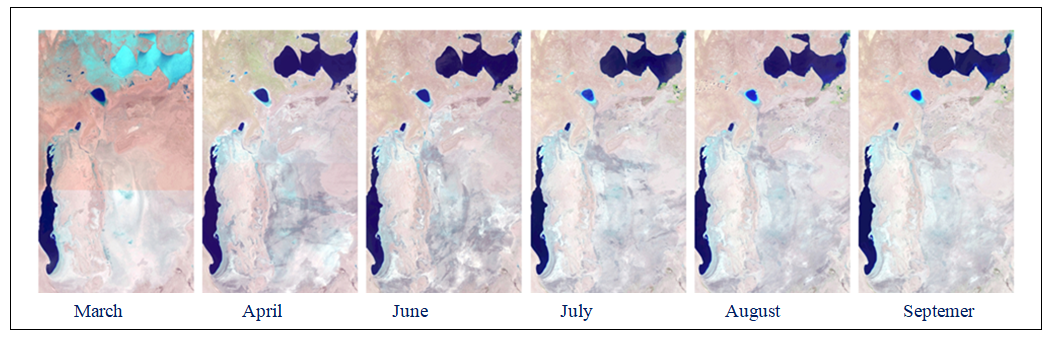 | Figure 1. Satellite Imagery of the Western and Eastern Parts of the Aral Sea in Spring, Summer, and Autumn 2024 (Landsat 8 OLI) |
It was observed that 605.9 million cubic meters of water flowed into the dried basin of the Greater Aral Sea through the Main Collector of Southern Karakalpakstan, bypassing the Amu Darya River delta. This situation is of considerable importance for assessing the hydrological and ecological conditions of the region, as it directly influences the redistribution of water resources and affects the ecological processes occurring within the dried areas of the Aral Sea basin.According to the analysis results, the volume of incoming water flow was 102.4 million cubic meters higher than in 2022, indicating a significant increase in the amount of water inflow. This situation may be explained by an increase in water discharge through the collector - drainage system, changes in hydrological conditions, or higher water consumption during irrigation processes. At the same time, compared to 2023, the water volume was also 3.9 million cubic meters higher, which indicates a positive growth trend in the dynamics of water inflow (Figure 2).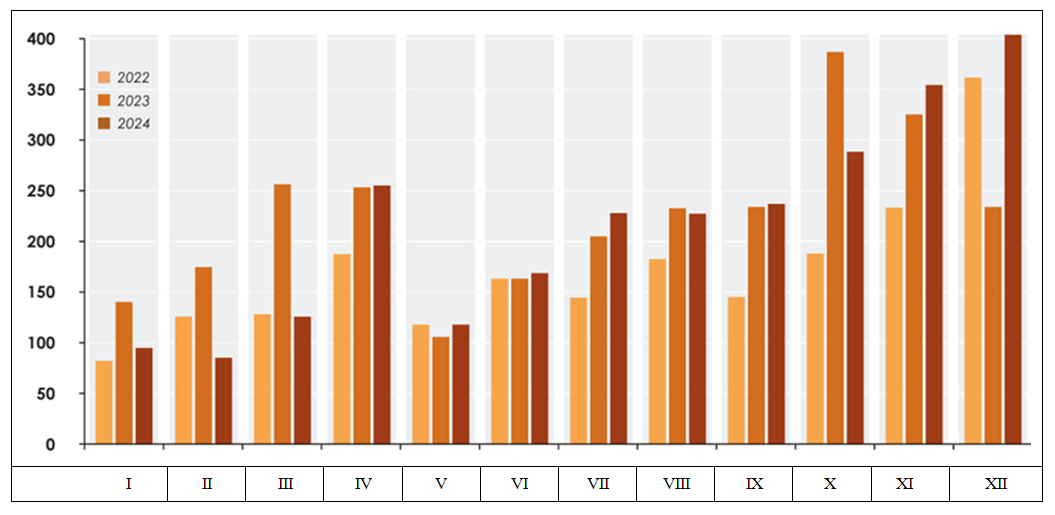 | Figure 2. Dynamics of Water Supply to the Amu Darya Delta (2022-2024, million m³) |
The monthly dynamics of water inflow directed to the dried basin of the Greater Aral Sea through the Main Collector of Southern Karakalpakstan during 2022-2024 were analyzed. The obtained data make it possible to assess the seasonal distribution of water resources in the region, changes in the hydrological regime, and the stability of the collector-drainage system operation.According to the analysis results, the total annual water inflow in 2022 amounted to 504 million cubic meters. During this period, relatively low water flow levels were observed in the winter and autumn months. In particular, from January to March, the water inflow ranged between 23 and 31 million cubic meters, while the highest value was recorded in May (55 million cubic meters). The relatively high level of water inflow during the summer months can be explained by the intensification of irrigation activities.In 2023, the total water inflow amounted to 602 million cubic meters, representing an increase of 98 million cubic meters compared to 2022. This indicates a significant rise in the volume of water discharged through the collector system (Table 1).Table 1. Dynamics of Water Inflow to the Dried Bed of the Large Aral Sea via the Main Collector of Southern Karakalpakstan (2022-2024, million m³)
 |
| |
|
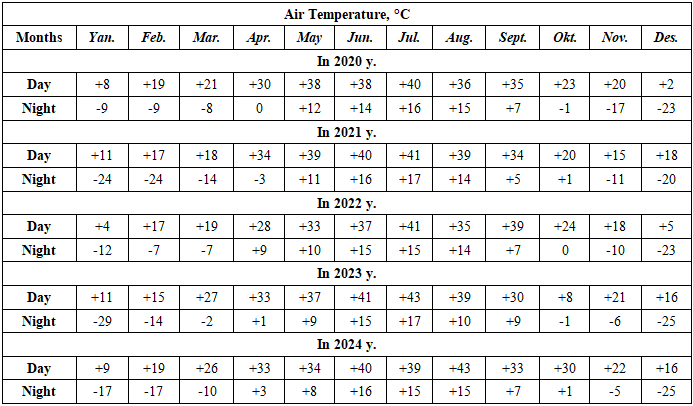
In this year, the water inflow was observed to be particularly high during the summer months, with the maximum value reaching 70 million cubic meters in August. This situation was attributed to the intensification of irrigation activities and the increase in the volume of drainage waters.In 2024, the total annual water inflow amounted to 606 million cubic meters, representing a slight increase of 4 million cubic meters compared to 2023. This indicates a stabilizing trend in the dynamics of water discharge through the collector system. The highest inflow values were again observed during the summer months, with a maximum of 79 million cubic meters recorded in August. In contrast, the sharp decrease in water inflow during the autumn and winter months is explained by the region’s seasonal hydrological characteristics.The analysis of interannual dynamics indicates that, during 2022-2024, the total water inflow exhibited a stable increasing trend. The high inflow observed during the summer months was associated with the increased water consumption for irrigated lands, the operation of drainage systems, and the influence of hydrometeorological factors. Conversely, the reduction in water inflow during the winter months is primarily linked to the seasonal decrease in irrigation activities.From this perspective, it is of significant scientific and practical importance to conduct regular monitoring of water inflow dynamics, perform a comprehensive analysis of its seasonal and annual variations, and develop measures for the efficient management of water resources.Based on observations and data analysis, the total water inflow amounted to 504 million cubic meters in 2022, 602 million cubic meters in 2023, and 606 million cubic meters in 2024. It should be noted that in 2024, no water inflow from the Amu Darya River delta or the Northern Aral Sea into the Greater Aral Sea was recorded, and the entire volume of water entering the sea was supplied solely through the Main Collector of Southern Karakalpakstan.During the study period, the rapid reduction of the Aral Sea’s surface area led to a significant intensification of continental climate characteristics in the Aral region. As a result of the diminished thermal and humidifying influence of the sea, the average air temperature during the summer, particularly in July, increased by 2.5-3.0°C, while in the winter, particularly in January, it decreased by 1-2°C.Throughout 2020-2024, the daily and monthly variations in air temperature in the Southern Aral Sea region were analyzed using a comparative approach, and their influence on the hydrological regime was assessed. In 2020, the daytime air temperature in the Southern Aral Sea region was approximately +8°C in January, rising to +19°C in February. In March, it reached +21°C, +30°C in April, and +38°C in May. During this period, the ice cover completely melted, and the water level partially stabilized. At the same time, the combined effects of increased air temperature and wind activity intensified evaporation processes.During the summer months, air temperatures remained high, reaching +38°C in June and +40°C in July, with +36°C recorded in August. The high summer temperatures significantly increased evaporation intensity, which contributed to a decline in water levels and an increase in water salinity. This, in turn, is likely to enhance the probability of stress conditions in local ecosystems. In the autumn months, temperatures gradually decreased, with +35°C in September, +23°C in October, +20°C in November, and +2°C in December. Although evaporation rates slowed during the autumn, the sharp diurnal temperature fluctuations were assessed to have a significant impact on hydrological processes (Table 2).Table 2. Monthly Air Temperature Dynamics (2020-2024 уу.)
 |
| |
|
In 2021, the daytime air temperature in the Southern Aral Sea region was +11°C in January, +17°C in February, and +18°C in March. In April, it rose to +34°C, followed by +39°C in May, +40°C in June, and one of the highest recorded values of +41°C in July. This phenomenon was primarily associated with the dryness of the atmosphere, low cloud cover, and high solar radiation intensity, which caused the land surface to heat rapidly during the day, while nighttime radiative cooling intensified, resulting in sharp temperature drops.In August, the daytime temperature reached +39°C, and in September, it was +34°C. The high temperatures contributed to increased evaporation rates and a tendency for declining water volumes, as reflected in the analysis results. Additionally, a potential increase in water salinity was assessed based on scientific reasoning.During the autumn months, temperatures gradually decreased, with +20°C in October, +15°C in November, and +18°C in December. The high monthly amplitude of air temperature in the autumn was identified as a critical climatic factor influencing the ecological condition, hydrological regime, and dynamics of biological processes in the Sudochye and Zhiltyrbas water bodies, and it is closely linked to the continental characteristics of the regional climate.Nighttime temperatures fell to -24°C in January and February, indicating severe winter cold and confirming the extreme nature of the region’s climate.In 2022, the daytime air temperature in the Southern Aral Sea region was +4°C in January, +17°C in February, and +19°C in March. The winter season was characterized by relatively warm daytime conditions but sharp nighttime cold, resulting in a season with high contrast and significant temperature variability. Such fluctuations in daytime and nighttime air temperatures were assessed to have a notable impact on hydrological processes, including freeze–thaw cycles, evaporation intensity, and soil moisture dynamics.In April, the daytime temperature reached +28°C, and in May it rose to +33°C. During the summer months, temperatures remained high, with +37°C in June, +41°C in July, and +35°C in August. In September, daytime temperature increased further to +39°C. During autumn, temperatures gradually decreased, with +24°C in October, +18°C in November, and +5°C in December. Nighttime temperatures during the winter months ranged from -12°C to -7°C.In 2023, temperature fluctuations became even more pronounced. The daytime air temperature was +11°C in January, +15°C in February, and +27°C in March. In April and May, temperatures reached +33°C and +37°C, respectively. During the summer months, the temperature rose to +41°C in June and one of the highest recorded values of +43°C in July, with +39°C in August. In the autumn, temperatures decreased, with +30°C in September, +8°C in October, +21°C in November, and +16°C in December. Nighttime temperatures dropped to -29°C in January, indicating extreme winter cold.In 2024, the seasonal temperature dynamics remained consistent. The daytime air temperature was +9°C in January, +19°C in February, +26°C in March, and +33°C in April. In May, it reached +34°C, followed by +40°C in June and +39°C in July. August recorded another peak of +43°C. During autumn, temperatures gradually decreased, with +33°C in September, +30°C in October, +22°C in November, and +16°C in December. Nighttime temperatures were -17°C in January and February, -10°C in March, and approximately +15°C during the summer months (Table 3).Table 3. Monthly Dynamics of UNN Index (UF) (2020-2024 yy.)
 |
| |
|
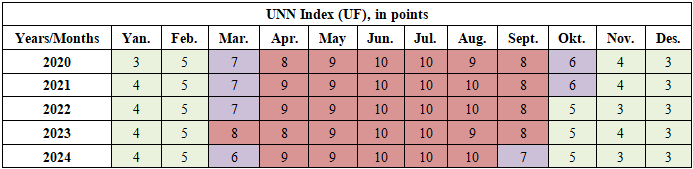
Overall, during 2020 - 2024, the highest air temperatures were mainly observed in July and August (+41°C to +43°C), while the lowest temperatures occurred in the winter months (down to -29°C). This pattern reflects the extremely continental characteristics of the region’s climate.Analysis of the monthly dynamics of the Ultraviolet (UV) index over 2020 -2024 revealed clear seasonal variation patterns throughout the year. The UV index, a key indicator of solar radiation intensity, showed significant differences across seasons. During the winter months, the UV index remained low, whereas in spring and summer, the index reached higher values, reflecting the increased solar radiation during these periods. According to data from 2020, the UV index (UVI) was relatively low at the beginning of the year. In January, the index was 3 points, increasing to 5 points in February. During the spring season, as solar radiation intensity increased, the index rose to 7 points in March, 8 points in April, and 9 points in May. The highest values were observed in the summer, with the UVI reaching 10 points in June and July and slightly decreasing to 9 points in August. In the autumn months, the UVI gradually declined, reaching 8 points in September, 6 points in October, 4 points in November, and 3 points in December.In 2021, the annual dynamics of the UV index (UVI) showed a pattern very similar to that observed in 2020. In January, the index was 4 points, increasing to 5 points in February and 7 points in March. During April and May, the UVI reached 9 points. High values were maintained throughout the summer, with the index at 10 points in June, July, and August. In the autumn months, the UVI gradually decreased, reaching 8 points in September, 6 points in October, 4 points in November, and 3 points in December.In 2022, the seasonal variations of the UV index (UVI) were clearly expressed. In January and February, the index was 4 and 5 points, respectively. It increased to 7 points in March and reached 9 points in April and May. During the summer months, the UVI reached its maximum value, with 10 points recorded in June, July, and August. In the autumn, a gradual decrease was observed, with the index at 8 points in September, 5 points in October, and 3 points in November and December.In 2023, the UV index (UVI) values were similar to those of previous years, with slight variations in some months. In January, the index was 4 points, increasing to 5 points in February. In March, it rose to 8 points, remaining at 8 points in April, and reached 9 points in May. During the summer months, high values were maintained, with the UVI at 10 points in June and July, and 9 points in August. In the autumn, the index gradually decreased, with 8 points in September, 5 points in October, 4 points in November, and 3 points in December.In 2024, the UV index (UVI) dynamics continued to reflect clear seasonal patterns. In January, the index was 4 points, rising to 5 points in February and 6 points in March. In April and May, it reached 9 points. During the summer, the UVI reached its highest values, with 10 points recorded in June, July, and August. In the autumn, the index gradually decreased, with 7 points in September, 5 points in October, and 3 points in November and December.Analysis of the UV index (UVI) dynamics during 2020-2024 indicates that, throughout the year, the index remained at 3-5 points in the winter months, gradually increased during spring, reached up to 10 points in the summer, and then declined again in the autumn. This pattern reflects the direct relationship between seasonal variations in solar radiation and the observed UVI values.The Sudochye and Zhiltyrbas water bodies of the Southern Aral Sea exhibit distinct hydrological and hydrochemical characteristics, and the formation and development of aquatic flora in these water bodies are directly influenced by variations in environmental factors. In particular, daytime and nighttime air and water temperature regimes, water salinity, light conditions, and the concentration of biogenic elements play a decisive role in the seasonal dynamics of aquatic communities.During the spring season, the increase in water temperature and the extension of daylight duration promotes the active growth of phytoplankton and periphyton communities. During this period, diatom species dominate both in composition and biomass, rapidly proliferating in the presence of sufficient silicon compounds in the aquatic environment. These dynamics play a critical role in determining the primary productivity of aquatic ecosystems.Based on the seasonal development dynamics of the Sudochye water bodies’ phytoplankton, it was found that during the spring season, diatoms (8 species), green algae (7 species), and blue-green algae (5 species) were dominant. Among Euglena species, 2 species and their varieties were recorded in spring.In the summer season, the Sudochye water body was dominated by green algae (13 species), diatoms (13 species), and blue-green algae (11 species), while 3 Euglena species were observed.For the autumn season, green algae (17 species), diatoms (15 species), and blue-green algae (13 species) were predominant, with 4 Euglena species recorded.During the winter season, the samples were primarily dominated by diatoms (9 species), green algae (7 species), and blue-green algae (4 species) (Figure 3).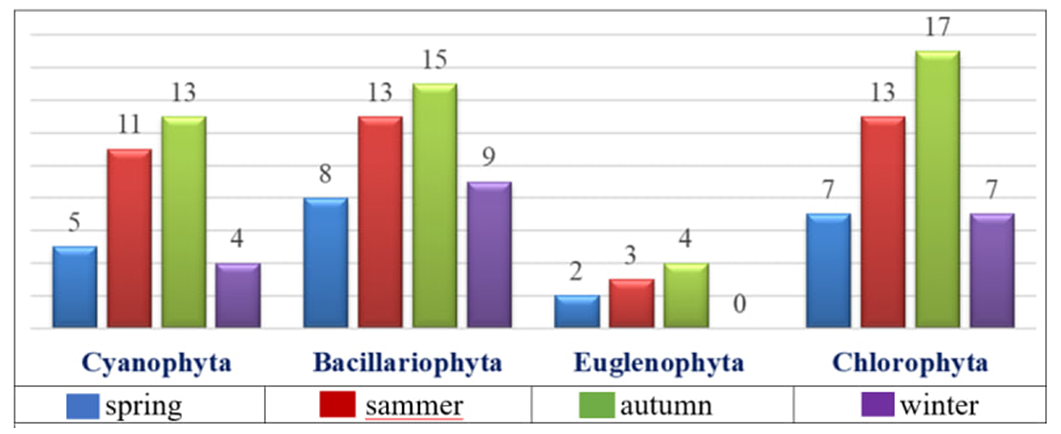 | Figure 3. Seasonal Development Dynamics of Phytoplankton in the Sudochye Lake System (2019-2025) |
Based on the seasonal algological samples collected from the Sudochye water bodies, the composition of Bacillariophyta (diatoms) was analyzed. It was found that the classes Centricae and Pennatophyceae, the orders Discoidales, Cymbellales, Araphinales, and Raphinales, and the families Coscinodiscaceae Küetz., Tabellariaceae, Fragilariaceae (Küetz.) D.T., and Achnanthaceae (Küetz.) Grun. were consistently present. Within these families, the genera Melosira Agardh, Tabellaria Ehr., Synedra Ehr., Fragilaria Lyngb., and Achnanthes Bory were regularly observed across all seasonal sample.In the oligotrophic and mesotrophic lakes Karateren and Begdulla-Aydin, the diatom Tabellaria flocculosa (Roth) Kütz. was observed in small quantities within planktonic and benthic communities, but it was consistently present in all seasonal samples. The persistent occurrence of Tabellaria flocculosa was associated with low concentrations of dissolved nutrients, high water transparency, the presence of moderate oxygen levels throughout the year, and low productivity of organic compounds.In assessing the temporal and spatial transformations of lake ecosystems, the traditional diatom analysis method has been widely applied. Based on the study of the seasonal development of phytoplankton in the Sudochye lake, it was found that Bacillariophyta (diatoms) were the dominant group throughout the year.As a result of changes in the physicochemical characteristics of the water body, the natural, initial components of the ecological systems were gradually replaced by species that are more stable under the new environmental conditions.Based on the seasonal development dynamics of phytoplankton in the Zhiltyrbas water body, during the spring season, blue-green algae (18 species), diatoms (14 species), and green algae (12 species) were dominant. Among other groups, 4 Euglena species and 1 Pyrrhophyta species were recorded in spring.In the summer season, the water body was dominated by blue-green algae (20 species), diatoms (19 species), and green algae (14 species). Additionally, 3 Euglena species and 4 Pyrrhophyta species and varieties were observed during this period (Figure 4).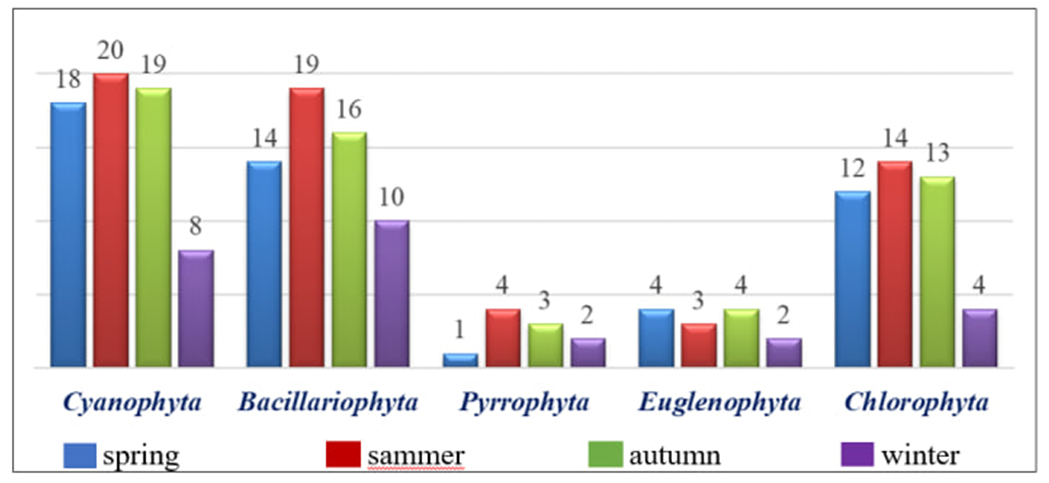 | Figure 4. Seasonal Development Dynamics of Phytoplankton in the Zhiltyrbas Lake System (2019-2025) |
For the autumn season, the Zhiltyrbas water body was primarily dominated by blue-green algae (19 species), diatoms (16 species), and green algae (13 species), while Euglena (4 species) and Pyrrhophyta (3 species) were present in minor amounts. During the winter season, diatoms (10 species) and blue-green algae (8 species) were the predominant groups, with other phytoplankton groups occurring in minimal numbers.In the Zhiltyrbas water body, among the Cyanophyta, the genus Merismopedia (Meyen.) Elenk., particularly Merismopedia tenuissima, was identified. Within the Bacillariophyta, representatives of the genera Cyclotella, Synedra, Rhoicosphenia, Navicula, Caloneis, Cymbella, and Nitzschia were distinguished as relatively diverse and consistently present components of the Zhiltyrbas lake plankton.Specifically, the species Cyclotella comta, Synedra berolinensis, S. ulna, Rhoicosphenia curvata, Nitzschia atomus, Caloneis alpestris, C. amphisbaena, Cymbella prostrata, Nitzschia linearis, N. vermicularis, and N. sigmoidea were frequently observed in the former left and right channels (northern part) of Zhiltyrbas Lak.Among the Chlorophyta, the genus Cladophora, specifically Cladophora glomerata, and the genus Spirogyra, specifically Spirogyra fluviatilis, were frequently observed. These species were particularly abundant in samples collected from the dam-enclosed central section of Zhiltyrbas Lake and the southern-western section near the Kazakhdarya Canal inflow. In samples collected from the 3-KS inflow (southeastern section) and the 1-KS inflow (southern-western section) of Zhiltyrbas Lake, representatives of Bacillariophyta were frequently observed. These included the genus Melosira Ag., specifically Melosira varians, the genus Cyclotella Kuetz., specifically Cyclotella comta, and the genus Fragilaria Lyngb., specifically Fragilaria capucina.Among the Euglenophyta thriving in the freshwater basins, Euglena hemichromata Skuja was identified as the most sensitive species to salinity in highly mineralized waters.Regarding the species composition of the algocenoses, representatives of Bacillariophyta-including Cyclotella meneghiniana Kütz., Chaetoceros muelleri Lemm., Achnanthes brevipes Ag., and Navicula exigua -were found to be dominant compared to species from other phyla.Under conditions of salinity changes, euryhaline species capable of osmoregulation from Bacillariophyta division, class Mediophyceae, order Thalassiosirales, family Thalassiosiraceae, genus Thalassiosira, species Thalassiosira nordenskioeldii Cleve, Thalassiosira tenera Proschkina-Lavrenko; class Mediophyceae, order Chaetocerotales, family Chaetocerotaceae, genus Chaetoceros, species Chaetoceros muelleri Lemmermann; class Bacillariophyceae, order Bacillariales, family Bacillariaceae, genus Nitzschia, species Nitzschia closterium (Ehrenberg) W. Smith, Amphora coffeaiformis (C. Agardh) Kuetzing, Achnanthes brevipes; and from Chlorophyta division, class Chlorophyceae, order Volvocales, family Dunaliellaceae, genus Dunaliella, species Dunaliella salina (Dunal) Teodoresco were observed in high abundance.
4. Сonclusions
The integrated analysis of climatic, hydrological, and algological data for the Southern Aral Sea region (2020-2024) and the Sudochye and Zhiltyrbas water bodies (2019-2025) revealed pronounced seasonal and interannual variability. The region’s strongly continental climate, with summer daytime temperatures of +41; + 43°C and winter nighttime minima down to −29°C, significantly influences evaporation, water mineralization, and hydrological regimes. Seasonal variations of ultraviolet radiation further shape phytoplankton productivity and community structure.Annual water inflow via the Southern Karakalpakstan main collector increased from 504 million m³ in 2022 to 606 million m³ in 2024, with maximum summer flows driven by irrigation and drainage activities. Phytoplankton was dominated by Bacillariophyta (Thalassiosira, Chaetoceros, Nitzschia, Amphora, Achnanthes) and euryhaline Chlorophyta (Dunaliella salina), showing high biomass and species diversity in spring-summer and reduced abundance dominated by cold- or salt-tolerant species in autumn-inter.These findings demonstrate that climatic conditions, hydrological dynamics, and salinity fluctuations directly control primary productivity and ecosystem stability. Peripheral water bodies, such as Sudochye and Zhiltyrbas, play crucial hydroecological roles, supporting biodiversity and resilience under increasing aridity. Continuous monitoring of water resources and phytoplankton dynamics is essential for sustainable management, ecological assessment, and developing adaptive strategies for the Southern Aral region. The study also provides a globally relevant example of how large-scale hydrological modifications impact semi-arid aquatic ecosystems.
References
| [1] | APHA. (2017). Standard Methods for the Examination of Water and Wastewater (23rd ed.). Washington, DC: American Public Health Association. ISBN: 978-087553-287-4. |
| [2] | Berdimbetov, T. (2023). Spatio-temporal variations of climate variables and extreme indices over the Aral Sea Basin during 1960-2017. Trends in Sciences. https://doi.org/10.48048/tis.2023.5664. |
| [3] | Chavez, P.S. Jr. (1996). Image-based atmospheric corrections revisited and improved. Photogrammetric Engineering and Remote Sensing, 62(9), 1025-1036. https://doi.org/10.14358/PERS.62.9.1025. |
| [4] | Deroin, J.P. (2025). Use of remote sensing data to study the Aral Sea Basin in Central Asia. Remote Sensing, 17(16), 2814. https://doi.org/10.3390/rs17162814. |
| [5] | Glantz, M.H. (1999). Societal Responses to Regional Climate Change: Forecasting by Analogy. Cambridge: Cambridge University Press. https://doi.org/10.1017/CBO9780511629644. |
| [6] | Hussain, M., et al. (2024). Anthropogenic activities and the influence of desertification processes on the water cycle and water use in the Aral Sea Basin. Journal of Hydrology: Regional Studies, 51, 101598. https://doi.org/10.1016/j.ejrh.2023.101598. |
| [7] | Kirillin, G.B., Shatwell, T., & Izhitskiy, A.S. (2025). Consequences of the Aral Sea restoration for its present physical state: temperature, mixing, and oxygen regime. Hydrology and Earth System Sciences, 29, 3569-3588. https://doi.org/10.5194/hess-29-3569-2025. |
| [8] | McFeeters, S.K. (1996). The use of the Normalized Difference Water Index (NDWI) in the delineation of open water features. International Journal of Remote Sensing, 17(7), 1425-1432. https://doi.org/10.1080/01431169608948714. |
| [9] | Micklin, P. (2007). The Aral Sea disaster. Annual Review of Earth and Planetary Sciences, 35, 47-2. https://doi.org/10.1146/annurev.earth.35.031306.140120. |
| [10] | Peterson, T.C., Easterling, D.R., Karl, T.R., Groisman, P.Y., & Anderegg, W. (1998). Homogeneity adjustments of in situ atmospheric climate data: A review. International Journal of Climatology, 18(13), 1493-1517. https://doi.org/10.1002/(SICI)1097-0088(19981115)18:13<1493: AID-JOC333>3.0.CO;2-X. |
| [11] | Tolypella, M., Guillory, W.X., & Zuccarello, G.C. (2016). Identification Keys to Common Freshwater Algae. Amsterdam: Elsevier. https://doi.org/10.1016/C2014-0-01196-0. |
| [12] | UNEP/IOC. (2010). Protocols for the Sampling and Analysis of Plankton in the Ocean. Paris: United Nations Environment Programme & Intergovernmental Oceanographic Commission. |
| [13] | Utermöhl, H. (1958). Zur Vervollkommnung der quantitativen Phytoplankton-Methodik. Mitteilungen der Internationalen Vereinigung für Theoretische und Angewandte Limnologie, 9, 1-38. |
| [14] | World Meteorological Organization. (2010). Manual on Hydrological Practices: Volume I – Hydrology: From Measurement to Hydrological Information (6th ed.). WMO- No. 168. Geneva: WMO. ISBN: 978-92-63-11068-2. |
| [15] | Zhou, Y., et al. (2020). The impact of climate change and human activities on the Aral Sea Basin over the past 50 years. Atmospheric Research, 245, 105125. https://doi.org/10.1016/j.atmosres.2020.105125. |


 Abstract
 Reference
 Full-Text PDF
 Full-text HTML