
-
Paper Information
- Next Paper
- Paper Submission
-
Journal Information
- About This Journal
- Editorial Board
- Current Issue
- Archive
- Author Guidelines
- Contact Us
International Journal of Genetic Engineering
p-ISSN: 2167-7239 e-ISSN: 2167-7220
2026; 14(3): 83-90
doi:10.5923/j.ijge.20261403.02
Received: Feb. 26, 2026; Accepted: Mar. 19, 2026; Published: Mar. 26, 2026

New Data on Systematic Analysis of Hunting of Animals and Birds in the Hunting Plains of Uzbekistan
 Abstract
 Reference
 Full-Text PDF
 Full-text HTML
Rashit Rakhimovich Rakhmonov1, 2, Muratbay Arepbaevich Jumanov3, Arepbaev Islambek Muratbaevich4, Avaz Rustamovich Rayimov1, Mehriniso Djuraevna Qoilova1, Avazbek Hamzayevich Barotov5, Jonibek Rashitovich Raximov6
1PhD., Associate Professor, Bukhara State Pedagogical Institute, Bukhara, Uzbekistan
2Independent Researcher, Karakalpak State University, Uzbekistan
3Doctor of Biological Sciences, Professor at Karakalpak State University, Uzbekistan
4Associate Professor, Doctor of Biological Sciences, Karakalpak State University, Uzbekistan
5PhD., Associate Professor, Bukhara State Pedagogical, Bukhara, Uzbekistan
6Lecturer, Department at the Bukhara State Pedagogical Institute, Bukhara, Uzbekistan
Correspondence to: Rashit Rakhimovich Rakhmonov, PhD., Associate Professor, Bukhara State Pedagogical Institute, Bukhara, Uzbekistan.
| Email: |  |
Copyright © 2026 The Author(s). Published by Scientific & Academic Publishing.
This work is licensed under the Creative Commons Attribution International License (CC BY).
http://creativecommons.org/licenses/by/4.0/

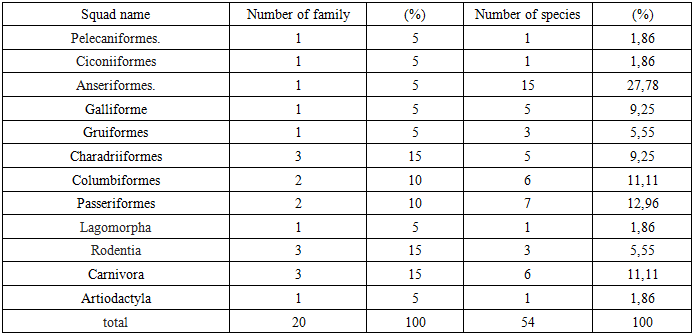
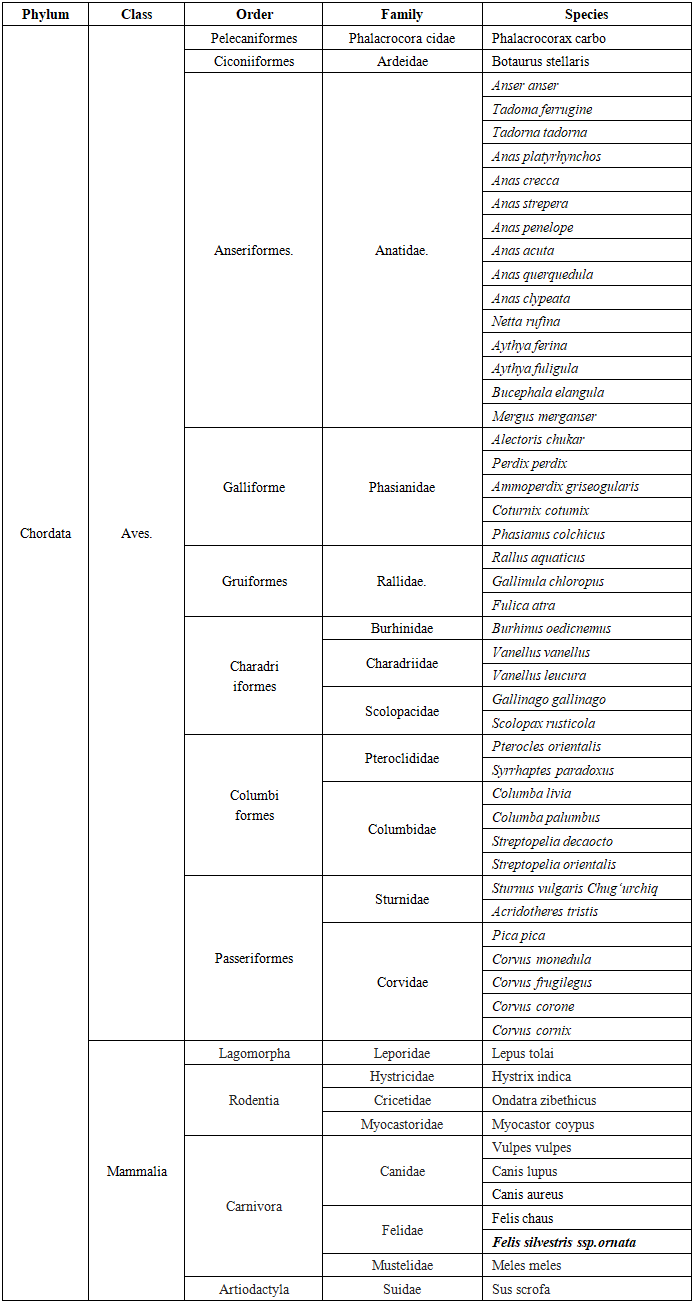
The article presents a systematic analysis of mammals and birds officially permitted for hunting in the lowlands of Uzbekistan, by classes, orders, families and species. As a result of the conducted research, it was established for the first time that animals permitted for hunting in the lowlands of Uzbekistan represent 2 classes, 12 orders, 20 families and 54 species. The biodiversity, taxonomy, distribution, abundance, and bioecological characteristics of commercial species harvested in the lowlands of the desert zone of Uzbekistan, the impact of anthropogenic factors on the fauna, and measures for the protection and sustainable use of species are analyzed. The article describes in detail the activities of organizations involved in hunting in the lowlands of Uzbekistan. Biodiversity loss is one of the biggest environmental problems today, and protecting animals, along with hunting them, is of great importance.
Keywords: Bukhara, Navoi, Khorezm, Republic of Karakalpakstan, Unique, Global climate change, Recreational load, Birds, Economic, Biodiversity, Protection, Hunting grounds, Wild animals, Anthropogenic
Cite this paper: Rashit Rakhimovich Rakhmonov, Muratbay Arepbaevich Jumanov, Arepbaev Islambek Muratbaevich, Avaz Rustamovich Rayimov, Mehriniso Djuraevna Qoilova, Avazbek Hamzayevich Barotov, Jonibek Rashitovich Raximov, New Data on Systematic Analysis of Hunting of Animals and Birds in the Hunting Plains of Uzbekistan, International Journal of Genetic Engineering, Vol. 14 No. 3, 2026, pp. 83-90. doi: 10.5923/j.ijge.20261403.02.
Article Outline
1. Introduction
- Natural biodiversity in key habitats has declined by 20% over the past century, and many species are threatened with extinction. The loss of a single species can have widespread ecological consequences affecting the global ecosystem. Today, special attention is being paid to the protection and sustainable use of wildlife, which is an important component of biodiversity. In particular, the widespread and sometimes irrational use of wild animals for hunting purposes, as well as existing problems in the field of hunting management, in many cases lead to the extinction or reduction in the number of species, sometimes turning them into rare or endangered species [2,15].
2. Literature Review
- Based on the zoogeographic characteristics of each region, foreign scientists conducted research on game population management, game species composition, hunting volume, hunting and game resource management, and the sustainable use of game species. Including B.T. Gray (1994), J. Madsen et al., (1995), J. Madsen (1995), H. Kokko et al., (1998), C.D. Fitzgibbon (1995), A. Gammell (1999), L. Munro (1999) G. Griffin (2000), F. Barends (2002), Ph. Chardonnet (2002), Y. Moy (2010), Michael Stokes (2011), A. Benitez-Lopez et al., (2017), R. Castillo-Contreras (2018), A. Hirschfeld (2019), Emmanuel Serrano (2020), Paulino Fandos (2023), T. Htay et al. (2023), Inmaculada Navarro (2025) and conducted by other scientists [4].
3. Materials and Methodology
- The study utilized basic zoological and ecological methods, as well as questionnaire surveys and statistical and comparative analysis. Wildlife use is highly diverse, and in Uzbekistan, this activity is primarily carried out through recreational hunting, and partly for sport and other (scientific and medical) purposes [7,10].The following methods were used to identify animals and record populations:1. Visual observation: Identification of animals by direct observation in their natural habitat.2. Identification by tracks and remains: Species identification using paw prints, fur, bird remains, and negative tracks.3. Traps and camera traps: Animal activity and species were recorded using special sensor cameras.4. Acoustic monitoring: identification using the vocalizations of birds and some mammals.5. Biological samples: laboratory analysis of soil, bird eggshells, fur, and food samples.Each method was applied in a manner that caused minimal environmental harm to the animals [7,10,11,12].During the count, it is necessary to move slowly and quietly along the route, periodically stopping to observe the surroundings. Accordingly, birds encountered during the count are recorded in a diary. Observations and calculations were conducted along designated routes and at stationary observation points. Pedometers and large-scale maps were used to determine the route lengths. The routes ranged from 1 to 5 km along the coastline of lakes owned by hunting grounds and other lakes, with route widths up to 100 to 300 meters. In other areas, the routes ranged from 1 to 20 km, with route widths of 50 to 200 meters. Calculations were conducted in clear weather from 6:00 to 9:00 AM and from 5:00 to 8:00 PM (Table 1).The animal count results were extrapolated to a 10-hectare area and the animal population density was determined using the following formula:
 Here D is the density; n is the number of birds encountered; L is the route length; W is the route width, or the distance from the route axis to the edge of the counting strip. The formula uses a factor of 2 to account for birds to the left and right of the route axis, but our calculations were based on one side of the route axis due to the lake's characteristics.The percentage of a particular species in the prey population (%) was determined using the following formula:
 Here a is the number of representatives of a specific species; b is the number of representatives of all species counted at the census location.
4. Results and Discussion
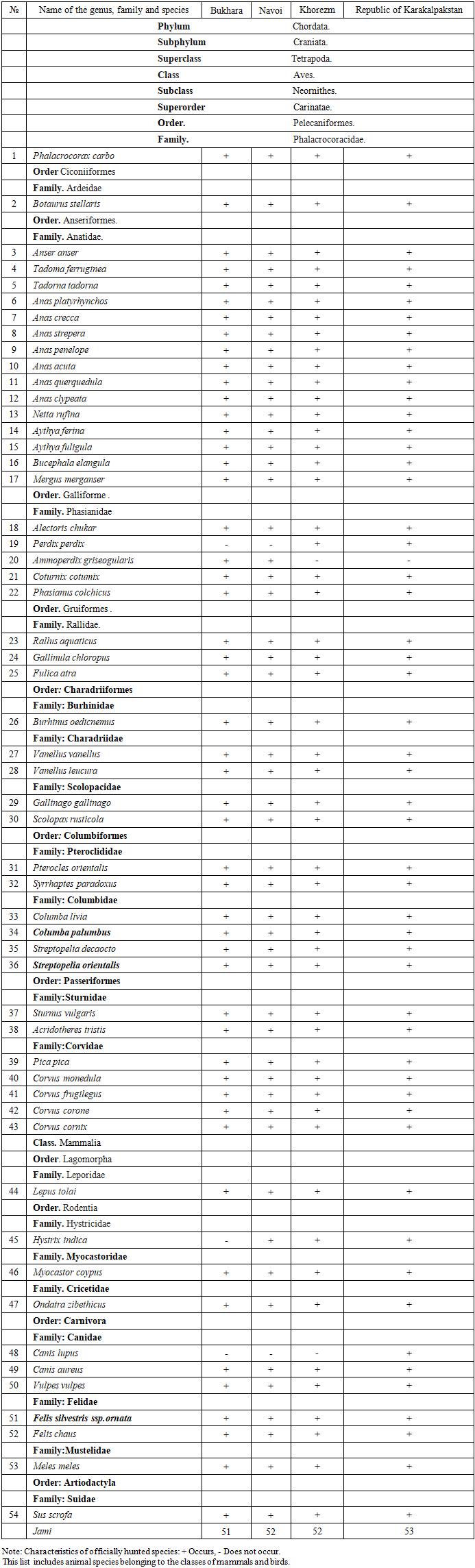
- Climate change, uncontrolled livestock grazing, recreational activities, and large-scale construction are leading to the degradation of natural ecosystems and a reduction in biodiversity in the lowlands of Uzbekistan. Rational use and protection of wild animals and animal products are of national and international importance. A systematic analysis of animals harvested in the lowlands of the desert zone of Uzbekistan revealed the presence of 2 classes, 12 orders, 20 families, and 54 species of animals and birds (Table 1) [6,9,13].
|
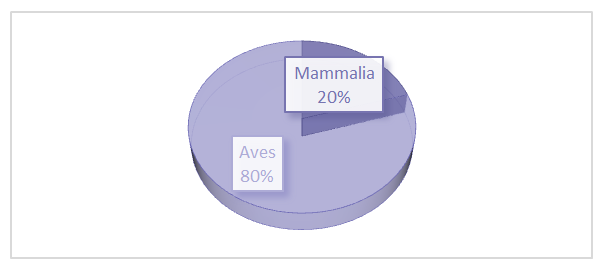 | Figure 1. Analysis of animals permitted for hunting in the lowlands of the desert zone of Uzbekistan, by class |
|
|
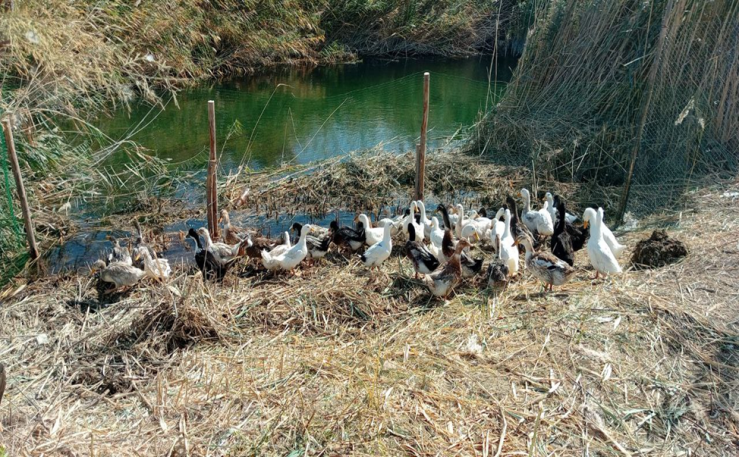 | Figure 2. Laying hens in the nursery at the Kumsultan hunting farm |
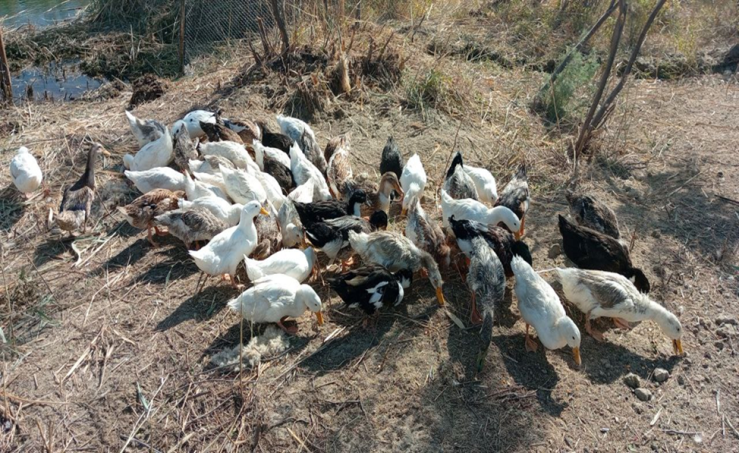 | Figure 3. Breeding of animals on a hunting farm in the lowlands of the desert zone of Uzbekistan using the nursery method |
5. Conclusions
- This research, which examines hunting grounds, which are an important part of the national economy, and the species hunted there, will contribute to the proper organization of hunting, optimized management of hunting grounds, further improvement of the system for issuing quotas and permits for the sustainable use of hunting grounds and game animals, and will also help address other issues related to hunting management on a scientific basis. Scientifically based hunting of animals permitted for hunting in the lowlands of Uzbekistan's desert zone is essential for regulating natural populations, preserving biodiversity, and ensuring ecological balance. Harmonizing the ecological, biological, and economic aspects of hunting is a key factor in ensuring sustainable use of nature in the future.