
-
Paper Information
- Paper Submission
-
Journal Information
- About This Journal
- Editorial Board
- Current Issue
- Archive
- Author Guidelines
- Contact Us
International Journal of Genetic Engineering
p-ISSN: 2167-7239 e-ISSN: 2167-7220
2026; 14(2): 71-76
doi:10.5923/j.ijge.20261402.04
Received: Feb. 2, 2026; Accepted: Feb. 22, 2026; Published: Mar. 5, 2026

Daily Flowering Time of Salvia Officinalis L. in Termez City
 Abstract
 Reference
 Full-Text PDF
 Full-text HTML
B. S. Uralov1, N. Mengnorov2, S. S. Chorshanbiyev1
1Termez State University, Termez, Uzbekistan
2Tashkent State Technical University, Tashkent, Uzbekistan
Copyright © 2026 The Author(s). Published by Scientific & Academic Publishing.
This work is licensed under the Creative Commons Attribution International License (CC BY).
http://creativecommons.org/licenses/by/4.0/

The daily flowering rhythm of S.officinalis L. was studied under the environmental conditions of Termez city. Observations were conducted during the initial flowering phase (16.04.2024) and the mass flowering stage (23.04.2024) to determine the dynamics of flower opening in relation to air temperature and relative humidity. The results showed that S. officinalis is a light-demanding species whose flowers predominantly open during daylight hours. At the beginning of flowering, a total of 45 flowers opened on a single plant between 06:00 and 18:00, with an average of 6.42±1.2 flowers opening every two hours. The most flowers bloomed at 10:00, when the air temperature was +22°C and the relative humidity was 59%. During the mass flowering stage, a single plant had a total of 478 flowers throughout the day. The highest rate of flower opening (124 flowers) happened between 10:00 and 12:00, when the air temperature was +23°C and the relative humidity was 48%. The most favorable temperatures for active flower opening were stable temperatures between 21 and 24.5°C. These findings offer significant insights into the bioecological traits and daily flowering rhythm of S. officinalis L., establishing a scientific foundation for its effective large-scale cultivation in the climatic context of Termez.
Keywords: Salvia officinalis L., Flowering rhythm, Mass flowering, Daily flowering dynamics, Temperature, Relative humidity, Bioecological characteristics, Termez conditions, Medicinal plants, Phenology
Cite this paper: B. S. Uralov, N. Mengnorov, S. S. Chorshanbiyev, Daily Flowering Time of Salvia Officinalis L. in Termez City, International Journal of Genetic Engineering, Vol. 14 No. 2, 2026, pp. 71-76. doi: 10.5923/j.ijge.20261402.04.
1. Introduction
- In recent years, the increasing demand for raw materials and formulations derived from medicinal plants has rendered the comprehensive examination of the ecological, phenological, and physiological traits of plants cultivated across diverse regions a critical scientific endeavour. Among the myriad of medicinal plants, Salvia officinalis L. (common sage) is of particular significance due to its abundance of essential oils, flavonoids, tannins, and various other biologically active constituents. This plant finds extensive application in pharmaceuticals, cosmetology, the food sector, and traditional medicine. Consequently, the investigation of the bioecological attributes of S. officinalis, particularly its flowering phenomena, establishes a vital scientific foundation for the ongoing enhancement of its industrial-scale cultivation methodologies.The way plants flower is closely linked to environmental conditions, with non-living factors like temperature, light duration and strength, and humidity directly affecting how flowers grow. Since S. officinalis is a photophilous (light-loving) plant, its flowers primarily open during daylight hours; at the same time, daily temperature variation is one of the main factors determining the frequency and intensity of flower opening. The climate of Termez city is characterized as subtropical continental, noted for its relatively rapid increase in temperature during the spring months, low humidity, and fluctuating air parameters throughout the day. Studying how these specific conditions affect the flowering process of S. officinalis is scientifically and practically significant.The main objective of this study is to determine the daily flowering rhythm of S. officinalis L. under Termez conditions during the onset and peak flowering periods, and to evaluate the correlation between the flower opening process and air temperature and relative humidity. Studying the daily flowering rhythm allows for the optimization of medicinal plant agrotechnology, the determination of the biological boundaries of the flowering period, and the designation of the most favorable time to obtain high-quality medicinal raw material. Furthermore, the results obtained have great practical significance as the scientific basis for the sustainable and effective cultivation of common sage in southern regions.Salvia officinalis L., or sage, is a perennial aromatic subshrub from the Mediterranean region that is widely grown for its medicinal, culinary, and ornamental uses [1], [2]. This species has been used in traditional medicine for a long time to treat a wide range of problems, such as oral infections, digestive problems, and cognitive enhancement. Its essential oil is also a useful ingredient in cosmetics, pharmaceuticals, and food preservation [3]. To learn more about S. officinalis's reproductive biology and ecological interactions, as well as to improve farming methods and get the most out of bioactive compounds, it is important to know how its flowering times change over time. The timing of flowering, especially the daily pattern of when flowers open and close (anthesis), is an important part of how a plant reproduces. It impacts the attraction of pollinators, the transfer of pollen, and ultimately the plant's reproductive success [4]. In many plant species, the opening of flowers is not random; rather, it is a process that is regulated by time and controlled by circadian rhythms and environmental factors [5], [6]. This kind of time control makes sure that pollinators are active at the same time as plants. This helps plants use their resources better and increases the chances of reproduction [7].It is imperative to understand the diurnal flowering patterns of Salvia officinalis, as the composition of its essential oil and the concentration of bioactive compounds exhibit significant fluctuations throughout the day [8], [9]. Studies indicate that significant secondary metabolites, such as monoterpenes, sesquiterpenes, and polyphenolic compounds, exhibit circadian oscillations. These oscillations are important for figuring out when to harvest and how good the plant material is [10,11]. Also, the way plants bloom affects how pollinators behave and how plant–pollinator networks work. This is important for understanding how ecosystems work and the services they provide [12]. Salvia officinalis L. is part of the Lamiaceae family, which has 236 genera and about 7,200 species, most of which have aromatic and medicinal properties [13]. The genus Salvia is one of the biggest in the family. It has more than 900 species and is found all over the world. The Mediterranean region, Central Asia, and the Americas have the most different types of Salvia [14]. S. officinalis comes from the Mediterranean basin, especially the Adriatic coast, and usually grows on dry, rocky slopes [15].This plant is a perennial subshrub that grows to be 20 to 80 cm tall and has a woody stem and many branches [16]. The leaves are opposite, simple, oblong-elliptic, or lanceolate, and they are 3–8 cm long. They are covered in glandular trichomes and have a strong smell [17]. There are whorls of flowers that make up the terminal spikes [18]. The upper lip of each flower is vaulted and the lower lip is three-lobed. The flowers are usually violet-blue, but they can also be pink or white [19]. The flower's structure is made to attract pollinators, especially bees [20].The flowering period of S. officinalis extends from March to July, depending on climatic conditions [21]. The plant does best in temperate climates and can handle dry spells, but it prefers full sun and well-drained soils [22]. Environmental factors like temperature, light, and water availability affect the timing of flowering, which can be different in different places and growing conditions [23]. S. officinalis is an important part of Mediterranean ecosystems because it provides nectar and pollen for pollinators, which helps plants and pollinators work together [24]. Bees, honeybees, and butterflies from the Hymenoptera, Diptera, and Lepidoptera orders are drawn to its fragrant leaves and flowers [25]. The timing of flowering and its daily patterns are important for making sure that pollinators come at the right times, which increases the chances of successful reproduction [26].Salvia officinalis exhibits distinct diurnal flowering, with anthesis occurring at specific times throughout the day. Studies conducted in the Qarshi oasis have monitored the diurnal flowering dynamics of S. officinalis by counting the number of open flowers every two hours from 5:00 a.m. to 7:00 p.m. [1], [2]. These investigations have enabled the mapping of bud development, anthesis, and closure, and have correlated these processes with precise diurnal rhythms.Research indicates that the highest intensity of flower opening in S. officinalis is observed during the morning hours. This morning flowering pattern is widespread among many plant species and holds adaptive significance for synchronisation with pollinator activity [27]. Morning anthesis ensures that flowers are available when pollinators are most active, increasing the likelihood of pollination and maximising reproductive success [28]. Furthermore, morning flowering helps plants avoid exposure to high temperatures and low humidity later in the day, which can damage floral organs and reduce pollinator activity [29].The precise timing of flower opening varies among plant species and is regulated by circadian clocks and environmental cues [30]. In Turnera ulmifolia, flowers open approximately two hours after dawn and wither after 3–4 hours [8]. In Oenothera, anthesis occurs about twelve hours after the transition from darkness to light [8]. Cestrum nocturnum exhibits circadian rhythms under continuous light or darkness, with a period of approximately 27 hours at 17°C, which becomes shorter at higher temperatures [8]. Although specific data on the exact timing of anthesis in Salvia officinalis are limited, existing evidence indicates a peak in flower opening during the morning hours. Studies conducted in the Qarshi oasis have observed flower opening beginning at 5:00 a.m., suggesting that anthesis initiates in the early morning [1], [2]. The temporal dynamics of flower opening encompass not only the onset of anthesis but also the development and maturation of floral organs.The floral lifespan, defined as the duration during which a flower remains open and functional, varies considerably among plant species. In Melissa officinalis, individual flowers have an average lifespan of 24 hours [4]. This relatively short floral longevity is characteristic of many Lamiaceae species and is considered an adaptation to maximise pollinator visits and pollen transfer [31].Although precise data on the floral lifespan of Salvia officinalis are limited, flowers typically remain open for a single day before withering and closing. The closure of the flower, like anthesis, may be a process linked to specific timing, although this aspect remains underexplored in S. officinalis.Floral longevity and the timing of closure are critical for pollinator activity and reproductive success. A short floral lifespan ensures that flowers are open during periods of peak pollinator activity, thereby increasing the likelihood of successful pollination [32]. Furthermore, a brief floral lifespan helps reduce the energetic costs associated with flower production and maintenance, enabling the allocation of more resources to seed development and other reproductive functions [33].
2. Materials and Methods
- The study was conducted in April 2024 under open-field conditions in the city of Termiz, Surkhandarya region. The experimental site is characterised by a subtropical continental climate, marked by pronounced diurnal temperature fluctuations, high solar radiation, and low relative humidity. The soil at the site is loamy in texture with moderate fertility. As the object of study, two-year-old, healthy Salvia officinalis L. plants, cultivated under uniform agrotechnical conditions, were selected. Phenological observations were carried out at two stages: the onset of flowering (16 April 2024) and the peak flowering period (23 April 2024). At both stages, to determine the diurnal rhythm of flower opening, observations were made at seven time intervals during the day—06:00, 08:00, 10:00, 12:00, 14:00, 16:00, and 18:00. At each observation point, the number of newly opened flowers per plant was recorded manually. Additionally, air temperature and relative humidity were obtained from the Termiz meteorological station and further verified using a digital thermo-hygrometer installed in the field. The data collected at each time interval were summarised across 10 plants, and mean values were calculated. The experiment was conducted in triplicate to ensure the reliability of the results. The collected data were processed using Microsoft Excel and Jasp software, with calculation of the arithmetic mean (M), standard error (m), and coefficients of variation. Diagrams and charts were constructed to graphically analyse the daily flowering rhythm. This comprehensive methodological approach enabled the identification of the flowering process of S. officinalis L. under the conditions of Termiz and its correlation with abiotic factors.
3. Results
- The conducted studies demonstrated that S. officinalis L., as a heliophilous species, is characterised by predominantly diurnal flower opening. Under the warm and arid spring climatic conditions of Termiz, the rhythm of flower opening was directly correlated with daily temperature fluctuations and relative humidity. At the initial stage of flowering, no flower opening was observed at 05:00 a.m. The first flowers began to open between 05:30 and 06:00, coinciding with the onset of rising air temperatures. At 06:00, with an air temperature of +16°C and relative humidity of 68%, four flowers were recorded as open. In subsequent hours, as the temperature increased, the number of open flowers also rose: at 08:00, with a temperature of +17.5°C and 63% humidity, seven flowers were open; at 10:00, under +22°C and 59% humidity, the number of open flowers reached its peak at twelve. During the hottest part of the day (12:00–16:00), flowering activity decreased slightly: at 12:00, six flowers were open, while at 14:00, as the temperature reached +30°C, nine flowers were open. Towards the end of the day, as the temperature dropped (at 18:00, +22°C and 36% humidity), the number of open flowers decreased to three.In total, during the initial stage of flowering, a single plant produced forty-five open flowers throughout the day. The average number of flowers opening in each two-hour interval was 6.42 ± 1.2 (see Table 1, Figure 1).
|

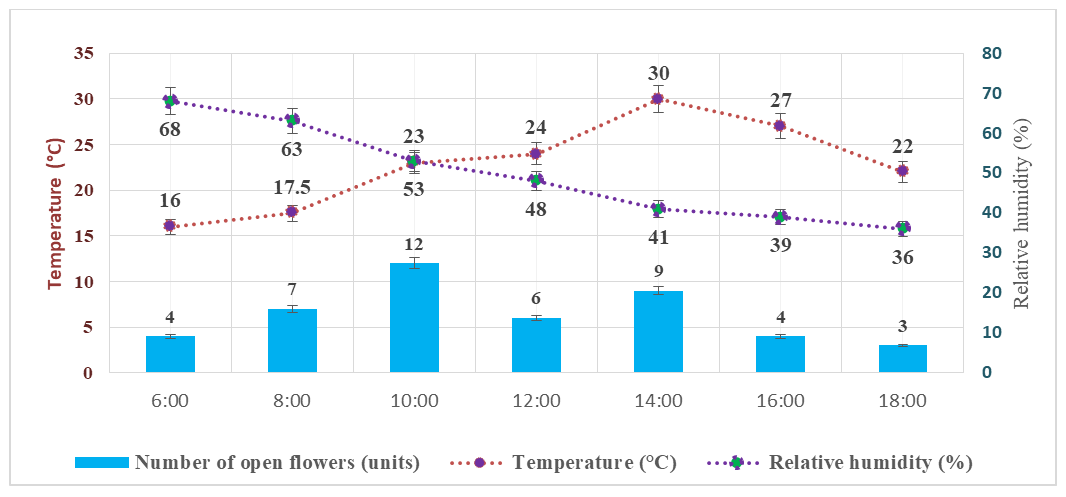 | Figure 1. Diurnal flowering pattern of S. officinalis L. at the onset of flowering under the conditions of Termiz (16 April 2024) |
|

4. Discussion
- The results of the present study indicate that the flowering rhythm of S. officinalis L. is significantly influenced by diurnal fluctuations in air temperature and relative humidity. This finding is consistent with previous scientific literature on the flowering biology of medicinal plants and further confirms the heliophilous nature of sage and the predominance of flower opening during daylight hours.During the initial stage of flowering, temperatures ranging between 16–22°C and a gradual decrease in relative humidity led to increased flower opening activity, whereas a decline in flowering was observed at temperatures above 30°C. This phenomenon can be attributed to the effect of high temperatures acting as a physiological stress factor for the plant.The peak flowering stage, characterised by the simultaneous mass opening of flowers, represents the most active phase in the phenological development of the species. The maximum rate of flower opening occurred between 10:00 and 12:00 in the morning, which coincided with optimal ranges of temperature and relative humidity—23°C and 48%, respectively—demonstrating the species' preference for moderately warm and relatively low humidity conditions.The findings of this study illustrate that the flowering process of S. officinalis progresses efficiently under the subtropical continental climate of Termiz. Investigation of the flowering rhythm facilitates the identification of phenological phases associated with essential oil synthesis, as metabolic activity intensifies during peak flower opening, potentially leading to an increase in the concentration of biologically active compounds. Therefore, understanding the diurnal dynamics of flowering holds practical significance for improving the quality of medicinal raw materials.
5. Conclusions
- Based on the conducted research, it was established that the flowering rhythm of Salvia officinalis L. under the conditions of Termiz is directly dependent on diurnal fluctuations in temperature and relative humidity. During the initial stage of flowering, the highest activity of flower opening was observed around 10:00 a.m. (+22°C, 59% humidity). In the peak flowering stage, the maximum rate of flower opening occurred between 10:00 and 12:00 (+23°C, 48% humidity). This period corresponds to the most active metabolic phase in the plant’s phenological development. The diurnal rhythm of flower opening was found to reach its maximum under moderately warm and dry conditions, while a sharp increase in temperature (30°C) and high humidity reduced flowering intensity. The results indicate that S. officinalis L. is ecologically suitable for large-scale cultivation under the conditions of Termiz. Determining the flowering rhythm provides a crucial scientific basis for identifying the phenological period with the highest essential oil content, determining optimal harvest times, and optimising agrotechnical measures. This study comprehensively elucidates the bioecological characteristics of S. officinalis and offers scientific and practical recommendations for the efficient cultivation of medicinal plants in southern regions.
 (Salvia officinalis L.)," Mağallaẗ al-ʿulūm al-zirāʿiyyaẗ wa-al-bīʾiyyaẗ wa-al-bayṭariyyaẗ, 2022. DOI: 10.26389/ajsrp.b060622.