
-
Paper Information
- Previous Paper
- Paper Submission
-
Journal Information
- About This Journal
- Editorial Board
- Current Issue
- Archive
- Author Guidelines
- Contact Us
International Journal of Genetic Engineering
p-ISSN: 2167-7239 e-ISSN: 2167-7220
2026; 14(2): 68-70
doi:10.5923/j.ijge.20261402.03
Received: Feb. 8, 2026; Accepted: Feb. 27, 2026; Published: Mar. 4, 2026

Early Detection and Correction of Lactase Deficiency in Newborns
 Abstract
 Reference
 Full-Text PDF
 Full-text HTML
Fayzullayeva Xilola Baxronovna1, Kim Oksana Vladislavovna1, Khazratkulova Mashkhura Ismatovna2
1Assistants of the Department of Biochemistry, Samarkand State Medical University, Samarkand, Uzbekistan
2Department of Fundamental Medical Sciences, Tashkent International University of Chemistry, Tashkent, Uzbekistan
Copyright © 2026 The Author(s). Published by Scientific & Academic Publishing.
This work is licensed under the Creative Commons Attribution International License (CC BY).
http://creativecommons.org/licenses/by/4.0/

This article discusses methods for early diagnosis of lactase deficiency in newborns and approaches to effective correction. The focus is on laboratory analysis of blood and stool samples, along with ultrasound assessment of the gastrointestinal tract. The study was conducted at the Maternity Complex No. 1 in Samarkand. The research group included 30 newborns diagnosed with lactase deficiency, and the control group consisted of 10 healthy newborns. The correction involved the use of the drug Izicol, and its effectiveness was thoroughly evaluated.
Keywords: Newborn, Lactase, Glucose, pH, Izicol
Cite this paper: Fayzullayeva Xilola Baxronovna, Kim Oksana Vladislavovna, Khazratkulova Mashkhura Ismatovna, Early Detection and Correction of Lactase Deficiency in Newborns, International Journal of Genetic Engineering, Vol. 14 No. 2, 2026, pp. 68-70. doi: 10.5923/j.ijge.20261402.03.
1. Introduction
- Lactase– the enzyme responsible for the digestion of lactose, is one of the most important enzymes involved in the regulation of lactase metabolism [2,3,7]. This condition manifests itself in babies with symptoms such as diarrhea, gas buildup, pain, abstinence from food, slowness in weight gain, and these conditions subsequently negatively affect the growth and development of the child [5,6,11]. According to world statistics, lactase deficiency in neonatal infants is 12-18% (Smith & Brown, 2021) [1,4,8]. Currently, the early detection of lactase deficiency and the development of effective correction methods remain an urgent issue [9,10]. Because by eliminating this condition in time, it is possible to ensure the quality of life and healthy development of babies. The selection of accurate and reliable diagnostic methods, together with laboratory analyzes, makes it possible to assess the effectiveness of corrective therapy [12]. Therefore, this study is relevant in the areas of modern Pediatrics and neonatology. The purpose of the study is to reduce the negative effects of this pathology by early detection of lactase deficiency in newborns, assessment of the effectiveness of clinical and laboratory diagnostic methods and the implementation of corrective therapy using the drug "Izikol".
2. Research Materials and Methods
- The study was carried out in the maternity complex No. 1 of the city of Samarkand for the period 2024-2025. The study involved newborns with a total gestational age of 38-40 weeks. The main group included 30 clinically and laboratory-approved lactase-deficient infants, and the control group included 10 clinically healthy infants with the same gestational age. The following diagnostic methods were used in the study:Coprogram (general stool analysis) - to determine the activity of digestive enzymes and the residue of lactose in the stool;PH indicator of feces-to determine the decrease in values in the gastrointestinal environment;Biochemical analysis of blood-to assess the state of inflammation and metabolism;UTT (ultrasound examination) of the gastrointestinal system-for the purpose of determining functional and morphological changes.As a method of Correction, the drug "Izikol" was given in prescribed doses, under the supervision of a doctor, to the infants of the main group, and its effectiveness was assessed.
3. Results
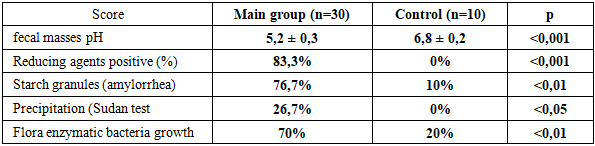
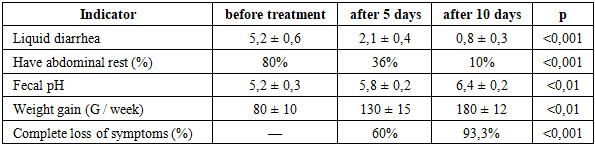
- According to the results of the study, the following clinical signs were identified in babies with lactase deficiency: multiple liquid diarrhea, abdominal rumbling and rest, refusal to suck and a slowdown in weight gain. No such established cases were observed in the control group. According to the results of the coprogram, the consistency of the general properties of feces: liquid or difficult to form, often observed in a more frothy form of chestnut or yellow color, smell: strongly bitter, with a bitter smell, which indicates that carbohydrates have undergone fermentation in the intestine. Reaction (pH): acidic (5.2 ± 0.3), which indicates that lactose does not completely break down into glucose and galactose due to lactase deficiency. Microscopic indicators, on the other hand, showed: starch granules (amylorrhea) were ingested in large quantities (76.7% in the main rice, 10% in the control rice), which means that carbohydrates are not fully absorbed. Colon flora: signs of enzymatic dysbiosis showed an increase in the number of enzymatic bacteria (Bifidobacterium, Lactobacillus) (70% in the main group, 10% in the control group). Under the influence of an acidic environment, the activity of large gas bubbles and microflora increased. According to the chemical changes in the coprogram, reducing substances (reducing substances): positive (+) or (++), (83.3% in the main group, 0% in the control group) that is, lactose or its monomers (glucose, galactose) were identified in the feces. Fats in the Sudan test: slightly increased (26.7% in the main group, 0% in the control group), since the main violation was observed in carbohydrate metabolism (Table 1). Macroscopic appearance stool size: increased (predisposition to polyphecaly), frothy appearance: due to so sababli formed in the fermentation of lactose. In the control group, these indicators were in the normal range.
|
|
|
4. Conclusions
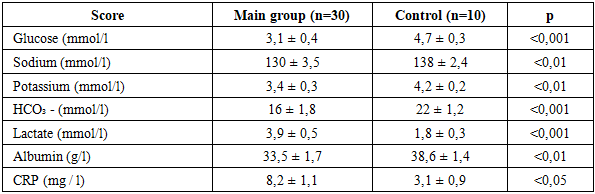
- The results of the study confirm that early detection and effective correction of lactase deficiency in newborns was successfully carried out. Coprogram and stool pH analysis are important in early detection of lactase deficiency. Hypoglycemia, hyponatremia, and lactatemia are major biomarkers in blood analysis. The drug "Izicol" led to a reliable improvement in clinical and laboratory indicators (p<0.05). The drug "Izicol" has shown high efficacy in reducing symptoms associated with lactase deficiency. Its mechanism of action is based on the replacement of the enzyme lactase, which is lacking in the small intestine, which helped to improve the digestive process of babies. For this reason,"Izicol" can be widely used on the basis of medical recommendations. In educational institutions and medical centers, it is recommended to regularly study the pH indicators of the coprogram and stool for early detection of lactase deficiency. It is also necessary to conduct more extensive research in order to monitor and confirm the effectiveness of drugs such as" Izicol".