Bobokhonov Muzaffar Ziyodullaevich1, Mustafayev Ilyor Muradullayevich2, Mardonov Sherzod Umaraliyevich1, Maxramov Zuxriddin Alisher ogli3
1Lecturer, Denov Institute of Entrepreneurship and Pedagogy, Denov, Uzbekistan
2PhD in Biology, Senior Researcher, Tashkent Botanical Garden named after F.N. Rusanov, Institute of Botany, Academy of Sciences of the Republic of Uzbekistan, Tashkent, Uzbekistan
3Master’s Student, Karshi State University, Karshi, Uzbekistan
Correspondence to: Mustafayev Ilyor Muradullayevich, PhD in Biology, Senior Researcher, Tashkent Botanical Garden named after F.N. Rusanov, Institute of Botany, Academy of Sciences of the Republic of Uzbekistan, Tashkent, Uzbekistan.
| Email: |  |
Copyright © 2026 The Author(s). Published by Scientific & Academic Publishing.
This work is licensed under the Creative Commons Attribution International License (CC BY).
http://creativecommons.org/licenses/by/4.0/

Abstract
Ganoderma resinaceum Boud., a rare medicinal polypore fungus, exhibits a narrow distribution in Uzbekistan, primarily confined to the Majrumsoy region of the Nurota range. This study integrates field surveys, morphological and molecular analyses, and literature review to assess its biology, ecological role, and population status. The species develops on living, weakened, or dead woody substrates, especially riparian Salix L. trees, producing white-rot via ligninolytic enzymes. Fruiting body formation is highly dependent on moisture availability, indicating vulnerability to drought and climate change. Biogeographically, G. resinaceum is a Palearctic species adapted to temperate and Mediterranean climate zones, with its occurrence influenced by host availability and environmental conditions. Its facultative pathogenicity and association with stressed or senescent trees suggest a role as a bioindicator of ecological imbalance. Conservation measures, including habitat protection, prevention of illegal logging, and regular monitoring, are essential to safeguard local populations and maintain the functional stability of Nurota range ecosystems. This study provides critical insights into the ecological, biogeographical, and conservation aspects of a rare medicinal fungus, supporting informed management in semi-arid forest landscapes.
Keywords:
Rare medicinal fungi, Forest ecology, Biogeography, Palearctic, Conservation, Riparian ecosystems, White-rot fungus, Climate sensitivity
Cite this paper: Bobokhonov Muzaffar Ziyodullaevich, Mustafayev Ilyor Muradullayevich, Mardonov Sherzod Umaraliyevich, Maxramov Zuxriddin Alisher ogli, Ecology, Biogeography, and Conservation Status of the Rare Medicinal Fungus Ganoderma resinaceum in Uzbekistan, International Journal of Genetic Engineering, Vol. 14 No. 2, 2026, pp. 63-67. doi: 10.5923/j.ijge.20261402.02.
1. Introduction
Ganoderma resinaceum Boud. belongs to the Basidiomycota division, class Agaricomycetes, order Polyporales, family Polyporaceae, and genus Ganoderma. In forest ecosystems, it grows as a saprotroph or facultative pathogen, decomposing dead or weakened woody tissues.Species of the genus Ganoderma are cosmopolitan basidiomycetes distinguished from other polypores by basidiospores with a characteristic double-walled structure. The genus Ganoderma was established by Karsten in 1881, with G. lucidum (Curtis) P. Karst. designated as the type species [1].Ganoderma species are widely distributed worldwide, with fruiting bodies typically growing on living, but more commonly on dead, woody substrates. They can function as facultative parasites on living trees or as saprotrophs on decaying wood. Ganoderma species produce two types of fruiting bodies: glossy, varnished structures with a bright yellowish-reddish surface, or smooth, dull, non-lustrous bodies. These fungi are generally not considered edible, as their fruiting bodies are tough, bitter in taste, and lack palatable texture. The double-walled basidiospores with an internal columnar structure represent a key diagnostic feature of the genus. Ganoderma species are of considerable economic importance due to their pharmacological properties [2].Ganoderma has traditionally been used as a medicinal mushroom, particularly in China, Japan, and Korea, for millennia to promote longevity and enhance overall health. It has been employed as a functional food to prevent and manage a wide range of immunological disorders. Research has confirmed the bioactivity of polysaccharides, proteins, and triterpenoids produced by Ganoderma, highlighting its biotechnological potential. In China, Ganoderma is known as “Linchzhi” or “Rui-zhi,” in Japan as “Reishi,” and in Korea as “Youngzhi.” Linchzhi has been used as a medicinal agent in traditional Chinese medicine for thousands of years and is regarded as a symbol of happiness, longevity, and protection. It is documented in the pharmacopoeia Shen Nong Ben Cao Jing from the Han dynasty and is widely represented in ancient art and literature [3,2,4,1].The main objective of this study was to analyze the biology, biogeography, and ecological characteristics of the locally occurring medicinal and rare fungus Ganoderma resinaceum, as well as to assess the current status of its populations.
2. Materials and Methods
Study object and sample collectionThis study investigated the biological characteristics, biogeographical distribution, and ecological status of G. resinaceum using an integrated research approach. The methodology combined field surveys, laboratory analyses, and a comparative review of relevant scientific literature.Field investigations were conducted in natural and cultivated forest ecosystems across Uzbekistan. Living, weakened, and dead woody tree trunks were examined for the presence of basidiocarps. For each recorded specimen, data on geographic location, substrate type, host tree condition, and environmental growth conditions were documented.Morphological and molecular identificationMorphological analyses were performed under laboratory conditions. Macromorphological characteristics of the fruiting bodies, including shape, size, color, surface texture, thickness, and hymenophore features, were examined. Micromorphological observations were carried out using light microscopy to determine basidiospore shape, size, and wall structure. These characteristics were evaluated as key diagnostic features of the genus Ganoderma.Molecular identification was conducted to confirm species identity. Genomic DNA was extracted from five-day-old pure culture mycelium following a standard extraction protocol. The internal transcribed spacer (ITS) region of ribosomal DNA was amplified by polymerase chain reaction (PCR) using universal primers. The amplified products were purified and sequenced. The resulting sequences were compared with reference data available in the NCBI GenBank database using the BLAST algorithm.Biogeographical AnalysisFor the biogeographical assessment, field data were compared with published sources. Additionally, relevant literature was reviewed to summarize information on the biology, ecological features, and medicinal importance of the genus Ganoderma. Based on the collected data, the current status of local G. resinaceum populations was evaluated and general conclusions regarding its distribution and conservation were formulated.
3. Results and Discussion
G. resinaceum is characterized by annual, stipitate basidiomata with a distinctly varnished, glossy, reddish-brown pileus surface. The basidiocarps are relatively thick, measuring 8.0–22.0 × 6.0–10.5 × 2.0–3.0 cm. The pileus margin is slightly incurved (concave), and the surface is smooth to slightly wrinkled. The margin is rounded, light greyish-yellow (ochre-buff), and approximately 1.0–1.5 cm wide. The stipe is short, laterally attached, reddish-brown in color, and measures 5–6 × 2–3 cm. The hymenial surface varies from cream to brown and contains circular to irregular pores, with a density of 2–6 pores per mm and pore diameters ranging from 97 to 306 µm. Basidiospores are yellowish-brown to fuscous, broadly ellipsoid to ovoid, semirugose, and possess a thick wall. Spore dimensions range from 9–13 × 5–8 µm (Figure 1). 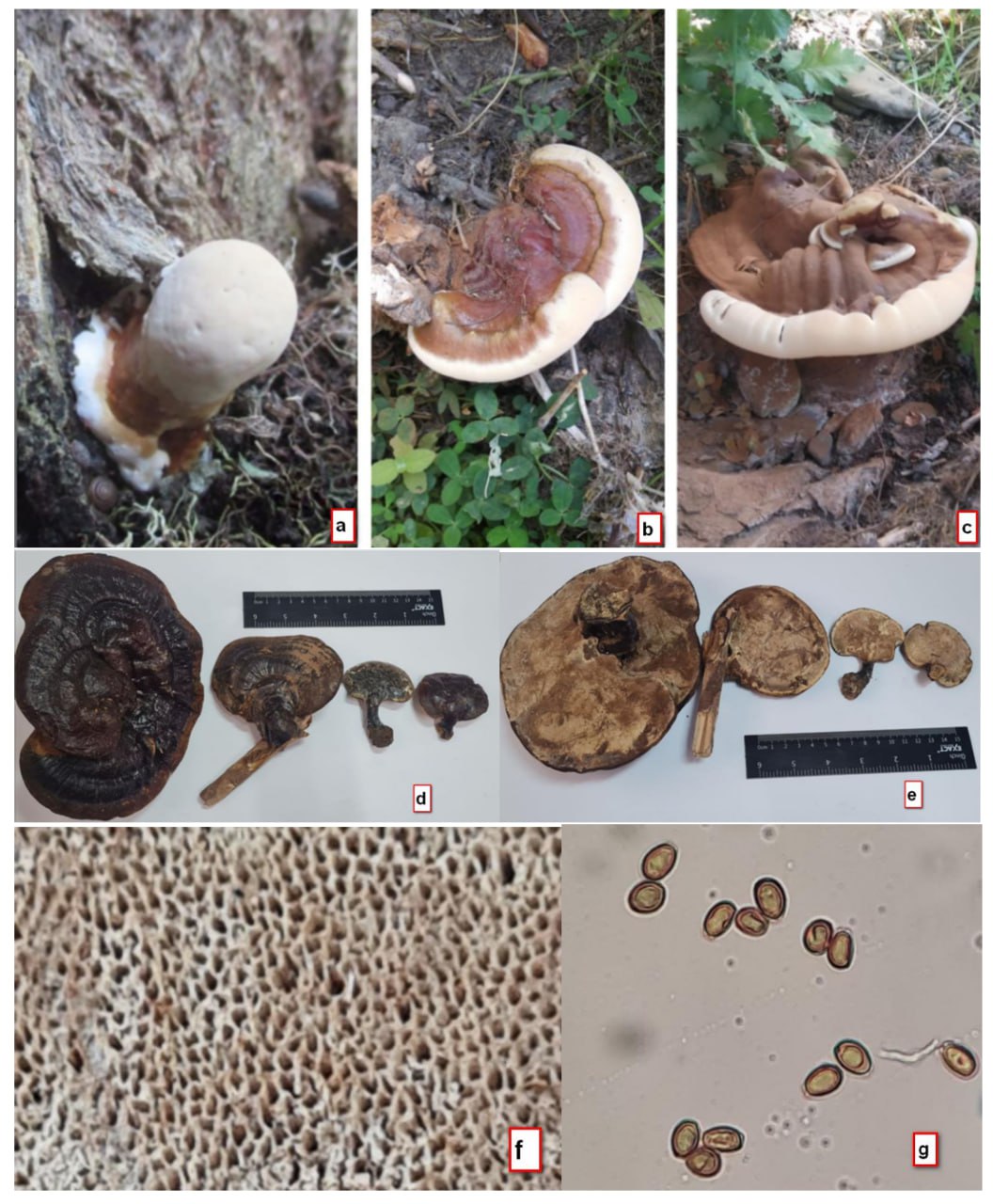 | Figure 1. Morphological and microscopic characteristics of Ganoderma resinaceum: a – young basidiocarp at the initial developmental stage, b – pileus surface showing a laccate, reddish-brown crust, c – Lateral view of a mature basidiocarp attached to the host tree, d–e – Dried basidiocarps (herbarium specimens), f – hymenial surface, g – ellipsoid, double-walled basidiospores observed under light microscopy |
The extracted genomic DNA was of sufficient quality for PCR amplification. Successful amplification of the ITS rDNA region and subsequent sequencing confirmed the suitability of the applied molecular protocol for Ganoderma samples. Sequence comparison analysis demonstrated 91% similarity with reference Ganoderma sequences available in public databases, supporting the taxonomic placement of the studied isolates within the genus.The functional role of G. resinaceum within forest ecosystems was evaluated based on available scientific literature. This species is primarily saprotrophic or occasionally a facultative pathogen, developing on both living and dead woody substrates and causing white rot [5].This process is mediated by ligninolytic enzymes produced by Ganoderma species – laccase, lignin peroxidase, and manganese peroxidase – which degrade lignin and cellulose, thereby reducing the mechanical strength of the wood and making it susceptible to biological decomposition [2,6].The ecological role of G. resinaceum in forest biocenoses is significant, contributing to nutrient cycling and enhancing soil fertility [7,8]. At the same time, the species exhibits facultative pathogenic behavior, capable of damaging living tissues in weakened or compromised trees and thereby negatively affecting tree phytosanitary condition [6,9].Due to its association with weakened or senescent trees, G. resinaceum is also considered a potential bioindicator of ecosystem stress and anthropogenic pressure. The abundance of wood-decaying fungi and the dynamics of fruiting body formation are often linked to drought, pollution, and habitat degradation, allowing their use as indicators of ecological imbalance in both natural and urban forests [10,11].Although G. resinaceum is widespread in many regions, its distribution varies depending on climate and host tree species. In Europe, it has been recorded on a variety of trees, with a particularly high prevalence on species of Quercus L. [8]. This highlights the ecological adaptability of the genus Ganoderma, while indicating that its growth and distribution are influenced by environmental conditions and host availability.In Uzbekistan, the distribution of G. resinaceum is relatively restricted. To date, mycological studies have recorded this species only in the Nurota mountain range. Extensive mycological surveys in other regions of the country, including the Western Tianshan, Northern Turkestan, Zarafshan, Bobotag, and Kuhitang ranges, have not detected its presence. Assessment of local populations indicates that in Uzbekistan, G. resinaceum occurs in a very narrow area, limited to the Majrumsoy region of the Nurota range. Currently, six populations have been identified in this area. They primarily develop on the trunks of riparian willow (Salix L.) trees or on fallen woody debris. This distribution pattern highlights the species’ strong dependence on moisture and its close association with riverine and stream ecosystems. In years of low precipitation, fruiting body production declines sharply, indicating high sensitivity to climatic factors, particularly moisture availability. Consequently, intensified drought conditions and ongoing climate change may negatively affect both the size and stability of local populations.These observations suggest that G. resinaceum is a rare and locally distributed species within the mycobiota of Uzbekistan, likely possessing narrow ecological requirements. Its occurrence in only a few areas is probably linked to specific ecological conditions, including particular climate regimes, host tree species, and microhabitat characteristics. Therefore, to conserve these rare medicinal populations, regular monitoring, habitat protection and restoration, and scientifically informed conservation measures are essential.Climate is a key factor determining the distribution of G. resinaceum. The species occurs predominantly in warm temperate and subtropical zones, where seasonal moisture facilitates its growth and sporulation. Its presence in semi-arid regions, provided that suitable woody substrates are available, indicates an ability to tolerate moderate drought conditions [12–15]. From a biogeographical perspective, G. resinaceum belongs to a group of lignicolous species adapted to temperate climates. Their distribution patterns are closely linked to the historical development of broadleaf forest ecosystems in the Palearctic region [16,17]. Ganoderma species are widely distributed in temperate and tropical biomes, with their occurrence primarily determined by climatic conditions, the availability of suitable host trees, and the continuity of woody substrates [18,15].Phylogenetic studies based on ribosomal DNA sequences indicate that Ganoderma resinaceum likely belongs to an evolutionary lineage associated with the Palearctic region [19,15]. Its diversification is closely linked to the evolutionary history of temperate broadleaf forests, particularly ecosystems dominated by genera such as Quercus, Fagus, and Populus. It is hypothesized that G. resinaceum developed in warm-temperate regions with sufficient moisture and the presence of suitable woody substrates. Climatic fluctuations during the Late Tertiary and Quaternary periods may have played a key role in shaping its present distribution, with forest fragmentation and reconnection promoting both population isolation and dispersal. G. resinaceum is primarily a Palearctic species. Its core distribution encompasses Southern and Central Europe, where it is relatively widespread, especially in lowland and submontane areas [12,13]. Its occurrence declines toward Northern Europe, reflecting climatic constraints such as lower temperatures and shorter growing seasons. In Western Asia, including the Caucasus, Turkey, Iran, and the Caspian region, G. resinaceum has been recorded under warm-temperate to semi-arid conditions, demonstrating some tolerance to seasonal drought. In general, G. resinaceum and related wood-decaying fungi are primarily distributed in temperate and Mediterranean climate zones, characterized by high summer temperatures and relatively low precipitation. This distribution pattern suggests adaptation to seasonal moisture limitations [14,20,21]. In particular, Mediterranean fungal communities are shaped by summer drought and autumn–winter precipitation regimes, indicating that wood-decaying basidiomycetes experience significant hydric stress [22]. Thus, warm and seasonally dry environments provide suitable ecological niches for the development and fruiting of white-rot fungi such as G. resinaceum. Outside its main range, G. resinaceum has been sporadically recorded in East Asia, including the Chinese and Korean peninsulas [15]. In these regions, its occurrence is often associated with managed landscapes, such as urban parks, botanical gardens, and roadside afforestation areas. In boreal and arid desert regions, the scarcity or absence of suitable host trees limits the natural distribution of the species [14,1]. Such peripheral records may also result from under-sampling, historical misidentifications, or recent anthropogenic introductions. Similar processes have been observed in other Ganoderma species, whose ranges have expanded through the transport of infected seedlings and wood products [20]. Overall, studying the ecology and biogeography of G. resinaceum is critical for understanding global fungal distribution patterns, phylogeographic differentiation within the Ganoderma lineage, and the functional stability of temperate forest ecosystems under contemporary climate change [17,15].
4. Conclusions
The results of the present study indicate that G. resinaceum has a narrow distribution in Uzbekistan and represents a rare, medicinal, and ecologically sensitive species. Current data show that it occurs primarily in the Nurota Mountains, associated with riparian Salix trees. Fruiting body formation is strongly dependent on moisture availability, with markedly reduced production during dry years. This highlights the species’ high sensitivity to hydric conditions and suggests that its population stability may be threatened under ongoing climate change. From an ecological perspective, G. resinaceum plays a crucial role as a white-rot lignicolous fungus, contributing to nutrient cycling in forest ecosystems. By decomposing lignin and other complex polymers, it facilitates the biological degradation of wood and enhances soil fertility. At the same time, its facultative pathogenicity on weakened trees underscores its phytosanitary significance. Its association mainly with stressed or senescent trees also allows it to serve as a potential bioindicator of anthropogenic pressure and ecological imbalance within forest ecosystems. Biogeographically, G. resinaceum is a Palearctic species characteristic of temperate and Mediterranean climate zones, with its distribution determined by climatic conditions, the presence of host trees, and the continuity of woody substrates. In Uzbekistan, its restricted distribution reflects its specific ecological requirements. Accordingly, the conservation of local G. resinaceum populations requires protection of riparian willow stands, prevention of illegal logging, and regular monitoring under the context of climate change.
References
| [1] | Hapuarachchi, K. K., et al. (2018). Ganoderma species: diversity, traditional uses, and modern medicinal applications. Journal of Fungal Biology, 152(4), 245–258. https://doi.org/10.1016/j.funbio.2018.01.005. |
| [2] | Paterson, R.R.M. (2006). Ganoderma – A therapeutic fungal biofactory. Phytochemistry, 67(18), 1985–2001. https://doi.org/10.1016/j.phytochem.2006.07.004. |
| [3] | Wachtel-Galor, S., Yuen, J., Buswell, J.A., Benzie, I.F.F. (2011). Ganoderma lucidum (Lingzhi or Reishi): A medicinal mushroom. In: Herbal Medicine: Biomolecular and Clinical Aspects, 2nd ed. Boca Raton: CRC Press, pp. 175–200. https://doi.org/10.1201/b10787-11. |
| [4] | Boh, B., Berovic, M., Zhang, J., Zhi-Bin, L. (2007). Ganoderma lucidum and its pharmaceutically active compounds. Biotechnology Annual Review, 13, 265–301. https://doi.org/10.1016/S1387-2656(07)13010-6. |
| [5] | Schwarze, F.W.M., Engels, J., Jezierski, G. (2010). Wood decay under the microscope. Berlin, Heidelberg: Springer. https://doi.org/10.1007/978-3-642-10733-8. |
| [6] | Cabarroi‑Hernández, M., Villalobos‑Arámbula, A.R., Torres‑Torres, M.G., Decock, C., Guzmán‑Dávalos, L. (2019). The Ganoderma weberianum‑resinaceum lineage: Multilocus phylogenetic analysis and morphology confirm G. mexicanum and G. parvulum in the Neotropics. MycoKeys, 59, 95–131. https://doi.org/10.3897/mycokeys.59.33182. |
| [7] | Nurul‑Aliyaa, Y.A., Awang, N.A., Mohd, M.H. (2023). Characterization of white rot fungi from wood decayed for lignin degradation. Letters in Applied Microbiology, 76(10), ovad118. https://doi.org/10.1093/lambio/ovad118. |
| [8] | Buratti, S., Rinaldi, F., Calleri, E., Bernardi, M., Oliva, D., Malgaretti, M., … Girometta, C.E. (2023). Ganoderma resinaceum and Perenniporia fraxinea: Two promising wood decay fungi for pharmaceutical degradation. Journal of Fungi (Basel), 9(5), 555. https://doi.org/10.3390/jof9050555. |
| [9] | Reyes, C., Poulin, A., Nyström, G., Schwarze, F.W.M.R., Ribera, J. (2021). Enzyme activities of five white‑rot fungi in the presence of nanocellulose. Journal of Fungi (Basel), 7(3), 222. https://doi.org/10.3390/jof7030222. |
| [10] | Boddy, L., Heilmann-Clausen, J. (2008). Baseline ecology of wood-decomposing fungi in temperate forests. Fungal Ecology, 1(2-3), 69–80. https://doi.org/10.1016/j.funeco.2008.06.001. |
| [11] | Marcot, B.G. (2017). Fungi as bioindicators of ecosystem health: monitoring approaches. Forest Ecology and Management, 400, 1–12. |
| [12] | Ryvarden L, Gilbertson RL. European Polypores. Synopsis Fungorum, Vols. 6–7. Oslo: Fungiflora; 1993–1994. 743 pp. |
| [13] | Bernicchia, A., & Gorjón, S. P. (2010). Polypores of Europe, Volume 1. Milano: Edizioni Candusso. 488 pp. |
| [14] | Bondartsev, A. S. (1953). Fungi of the USSR. Polyporaceae. Moscow: Academy of Sciences. 396 pp. |
| [15] | Zhou, L.W., Vlasák, J., Dai, Y.C., et al. (2015). Ganoderma in East Asia: Phylogeny and distribution. Mycologia, 107(5), 1095–1110. https://doi.org/10.3852/15-043. |
| [16] | Ryvarden, L.; Melo, I.; Niemelä, T., 2014. Poroid Fungi of Europe. Synopsis Fungorum, Vol. 31, Fungiflora, Oslo, 455 pp. |
| [17] | Moncalvo, J.M., Ryvarden, L. (1997). A phylogenetic overview of the Polyporaceae: Ganoderma lineages. Mycologia, 89(6), 832–843. |
| [18] | Gilbertson, R.L., Ryvarden, L. (1986). North American Polypores, Vol. 1. Oslo: Fungiflora. |
| [19] | Moncalvo, J.M., Lutzoni, F.M., Rehner, S.A., Johnson, J., Vilgalys, R. (1995). Phylogenetic relationships of Ganoderma inferred from ribosomal DNA sequences. Systematic Biology, 44(3), 435–449. |
| [20] | Rodríguez, A., López, M., Pérez, A. (2024). Mediterranean Ganoderma species and drought adaptation. Mycology Progress, 23(2), 1–12. |
| [21] | Náplavová, K., Vrška, T., Jirásek, J. (2020). Wood-decaying fungi in Mediterranean climates. Fungal Ecology, 48, 100958. https://doi.org/10.1016/j.funeco.2020.100958. |
| [22] | Ponce, M., Torres, M., & García, F. (2023). Hydric stress tolerance in Mediterranean wood-decomposing fungi. Forest Pathology, 53(2), https://doi.org/10.1111/efp.12975. |


 Abstract
 Reference
 Full-Text PDF
 Full-text HTML