-
Paper Information
- Next Paper
- Paper Submission
-
Journal Information
- About This Journal
- Editorial Board
- Current Issue
- Archive
- Author Guidelines
- Contact Us
International Journal of Genetic Engineering
p-ISSN: 2167-7239 e-ISSN: 2167-7220
2026; 14(2): 57-62
doi:10.5923/j.ijge.20261402.01
Received: Jan. 28, 2026; Accepted: Feb. 16, 2026; Published: Mar. 4, 2026

Growth and Development of Sedum Spectabile During the Vegetative Stages, Seasonal Development Pattern (Phenology)
 Abstract
 Reference
 Full-Text PDF
 Full-text HTML
Nurbek Kuchkarov
PhD., Associate Professor, National University of Uzbekistan, Tashkent, Uzbekistan
Correspondence to: Nurbek Kuchkarov, PhD., Associate Professor, National University of Uzbekistan, Tashkent, Uzbekistan.
| Email: |  |
Copyright © 2026 The Author(s). Published by Scientific & Academic Publishing.
This work is licensed under the Creative Commons Attribution International License (CC BY).
http://creativecommons.org/licenses/by/4.0/

Information is provided on the growth and development of Sedum spectabile under introduced conditions, the sum of positive temperatures generated in the required environment during its phenological stages, and its adaptive characteristics.
Keywords: Sedum spectabile, Vegetation, Budding stage, Flowering stage, Fertilization stage, Air temperature, Soil temperature, Soil moisture
Cite this paper: Nurbek Kuchkarov, Growth and Development of Sedum Spectabile During the Vegetative Stages, Seasonal Development Pattern (Phenology), International Journal of Genetic Engineering, Vol. 14 No. 2, 2026, pp. 57-62. doi: 10.5923/j.ijge.20261402.01.
Article Outline
1. Introduction
- Uzbekistan is located in the arid climate region of Central Asia and faces water shortages in the cultivation of cultural, ornamental, medicinal, and agricultural plants. Selecting plants that can produce high biomass even in such extreme conditions and using species that can achieve the desired yield even in conditions of water scarcity is of scientific and practical importance. Sedum spectabile is one of such promising plants. Its ability to produce high biomass even under low irrigation conditions, its medicinal properties, and its adaptability to the duration of dry days are scientifically proven, and some of its bioecological characteristics is discussed below.
2. Literature Analysis and Methods
- Research work and field experiments were conducted in the experimental field of the Botanical Garden of the National University of Uzbekistan named after Mirzo Ulugbek during 2023-2025 years. The biomorphological characteristics of plants were studied using the methods of T.A. Rabotnov [1], I.G. Serebryakov [2], A.A. Uranov [4,5], L.A. Zhukova [6] and the root system was studied using the methods of P.K. Krasilnikov [7].In the studies of phenological and seasonal development rhythms in the studied plants, the methods of I.V. Borisova [8] and I.N. Beideman [9] were used. During the growing season, the formation of grasses, the appearance of true leaves, the formation of branches and the growth of stems, budding, the beginning of flowering, the completion of flowering, seed setting, seed maturation, and the duration of the growing season were studied.
3. Results
- The growth and development of Sedum spectabile during the vegetative stages was studied during 2023-2025 years, and phenological observations were conducted on the plants throughout the season. The main purpose of conducting phenological research is to observe the beginning and end of vegetation in plants at a certain time of the year, the duration of days during the season, the sum of positive and beneficial temperatures necessary for plants, and in general, various environmental factors (light, humidity, temperature) that are important in monitoring the course of the vegetation, and in developing scientifically based recommendations for practice [10].S.N. Kudryashov emphasized that phenological observations of the growth and development of plants during the season are of great importance in the introduction assessment of species [11]. The method of vegetative propagation of plants by dividing bushes is close to natural reproduction, and perennial ornamental plants are propagated in this way. Perennial plants that have numerous branches (tubercles) from underground stems are dug up from the ground, and individuals with their own roots are separated by hand or with a sharp object and planted in new places [12].The rhizome of the Sedum spectabile plant, imported from China in 2021 for cultivation in the conditions of the Botanical Garden of the National University of Uzbekistan, was planted in the experimental field in the first decade of February 2023 year, and it was observed that a leafy shoot began to form from the regeneration buds on the caudex on the second and third decade of this month. Leaf growth began to be observed in the first and second decades of March, when the average air temperature was +10-15°C, the maximum air temperature was +24,2-25,0°C, the relative humidity was 41-45%, and the average soil temperature was +13-15°C.It was noted that Sedum spectabile began to form 6-8 leaves in the third decade of March and the first decade of April, when the air temperature was on average +17,5-19,2°C, the relative humidity was 50-51%, the average soil temperature was +20-21°C, and the soil humidity was 20,9-21,0%. The length of the leaf plate was determined to be 1,5-2,0 cm, width 0,8-1,0 cm. The formation of subsequent leaf orders was observed for 10-12 days. The main root continued to grow, and the number of lateral roots increased. The length of the root reached 10,5-16,2 cm, and the length of the lateral root reached an average of 3,0-4,0 cm.In the first and second decades of April, when the average air temperature reached +17,5-24,5°C, relative air humidity reached 48-50%, average soil temperature reached +20-22°C, and soil humidity reached 20,9-21,0%, an average of 12-14 leaves formed on the vegetative shoot of the plant. When the leaves reached an average length of 2,5-3,5 cm and a width of 1,5-1,8 cm, the growth of leaf veins was observed. The root system is taproot, the main root reaches an average of 16-20 cm, from which branching and complexity of 2-3-order lateral roots were observed.Plant in virgin stage (v) In the third decade of April and the first decade of May, the average air temperature was +22,5-29,7°C, the relative air humidity was 38-40%, the average soil temperature was +28-30°C, and the soil humidity was 19,0-20,0%. It was observed that an average of 15-18 mature leaves were formed on vegetative shoots. The leaves are on average 8-10 cm long, 4-5 cm wide, the leaf blades are short, the upper leaves are sessile on the stem. The length of the main root has been recorded to reach an average of 20-22 cm.Budding stage (g) – explained by the growth of upright generative branches. This process was observed in the second and third decades of May, when the average air temperature reached +22,5-29,7°C, relative air humidity reached 38-40%, average soil temperature reached +28-30°C, and soil humidity reached 19,0-20,0%. It was found that the plants in this stage reached an average height of 40-45 cm. The leaves at the bottom of the stem are deciduous, while the leaves at the top are alternately arranged on the stem in short bundles. Mature leaves are 9-10 cm long and 4-6 cm wide. The budding stage began in the first and second decades of May and lasted until the third decade of July. The flowering stage was noted to begin in the second decade of June and last until the third decade of August (Figure 1). The structure of the flower on the generative branches is a simple shield, the inflorescence is basipetal, the flowers open from top to bottom and produce seeds. It was noted that the fertilization stage began in the third decade of July and lasted until the second and third decades of October. It was determined that the average weight of 1000 seeds produced by plants in the vegetation year (2023) was 0,17-0,18 g.
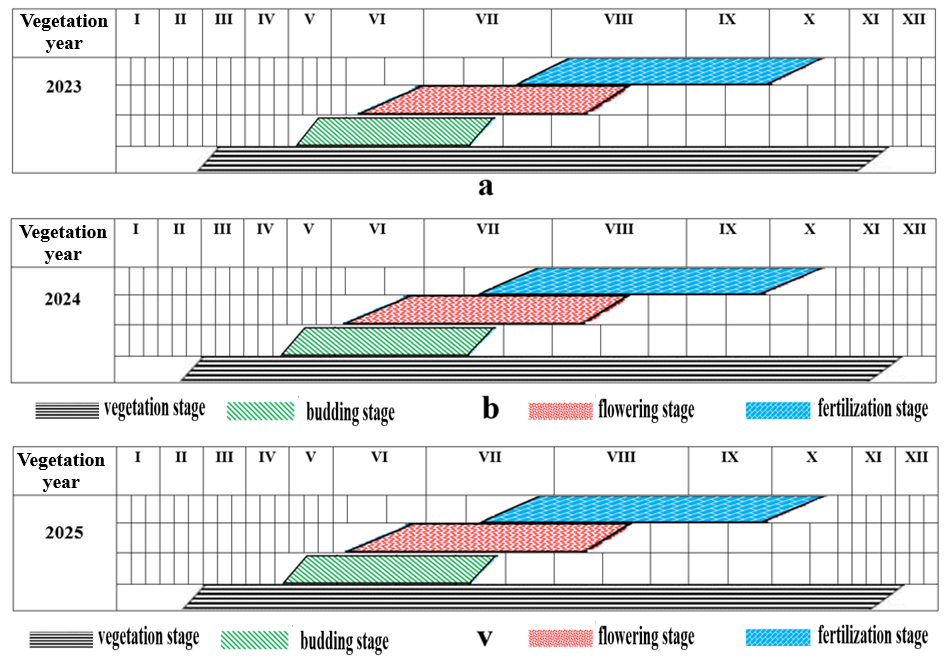 | Figure 1. Phenospectrum of Sedum spectabile: a-2023 year; b-2024 yaer; v-2025 year seasonal observations |
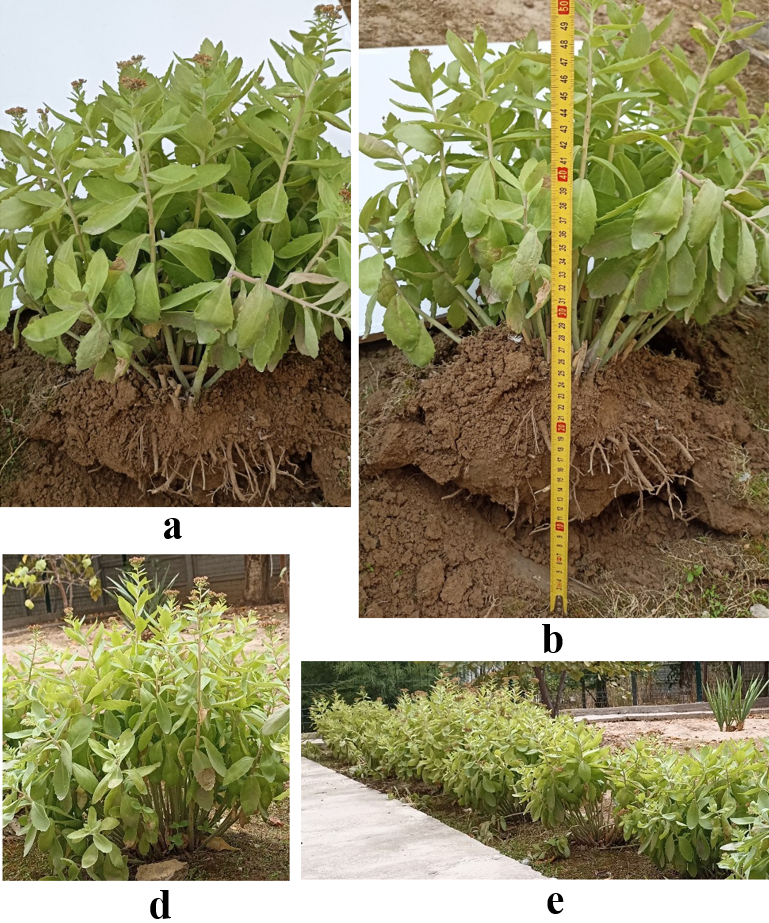 | Figure 2. Biomorphological appearance of Sedum spectabile during the generative period |
4. Discussion
- In conclusion, it can be said that during 2023-2025 years, various stages of the vegetation period of S. spectabile passed optimally, while the total vegetation period increased from 250-260 days to 270-280 days, which in turn is explained by the fact that the morphobiological adaptation characteristics of the species, especially the improvement of the root system, water regime indicators, and the shedding of leaves on the lower part of the stem during periods of high ambient air temperature, ensured the successful and complete passage of vegetation under the conditions of introduction.
5. Conclusions
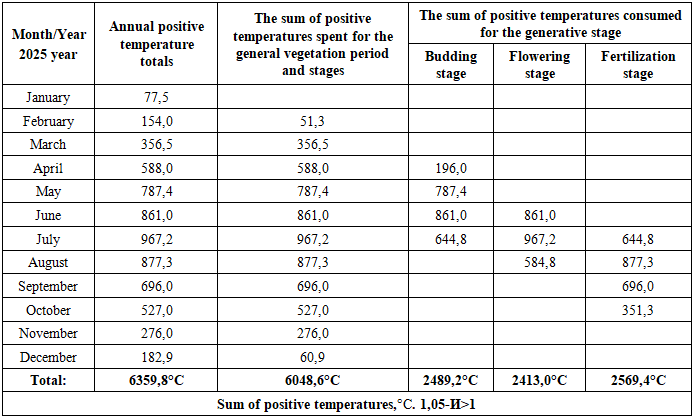
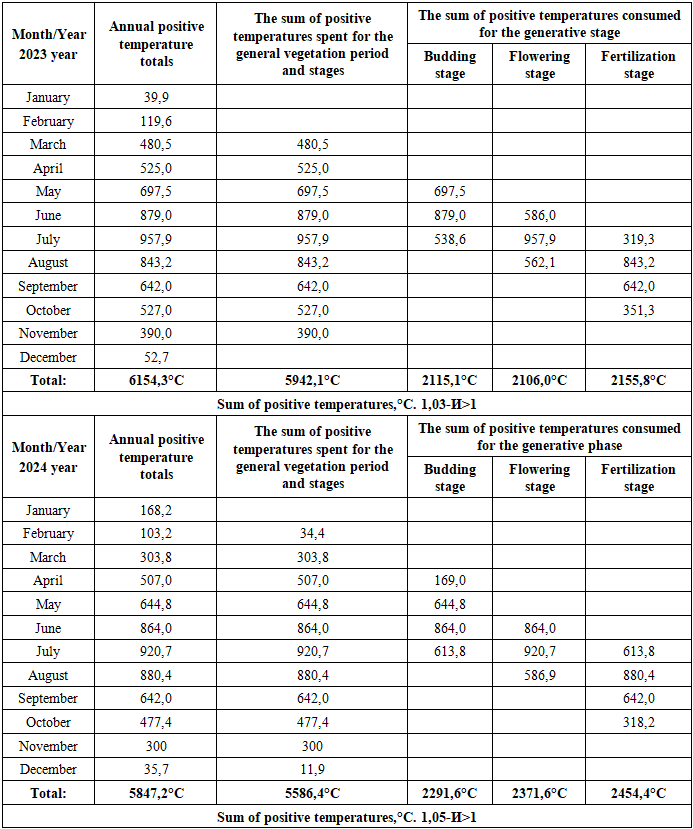
- A. Gumboldt noted that the introduction of plants will only be successful if the sum of the beneficial temperatures of the environment in which they are introduced is higher than the sum of the positive temperatures in the natural habitat of the species. The amount of heat absorbed by an organism over a certain period of time is called the sum of positive temperatures. The total vegetation period of S. spectabile in 2023 year was 250-260 days, during which the sum of positive temperatures was 5942,1°C, the development index was 1,03-I>1, in 2024 year the generative period - budding, flowering, and fertilization stages were observed and lasted 270-280 days, during which the sum of positive temperatures was 5540,1°C, the development index was 1,05-I>1, in 2025 year the generative period - budding, flowering, and fertilization stages were observed and lasted 270-280 days, during which the sum of positive temperatures was 6048,6°C, the development index was 1,05-I>1 (Tables 1-2). This indicates that the species has adapted well to its introduced environment.
|
|